The best torque screwdriver is the one that matches your required torque range, provides a clear signal at the setting, and can stay reliable through the jobs you actually do. This guide helps you compare adjustable, preset, mechanical, and digital torque screwdrivers with confidence.
Choose the tool type before choosing the badge on the handle
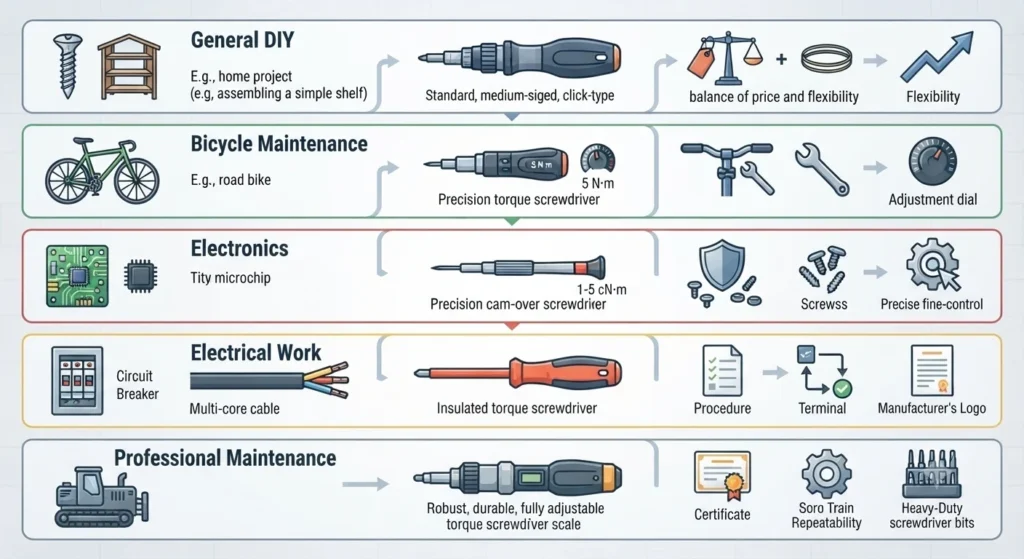
There is no single best torque screwdriver for every job. A low-range cam-over tool makes more sense for delicate electronics than a broad-range adjustable driver used for maintenance work. Use this shortlist to narrow the type of tool, then verify the exact model’s stated accuracy, bit drive, calibration support, included accessories, and warranty.
| Best for | Recommended tool style | Typical range to seek | Why it fits |
|---|---|---|---|
| General DIY | Adjustable mechanical click-type driver | Match the project specification | A practical balance of price, familiar feedback, and flexibility for occasional work. |
| Bicycle maintenance | Compact adjustable or preset low-range driver | Often measured in N·m | Clear settings and a compact body help around stems, seat clamps, and accessories. |
| Electronics | Precision cam-over or preset driver | Low cN·m or in-lb range | Fine control helps protect small fasteners, threads, housings, and circuit-board hardware. |
| Electrical work | Specified insulated or standard torque driver | Equipment-maker specified | Terminal torque is application-specific; documentation and procedure matter most. |
| Professional maintenance | Serviceable adjustable driver with certificate | A range centered on recurring work | Calibration access, repeatability, durable construction, and documentation justify the higher cost. |
What matters when comparing torque screwdrivers
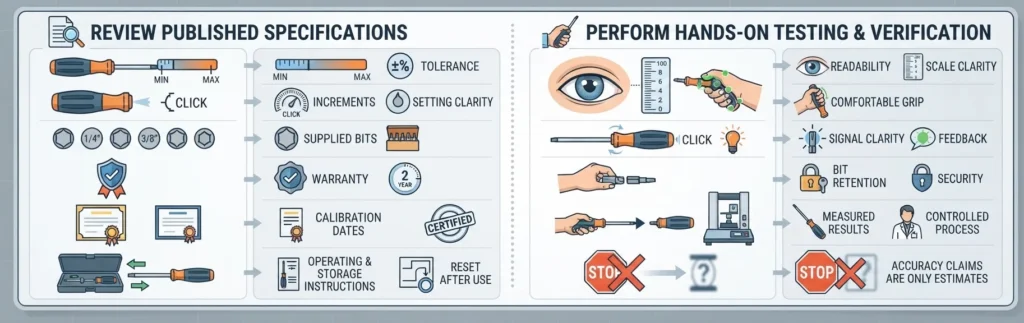
A meaningful torque screwdriver comparison begins with published specifications: torque range, stated accuracy, adjustment increments, drive size, supplied bits, warranty, and calibration documentation. We also look for operating instructions that explain whether the tool should be reset after use or kept within a particular storage range.
Hands-on testing can add useful context about scale readability, grip comfort, signal clarity, bit retention, and setting security. However, accuracy claims should only be treated as measured results when the tool has been checked with an appropriate calibrated torque analyzer under a controlled process.
The right recommendation depends on the fastener and the consequences of overtightening
Instead of naming one model as universally superior, start with the type of work you do most. The best choice keeps your usual target torque comfortably inside its specified operating range—not pressed against the lowest or highest mark.
Best overall: adjustable mechanical torque screwdriver
For mixed home and workshop use, an adjustable click-type torque screwdriver is usually the most versatile starting point. Look for a lockable adjustment, an easy-to-read scale, a comfortable handle, and a torque range that covers your recurring specifications.
Best budget approach: a focused preset driver
If you repeatedly fasten one common specification, a preset cam-over screwdriver can be a sensible lower-cost option. It reduces adjustment mistakes, but it is less flexible when your work calls for several different torque settings.
Best digital option: clear readout and multi-unit work
A digital torque screwdriver can be useful when you regularly move between inch-pounds, Newton-meters, and centinewton-meters or need a visible target display. Check battery type, low-battery behavior, resolution, and whether the display is practical in your workspace.
Best for low-torque precision work: cam-over control
For electronics, instrument hardware, and other delicate assemblies, a low-range precision torque screwdriver with a positive cam-over action is often easier to control than a broad-range tool. Confirm that its drive and supplied bits fit your fasteners without wobble.
Mechanical, digital, preset, and adjustable tools solve different problems
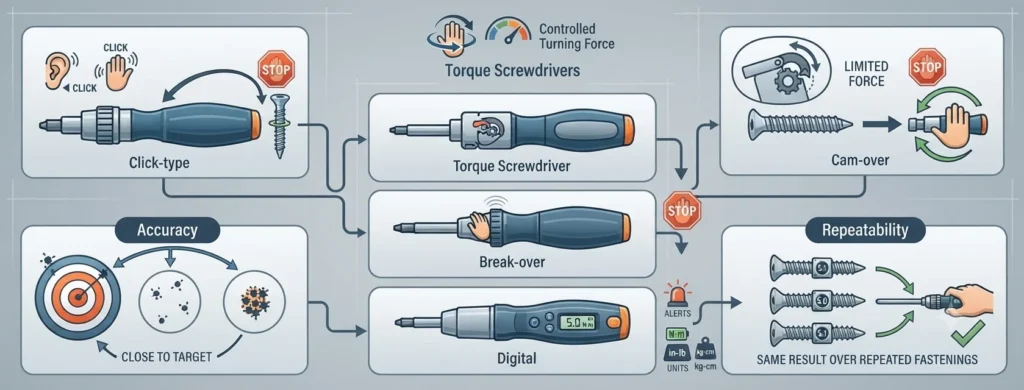
All torque screwdrivers aim to help you apply a controlled amount of turning force, but their feedback differs. Accuracy describes how close a reading or release point is to the target. Repeatability describes how consistently the tool reaches the same result over repeated fastenings. Both matter.
- Click-type: typically provides an audible and tactile click at the target. Stop applying force when the signal occurs.
- Cam-over: slips or rotates once the target is reached, helping limit additional torque after the setting.
- Break-over: the handle or mechanism pivots at the setting, creating a strong physical cue to stop.
- Digital: presents torque on a display and may offer alerts or multiple units, but requires battery management and careful handling.
Start with the equipment manufacturer’s specification—not a generic number
The correct torque setting on a screwdriver depends on the fastener, material, thread condition, lubrication, and the equipment manufacturer’s specification. A bicycle stem, electrical terminal, computer enclosure, and industrial panel can all require very different values.
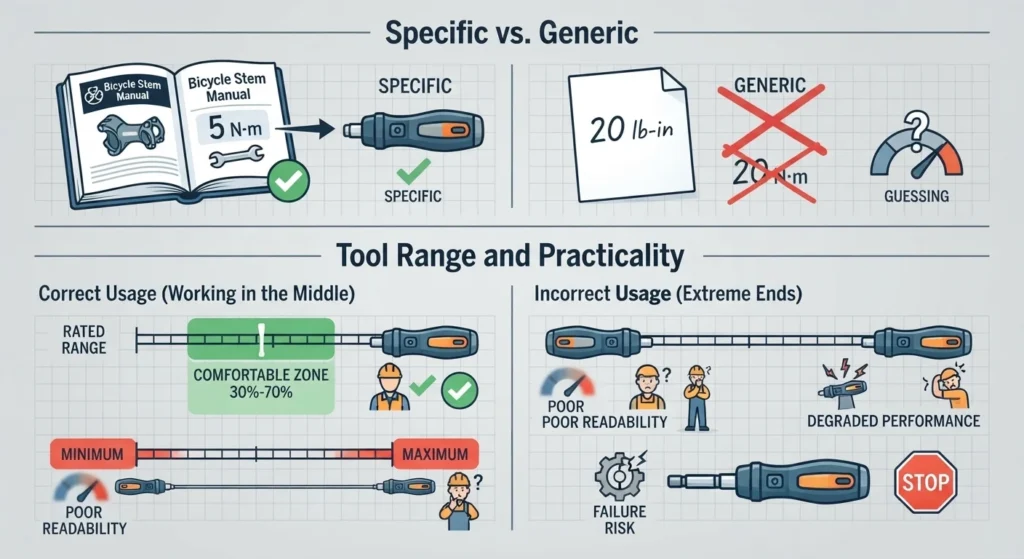
Choose a tool whose normal working setting sits comfortably within its rated range. A screwdriver may technically cover a value at its extreme end, but practical readability and stated performance are often better when you are not constantly working at the minimum or maximum limit. Never use a torque screwdriver beyond its rated range.
Common torque units
Inch-pounds (in-lb)
Common on many North American torque screwdrivers and useful for lower-torque fastening work.
Newton-meters (N·m)
The SI unit often used in bicycle, automotive, industrial, and international equipment documentation.
Centinewton-meters (cN·m)
A fine-resolution unit frequently encountered in precision assembly and low-torque applications.
Controlled fastening is more than turning until it feels tight
Read the manufacturer’s instructions for your exact tool before use. The mechanism and storage requirements vary. In particular, do not assume every torque screwdriver is suitable for loosening stuck fasteners; that job may damage the mechanism or affect calibration.
- Confirm the required torque from a reliable equipment or component manufacturer specification.
- Select the correct bit, seat it fully in the fastener, and set the tool to the specified value using its scale or display.
- Apply steady force through the handle while keeping the driver aligned with the fastener to reduce cam-out and side loading.
- Stop immediately at the click, break-over, cam-over, or digital signal. Do not add an extra twist “just to be sure.”
A torque screwdriver is a measuring tool as well as a hand tool
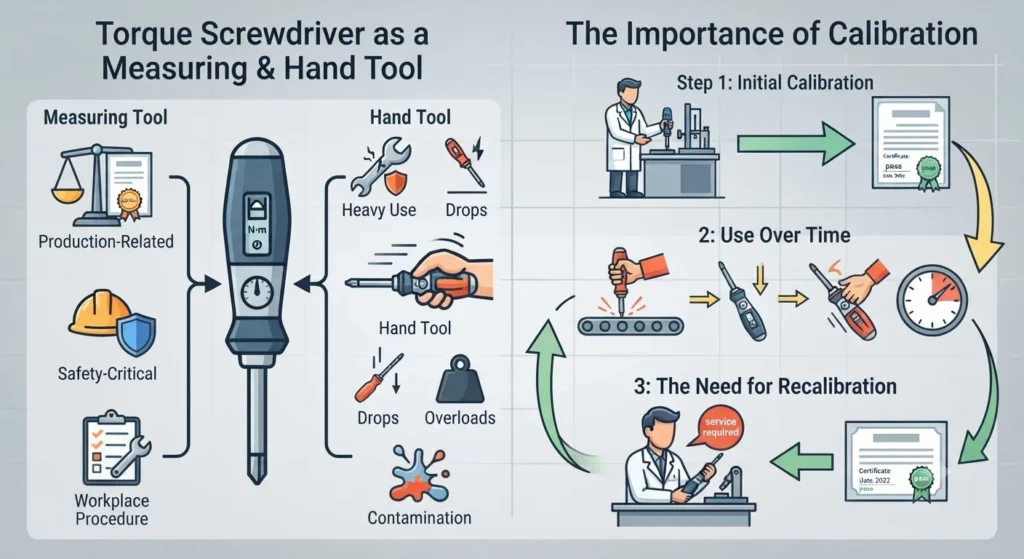
Calibration certificates and service availability matter most when torque control is documented, safety-critical, production-related, or required by workplace procedure. A certificate documents a result at a point in time; it does not guarantee that the tool will remain accurate indefinitely after drops, overloads, contamination, or heavy use.
Torque screwdriver FAQs
Are digital torque screwdrivers more accurate?
Not automatically. A digital display can make a setting easier to read and can provide useful feedback, but accuracy depends on the individual tool’s design, stated tolerance, calibration condition, correct use, and operating environment. Compare the published accuracy specification for the exact model.
Can I use a torque screwdriver to loosen screws?
Only if the manufacturer explicitly allows it. Many torque screwdrivers are intended for controlled tightening, not breaking loose seized or overtightened fasteners. Use an ordinary screwdriver or suitable hand tool for loosening unless your tool’s manual says otherwise.
How often should a torque screwdriver be calibrated?
There is no single interval for every user. Follow the manufacturer’s recommendation and any quality-system requirement. More frequent verification may be appropriate for heavily used, dropped, overloaded, or production-critical tools.
What is the most important feature to compare?
Torque range is the first filter. Once you have a tool that properly covers the specification, compare stated accuracy, repeatability information, adjustment security, readable markings, bit compatibility, case quality, documentation, and calibration support.