
Everything you need to know about lug nuts — from choosing the right type and size to using a lug wrench safely and knowing when replacement is needed.
Lug nuts are the only fasteners keeping your wheels attached to your vehicle. A single loose or missing lug nut can lead to wheel wobble, uneven brake wear, and — in the worst case — a wheel separating at highway speed.
This comprehensive guide covers the different types of lug nuts, how to determine the correct size and thread pattern for your vehicle, when and why to use locking lug nuts, proper torque techniques with a lug wrench, and a step-by-step lug nut replacement guide. Whether you’re changing a flat tire or upgrading to aftermarket wheels, understanding your lug nuts is essential for safe driving.
What Are Lug Nuts and Why Do They Matter?
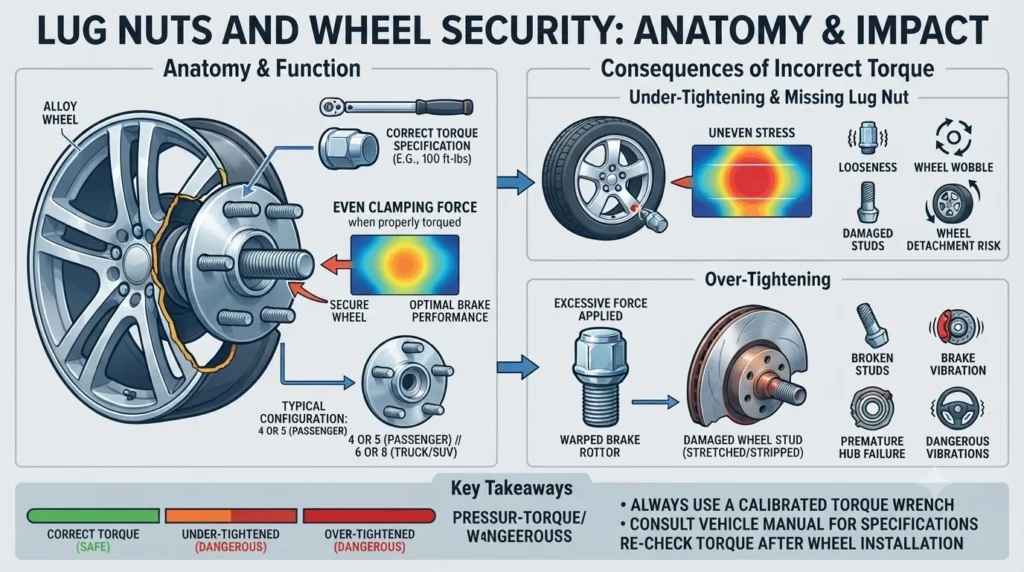
A lug nut is a threaded fastener that secures a wheel to the vehicle’s hub assembly. Each wheel typically uses 4 to 8 lug nuts depending on the vehicle type — passenger cars commonly have 4 or 5, while trucks and SUVs often use 6 or 8. The lug nut threads onto a wheel stud that protrudes from the hub, and when tightened to the correct torque specification, it clamps the wheel firmly against the hub face.
Properly torqued lug nuts distribute clamping force evenly across the wheel. If even one lugnut is loose, missing, or over-tightened, it creates uneven stress that can warp brake rotors, damage wheel studs, and cause dangerous vibrations. Vehicle manufacturers specify exact torque values — typically between 80 and 140 ft-lbs for passenger vehicles — because both under-tightening and over-tightening cause failures.
Types of Lug Nuts
Conical (Tapered) Seat Lug Nuts
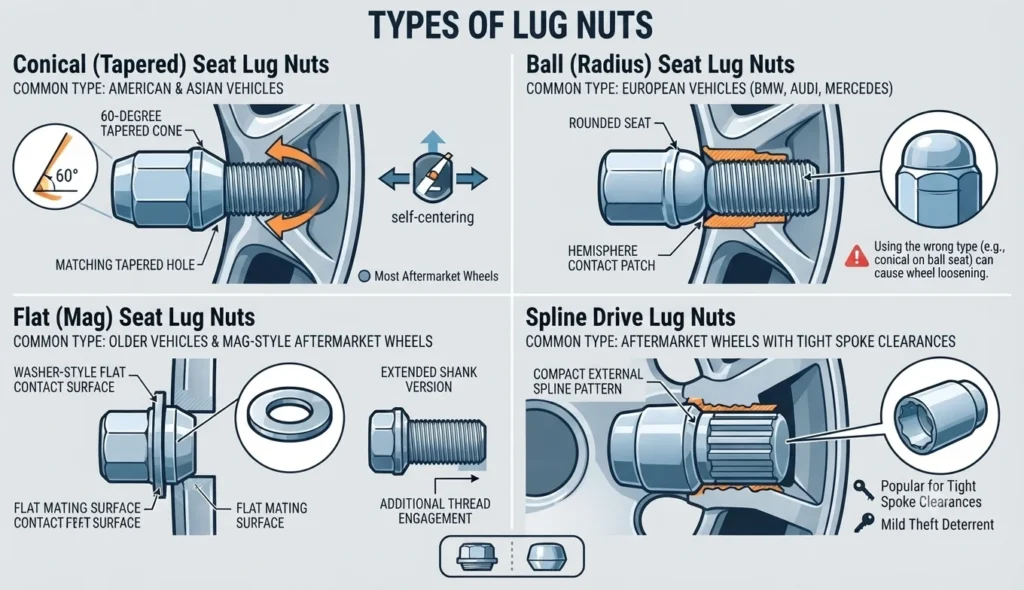
The most common type found on American and Asian vehicles. These lug nuts have a 60-degree tapered cone that centres the wheel on the hub as you tighten. The conical seat wedges into a matching tapered hole in the wheel, providing excellent self-centring and consistent clamping force. Most aftermarket wheels also use conical seat lug nuts.
Ball (Radius) Seat Lug Nuts
Common on European vehicles — BMW, Mercedes-Benz, Audi, and Volkswagen frequently use ball seat lug nuts (or lug bolts). The rounded seat creates a hemisphere contact patch with the wheel. Using a conical lug nut on a ball seat wheel — or vice versa — will NOT properly secure the wheel and can cause it to loosen while driving.
Flat (Mag) Seat Lug Nuts
Flat seat lug nuts have a washer-style flat contact surface and are typically found on older vehicles and certain aftermarket mag-style wheels. They require a perfectly flat mating surface on the wheel. An extended shank version provides additional thread engagement for thicker aftermarket wheels.
Spline Drive Lug Nuts
Spline drive lugnuts have a compact external spline pattern instead of a standard hex shape, requiring a special thin-wall spline socket. They’re popular on aftermarket wheels with tight spoke clearances where a standard lug wrench won’t fit. Some spline designs also double as a mild theft deterrent.
Lug Nut Sizes: Thread Pitch, Hex Size & Seat Type
Every lug nut has three critical measurements: thread size (diameter and pitch), hex size (the socket size needed to turn it), and seat type. Thread size is expressed as diameter × pitch — for example, 12mm × 1.5 or 1/2″ × 20. Using the wrong thread pitch will cross-thread and destroy both the lug nut and wheel stud.
Common metric thread sizes include M12 × 1.25 (Nissan, Subaru, Lexus), M12 × 1.5 (Honda, Toyota, Hyundai, most GM), and M14 × 1.5 (Ford trucks, newer GM trucks, many European vehicles). SAE sizes like 7/16″ × 20 and 1/2″ × 20 appear on older American vehicles. Your owner’s manual or a lug nut sizing chart from the wheel manufacturer will confirm the correct spec.
Hex sizes (the lug wrench socket you need) typically range from 17mm to 22mm. The most common passenger car size is 19mm (3/4″). Trucks often use 21mm or 22mm. Always use the correct size lug wrench or socket — a loose-fitting wrench rounds off the hex flats, making future removal difficult or impossible.
Locking Lug Nuts: Anti-Theft Wheel Protection
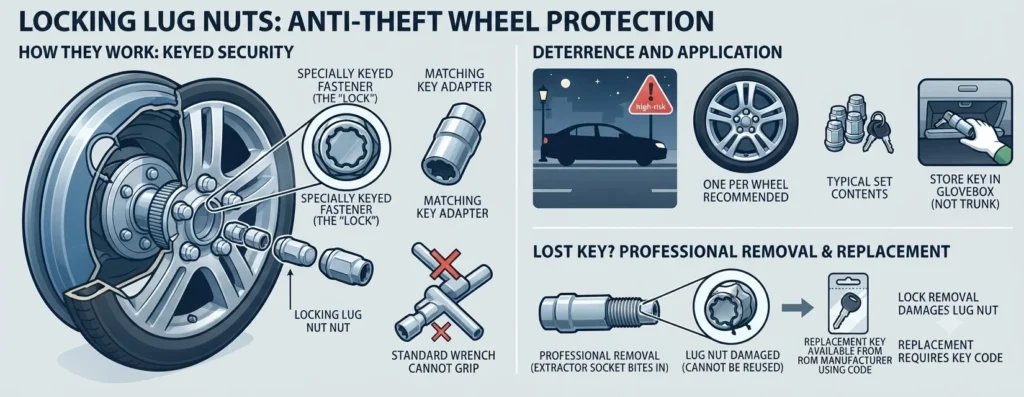
Locking lug nuts replace one standard lug nut per wheel with a specially keyed fastener that requires a unique adapter socket (the “key”) to install or remove. Without the matching key, a standard lug wrench cannot grip the locking lug nut — deterring opportunistic wheel theft.
Locking lug nuts are highly recommended if you have expensive alloy wheels, live in an area with high vehicle theft, or park overnight on the street. Most sets include four locking lugnuts (one per wheel) plus one or two key sockets. Store the key in your glovebox — not the trunk — so you can access it during a roadside tire change.
If you lose your locking lug nut key, a tire shop can remove the locks using a special extractor socket that bites into the outer surface. This damages the locking lug nut (it cannot be reused), but frees your wheel. Replacement key sets are available from the manufacturer using the code stamped on your original key packaging.
Lug Nut Safety Tips Every Driver Should Know
• Always tighten lug nuts in a star (criss-cross) pattern to distribute clamping force evenly.
• Use a calibrated torque wrench — never an impact gun at full blast — to achieve the manufacturer’s specified torque.
• Re-torque lug nuts after driving 50–100 miles on new or re-mounted wheels.
• Inspect lug nuts visually every time you check tire pressure. Look for rust, cracks, or swollen lugnuts (a sign of internal corrosion).
• Never use lubricant on lug nut threads unless your manufacturer specifically calls for it — oil changes the torque-to-clamp relationship and can lead to over-tightening. |
• Replace any lug nut that shows thread damage, rounded hex flats, or a cracked seat — a damaged lugnut cannot maintain proper clamping force.
• If your lug wrench slips or the lug nut won’t budge, stop and seek professional help rather than risking a rounded fastener.
Lug Nut Replacement: Step-by-Step Guide
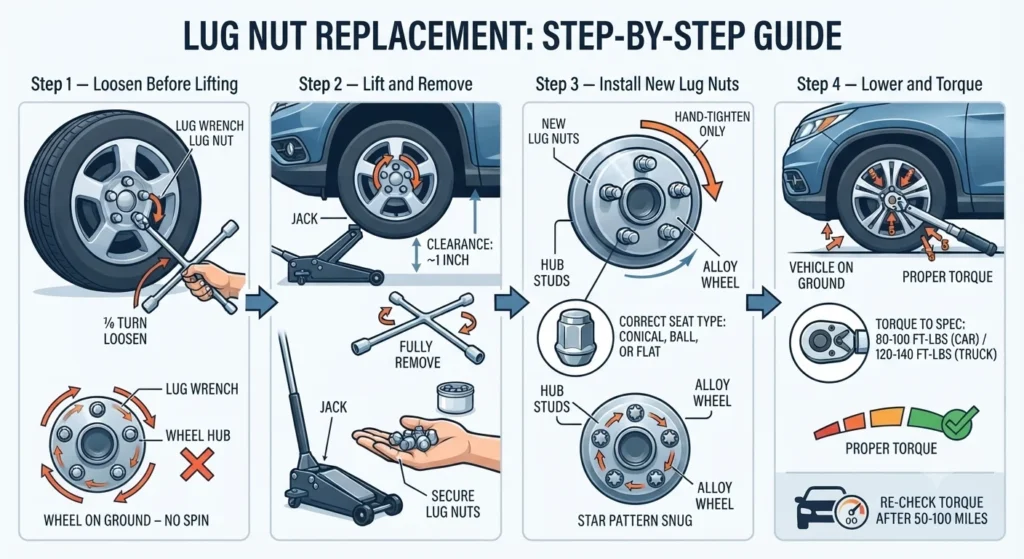
Whether you’re changing a flat tire on the roadside or replacing worn lug nuts at home, here’s the safe procedure using a lug wrench and basic tools:
Step 1 — Loosen Before Lifting
With the vehicle on the ground and the parking brake set, use your lug wrench to break each lug nut loose by turning counter-clockwise approximately ¼ turn. The weight of the vehicle prevents the wheel from spinning. Never fully remove lug nuts while the car is on the ground.
Step 2 — Lift and Remove
Position the jack at the manufacturer-specified lift point and raise the vehicle until the tire clears the ground by about 1 inch. Now fully remove each lug nut with the lug wrench and pull the wheel off the hub studs. Place lug nuts in a container so none are lost.
Step 3 — Install New Lug Nuts
Mount the wheel onto the hub studs and hand-thread each new lug nut clockwise until finger-tight. Ensure the correct seat type (conical, ball, or flat) faces the wheel. Snug them in a star pattern using the lug wrench — do not fully torque yet.
Step 4 — Lower and Torque
Lower the vehicle to the ground. Using a torque wrench, tighten each lug nut to the manufacturer’s specification in a star pattern (typically 80–100 ft-lbs for cars, 120–140 ft-lbs for trucks). Re-check torque after 50–100 miles of driving.
Frequently Asked Questions About Lug Nuts
Can you drive with a missing lug nut?
You can drive short distances at low speed to reach a repair shop, but it’s not safe for extended driving. A missing lugnut increases stress on the remaining fasteners and can cause wheel wobble. On a 4-lug wheel, one missing nut means 25% less clamping — replace it immediately.
How much does lug nut replacement cost?
Standard lug nuts cost $2–$8 each depending on material and finish. A full set of 20 quality chrome or black lug nuts typically runs $30–$80. Locking lug nuts cost $20–$60 for a set of four plus the key. Labour for professional installation is minimal — most shops include it with a tire service.
What size lug wrench do I need?
Most passenger cars use a 19mm (3/4″) lug wrench. Trucks often require 21mm or 22mm. Check your owner’s manual or measure an existing lug nut. A four-way lug wrench (cross wrench) with 17mm, 19mm, 21mm, and 22mm sockets covers most vehicles and provides better leverage than the wrench included with your spare tire kit.
Are locking lug nuts worth it?
Yes — especially if you have expensive aftermarket wheels or park in high-theft areas. Locking lug nuts cost $20–$60 and add significant deterrence against opportunistic wheel theft. The minor inconvenience of needing a key socket is far outweighed by the cost of replacing stolen wheels and tires.
What happens if lug nuts are over-tightened?
Over-tightened lug nuts can stretch or break wheel studs, warp brake rotors (causing pulsation when braking), crack the wheel mounting flange, and make future removal extremely difficult. Always use a torque wrench set to your vehicle’s specification rather than an impact gun at full power.
Can I use any lug nut on my car?
No. Lug nuts must match your vehicle’s thread size and pitch, and the seat type must match your wheel (conical, ball, or flat). Using the wrong lugnut can result in improper seating, cross-threading, or wheel detachment. Always verify compatibility with your vehicle manual or wheel manufacturer specifications.