

QUICK ANSWER
| Cost (Battery) | Installed at Shop | Avg Lifespan | Full Charge Voltage | DIY Time |
|---|---|---|---|---|
| $60–$350 | $100–$300 | 3–5 years | 12.6V | 15–30 min |
A dead car battery is the leading cause of roadside breakdowns in the United States, according to AAA. Whether you need to jump-start your car right now, figure out how much a replacement will cost, or test whether your battery actually needs replacing — this guide covers everything in order.
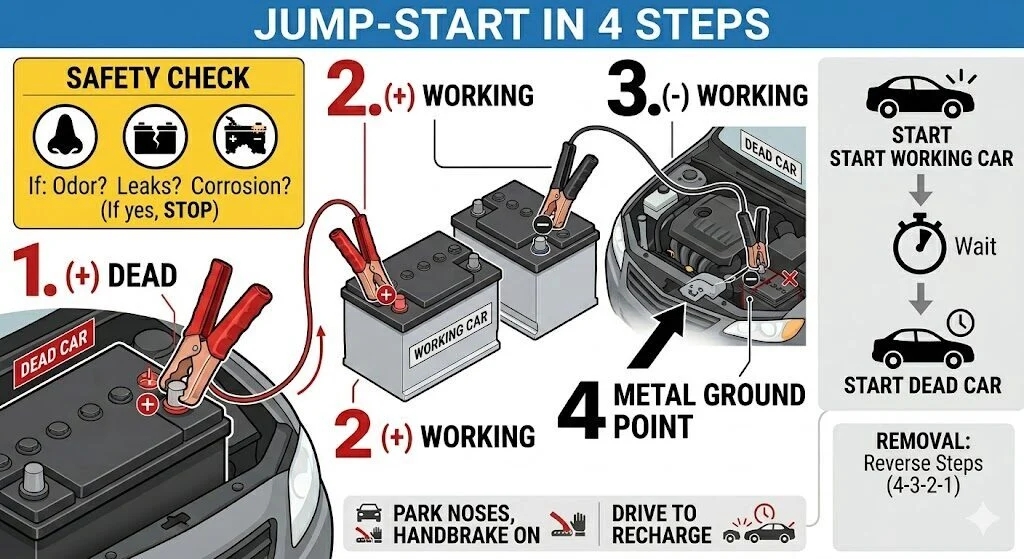
🚨 How to Jump-Start a Car — 4 Steps
Connect cables in this exact order. Getting the sequence wrong can damage both vehicles.
⚠️ DO NOT ATTEMPT TO JUMP-START IF:You smell sulphur (rotten eggs) · Battery case is cracked or leaking · Terminals have heavy corrosion build-up · Battery appears swollen or deformed. Call roadside assistance in these cases.
Cable Connection Order
| Step | Connection | Detail |
|---|---|---|
| Step 1 — Red | Red → Dead Battery (+) | Clamp to positive (+) terminal of flat battery |
| Step 2 — Red | Red → Good Battery (+) | Other end to positive (+) of the working battery |
| Step 3 — Black | Black → Good Battery (−) | Clamp to negative (−) of the working battery |
| Step 4 — Black | Black → Bare Metal on Dead Car | Unpainted metal bracket — NOT the dead battery terminal |
- Park the working car nose-to-nose — Cables need to reach both batteries. Turn both vehicles off and apply the handbrake on both cars before doing anything else.
- Connect cables in the exact order shown above — Red to dead positive → red to good positive → black to good negative → black to bare metal on the dead car. Never let the clamps touch each other once connected to a live terminal.
- Start the working car — wait exactly 2 minutes — Let the working car run for 2 minutes. This gives the flat battery enough charge to crank. Attempting to start the dead car immediately will not work and strains both batteries.
- Start the dead car — remove cables in reverse order — If it starts, remove cables in reverse: black from bare metal → black from good battery → red from good battery → red from started car. Drive for at least 30 minutes to recharge. If it does not start after 3 attempts, the battery needs replacing — not just a jump.
💡 BATTERY LIGHT — NOT ALWAYS THE BATTERYThe battery warning light can also indicate a failing alternator, loose serpentine belt, or bad terminal connection. If the light came on while the car was running (not just at start-up), the alternator is the more likely cause. A new battery will not fix an alternator problem. Test both before spending money.
💰 Car Battery Replacement Cost — Full Pricing Breakdown
A car battery costs $60–$350 depending on type, plus $20–$50 for professional installation at most shops.
| Battery Type | Battery Cost | DIY Total | Shop Installed | Best For |
|---|---|---|---|---|
| Standard Flooded | $60–$120 | $60–$120 | $80–$170 | Older vehicles, basic commuters |
| Mid-Range Flooded | $120–$180 | $120–$180 | $140–$230 | Most everyday vehicles 2005–2015 |
| AGM Battery | $180–$300 | $180–$300 | $200–$350 | Modern vehicles, start-stop engines |
| Premium AGM / Optima | $250–$350 | $250–$350 | $270–$400 | Performance vehicles, trucks |
💰 DIY VS SHOP — IS IT WORTH DOING YOURSELF?
Shops charge $20–$50 for installation labour. On a $100 battery that is a 20–50% markup. For most cars the swap takes 20 minutes with a 10mm socket. However — vehicles with a Battery Management System (common on BMW, Mercedes, Audi, and many 2016+ vehicles) require the new battery to be registered with dealer software after replacement.
| 🔧 FROM THE WORKSHOP — FIRST-HAND EXPERIENCE “The single most common mistake I see is customers fitting a standard flooded battery in a car that specifies AGM — particularly any vehicle with start-stop technology made after 2014. The car’s battery management system is calibrated for AGM charge characteristics. A standard battery will drain faster, charge incorrectly, and typically fail within 12–18 months instead of the expected 4–6 years. Always check your door jamb sticker or owner’s manual for the OEM battery specification before buying.”— Usama, ASE-Certified Automotive Technician · 10+ years workshop experience · GearHead Grove |
🔧 How to Replace a Car Battery — Tools & Step-by-Step
Replacing a car battery takes 15–30 minutes for most vehicles. Tools needed:
- 10mm socket wrench (most vehicles)
- Safety gloves and glasses
- Memory saver — optional but recommended (preserves radio presets and window calibration)
- Terminal cleaning brush
- Baking soda and water — for corrosion removal
- Turn off engine — connect memory saver if available — A memory saver plugs into your OBD-II port or cigarette lighter and maintains power during the swap, preserving radio presets, window calibration, and throttle position settings.
- Disconnect the negative (−) terminal first — Always remove the black negative cable first. Removing positive first risks a short circuit if the wrench touches the car body. Loosen the clamp nut with your 10mm socket and wiggle free.
- Disconnect the positive (+) terminal — Remove the red cable the same way. Move both cables aside so they cannot accidentally contact the battery terminals while you work.
- Remove hold-down bracket and lift out the battery — Most batteries have a clamp at the base — remove with socket wrench. Lift straight up using both hands. Car batteries weigh 30–50 lbs — lift with your legs, not your back.
- Clean terminals if corroded — White or green powder is lead sulphate corrosion. Mix baking soda in water, apply to terminals, scrub with wire brush, rinse with clean water, dry thoroughly. Corroded terminals cause poor connections even on a new battery.
- Install new battery — connect positive first, then negative — Lower battery into tray, secure hold-down bracket, then connect positive (+) first, then negative (−). Tighten firmly — a loose terminal is the most common reason a new battery appears to fail.
⚠️ MODERN VEHICLES MAY NEED BATTERY REGISTRATIONVehicles with a Battery Management System — common on BMW, Mercedes-Benz, Audi, Volkswagen, and many 2016+ models — require the new battery to be registered using specialist diagnostic software after replacement. Without registration the charging system stays calibrated for the old battery, significantly shortening the new one’s life.
🔬 How to Test a Car Battery with a Multimeter
A multimeter test takes under 2 minutes and tells you whether your battery needs charging, replacing, or is still in good health.
- Set multimeter to DC Voltage — 20V range — Turn the dial to DC Volts (marked DCV or V—). Select the 20V range. A car battery sits between 11.5V and 12.8V so the 20V setting gives an accurate reading.
- Connect red probe to (+), black probe to (−) — Touch red to positive terminal, black to negative. Car must be off and rested for at least 30 minutes. A recently driven battery reads higher than its true resting voltage.
- Read the voltage and compare to the chart below — Use the table to interpret the result and decide whether to charge and retest or replace.
Car Battery Voltage Chart
| Voltage | State of Charge | Action |
|---|---|---|
| 12.6V – 12.8V | 100% — Fully charged | Battery is healthy. No action needed. |
| 12.4V – 12.6V | 75–100% — Good | Acceptable. Consider a maintenance charge if closer to 12.4V. |
| 12.2V – 12.4V | 50–75% — Low | Charge before testing. May still be healthy once fully charged. |
| 12.0V – 12.2V | 25–50% — Discharged | Charge fully then retest. Battery may be weakening. |
| Below 12.0V | Under 25% — Failing | Likely needs replacing. Recharge may only be temporary. |
| Below 11.8V | Critically discharged | Replace immediately. Cannot hold sufficient charge. |
🔬 VOLTAGE TEST VS LOAD TEST — THE KEY DISTINCTION
A battery can read 12.6V at rest and still fail under load — especially in cold weather. A voltage test shows state of charge; a load test (applying a draw equal to half the battery’s CCA rating) shows whether the battery can actually deliver cranking power. Most auto parts stores (AutoZone, O’Reilly, Advance Auto Parts) offer free load tests. If your battery passes the voltage test but still cranks slowly, request a free load test before buying a replacement.
📅 How Long Does a Car Battery Last — And How to Extend It
The average car battery lasts 3–5 years under normal conditions. AGM batteries extend this to 4–7 years. These factors shorten battery lifespan most significantly:
- Extreme heat: Extreme heat — heat kills batteries faster than cold by accelerating internal corrosion and water evaporation. The American Southwest has measurably higher battery failure rates.
- Short trips: Short trips — regular drives under 20 minutes prevent the alternator from fully recharging the battery after each cold start.
- Parasitic drain: Parasitic drain — aftermarket accessories, faulty modules, or a vehicle left standing for weeks without being driven slowly flatten a battery.
- Deep discharge: Deep discharge events — leaving lights on overnight causes deep discharge. Each event reduces total capacity. Multiple events compound the damage.
AGM vs Standard Flooded Battery — Which Do You Need?
| Feature | Standard Flooded | AGM Battery |
|---|---|---|
| Cost | $60–$180 | $180–$350 |
| Typical lifespan | 3–5 years | 4–7 years |
| Start-stop engines | Not compatible | Required |
| Construction | Wet cell, may need water | Sealed, spill-proof |
| Deep discharge tolerance | Low | High |
| Charger requirement | Standard | AGM-compatible charger |
| Common vehicles | Pre-2014, older models | BMW, Mercedes, Audi, 2015+ vehicles |
⚠️ MOST COMMON BUYER MISTAKE
Fitting a standard flooded battery in a vehicle that specifies AGM. The charging system in start-stop and modern vehicles is calibrated for AGM charge characteristics. A standard battery fitted in these cars will be consistently overcharged, degrading in 12–18 months. Always confirm your OEM battery specification before purchase — it is printed on the door jamb sticker or in your owner’s manual.
Car Battery Brand Guide
| Brand | Type | Best For |
|---|---|---|
| Optima Red Top | AGM · Premium | Performance vehicles, trucks, off-road — maximum cranking power |
| DieHard Gold | AGM · Mid-Range | Solid mid-range AGM at Advance Auto Parts. Good warranty. |
| Duracell Automotive | Standard & AGM | Best value — often available at Costco and Sam’s Club |
| Interstate Batteries | Standard & AGM | Widely available. Legitimate OEM supplier. Solid warranty. |
| ACDelco | Standard & AGM | OEM supplier for GM. First choice for Chevy, GMC, Buick, Cadillac |
Trickle Charger vs Battery Maintainer vs Battery Tender — The Definitive Difference
| Type | Safety Rating | Description |
|---|---|---|
| Trickle Charger | ⚠️ Use with caution | Delivers constant low current (1–3 amps) regardless of battery level. Can overcharge if left connected too long. Use to recover a flat battery then disconnect. Not safe for long-term unattended use. |
| Battery Maintainer | ✅ Safe long-term | Monitors battery voltage and switches between charge and float mode automatically. Will not overcharge. Safe to leave connected indefinitely. Best for stored or infrequently used vehicles. |
| Battery Tender | ⭐ Best for storage | Brand name (by Deltran) that has become a generic term. Their products are battery maintainers — smart chargers with automatic float mode. Safe for indefinite connection on motorcycles, classic cars, and seasonal vehicles. |
💡 KEY RULE FOR AGM BATTERIESAGM batteries require a charger specifically set for AGM mode. A standard trickle charger at the wrong voltage can permanently damage an AGM battery. If you own a modern vehicle with an AGM battery, buy a smart charger with an explicit AGM mode before connecting anything.
❓ Frequently Asked Questions
How much does a car battery cost?
A standard car battery costs $60–$180. AGM batteries cost $180–$350. Professional installation adds $20–$50 at most shops. Total installed cost for most vehicles is $100–$300. Prices verified against AutoZone, Advance Auto Parts, O’Reilly, Walmart, and Costco — April 2026.
How long does a car battery last?
Most car batteries last 3–5 years. AGM batteries last 4–7 years. Heat degrades batteries faster than cold. If your battery is over 4 years old and cranking slowly, test it before it fails completely — AAA reports battery failure is the single leading cause of roadside breakdowns in the US.
How many volts is a car battery?
A fully charged car battery reads 12.6 volts at rest. Between 12.4V and 12.6V is acceptable. Below 12.0V means the battery is discharged and needs charging or replacing. Below 11.8V indicates a failing battery. A running engine produces 13.5V–14.5V — that is your alternator charging output, not the battery itself.
Can I replace a car battery myself?
Yes, for most vehicles — it takes 15–30 minutes with a 10mm socket and gloves. However, vehicles with a Battery Management System (common on BMW, Mercedes, Audi, and many 2016+ vehicles) need the new battery registered with diagnostic software after replacement. Check your owner’s manual before doing a DIY swap on a modern vehicle.
What does the battery warning light mean?
The battery light indicates a problem in the charging circuit — which could be the battery, the alternator, a loose serpentine belt, or a bad terminal connection. If the light appeared while the car was running rather than at start-up, the alternator is the more likely cause. Test both before replacing anything.
What is an AGM battery and do I need one?
AGM (Absorbent Glass Mat) batteries are sealed, vibration-resistant, and required for vehicles with start-stop technology. Most vehicles made after 2014 specify AGM. Using a standard battery in an AGM-required vehicle causes the charging system to overcharge it, typically resulting in failure within 12–18 months. Check your door jamb sticker or owner’s manual for your OEM battery specification.
What is the difference between a trickle charger and a battery maintainer?
A trickle charger delivers constant current and can overcharge if left connected long-term — use it to recover a flat battery then disconnect. A battery maintainer monitors charge level and switches to float mode automatically when full — safe to leave connected indefinitely. For stored or seasonal vehicles, always use a maintainer. ‘Battery Tender’ is a brand name for a battery maintainer.
How do I test a car battery with a multimeter?
Set the multimeter to DC Volts at the 20V range. Connect red probe to positive (+) and black to negative (−) with the car off and rested 30 minutes. A reading of 12.6V means fully charged. Below 12.0V indicates discharge. Below 11.8V suggests replacement. For a definitive result, ask your local auto parts store for a free load test.