
⚡ Quick Answer
Most car batteries last 3–5 years. In hot climates (Texas, Arizona, Florida), heat accelerates chemical breakdown and many batteries fail in as little as 2–3 years. In cold climates, a weakening battery may seem fine all summer then suddenly refuse to start on a frigid morning. If your battery is over 3 years old, it’s worth testing — most auto parts stores do it free in 5 minutes.
What Actually Shortens Battery Life
Your battery doesn’t die randomly. Three environmental and behavioral factors account for the vast majority of early failures — and two of them are things most drivers never consider.
🔥 Extreme Heat
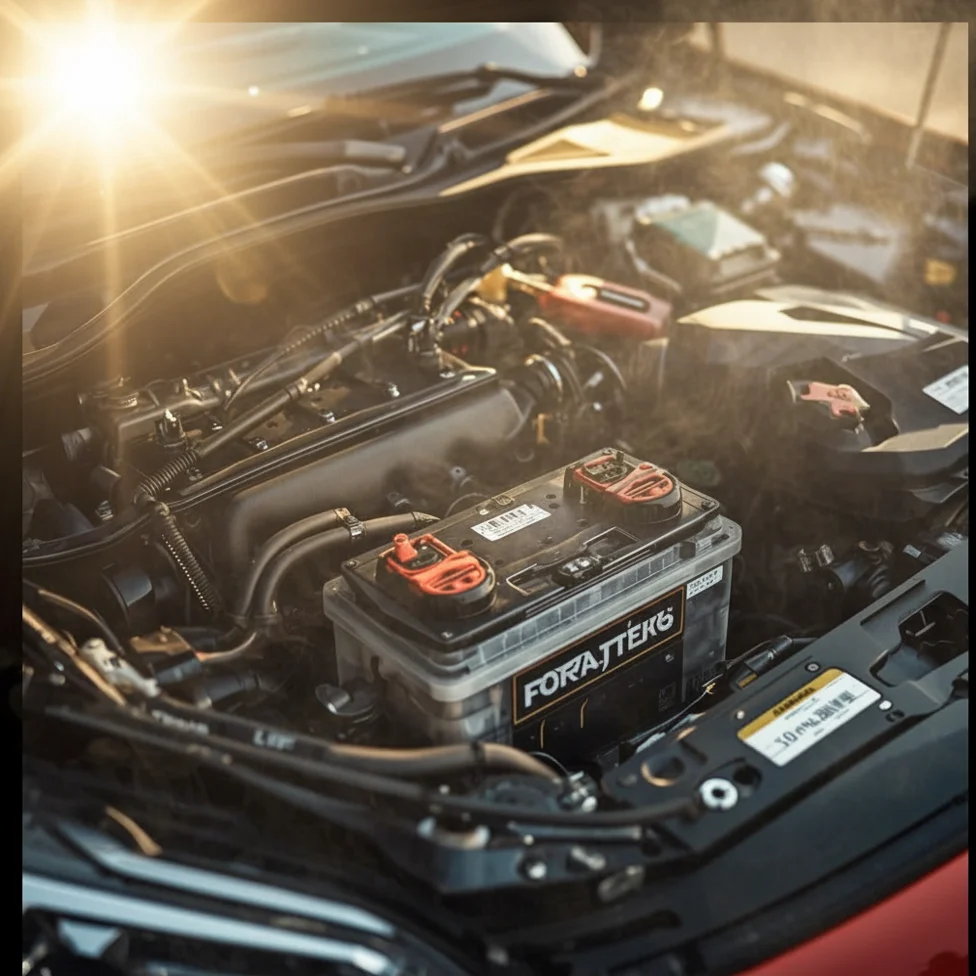
Heat is the #1 battery killer. Temperatures above 100°F accelerate the internal chemical reactions inside a lead-acid battery, causing plate corrosion and electrolyte evaporation. Southern US drivers should plan on a 2–3 year replacement cycle.
❄️ Bitter Cold
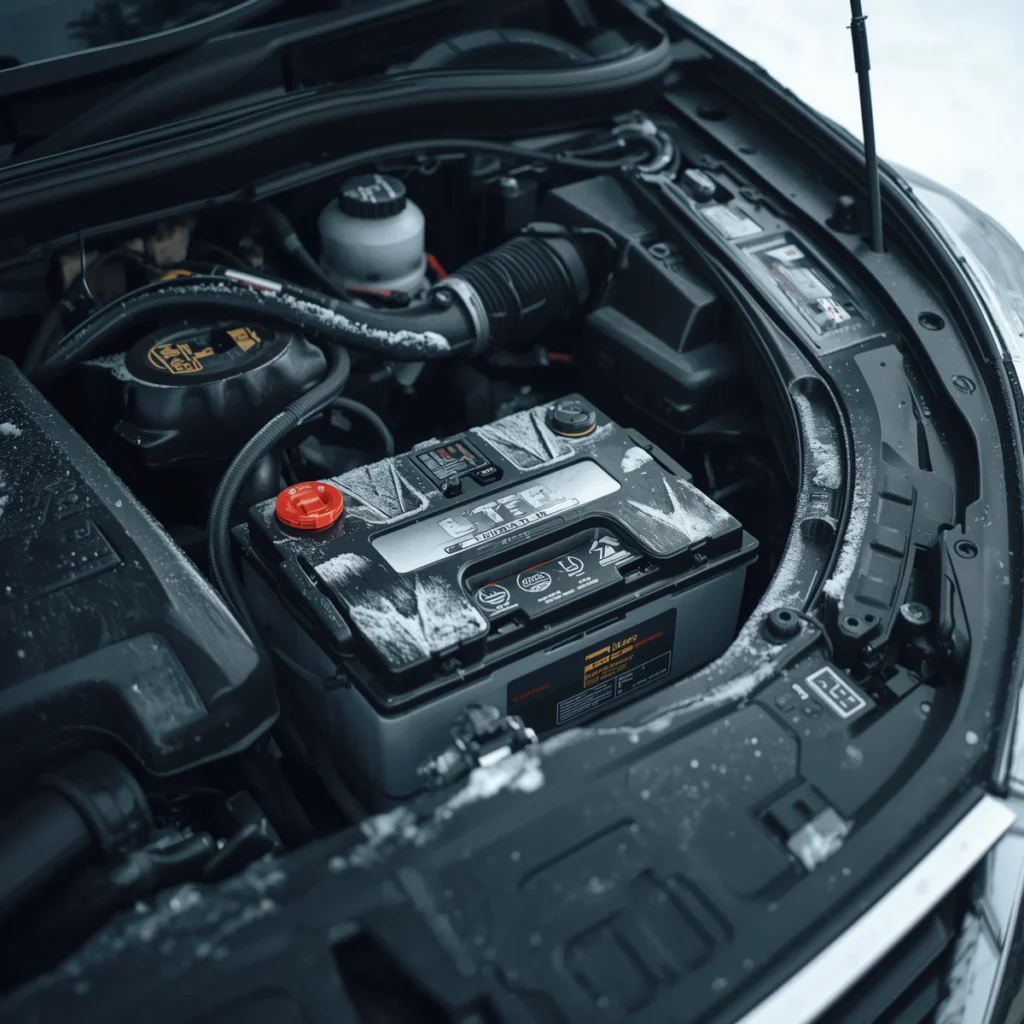
Cold doesn’t destroy batteries — it exposes weak ones. At 0°F, a battery loses up to 60% of its cranking power while the engine simultaneously needs more power to start. A battery at 70% health in summer may completely fail in January.
🏙️ Short Trips
Every cold start pulls a large charge from the battery. Your alternator needs roughly 20–30 minutes of driving to replenish it. If most of your trips are under 15 minutes, your battery slowly drains deeper with each cycle — significantly shortening its life.
6 Warning Signs Your Battery Is Dying
Batteries rarely die without warning. Here are the signals to watch for — and what each one actually means.
Slow or sluggish crankEngine takes noticeably longer to turn over than usual. This is often the first sign of a weakening battery — the “rrr-rrr-rrr” sound before it catches.
Dimming headlights or dash lightsLights that dim at idle but brighten when you rev the engine point directly to a battery that can’t hold sufficient charge between alternator pulses.
Battery warning lightThe battery icon on your dashboard can indicate a failing battery, a bad alternator, or a poor connection. Don’t ignore it — get it tested within the week.
Clicking when turning the keyA rapid click-click-click with no engine turnover means the battery doesn’t have enough juice to engage the starter motor. Single loud click = starter solenoid issue.
Swollen or bloated battery caseA battery case that looks puffy or bulging has been damaged by overcharging or excessive heat. A swollen battery is a safety hazard — replace it immediately.
Corrosion on terminalsWhite, blue, or greenish crusty buildup on the positive or negative terminals increases electrical resistance. It can cause hard starts even if the battery itself is still healthy.
If you’re seeing two or more of these signs simultaneously, don’t wait for a dead battery in a parking lot. Get a free load test done now.
Battery Types & How Long Each Lasts
Not all car batteries are the same. The type that came in your vehicle affects both its lifespan and what you should replace it with.
Lead-Acid (Flooded)
The standard battery in most vehicles. Affordable and widely available, but requires occasional maintenance and vents small amounts of hydrogen gas. Most common failure mode is sulfation from repeated deep discharge.
AGM (Absorbent Glass Mat)
The premium sealed battery found in most modern vehicles with stop-start systems, push-button ignitions, and heavy electronics loads. More vibration-resistant, handles deeper discharge cycles, and charges faster. Required in many 2015+ vehicles.
Lithium-Ion (12V Auxiliary)
Increasingly found in hybrids and EVs as an auxiliary battery alongside the high-voltage traction pack. Lightweight, long-lasting, and handles temperature extremes better than lead-acid — but significantly more expensive and requires specific chargers.
⚠ If your vehicle requires AGM, never substitute a standard flooded battery. Doing so can damage the alternator and charging system, which are calibrated for AGM’s different charge profile.
How to Test Your Battery Voltage in 3 Minutes
A basic multimeter (under $20 at any hardware store) gives you a definitive health reading in about 3 minutes. Here’s exactly how to do it.
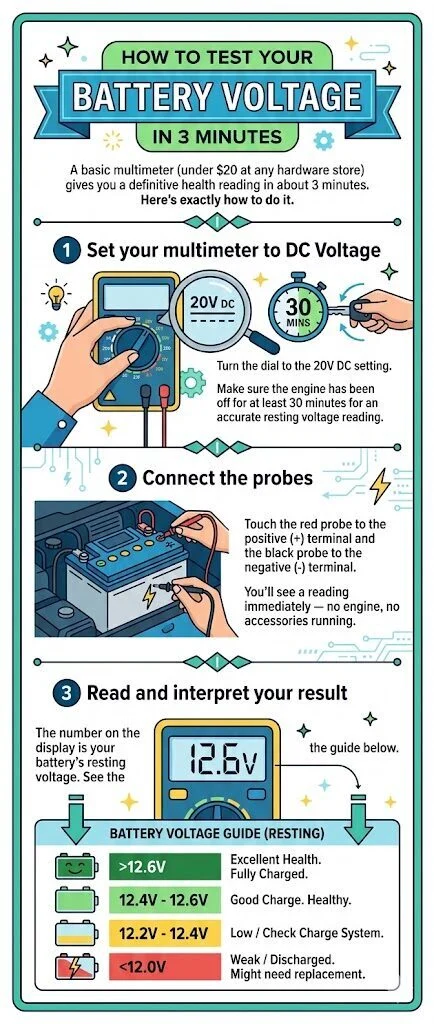
12.6V or above → Fully charged ✅
12.4V → ~75% charged — monitor it
12.2V → ~50% charged — recharge soon
12.0V → ~25% charged — near dead ⚠
Below 11.8V → Replace immediately 🔴
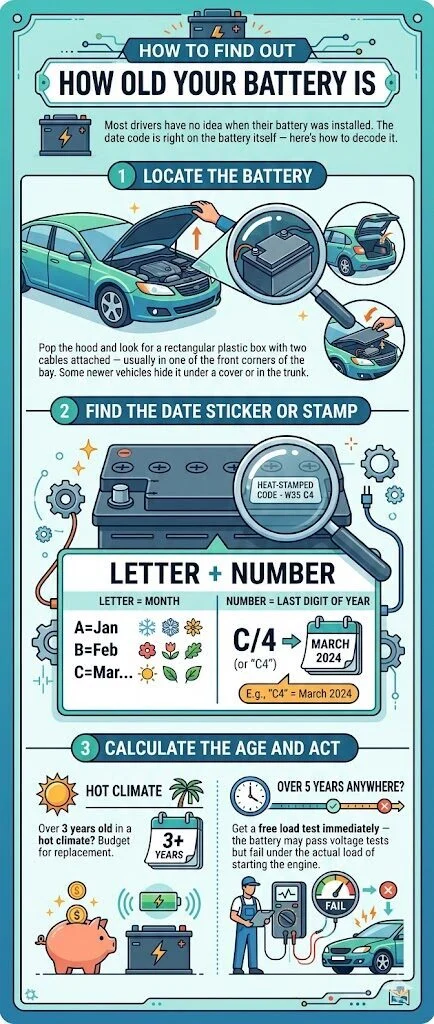
How to Find Out How Old Your Battery Is
Most drivers have no idea when their battery was installed. The date code is right on the battery itself — here’s how to decode it.
5 Ways to Make Your Battery Last Longer
You can’t stop batteries from aging, but these habits meaningfully slow the process and prevent avoidable failures.
Drive for at least 20–30 minutes regularly. Short trips are battery killers. If you mostly run errands under 15 minutes, a battery tender or trickle charger ($25–$50) plugged in overnight once a week keeps the battery fully topped up between short drives.
Turn everything off before shutting down. Headlights left on for 2 hours can fully drain a battery. Get in the habit of confirming all lights, AC, and accessories are off before leaving the car. Many modern vehicles do this automatically — older ones don’t.
Clean terminal corrosion once a year. Mix one tablespoon of baking soda with one cup of water. Disconnect the terminals (negative first), apply the mixture with an old toothbrush, rinse with water, dry thoroughly, and reconnect. This takes 10 minutes and improves electrical flow significantly.
Park in a garage when possible. In summer, a garage can be 30–40°F cooler than a sun-baked parking lot. In winter, even an unheated garage dramatically reduces cold-soak stress. Both temperature extremes accelerate chemical degradation — shade and shelter extend battery life measurably.
Test your battery annually after year 3. Most auto parts stores (AutoZone, O’Reilly, Advance Auto, NAPA) offer free battery load tests. A load test applies real starting load to the battery and measures how it performs under stress — far more accurate than a simple voltage check. 5 minutes, free, no appointment needed.
🔋 When in Doubt, Get It Tested
A dead battery strands you at the worst possible time. If your battery is over 3 years old, or you’ve noticed any of the warning signs above, stop by any auto parts store for a free load test. It takes 5 minutes and gives you a clear yes-or-no answer. The peace of mind is worth the detour.