
Trailer weight ratings determine how much your trailer can safely carry, how it handles on the road, and whether your tow vehicle can pull it without issues. If you are shopping for a new equipment trailer or dump trailer, understanding terms like GVWR, payload capacity, and tongue weight is not optional. Getting these numbers wrong puts your safety at risk and can lead to fines, blown tires, or worse.
This guide breaks down every weight rating you need to know before buying or loading a trailer.
What Is GVWR on a Trailer?
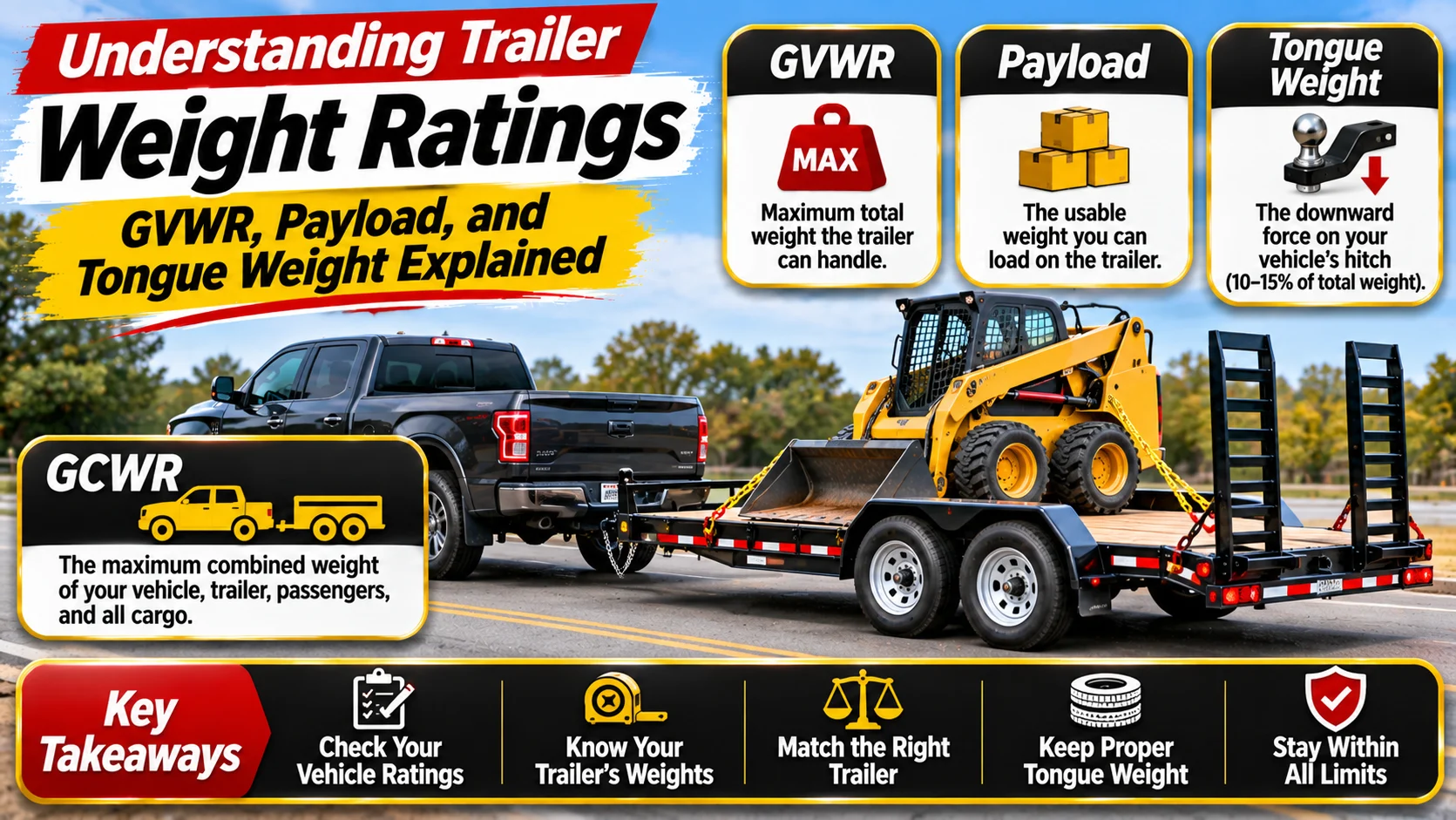
GVWR stands for Gross Vehicle Weight Rating. It is the maximum total weight your trailer is designed to handle, including the weight of the trailer itself plus everything you load onto it. The manufacturer sets this number based on the trailer’s frame, axles, suspension, tires, and other structural components.
For example, if a trailer has a GVWR of 14,000 lbs and the trailer itself weighs 3,500 lbs, you can safely load up to 10,500 lbs of cargo. Exceeding the GVWR puts excessive stress on the axles, brakes, and frame, which creates dangerous driving conditions and accelerates wear on every component.
You will find the GVWR listed on the trailer’s VIN plate, usually located on the front left side of the frame near the tongue.
Payload Capacity: How Much Can You Actually Load?
Payload capacity is the difference between the GVWR and the trailer’s curb weight (also called dry weight or empty weight). This is the actual usable weight you can put on the trailer.
Payload Capacity = GVWR minus Curb Weight
Keep in mind that payload includes everything: the equipment, materials, tools, fuel in any onboard tanks, and even accessories you have added like toolboxes or spare tires. Many buyers focus only on the GVWR without subtracting the trailer’s own weight, which leads to overloading.
When comparing trailers, always check both the GVWR and the curb weight. Two trailers with identical GVWRs can have very different payload capacities depending on their construction. Aluminum trailers, for instance, tend to offer more payload because the trailer itself weighs less. Steel trailers are heavier but often come at a lower price point. Dealers like Titan Equipment carry a range of both steel and aluminum options, so you can compare side by side based on the work you need the trailer for.
Tongue Weight and Why It Matters
Tongue weight is the downward force the trailer’s coupler exerts on the hitch of your tow vehicle. It plays a major role in towing stability.
As a general rule, tongue weight should be about 10% to 15% of the total loaded trailer weight for bumper pull trailers. For gooseneck trailers, the target is closer to 15% to 25% because the connection point sits over the rear axle of the truck, allowing for more weight transfer.
Too little tongue weight causes the trailer to sway at highway speeds, which is one of the most common causes of towing accidents. Too much tongue weight pushes down the rear of the tow vehicle, lifting the front wheels and reducing steering control.
You can measure tongue weight with a tongue weight scale or by using a bathroom scale with a simple lever setup. Many trailer dealers will help you check this before you leave the lot.
GCWR: The Number Most People Forget
Gross Combined Weight Rating (GCWR) is the maximum allowable weight of your tow vehicle, passengers, cargo in the truck, the trailer, and everything on the trailer, all added together. Your truck’s manufacturer sets this number.
Even if your trailer is well within its own GVWR, you can still exceed the GCWR if your truck is loaded heavy or if the truck itself is not rated for the combined load. Always check your vehicle’s owner manual or door sticker for the GCWR before you buy a trailer.
How to Match a Trailer to Your Tow Vehicle
Start with your tow vehicle’s towing capacity and GCWR. Then work backward:
Subtract the weight of your truck (loaded with passengers and gear) from the GCWR. That gives you the maximum trailer weight you should be pulling. From there, find a trailer with a GVWR that fits within that range and has enough payload capacity for the loads you plan to haul.
If you regularly haul equipment close to the trailer’s limits, consider sizing up. Running at 80% to 90% of capacity on every trip wears out brakes, tires, and bearings much faster than leaving a margin.
Frequently Asked Questions
What happens if you exceed your trailer’s GVWR?
Exceeding the GVWR puts extreme stress on the trailer’s axles, tires, and braking system. It can cause tire blowouts, brake failure, or structural damage to the frame. It also makes the trailer harder to control and can result in roadside fines during inspections.
Is GVWR the same as towing capacity?
No. GVWR is the maximum weight the trailer can handle. Towing capacity is the maximum weight your truck can pull. These are two separate ratings from two different manufacturers, and you need to stay within both limits.
How do I find my trailer’s curb weight?
Check the VIN plate on the trailer frame, the manufacturer’s spec sheet, or your bill of sale. If you cannot find it, take the empty trailer to a public scale (most truck stops and gravel yards have them) and weigh it.
Do I need to account for tongue weight separately?
Tongue weight is part of the trailer’s total weight, not an addition to it. However, you do need to make sure the tongue weight does not exceed your hitch’s rating. Most Class III hitches are rated for up to 600 lbs of tongue weight, while gooseneck hitches can handle significantly more.