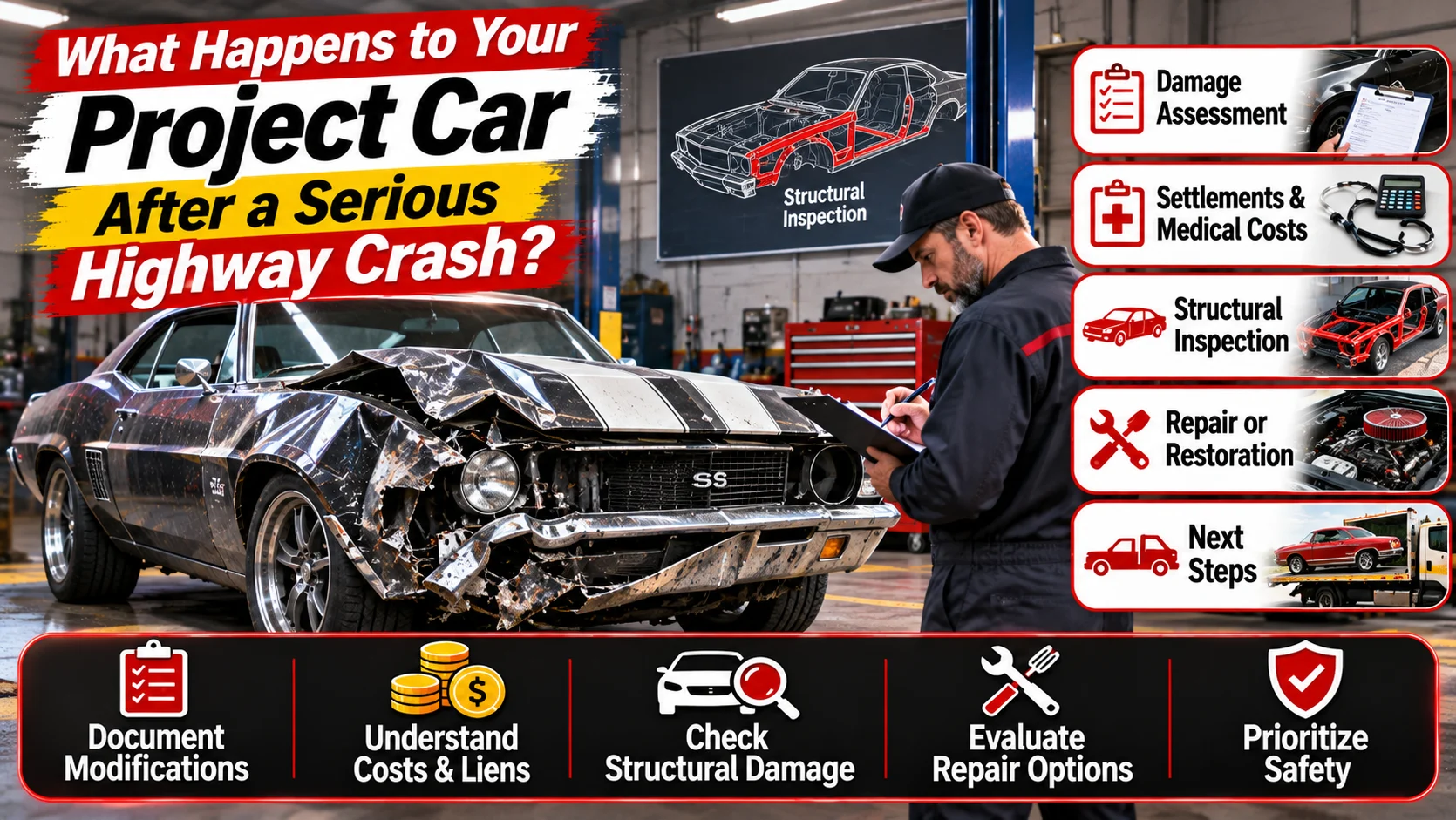

For many car enthusiasts, a project car represents years of hard work, personal investment, and countless weekends. Unfortunately, a highway crash can change everything within seconds.
According to the National Highway Traffic Safety Administration, US traffic fatalities were estimated at 36,640 in 2025, representing a 6.7% decrease from 2024. Even with that decline, the 2025 estimate corresponds to a rate of 1.10 fatalities per 100 million vehicle miles traveled.
That scale of roadway risk helps explain why a single high-speed incident can threaten a cherished build in seconds. Suddenly, your carefully maintained vehicle might have extensive damage, questionable structural integrity, or even a total loss designation.
Beyond the physical damage, you’ll face repair estimates, medical expenses, and difficult financial decisions. Understanding what happens next can help you protect your investment and make informed choices.
Your Vehicle Undergoes an Initial Damage Assessment
After a serious highway collision, your first priority should be getting somewhere safe. Once emergency responders arrive, they’ll help manage the immediate situation and assess potential injuries. Your damaged vehicle will eventually need professional inspection before anyone determines its condition.
An adjuster examines visible damage, photographs affected areas, and prepares an estimated repair cost. However, heavily modified vehicles can make this assessment considerably more complicated.
Your project car might contain aftermarket components, custom bodywork, or specialized performance upgrades. Standard valuation methods might overlook these additions when calculating your vehicle’s pre-accident value.
Keep receipts, photographs, installation records, and previous appraisals at hand. These documents help establish the actual value of your vehicle before the collision.
Collision Settlements and Medical Liens Can Complicate Your Restoration Budget
After a serious highway collision, the responsible party’s claims process must determine whether repairing your project car makes financial sense. Assessors compare estimated repair costs against the vehicle’s actual cash value. If repairs exceed applicable thresholds, the vehicle might be declared a total loss.
However, standard damage assessments don’t always recognize expensive modifications or custom components. Your upgraded engine, aftermarket suspension, and specialized bodywork might carry considerable replacement value. Keep receipts, photographs, and independent appraisals available when negotiating your settlement.
Your financial situation can become more complicated when the accident also involves serious injuries. Medical liens allow healthcare providers to collect outstanding treatment expenses from certain future settlement proceeds. Consequently, a portion of your personal injury compensation might already be committed before you receive payment.
Some injured drivers arrange letters of protection through their attorneys to defer medical payments until settlement. This can preserve immediate cash for transportation expenses and necessary vehicle repairs. However, understanding whether letters of protection are discoverable during litigation also matters when evaluating these arrangements.
In certain states, as Loewy Law Firm notes, discovery is the lawsuit stage where both sides request case documents and information. Defense lawyers can request records from your medical providers, even though they are not parties to the lawsuit. Such scrutiny can lead to disputes over whether treatment charges reflect reasonable market rates.
These disagreements sometimes complicate settlement negotiations and delay access to expected compensation. Understanding which funds cover medical expenses and vehicle repairs helps establish realistic restoration budgets.
Hidden Structural Damage Can Change Everything
Visible damage rarely tells the complete story after a serious highway accident. Your vehicle might look repairable while suffering substantial damage underneath its exterior panels. Consequently, professional technicians must examine its underlying structure before recommending restoration.
A collision can damage the frame, suspension mounting points, steering components, and subframe. Even relatively minor misalignment can affect handling, tire wear, and overall driving stability. These problems become particularly concerning when your project car has performance modifications.
Specialists often use computerized measuring systems to identify structural deviations accurately. They compare measurements against manufacturer specifications before determining necessary corrective work. Depending on the findings, technicians might recommend frame straightening, component replacement, or extensive structural repairs.
For heavily modified vehicles, finding qualified specialists becomes especially important during this process. Not every collision repair facility understands custom fabrication or aftermarket performance components.
Choosing experienced professionals helps prevent additional complications during your vehicle’s eventual restoration. Data from the US Bureau of Labor Statistics shows that employment of automotive body and glass repairers is projected to grow 4% from 2025 to 2035, with about 13,900 openings projected each year on average.
So there are a lot of options, sure, but since structural and body work relies on specialized training, locating the right shop or professionals takes careful vetting.
Choosing Between Professional Repairs and a Complete Restoration
Once technicians understand the damage, you’ll need to consider your restoration options. The cheapest estimate doesn’t necessarily represent the safest or most practical solution. Instead, evaluate repair quality, replacement components, labor expertise, and long-term reliability.
Repair inflation directly affects whether fixing a damaged car makes financial sense. According to the US Bureau of Labor Statistics, the Consumer Price Index for motor vehicle maintenance and repair rose 5.2% over the 12 months ending in August 2026. An earlier US Bureau of Labor Statistics release showed motor vehicle maintenance and repair up 5.1% over the 12 months ending in April 2026.
Besides, some project cars need extensive mechanical repairs alongside cosmetic bodywork. Others require replacement engines, transmissions, suspension systems, or specialized electronic components. Your repair facility should provide a detailed estimate covering these requirements.
Original equipment manufacturer components might preserve compatibility with existing vehicle systems. However, aftermarket replacements could provide suitable alternatives for certain modified vehicles. Discuss these choices with specialists familiar with your particular build.
You should also consider whether restoration costs exceed the vehicle’s realistic post-repair value. Sentimental attachment matters, but your financial situation deserves careful consideration. Sometimes, purchasing another project car makes considerably more practical sense.
FAQs
Can aftermarket modifications make me legally liable or partially at fault in a highway collision?
Aftermarket modifications do not automatically make you legally responsible for a collision. However, improperly installed or illegal modifications that contribute to an accident may affect liability or comparative fault determinations. Preserve installation records, inspection documents, and modification receipts to help establish whether your vehicle was properly maintained.
What paperwork, photos, and receipts should you organize to document the custom parts installed on a wrecked build?
Keep original purchase receipts, invoices, installation records, warranty documents, and modification permits where applicable. Photograph each custom part before installation, including serial numbers, brands, and identifying details. After a crash, document visible damage from multiple angles and retain repair estimates and towing records to support valuation.
What signs of structural damage indicate that a crashed project car will never align or handle properly again?
Severely bent frame rails, distorted suspension mounting points, damaged subframes, and buckled floor sections can indicate major structural damage. Misaligned doors, uneven panel gaps, abnormal wheel positioning, or persistent alignment problems may reveal underlying deformation. However, these signs alone cannot establish irreparability; a qualified collision specialist must assess structural measurements and repair feasibility.
What to Do After Your Project Car Gets into a Serious Crash
| Key Point | Summary |
| Initial damage assessment | Document aftermarket modifications, receipts, and pre-accident vehicle value. |
| Financial loss and medical expenses | Total loss decisions, aftermarket valuations, medical liens, and letters of protection can complicate settlement negotiations and restoration budgets. |
| Inspect hidden structural damage | Professional technicians should examine the frame, suspension, steering, and other underlying components before approving repairs. |
| Compare repair and restoration options | Evaluate repair estimates, specialist expertise, replacement parts, rising costs, and post-repair value before deciding whether to rebuild. |
| Protect the vehicle and personal belongings | Contact the tow yard promptly, document removable items, and obtain permission before collecting parts or altering the vehicle. |
Recovering a project car after a serious highway crash involves considerably more than replacing damaged body panels. You’ll need to navigate structural inspections, restoration decisions, and potentially complicated financial obligations.
Understanding these issues early helps you avoid unexpected financial problems during restoration. Most importantly, never compromise structural safety simply to preserve your original investment.
With qualified repair specialists, careful documentation, and sound financial planning, rebuilding remains possible. Your project car might eventually return to the highway looking better than ever.