Your car starts idling roughly, hesitates when you accelerate, or suddenly displays a check engine light. One possible cause is a problem with the EGR valve, a component that helps control engine emissions.
But these symptoms do not automatically mean the EGR valve has failed. A restricted exhaust passage, damaged wiring, faulty sensor, or unrelated engine problem can produce similar results. Replacing the valve without testing may waste money and leave the original problem unresolved.
This guide explains what an EGR valve does, how it works, common signs of trouble, diagnostic trouble codes, and practical checks that can help you decide whether cleaning, repair, or replacement is appropriate.
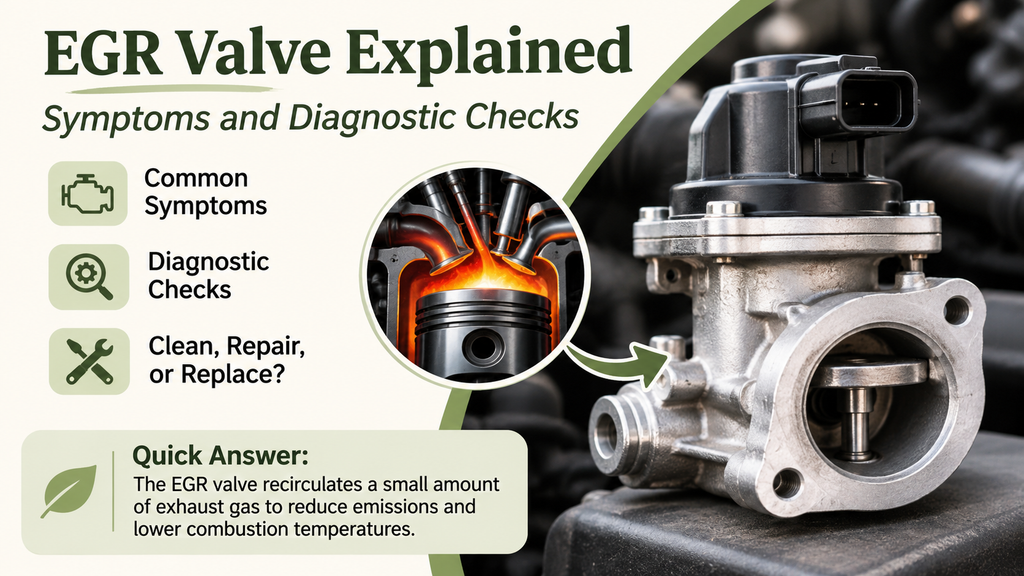
Quick Answer: What Is an EGR Valve?
An EGR (exhaust gas recirculation) valve controls the flow of exhaust gases back into an engine’s intake system. This helps reduce nitrogen oxide (NOx) emissions by lowering peak combustion temperatures. If the valve sticks open, fails to open when commanded, or cannot control flow correctly, the engine may develop rough running, hesitation, or emissions-related fault codes.
What Is an EGR Valve?
The EGR valve is part of a vehicle’s exhaust gas recirculation system. Its primary purpose is to help control nitrogen oxide emissions produced during combustion.
Nitrogen oxides form more readily when combustion temperatures are high. An EGR system introduces a carefully controlled amount of exhaust gas into the intake charge. Because this recycled gas contains less oxygen than fresh air and absorbs heat, it helps reduce peak combustion temperatures.
The valve acts as a flow-control device. Depending on engine design, it may be operated by engine vacuum, electronic actuators, or other control mechanisms. Some engines instead use internal EGR strategies through variable valve timing and may not have a conventional external EGR valve.
Key Takeaway
The EGR valve is an emissions-control component, not a device designed to increase horsepower. Correct operation depends on engine conditions, the valve mechanism, and the surrounding system.
How Does an EGR Valve Work?
In a typical external EGR system, exhaust gases are routed from the exhaust side of the engine back toward the intake system. The engine control module determines when and how much EGR flow is appropriate.
The exact strategy depends on engine speed, load, temperature, emissions requirements, and vehicle design. EGR is often limited or disabled during operating conditions where it could reduce combustion stability or maximum power.
- The engine produces exhaust gases. Combustion generates gases that normally travel through the exhaust system.
- The engine controller requests EGR flow. When conditions are suitable, the controller commands the EGR system to operate.
- The valve controls recirculation. A measured amount of exhaust passes into the intake path. Some designs use an EGR cooler.
- Exhaust gas mixes with the intake charge. The mixture can reduce peak combustion temperatures and help limit NOx formation.
- The system adjusts flow. The controller changes EGR operation as driving conditions change.
Gasoline vs. Diesel EGR Systems
Gasoline and diesel engines can both use EGR, but their control strategies and system components are not necessarily identical.
Diesel vehicles may use cooled EGR arrangements with additional piping and an EGR cooler. Some diesel engines also have more complex high-pressure or low-pressure EGR systems.
For this reason, a testing method that works on one vehicle may be incorrect for another. Always identify the engine and EGR design before performing an actuator test or removing parts.
Where Is the EGR Valve Located?
An EGR valve is commonly mounted on or near the engine, connected to the exhaust and intake flow paths. However, its location varies significantly between manufacturers and engines.
On some vehicles, it may be visible near the intake manifold or cylinder head. On others, it can be positioned behind the engine, beside an EGR cooler, or beneath other components.
Before searching for it, identify the vehicle’s year, make, model, engine, and emissions configuration. Use the appropriate factory service information to confirm its location.

Common Symptoms of a Bad EGR Valve
A malfunctioning EGR system can affect engine operation in several ways. The symptoms depend on whether exhaust gas is flowing when it should not, failing to flow when requested, or being controlled incorrectly.
None of the following symptoms confirms a failed EGR valve on its own. They should be treated as clues that help guide further inspection.
1. Rough Engine Idle
Excessive EGR flow at idle can disturb combustion, causing vibration, unstable engine speed, or rough running.
2. Engine Stalling
A valve stuck open may allow too much exhaust gas into the intake, potentially causing the engine to stall at low speed.
3. Poor Acceleration
Incorrect EGR flow may contribute to hesitation or reduced performance, although fuel and ignition problems can cause similar symptoms.
4. Check Engine Light
The engine controller may record an EGR-related diagnostic trouble code when flow or control does not match expected conditions.
5. Engine Knock or Ping
On certain gasoline engines, insufficient EGR under conditions where it is needed may contribute to abnormal combustion or pinging.
6. Reduced Fuel Economy
A malfunctioning EGR system may contribute to inefficient operation, but fuel economy changes alone are not reliable evidence of EGR failure.
Important Diagnostic Reminder
Rough idle, hesitation, and stalling can also result from vacuum leaks, intake restrictions, fuel-delivery problems, ignition faults, or sensor malfunctions. Do not purchase an EGR valve based on symptoms alone.
EGR Valve Stuck Open vs. Stuck Closed
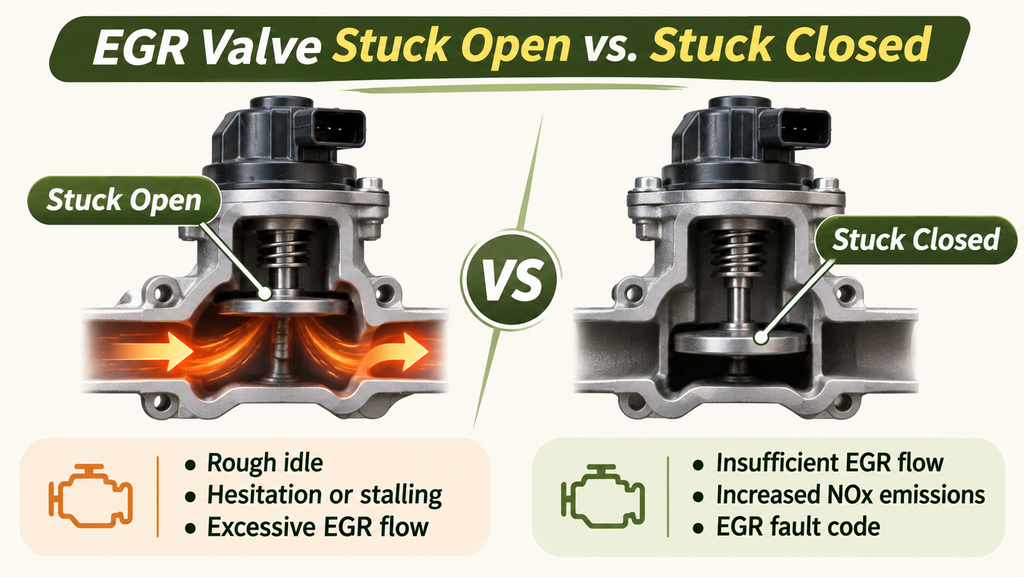
Two common EGR fault conditions are a valve that remains open when it should close and a valve that cannot deliver the expected exhaust flow.
| Condition | Possible Effects | Diagnostic Direction |
|---|---|---|
| Stuck Open | Rough idle, hesitation, stalling, or excessive EGR flow | Check valve seating, actuator operation, flow data, and control commands |
| Stuck Closed | Insufficient EGR flow, increased NOx emissions, or an EGR fault code | Check valve movement, restricted passages, electrical or vacuum controls |
| Intermittent Operation | Inconsistent performance or recurring warning lights | Inspect wiring, connectors, sensors, and operating conditions |
Importantly, insufficient EGR flow does not necessarily mean that the valve itself is stuck closed. Carbon-blocked passages, a faulty control component, or sensor problems can produce similar results.
What Causes an EGR Valve to Fail?
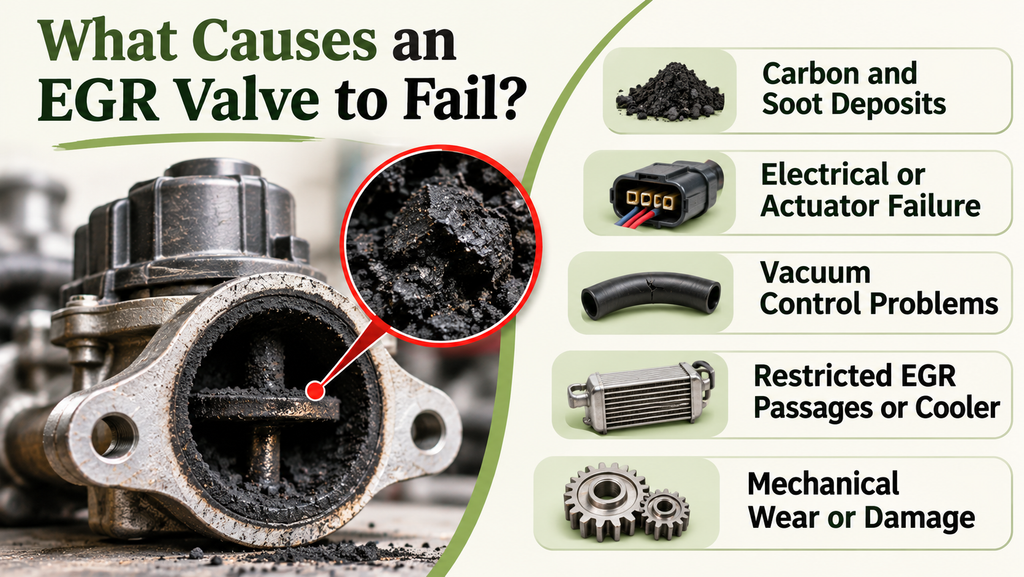
EGR systems operate in a demanding environment where heat, exhaust gases, and deposits can affect moving parts and flow passages.
Carbon and Soot Deposits
Deposits can accumulate on the valve or within nearby passages. Heavy buildup may restrict flow or interfere with valve movement. However, visible deposits alone do not necessarily prove that the valve is defective.
Electrical or Actuator Failure
Electronically controlled valves may develop motor, sensor, wiring, or connector faults. These failures may prevent the valve from responding to control commands.
Vacuum Control Problems
On vacuum-operated systems, damaged hoses, faulty solenoids, or insufficient control vacuum may prevent correct operation even when the EGR valve itself is functional.
Restricted EGR Passages or Cooler
Exhaust passages and EGR coolers can become restricted. An EGR-related fault code may appear even when the valve can still move normally.
Mechanical Wear or Damage
Internal components may wear, stick, or become damaged over time. Mechanical failure may require replacement when cleaning or an external repair cannot restore function.
Common EGR Valve Diagnostic Trouble Codes
An OBD-II scanner can reveal codes related to EGR flow, electrical control, or position-sensor performance. These codes identify the type of problem detected by the engine controller, not necessarily the exact failed component.
| Code | General Meaning | What to Investigate |
|---|---|---|
| P0400 | EGR flow malfunction | Overall EGR flow and control |
| P0401 | Insufficient EGR flow detected | Restricted passages, valve operation, sensors |
| P0402 | Excessive EGR flow detected | Valve seating, flow control, feedback |
| P0403 | EGR control circuit malfunction | Wiring, connectors, actuator or solenoid |
| P0404 | EGR control range/performance | Valve response and position feedback |
| P0405 | EGR sensor A circuit low | Sensor circuit and electrical signals |
| P0406 | EGR sensor A circuit high | Sensor circuit and electrical signals |
Code definitions and test conditions can vary by vehicle. Related EGR sensor or circuit codes may also be present. Use manufacturer-specific diagnostic information before interpreting detailed test values.
Example: Code P0401
P0401 indicates that the system detected insufficient exhaust-gas recirculation. Possible causes include restricted passages, incorrect valve operation, and control or sensor problems. Replacing the valve immediately is not a complete diagnostic strategy.
How to Diagnose an EGR Valve Problem
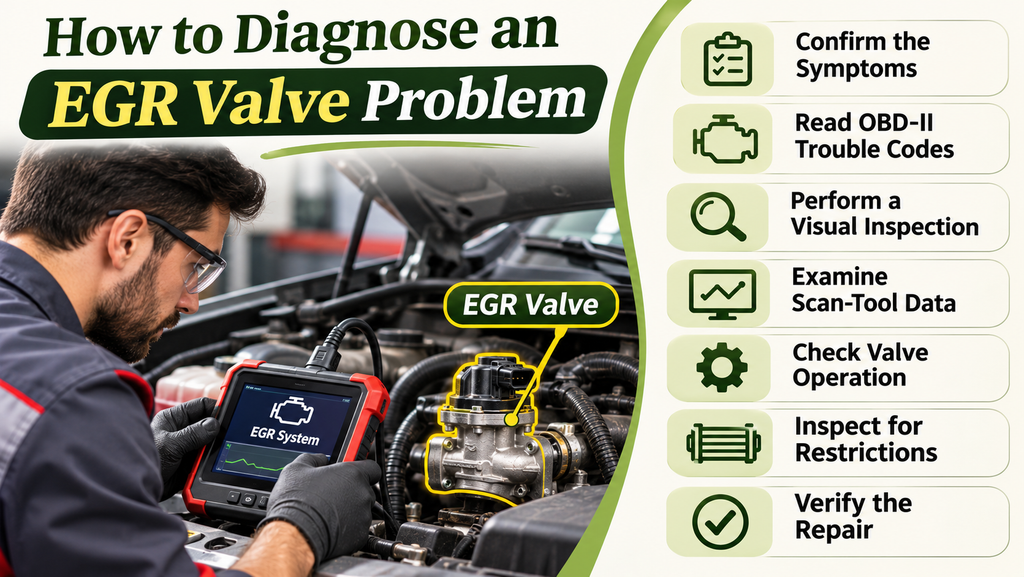
A reliable diagnosis starts with evidence. Confirm the symptoms, examine available fault information, and inspect the system before deciding which part needs attention.
Safety Before Testing
The EGR system is connected to extremely hot exhaust components. Allow the engine to cool before physical inspection. Keep hands, clothing, and tools away from belts, fans, and moving parts. Cooling fans may start unexpectedly. Perform engine-running tests only using the correct service procedure and suitable equipment.
Confirm the Symptoms
Record when the problem occurs: at idle, during acceleration, after the engine warms up, or under specific driving conditions.
Also note whether the check engine light is on and whether other engine symptoms occur at the same time.
Read OBD-II Trouble Codes
Connect a compatible scan tool and read stored, pending, and permanent codes where supported. Record the freeze-frame data associated with relevant faults.
Do not erase the codes before documenting the information. Doing so may remove useful diagnostic clues.
Perform a Visual Inspection
With the engine off and cool, inspect accessible EGR connectors, hoses, wiring, and surrounding components. Look for disconnected hoses, corrosion, loose connectors, and visible damage.
Do not disconnect hot exhaust fittings or remove components before reviewing the vehicle-specific procedure.
Examine Scan-Tool Data
If supported, compare commanded EGR operation with position or flow-related feedback during the operating conditions specified by the manufacturer.
Remember that reported EGR position does not always prove that the expected exhaust flow is occurring.
Check Valve Operation Correctly
Follow the factory diagnostic procedure for the particular EGR design. Some systems allow controlled actuator tests using a capable scan tool. Others require vacuum or electrical measurements.
Do not apply battery voltage or vacuum directly to an EGR component unless the service procedure specifically authorizes that test.
Inspect for Restrictions and Related Faults
If diagnostic evidence suggests insufficient flow, investigate restricted EGR passages, cooler problems where fitted, and other system components.
For electrical codes, use the correct wiring diagram and test specifications rather than assuming carbon deposits are the cause.
Verify the Repair
After correcting the confirmed problem, follow the manufacturer procedure for any required adaptation, relearn, fault-code clearing, and verification.
Confirm that the original symptoms are resolved and that applicable EGR monitors or test conditions complete successfully.
What If the EGR Valve Tests Normally?
A valve that responds correctly during testing may not be the cause of the fault. Further investigation may be necessary.
Depending on the vehicle and trouble code, a technician may need to check flow restrictions, sensors, wiring, intake leaks, or other emissions-system components. Some EGR faults only appear under particular temperature or load conditions.
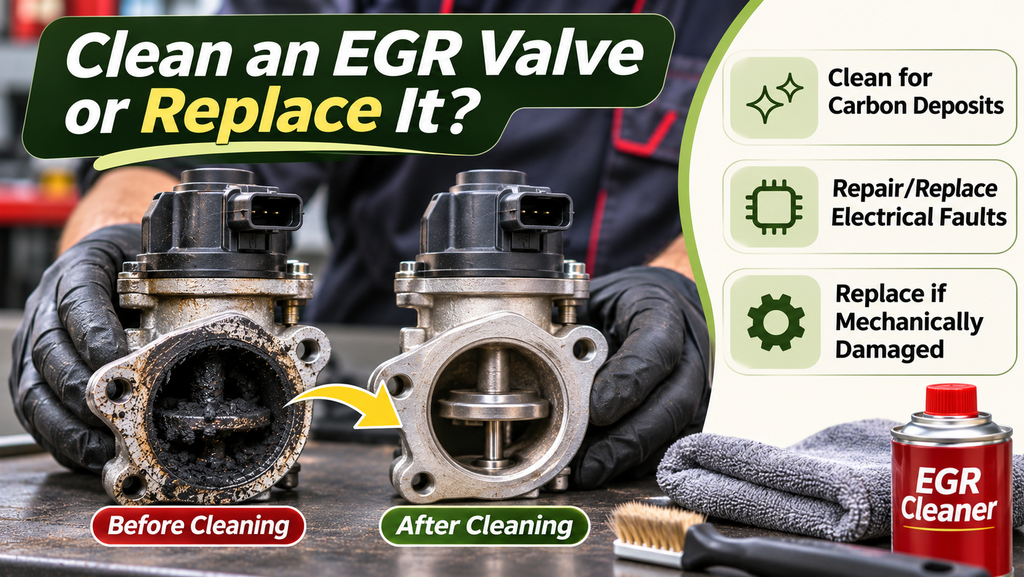
Can You Clean an EGR Valve Instead of Replacing It?
Cleaning may be appropriate when deposits are preventing otherwise functional components from operating correctly. However, it cannot repair damaged electronics, broken actuators, or severely worn internal mechanisms.
| Finding | Possible Approach |
|---|---|
| Carbon deposits restrict an accessible passage | Consider approved cleaning after confirming the restriction |
| Electrical actuator or position sensor has failed | Repair the relevant circuit or replace the failed component |
| Valve mechanism is damaged or excessively worn | Replacement may be necessary |
| Valve works but the system reports low flow | Investigate passages, cooler, and control or feedback components |
Important Precautions When Cleaning
- Follow the manufacturer procedure for removing and handling the valve.
- Use only cleaning products approved for the component and materials.
- Do not immerse an electrical actuator or sensor assembly in solvent.
- Prevent loosened carbon, tools, or debris from entering the engine.
- Replace seals or gaskets when required by the service instructions.
- Do not force an electronic valve open or damage its internal mechanism.
EGR Valve Replacement and Repair Cost
The cost of diagnosing or replacing an EGR valve varies widely by vehicle, engine design, component accessibility, labor rate, and whether related parts require attention.
A relatively accessible valve may take less labor to service than a valve integrated with a complex diesel EGR cooler assembly. Additional repairs to hoses, passages, wiring, or other components can increase the total cost.
What Affects the Final Repair Bill?
- Vehicle year, make, model, and engine
- Valve-only versus integrated EGR assemblies
- OEM and aftermarket part availability
- Required diagnostic labor
- Accessibility and disassembly requirements
- Gaskets, coolant, or additional related repairs
- Calibration or relearn requirements
Ask the shop for a written estimate separating diagnostic charges, parts, labor, and any recommended additional work.
A low-priced replacement valve is not necessarily the least expensive solution if a clogged passage or electrical fault is the true cause.
Can You Drive With a Bad EGR Valve?
Whether a vehicle can be driven temporarily depends on the symptoms and severity of the malfunction.
A vehicle with a steady check engine light and otherwise normal operation may be able to reach a repair facility, provided the owner’s manual does not advise otherwise. However, it should still be diagnosed promptly.
Stop Driving When Serious Symptoms Appear
Do not continue driving if the engine repeatedly stalls, loses power severely, overheats, makes abnormal knocking noises, or displays a flashing check engine light. Move to a safe location and arrange professional assistance.
A flashing check engine light can indicate an active misfire capable of damaging the catalytic converter. This warning should not be assumed to be an EGR-specific problem.
Should You Delete or Block the EGR Valve?
Removing, disabling, or blocking an emissions-control system is not a recommended repair. Such modifications may violate emissions laws applicable to vehicles operated on public roads and may create additional engine-management problems.
The appropriate approach is to restore the system to its intended operating condition using compatible parts and approved repair procedures.
How to Help Prevent EGR System Problems
EGR components operate in harsh conditions, and not every failure is preventable. However, good maintenance can help reduce avoidable engine and emissions-system problems.
- Follow the manufacturer’s oil, filter, and engine maintenance schedule.
- Diagnose recurring engine faults instead of repeatedly clearing codes.
- Address intake, fueling, and combustion problems when identified.
- Use the correct fuel and fluids specified for the vehicle.
- Have the EGR system inspected when symptoms or relevant fault codes appear.
- Avoid relying on fuel additives as a guaranteed solution for EGR deposits.
There is no universal EGR cleaning interval that applies to every engine. Follow the specific maintenance and service recommendations for your vehicle.
Frequently Asked Questions About EGR Valves
What does an EGR valve do?
An EGR valve regulates exhaust-gas recirculation into the intake system to help reduce peak combustion temperatures and nitrogen oxide emissions.
What are the most common symptoms of a bad EGR valve?
Possible symptoms include rough idle, stalling, hesitation, reduced performance, and a check engine light. These signs can also result from unrelated problems, so diagnosis is necessary.
Can a bad EGR valve cause rough idle?
Yes. Excessive exhaust-gas flow during idle can disturb combustion and cause unstable engine operation. However, other intake, ignition, or fueling issues can produce similar symptoms.
Can you clean an EGR valve without replacing it?
Sometimes. Cleaning may help when carbon deposits interfere with flow or movement. It will not repair failed electronics, damaged actuators, or worn mechanisms.
What does code P0401 mean?
P0401 generally means insufficient EGR flow was detected. Possible causes include restricted passages, valve-control faults, and sensor problems. It does not prove that the valve itself needs replacement.
What happens if an EGR valve is stuck open?
A valve stuck open may allow excessive exhaust gas into the intake, potentially causing rough idle, hesitation, stalling, or an excessive-flow fault. The exact effects vary by engine.
What happens if the EGR valve stays closed?
When EGR flow is required but unavailable, NOx emissions may increase and the engine controller may detect insufficient recirculation. Effects on performance depend on the engine and operating conditions.
Can a bad EGR valve cause a car to stall?
Yes, particularly if excessive EGR flow interferes with combustion at low speed. Fuel, ignition, or other engine-control problems must also be considered.
How do you test an EGR valve?
Start by reading diagnostic codes and inspecting accessible connections. Vehicle-specific testing may include scan-tool data, actuator commands, flow checks, or electrical measurements. Follow the manufacturer’s service procedure.
How much does EGR valve replacement cost?
Cost depends on the vehicle, valve design, accessibility, labor charges, and additional parts required. Obtain a vehicle-specific estimate after confirming the fault.
Can you drive with an EGR valve problem?
Some vehicles may remain drivable with mild symptoms, but serious stalling, overheating, severe power loss, abnormal knocking, or a flashing check engine light requires immediate attention. Follow the owner’s manual.
Do all cars have an EGR valve?
No. EGR designs vary, and some engines use internal exhaust-gas recirculation through valve-timing strategies rather than a separate conventional EGR valve.
Final Thoughts
The EGR valve plays an important role in controlling engine emissions. When the system malfunctions, drivers may experience rough running, hesitation, warning lights, or other symptoms. But those symptoms are not enough to identify the valve as the failed part.
The most useful approach is to read the trouble codes, inspect the system, verify valve operation, and rule out related faults before choosing a repair.
Cleaning may resolve certain deposit-related restrictions, while genuine mechanical or electronic failures may require replacement. For complicated systems, a qualified technician with manufacturer-specific diagnostic information is the safer choice.