The camshaft and crankshaft are two essential components inside an internal combustion engine. Although they perform different jobs, they must work together with precise timing to keep the engine running smoothly.
The crankshaft converts the up-and-down movement of the pistons into rotation, while the camshaft controls when the engine’s intake and exhaust valves open and close. A timing belt, timing chain, or gear system keeps these movements synchronized.
Understanding how the camshaft, crankshaft, and engine timing work together can help you recognize potential engine problems, make sense of repair recommendations, and better understand how your vehicle produces power.
Quick Answer
What is the difference between a camshaft and a crankshaft? The camshaft controls valve operation, allowing fresh air to enter the cylinders and exhaust gases to leave. The crankshaft converts piston movement into rotational power. In a conventional four-stroke engine, the crankshaft completes two revolutions for every one revolution of the camshaft.
What Is a Camshaft?
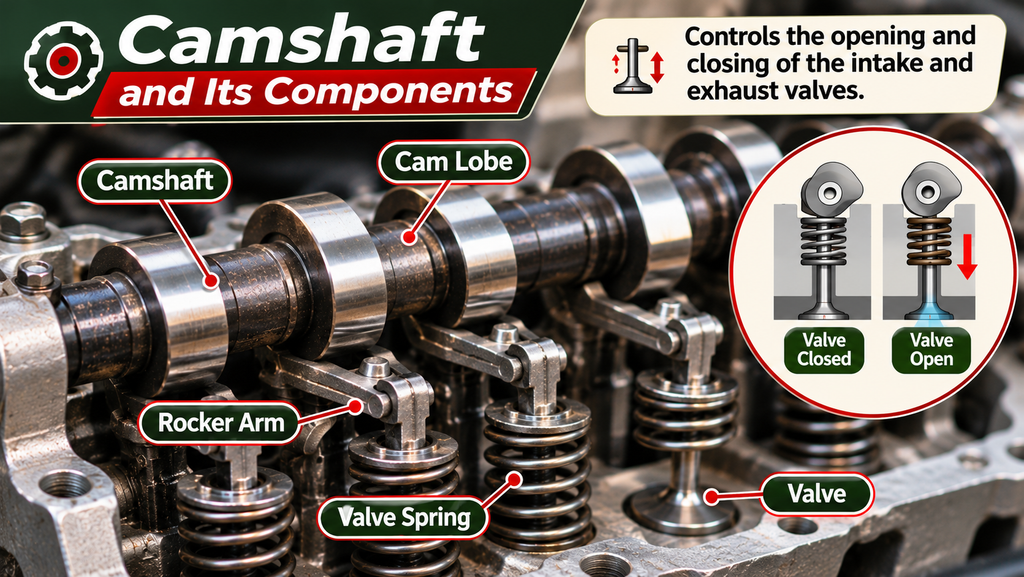
A camshaft is a rotating metal shaft fitted with specially shaped raised sections called cam lobes. Its primary purpose is to control the opening and closing of the intake and exhaust valves in an internal combustion engine.
These valves manage the movement of air into the engine and exhaust gases out of it. Without properly timed valve operation, the engine cannot efficiently complete its combustion cycle.
How Does a Camshaft Work?
As the camshaft rotates, each cam lobe pushes against a valve-train component, such as a follower, lifter, or rocker arm. This movement opens the corresponding valve against the force of its valve spring.
As the lobe rotates away, the valve spring returns the valve toward its closed position.
The shape and position of each cam lobe help determine three important aspects of valve operation:
- Valve timing: When the valve begins opening and finishes closing.
- Valve lift: How far the valve opens.
- Valve duration: How long the valve remains open, measured in degrees of rotation.
These factors affect engine breathing, efficiency, torque, and power delivery.
Where Is the Camshaft Located?
Camshaft location depends on the engine design. Two common arrangements are:
Overhead Camshaft (OHC)
In an overhead-cam engine, one or more camshafts are mounted in the cylinder head above the valves. Single overhead camshaft (SOHC) and dual overhead camshaft (DOHC) designs are common.
Overhead Valve (OHV)
In a traditional pushrod or overhead-valve engine, the camshaft is located inside the engine block. It operates the valves through lifters, pushrods, and rocker arms.
Why Is the Camshaft Important?
The camshaft influences when the engine can take in air and release exhaust gases. Correct valve operation supports efficient combustion and consistent engine performance.
An incorrectly timed camshaft may cause rough running, reduced power, or other problems, although these symptoms can have several possible causes.
What Is a Crankshaft?
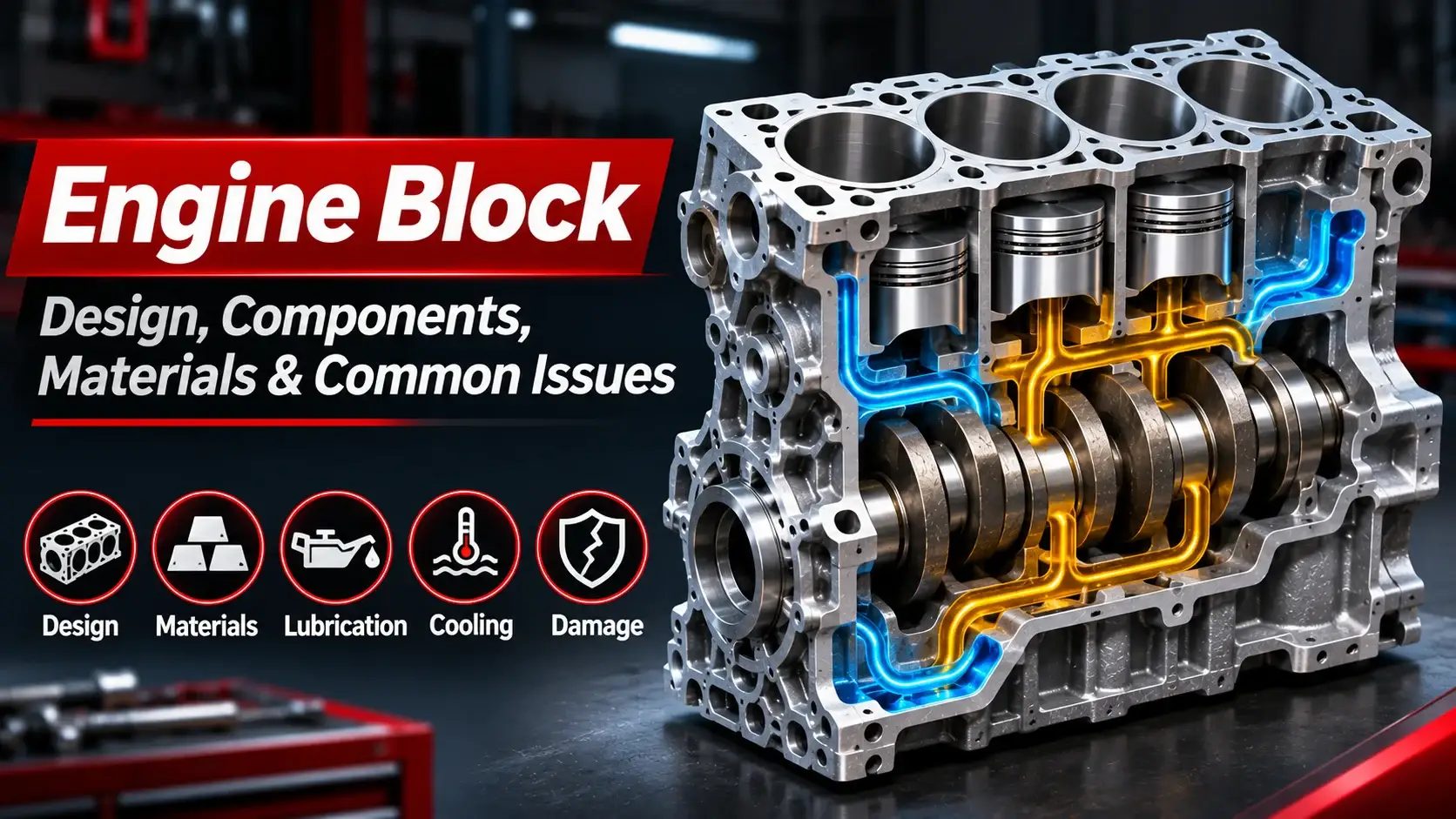
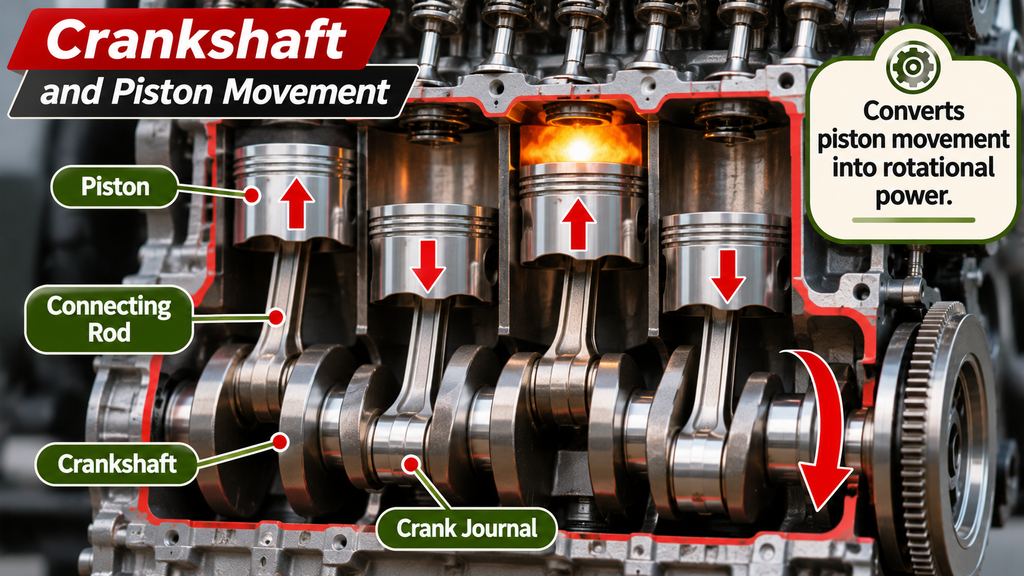
A crankshaft is a strong, precisely manufactured rotating shaft located in the lower portion of a typical piston engine. Its main job is to convert the pistons’ up-and-down movement into rotational motion that can ultimately help drive the vehicle.
Each piston connects to the crankshaft through a connecting rod. During the power stroke, expanding combustion gases push the piston downward, and the connecting rod applies force to an offset crankshaft journal, producing torque.
How Does a Crankshaft Work?
During the combustion process, pressure pushes a piston downward. Its connecting rod transfers the force to the crankshaft, making the shaft rotate.
Other cylinders’ power strokes, along with the rotating assembly’s momentum, help carry the engine through the remaining strokes.
The crankshaft connects to the flywheel or flexplate, which helps transfer torque through the transmission and into the drivetrain.
Main Parts of a Crankshaft
- Main journals: Bearing surfaces that support the crankshaft inside the engine block.
- Crankpins: Offset journals that connect to the connecting rods.
- Counterweights: Help balance rotating and reciprocating forces.
- Oil passages: Carry pressurized engine oil to important bearing surfaces in many designs.
- Front and rear ends: Accommodate components such as the timing drive, pulley, flywheel, or flexplate.
Where Is the Crankshaft Located?
In a conventional automotive piston engine, the crankshaft sits within the engine block or crankcase, below the cylinders. Its main bearings support it while allowing it to rotate.
The crankshaft is built to handle substantial combustion forces, but proper lubrication is essential. Oil starvation or bearing damage can lead to serious engine problems.
Camshaft vs Crankshaft: Key Differences
The easiest way to understand the difference is to remember that the camshaft manages valve operation, while the crankshaft manages piston-to-rotational movement.
| Feature | Camshaft | Crankshaft |
|---|---|---|
| Main function | Controls engine valves | Converts piston movement into rotation |
| Typical location | Cylinder head or engine block | Lower engine block or crankcase |
| Connected components | Valve-train components | Connecting rods and pistons |
| Rotation in a four-stroke engine | One revolution per complete cycle | Two revolutions per complete cycle |
| Major mechanical features | Cam lobes and journals | Crankpins, main journals, and counterweights |
| Primary role | Coordinates gas exchange | Produces rotational torque |
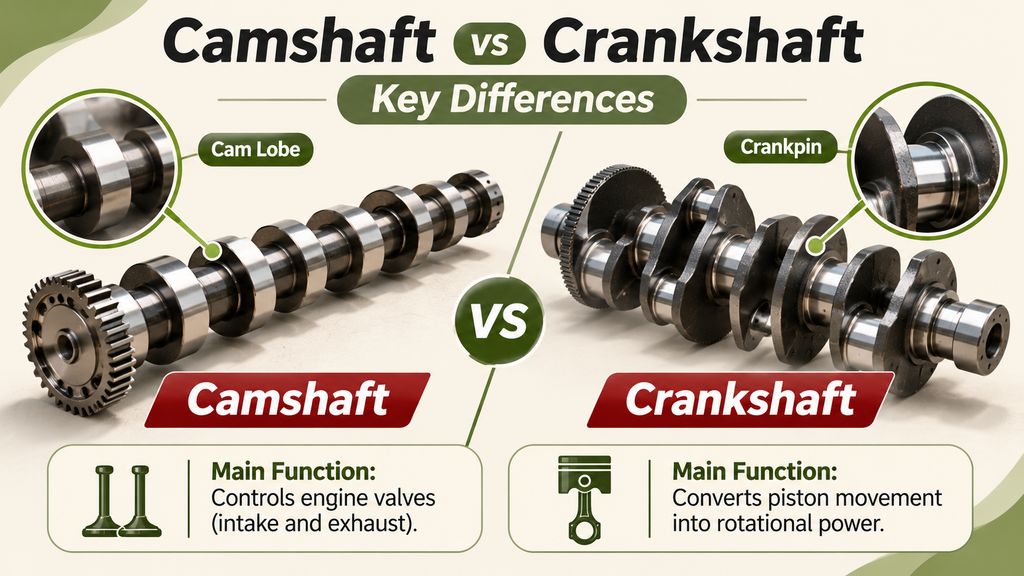
Simple way to remember: The crankshaft follows piston movement and delivers rotation. The camshaft uses synchronized rotation to operate the valves at the correct points in the engine cycle.
How Do the Camshaft and Crankshaft Work Together?
The camshaft and crankshaft perform different mechanical functions, but their positions must remain synchronized for the engine to work correctly.
The crankshaft determines where the pistons are in their travel. The camshaft operates the valves according to those piston positions.
A mechanical timing drive links the two shafts. Depending on the engine, this connection may use a toothed timing belt, metal timing chain, or timing gears.
Why Does the Crankshaft Rotate Twice as Fast?
A conventional four-stroke engine completes its operating cycle through four piston strokes:
- Intake
- Compression
- Power
- Exhaust
Each stroke requires half a crankshaft revolution. Therefore, one complete four-stroke cycle requires 720 degrees of crankshaft rotation, equal to two full revolutions.
The camshaft completes one full revolution during that same cycle, allowing each valve to operate according to its required timing.
Crankshaft
2 complete revolutions = 720° during one four-stroke cycle.
Camshaft
1 complete revolution = 360° during the same cycle.
This mechanical relationship is critical. If the shafts lose their correct alignment, the valves may open or close at the wrong point in the piston’s travel.
What Is Engine Timing and How Does It Work?
Engine timing refers to the coordination of important events during the combustion cycle, including piston movement, valve opening and closing, and the timing of ignition or fuel injection.
When discussing the camshaft and crankshaft, the most relevant type is valve timing, which describes when the intake and exhaust valves open and close relative to crankshaft position.
The Four-Stroke Engine Cycle Explained
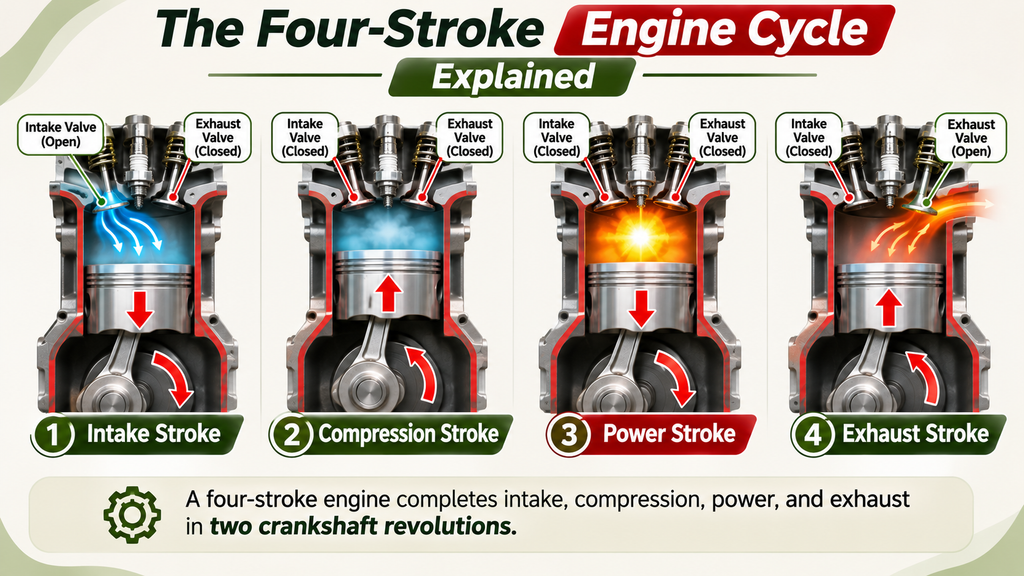
1. Intake Stroke
The piston moves downward from near top dead center (TDC) toward bottom dead center (BDC). The intake valve is open during the principal intake period, allowing fresh air, or an air-fuel mixture depending on the fuel system, to enter the cylinder.
2. Compression Stroke
The piston moves upward, compressing the cylinder charge. Both the intake and exhaust valves are normally closed through most of this stroke.
Compression prepares the mixture for combustion in a gasoline engine.
3. Power Stroke
Near the end of the compression stroke, the spark plug ignites the mixture in a typical gasoline engine. Expanding gases push the piston downward, transferring force through the connecting rod to the crankshaft.
Diesel engines use compression ignition instead of a spark plug.
4. Exhaust Stroke
The piston travels upward as the exhaust valve opens, helping push burned gases out of the cylinder through the exhaust system.
After the exhaust process, the cycle repeats.
Important: This is a simplified description of the four strokes. Actual valve opening and closing events may occur slightly before or after the piston reaches top or bottom dead center. Their precise timing depends on engine design and operating conditions.
What Happens at Top Dead Center?
Top dead center is the highest position a piston reaches in its cylinder. Bottom dead center is its lowest position.
In a four-stroke engine, a piston reaches top dead center twice during a complete cycle: once near the end of compression and once near the transition between exhaust and intake.
The camshaft’s position helps determine which valves should be operating at each point.
Valve Timing vs Ignition Timing
Although the terms sound similar, valve timing and ignition timing refer to different processes.
- Valve timing: Controls when intake and exhaust valves open and close.
- Ignition timing: Controls when a spark occurs relative to piston and crankshaft position in a spark-ignition engine.
Both influence engine performance, but a problem in one system does not automatically mean the other is faulty.
Timing Belt vs Timing Chain: How Are the Shafts Connected?
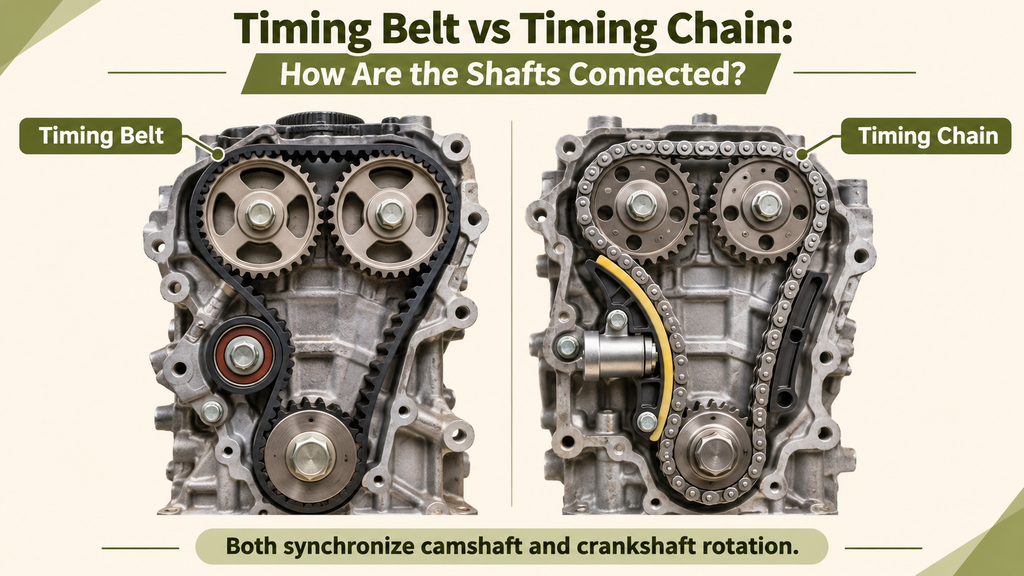
Many automotive engines use either a timing belt or a timing chain to maintain the correct rotational relationship between the crankshaft and camshaft.
Both systems perform the same essential task, but they differ in construction, service requirements, and operating characteristics.
What Is a Timing Belt?
A timing belt is a reinforced toothed belt that connects the crankshaft and camshaft timing pulleys. Its teeth engage with the pulleys to maintain correct synchronization without normal slippage.
Many timing belt systems require replacement at manufacturer-specified intervals. The correct interval depends on the vehicle, engine, operating conditions, and service schedule.
What Is a Timing Chain?
A timing chain is a metal chain that runs around timing sprockets. It operates with guides and tensioners that control chain movement and maintain proper tension.
Timing chains are often designed for long service life, but they are not maintenance-free. Chain wear, tensioner problems, or guide damage can eventually affect timing accuracy.
Timing Belt vs Timing Chain Comparison
| Feature | Timing Belt | Timing Chain |
|---|---|---|
| Construction | Reinforced toothed belt | Metal chain |
| Lubrication | Usually operates dry; some designs are oil-wetted | Generally lubricated by engine oil |
| Service interval | Often scheduled for replacement | Frequently condition-dependent |
| Common issues | Age, wear, contamination, tension problems | Wear, tensioner failure, guide damage |
| Failure consequences | Potential loss of timing and engine damage | Potential loss of timing and engine damage |
Some engines use timing gears instead. Regardless of the system, the goal is to maintain the required camshaft-to-crankshaft relationship.
What Is Variable Valve Timing?
Many modern engines use variable valve timing (VVT) to adjust when certain valves open and close under different operating conditions.
A conventional fixed-timing engine uses valve events determined by its camshaft geometry and installed timing position. A variable valve timing system can adjust the camshaft’s phase relative to the crankshaft, changing the opening and closing points.
Some advanced systems can also vary valve lift or duration using additional mechanisms.
How Does Variable Valve Timing Help?
Depending on the engine design, VVT can improve:
- Low-speed torque.
- High-speed power delivery.
- Fuel efficiency under certain conditions.
- Emissions control.
- Overall engine flexibility across different RPM ranges.
Engine oil pressure, electronically controlled actuators, and camshaft phasers are commonly involved in hydraulic VVT systems.
Because of this, incorrect oil level, unsuitable oil viscosity, or internal oil-flow problems may affect VVT operation on some engines.
Key distinction: Variable valve timing changes the valve event positions within the system’s designed operating range. It does not mean the crankshaft and camshaft are allowed to become mechanically unsynchronized.
What Happens When Engine Timing Is Incorrect?
Incorrect engine timing occurs when valve events no longer match the intended crankshaft and piston positions.
Possible causes include a timing belt that has jumped teeth, a stretched or worn chain assembly, faulty tensioners, incorrectly installed timing components, or problems with a variable valve timing mechanism.
The consequences depend on how far the timing is out of specification and on the engine’s mechanical design.
Common Symptoms of Engine Timing Problems
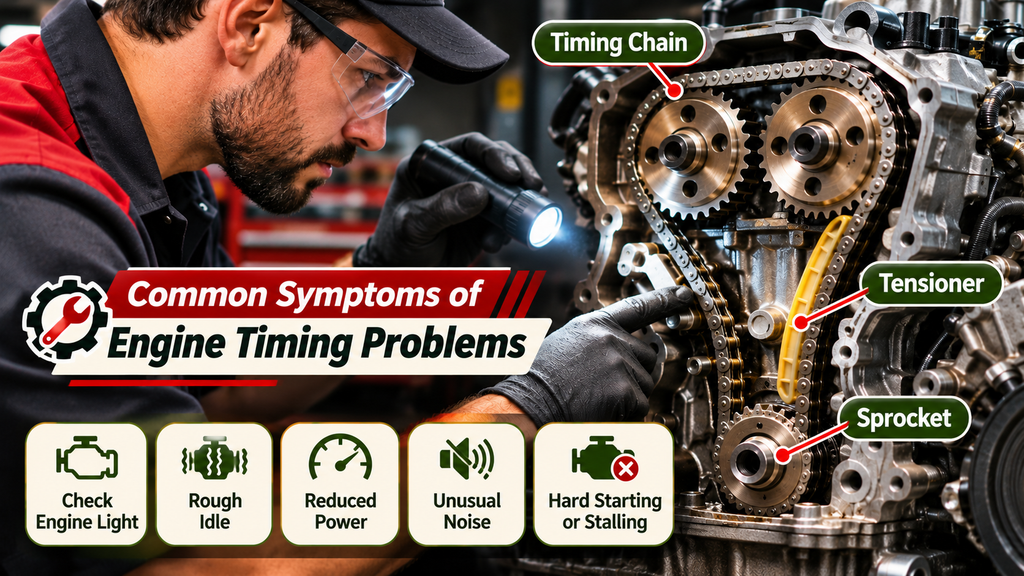
1. Rough Engine Idle
Incorrect valve timing can disrupt cylinder filling and combustion, causing unstable idle or vibration.
However, spark plugs, fuel delivery problems, intake leaks, and other faults can cause similar symptoms.
2. Reduced Engine Power
If the valves open or close at inappropriate times, the engine may have difficulty moving air efficiently. This can reduce torque, throttle response, and overall power.
3. Check Engine Light
Modern engine computers monitor crankshaft and camshaft signals. Certain diagnostic trouble codes, such as P0016 on applicable vehicles, can indicate a camshaft-to-crankshaft position correlation problem.
A correlation code is a diagnostic clue, not proof that the timing chain or belt has failed.
4. Unusual Engine Noise
Worn timing chains, guides, or tensioners may produce rattling noises, sometimes especially during startup.
Noise location and timing can vary, and other engine components may create similar sounds.
5. Engine Misfires or Stalling
Severely incorrect valve timing can interfere with normal combustion and cause misfires, difficult starting, or stalling.
These symptoms should be investigated rather than immediately attributed to a camshaft or crankshaft fault.
6. Engine Will Not Start
A broken timing belt, failed chain, or significant loss of synchronization can prevent an engine from starting.
A no-start condition has many possible causes, so further testing is necessary.
Can Incorrect Timing Damage an Engine?
Yes. In an interference engine, the pistons and valves occupy overlapping areas at different times during normal operation.
Correct timing prevents them from colliding. If mechanical timing fails severely enough, a piston may contact an open valve, potentially causing bent valves, piston damage, or other internal engine damage.
A non-interference engine is generally designed to avoid this type of piston-to-valve contact, although timing failure can still stop the engine and lead to repairs.
Safety warning: If a timing belt or chain failure is suspected, avoid repeatedly cranking or attempting to start the engine. Further movement may increase damage in some engine designs. Have the timing system inspected using the vehicle manufacturer’s procedures.
How Is Incorrect Engine Timing Diagnosed?
A qualified technician generally begins by checking symptoms, fault codes, service history, and the engine manufacturer’s diagnostic procedures.
Depending on the vehicle, the technician may:
- Scan the engine control module for diagnostic trouble codes.
- Review camshaft and crankshaft position data.
- Check engine oil level and condition where VVT operation may be involved.
- Inspect accessible timing-related components for wear or damage.
- Verify mechanical timing alignment using model-specific tools and instructions when indicated.
- Perform additional tests to distinguish sensor, wiring, actuator, and mechanical faults.
Not every diagnostic step is necessary for every vehicle. A technician should follow the appropriate service information rather than replacing parts based only on a code description.
How to Prevent Camshaft, Crankshaft, and Engine Timing Problems
Camshafts, crankshafts, and timing components are designed for demanding operating conditions. However, maintenance and early attention to symptoms can help reduce avoidable problems.
1. Follow the Manufacturer’s Maintenance Schedule
If your engine has a timing belt with a specified replacement interval, follow the schedule in the owner’s manual or official service information.
Do not assume that every timing chain requires routine replacement or that every chain will last for the entire life of the vehicle.
2. Maintain the Correct Engine Oil
Use the oil viscosity and specifications recommended for your engine. Proper lubrication helps protect camshaft bearings, crankshaft bearings, and oil-dependent timing mechanisms.
Regular oil changes are particularly important for engines with oil-operated VVT systems and hydraulic chain tensioners.
3. Investigate Unusual Engine Noises
New rattling, knocking, or persistent ticking noises deserve attention, especially when accompanied by warning lights or changes in engine performance.
Not every unusual noise originates from the timing system.
4. Address Check Engine Lights
A check engine light should be diagnosed using appropriate diagnostic equipment. Avoid assuming that a stored sensor or correlation code identifies the exact failed component.
5. Use Correct Procedures During Timing Repairs
Camshaft and crankshaft timing procedures can require special locking tools, precise torque specifications, and model-specific alignment methods.
Incorrect assembly may result in poor running or serious internal damage. Advanced timing repairs are generally best handled by technicians with the necessary tools and experience.
Maintenance takeaway: The most useful starting point is your vehicle’s exact year, make, model, engine, and official maintenance schedule. Timing system designs and service requirements can differ substantially between engines.
Frequently Asked Questions
What is the main difference between a camshaft and a crankshaft?
The camshaft operates the engine’s intake and exhaust valves. The crankshaft converts piston movement into rotation. They perform different jobs but must remain synchronized.
Does the camshaft control engine speed?
The camshaft influences engine breathing and the RPM range where an engine performs efficiently. It does not directly set engine speed. Engine RPM depends on operating conditions, load, and engine management.
Does the crankshaft turn the camshaft?
Yes. In a conventional automotive piston engine, the crankshaft drives the camshaft through a timing belt, chain, or gear arrangement.
How many times does the camshaft rotate for every crankshaft revolution?
In a conventional four-stroke engine, the camshaft rotates once for every two crankshaft revolutions. This is a 2:1 crankshaft-to-camshaft speed relationship.
Can an engine run with a broken camshaft?
A broken camshaft can prevent proper valve operation and cause severe engine problems. Many engines will stop running or fail to start. Attempting to operate an engine with suspected internal damage is unsafe.
Can a bad crankshaft cause engine knocking?
Damage to crankshaft journals or associated bearings can contribute to knocking noises. However, knocking can have many causes, so the crankshaft should not be blamed without inspection.
What happens if the camshaft and crankshaft are out of sync?
Incorrect synchronization can lead to rough running, reduced power, misfires, a no-start condition, or internal engine damage. The severity depends on the engine design and amount of timing error.
Is a camshaft position sensor the same as a camshaft?
No. The camshaft is a mechanical shaft that operates the valves. The camshaft position sensor is an electronic component that detects camshaft position for the engine control system.
Is a crankshaft position sensor the same as a crankshaft?
No. The crankshaft is a rotating mechanical component connected to the pistons. The crankshaft position sensor monitors its position and rotational speed.
Which is better, a timing belt or a timing chain?
Neither is universally better. Timing belts commonly have scheduled replacement requirements, while timing chains are often designed for longer service life. Reliability and maintenance depend on the specific engine and system design.
Can incorrect engine timing damage valves?
Yes. In an interference engine, sufficiently incorrect valve timing may allow pistons to contact open valves, potentially bending or damaging them.
What is the difference between valve timing and ignition timing?
Valve timing determines when the intake and exhaust valves operate. Ignition timing determines when a spark occurs in a spark-ignition engine relative to crankshaft position.
Final Thoughts: Why Camshaft and Crankshaft Timing Matters
The camshaft, crankshaft, and timing system work together to keep an internal combustion engine operating correctly.
The crankshaft transforms piston movement into rotational power, while the camshaft operates the valves so the cylinders can take in air and release exhaust gases at the intended times.
The timing belt, chain, or gear drive maintains their mechanical relationship. In a conventional four-stroke engine, the crankshaft turns twice for every camshaft revolution.
Understanding these basic functions makes it easier to recognize why proper engine timing is important. If your vehicle develops unusual noises, a check engine light, or persistent running problems, use the manufacturer’s service guidance and obtain a reliable diagnosis before authorizing major repairs.