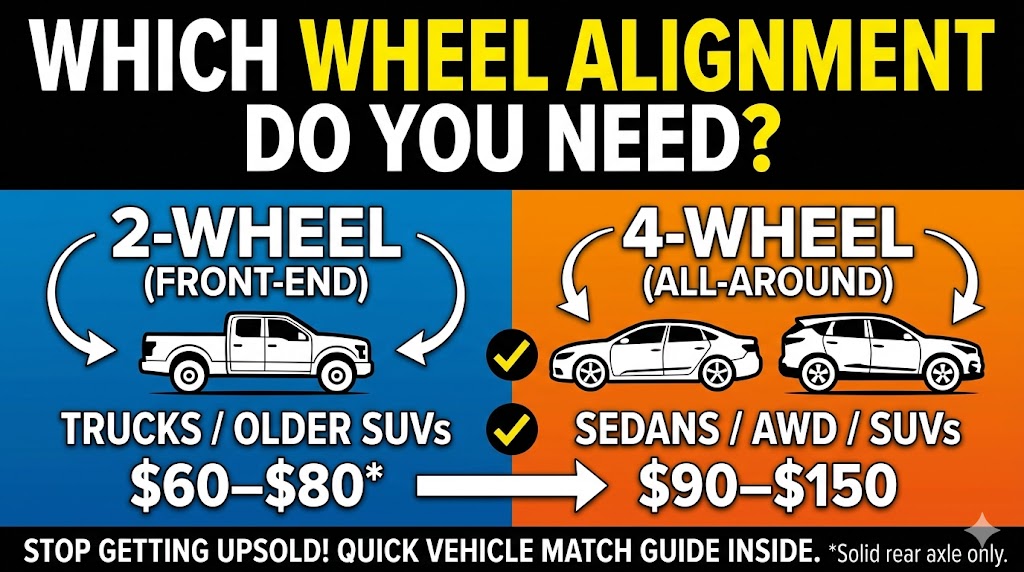

Not sure which alignment you need? Match your vehicle below.
*”Thrust angle” means sensors go on all 4 wheels for measurement, but only the fronts are physically adjusted.
📋 In This Article
1 What Is a Wheel Alignment, Really?
A wheel alignment is not about your wheels or tires — it’s about adjusting the suspension components that connect your wheels to the vehicle. The goal is to ensure all tires point in the exact direction the manufacturer intended.
Three angles are measured and adjusted during an alignment:
Camber
The inward or outward tilt of the tire when viewed from the front. Incorrect camber causes uneven wear on the inside or outside edge.
Toe
Whether tires point inward (toe-in) or outward (toe-out) when viewed from above. The #1 cause of premature tire wear.
Caster
The angle of the steering axis. Affects steering stability and return-to-center feel. Only adjusted on front wheels.
Understanding these three angles is the key to understanding why some vehicles need all four wheels adjusted — and others don’t.
2 The 2-Wheel (Front-End) Alignment Explained
A 2-wheel alignment adjusts only the front axle. The technician measures and corrects camber, toe, and caster on the two front wheels. The rear wheels are left untouched.
✓ A 2-Wheel Alignment Is Right For You If:
- ✓ Your vehicle has a solid rear axle (most pickup trucks, older SUVs)
- ✓ Your rear suspension has no adjustable components
- ✓ A technician has confirmed the rear wheels are within factory spec
“About 40% of the trucks I see don’t have adjustable rear suspension. For those vehicles, a 2-wheel alignment with a thrust angle check is the correct service — not a 4-wheel. Any shop telling you different is either misinformed or upselling.”
3 The 4-Wheel Alignment Explained
A 4-wheel alignment adjusts all four corners of the vehicle. The technician measures and corrects camber and toe on both the front and rear axles. This is only possible when the vehicle has independent rear suspension — meaning each rear wheel moves independently on its own set of control arms and linkages.
✓ A 4-Wheel Alignment Is Right For You If:
- ✓ You drive a modern sedan, hatchback, or crossover (2000+)
- ✓ Your vehicle has independent rear suspension (most cars today)
- ✓ You drive an AWD or 4WD vehicle with independent suspension
- ✓ You recently hit a pothole or curb hard enough to feel the impact
Here’s the key fact: If you drive a 2015+ Honda Accord, Hyundai Elantra, Toyota Camry, or virtually any modern front-wheel-drive sedan — your car has independent rear suspension. The mechanic is not scamming you. The 4-wheel alignment is the correct service for your vehicle.
Budget Tip
If cost is a concern, ask the shop to show you the alignment printout before any work is done. If all four wheels are within factory spec, you may not need an alignment at all — even with new tires. A reputable shop will show you the numbers.
4 Solid Axle vs. Independent Suspension
For Truck & SUV Owners
This is where the confusion lives — and where a lot of money gets wasted. Here’s the mechanical reality:
Solid Rear Axle
Both rear wheels are connected by a single rigid beam (the axle housing). One wheel cannot move independently of the other.
Common Vehicles:
Ford F-150 (pre-2021 rear), Chevy Silverado, RAM 1500, Toyota Tacoma, Jeep Wrangler, Ford Ranger
Independent Rear Suspension
Each rear wheel is mounted on its own set of control arms and linkages. Each wheel can move and be adjusted independently.
Common Vehicles:
Honda Accord, Toyota Camry, Subaru Outback, Toyota RAV4, Hyundai Tucson, most modern sedans & crossovers
Here’s the bottom line: Your buddy was right — and wrong. He’s right that the rear wheels on your truck cannot be adjusted. But he’s wrong to imply the rear wheels don’t matter. The shop still needs to put sensors on the rear to measure the thrust angle (explained next), which ensures the fronts are aligned relative to where the rears are actually pointing.
5 What Is a Thrust Angle Alignment?
This is the service your truck actually gets — even if the invoice says “2-wheel alignment.”
Thrust Angle, Simplified
Imagine drawing an invisible line from the center of the rear axle straight forward. That line is the thrust line. Ideally, it should perfectly match the vehicle’s centerline.
•
If the thrust line is off (even by a fraction of a degree), the front wheels must be adjusted to compensate — otherwise the car will “crab walk” slightly to one side.
When you take your truck in for a “2-wheel alignment,” a competent shop will:
- Mount sensors on all four wheels — this doesn’t mean they’re adjusting all four
- Measure the thrust angle from the rear axle
- Adjust the front wheels relative to the thrust line, not just the centerline
This is why the service may be called a “thrust angle alignment” on your receipt. It’s the mechanically correct procedure for solid-axle vehicles.
! AWD & 4WD Owners: Read This Carefully
Critical Warning for AWD Vehicles
If you drive a modern AWD crossover or SUV with independent rear suspension, a 4-wheel alignment is not optional — it is mandatory.
Here’s what happens when rear wheels are misaligned on an AWD vehicle:
Tire scrubbing: Misaligned rear wheels fight against the front wheels. Each tire is being dragged slightly sideways with every rotation, causing rapid and uneven tire wear.
Drivetrain stress: AWD systems rely on all four wheels rotating at precisely matched speeds. Misalignment creates constant micro-corrections in the center differential and coupling, generating heat and premature wear.
Expensive damage: A center differential replacement on a Subaru Outback runs $2,500–$4,000. A transfer case replacement on a Toyota RAV4 can exceed $3,000. A 4-wheel alignment costs $100–$150.
Here’s your answer: After hitting that pothole, a 4-wheel alignment is absolutely the right call. The crooked steering wheel means something shifted. On your AWD vehicle, even a half-degree of misalignment in the rear can cascade into tire and drivetrain problems that cost 20–30x more than the alignment itself.
Warranty Note
Most manufacturers require alignment checks after pothole impacts to maintain powertrain warranty coverage. Keep your alignment printout as documentation — it shows the shop measured all four wheels and corrected them to factory spec.
7 Is the Shop Upselling You? How to Tell
Not every recommendation is an upsell. Here’s how to tell the difference:
Red Flag: Likely an Upsell
“You need a 4-wheel alignment” — but you drive a truck with a solid rear axle. The rear literally cannot be adjusted. Ask them what specifically they would adjust on the rear.
Green Flag: Legitimate Recommendation
“You need a 4-wheel alignment” — and you drive a modern sedan, crossover, or AWD vehicle with independent rear suspension. This is the correct service for your car.
The Magic Question to Ask
“Does my vehicle have adjustable rear suspension components?” If yes → 4-wheel. If no → 2-wheel with thrust angle. Any honest tech will answer this in 5 seconds.
8 Frequently Asked Questions
Know What You Need. Get It Done Right.
Print this article or save it to your phone. Show the cheat sheet to your service advisor so you’re both on the same page — literally.
About This Article
Author Qualifications
Written by an ASE Certified Master Technician with 18 years of hands-on experience in wheel alignment and suspension repair at both independent and national chain shops.
Editorial Standards
This article contains no affiliate links, sponsored content, or paid recommendations. All cost estimates reflect 2025 national averages from RepairPal and AAA data.
Sources: National Institute for Automotive Service Excellence (ASE) · Tire Industry Association (TIA) · Hunter Engineering Technical Bulletins · OEM Service Manuals (Toyota, Honda, Subaru, Ford, GM)