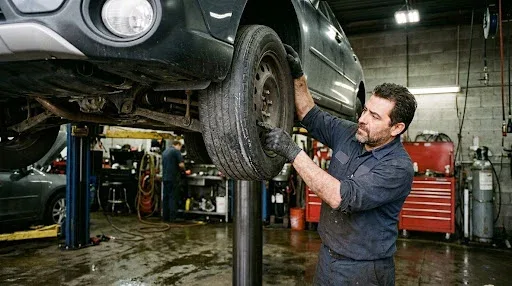

A plain-English guide to the heavy metal bar that makes your car actually move — no engineering degree required.
⚡ Quick Answer
A crankshaft is a long, heavy metal bar at the bottom of your engine that converts the up-and-down pumping of the pistons into the spinning motion that ultimately turns your wheels. Think of it like bicycle pedals turning your leg power into wheel rotation.
Crankshaft Definition — In Plain English
A crankshaft is a rotating shaft inside your engine that transforms the linear (up-and-down) motion of the pistons into rotational (spinning) motion. That rotational motion is what eventually reaches your wheels and moves your car forward.
It’s typically made from forged steel or cast iron, and it’s one of the heaviest single parts in your engine. Every internal combustion engine — whether it’s a tiny 3-cylinder or a massive V8 — has exactly one crankshaft.
The Bicycle Analogy (The Easiest Way to Understand It)
Imagine you’re riding a bicycle. Your legs pump up and down on the pedals — that’s linear motion, just like your engine’s pistons. The pedal crank (that metal arm the pedal is attached to) converts your leg pumps into a spinning motion that turns the chain and moves the bike forward.
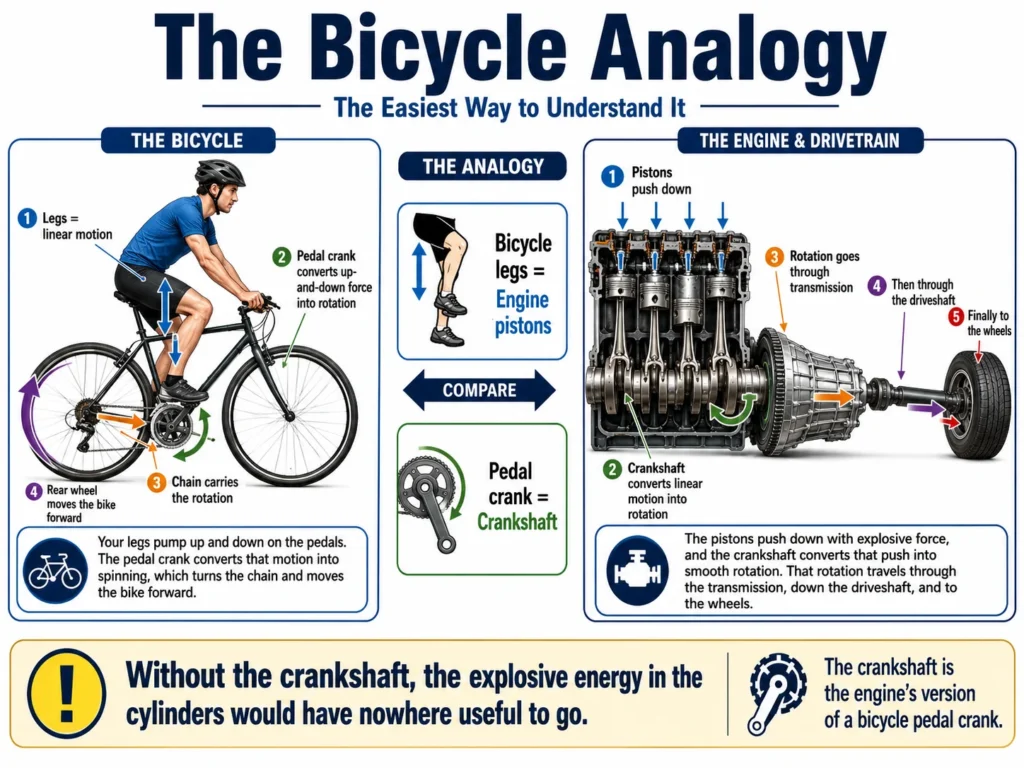
Your car’s crankshaft works the exact same way. The pistons (your “legs”) push down with explosive force, and the crankshaft (the “pedal crank”) converts that push into smooth rotation.
That rotation travels through the transmission, down the driveshaft, and finally to your wheels. Without the crankshaft, all that explosive energy in your cylinders would have nowhere useful to go.
Where Does the Crankshaft Live? (Engine Diagram)
The crankshaft sits at the very bottom of your engine block, in an area mechanics call the “crankcase.” It runs the full length of the engine, with each piston connected to it via a connecting rod.
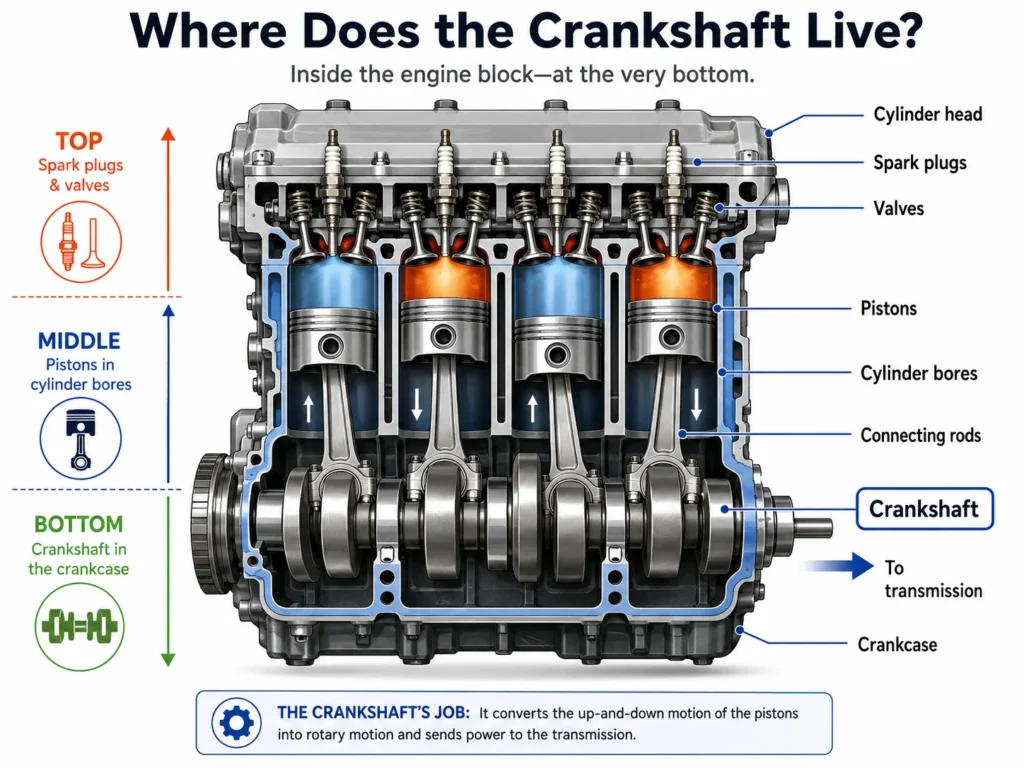
Here’s the layout from top to bottom: spark plugs and valves sit at the top (cylinder head), pistons move up and down in the middle (cylinder bores), and the crankshaft spins at the bottom, collecting all that piston energy and sending it to the transmission.
Key Parts of a Crankshaft (Explained Simply)
A crankshaft looks complicated, but it only has a few key areas you need to know about:
Main Journals
The smooth, cylindrical sections that sit in bearings and allow the crankshaft to spin freely. Think of them as the axle points — they hold the shaft in place while letting it rotate.
Rod Journals (Crank Pins)
These are the offset sections where the connecting rods attach. Because they’re off-center from the main axis, the piston’s push creates the turning force (torque).
Counterweights
Heavy lumps of metal on the opposite side of each crank pin. They balance out the weight of the pistons and rods so the engine doesn’t vibrate itself apart at high speeds.
Flywheel Flange
The flat end of the crankshaft where the heavy flywheel bolts on. The flywheel smooths out the power delivery and connects to your clutch or torque converter.
How the Crankshaft Works (Step by Step)
Here’s what happens thousands of times per minute while your engine is running:
- Fuel and air ignite inside a cylinder, creating an explosion that forces the piston downward with tremendous force.
- The piston is connected to the crankshaft via a connecting rod. As the piston pushes down, it pushes the connecting rod, which pushes on the offset crank pin.
- Because the crank pin is offset from the center, that downward push creates a turning force — converting linear motion into rotation.
- Multiple pistons fire in sequence (not all at once), keeping the crankshaft spinning smoothly and continuously.
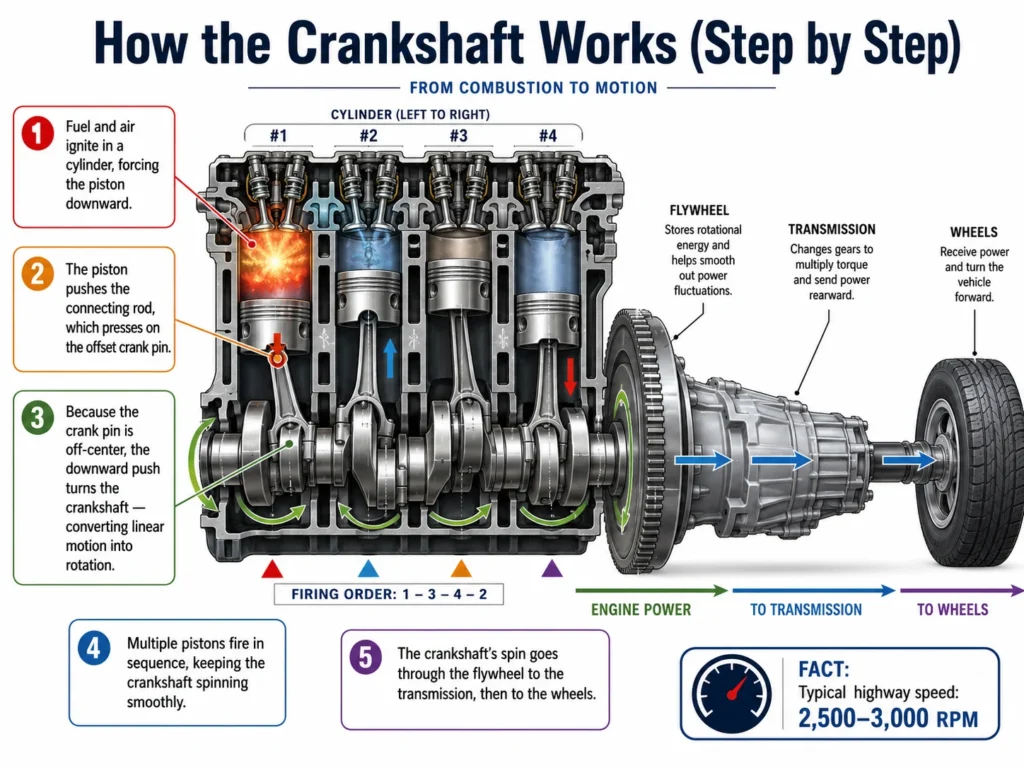
That continuous spin is sent through the flywheel to your transmission, which adjusts the speed and sends it to your wheels. At highway speed, your crankshaft might be spinning at 2,500–3,000 RPM (revolutions per minute).
Crankshaft vs. Camshaft — What’s the Difference?
These two get confused constantly because they sound similar. Here’s the quick breakdown:
| Feature | Crankshaft | Camshaft |
|---|---|---|
| Location | Bottom of engine block | Top of engine (cylinder head) |
| Job | Converts piston motion → rotation | Opens & closes valves |
| Connected to | Pistons via connecting rods | Crankshaft via timing belt/chain |
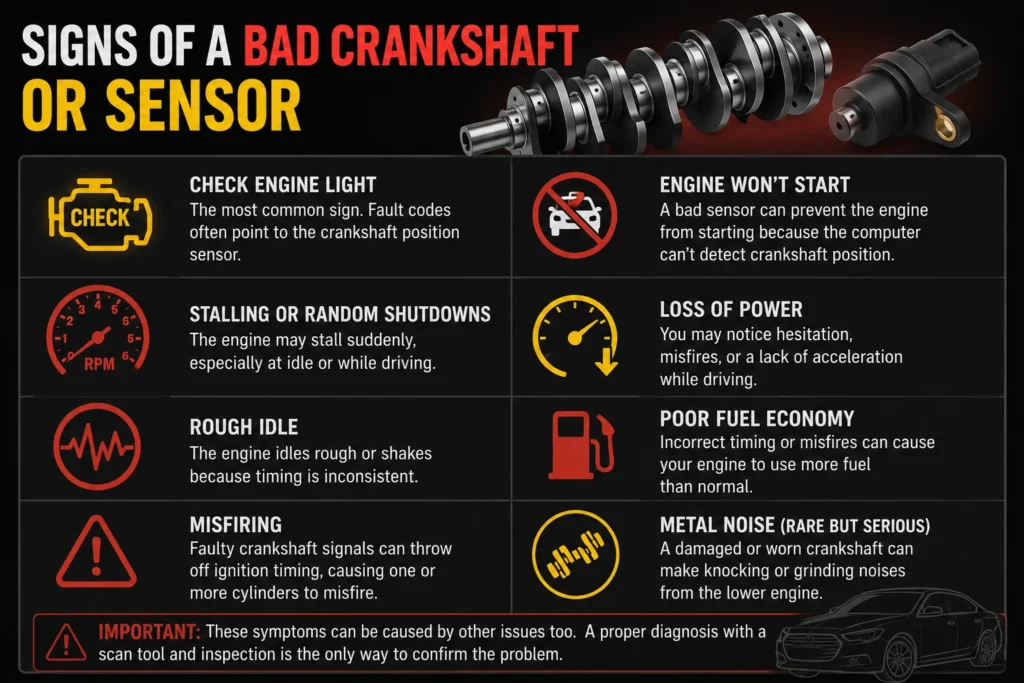
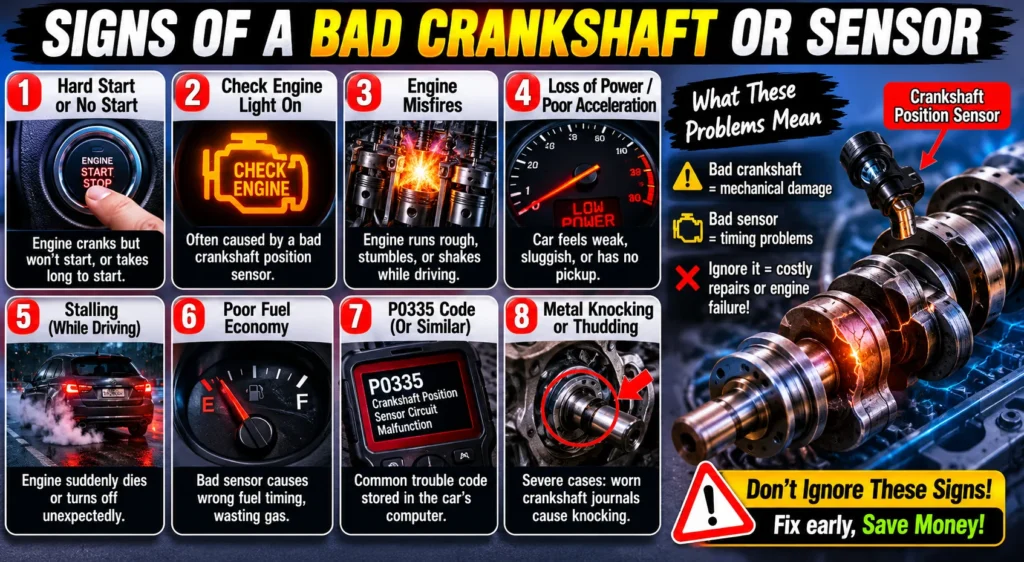
Signs of a Bad Crankshaft or Sensor
If a mechanic mentioned your crankshaft or crankshaft position sensor, here are the warning signs that brought you (or should bring you) to the shop:
Frequently Asked Questions
How much does it cost to replace a crankshaft?
A full crankshaft replacement is rare and expensive — typically $2,000–$5,000+ including labor because the entire engine must be disassembled. However, a crankshaft position sensor replacement is much cheaper, usually $150–$300.
Can you drive with a bad crankshaft sensor?
Technically sometimes, but it’s not recommended. A failing sensor can cause stalling at any moment — including at highway speeds or in intersections. Get it diagnosed as soon as possible.
Is a crankshaft the same as a camshaft?
No! They’re different parts with different jobs. The crankshaft (bottom of engine) converts piston motion into rotation. The camshaft (top of engine) opens and closes the valves that let fuel in and exhaust out. They’re connected by a timing belt or chain.