
If you have ever looked at your automatic gear shifter and wondered what the letter L means, you are not alone. Many drivers know what P, R, N, and D mean, but the L gear can feel confusing if no one has explained it clearly.
Quick Answer: What Does L Mean on a Car?
L means Low gear. In simple words, it keeps your car in a lower gear so the engine gives you more control at low speeds. L gear is useful for steep hills, downhill driving, towing, snow, mud, or slow roads, but it is not meant for normal highway driving.
What Does the L Stand for in a Car?
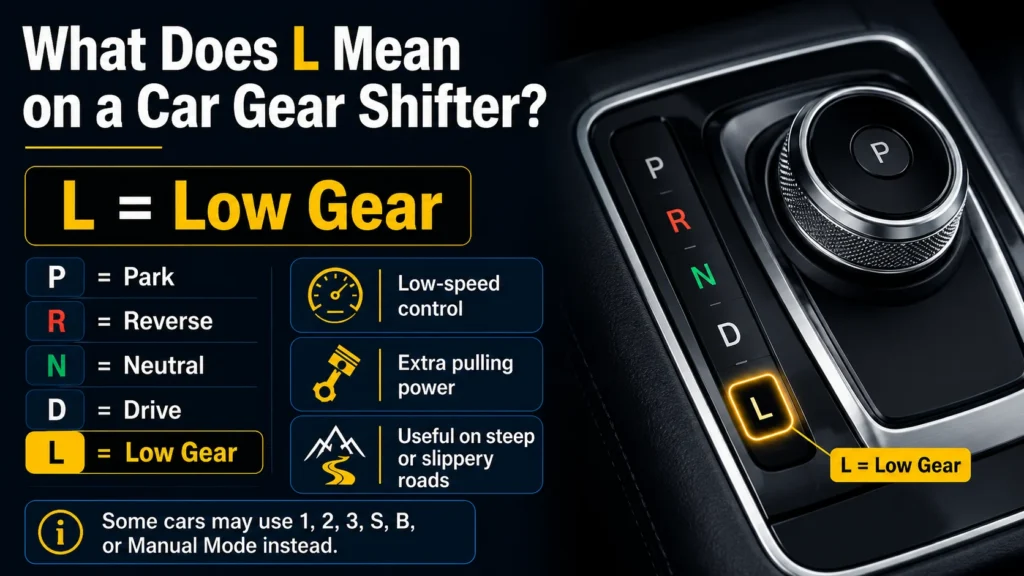
The L stands for Low. When you shift an automatic car into L gear, you are telling the transmission to stay in a lower gear instead of shifting up through the gears like it normally does in Drive.
In normal driving, you use D, which means Drive. In Drive, the car automatically changes gears as your speed increases or decreases. That is why most drivers can simply put the car in D and drive without thinking about gear changes.
L gear works differently. It limits the car to a lower gear range. This gives the wheels more pulling power at low speed and helps the engine slow the car down when you are going downhill. That is why L gear is not about speed. It is about control.
So, when someone asks, what does the L stand for in a car, the simple answer is Low gear. It is there for special driving conditions where you need more control than normal Drive mode gives you.
What Does L Mean on a Car Gear Shifter?
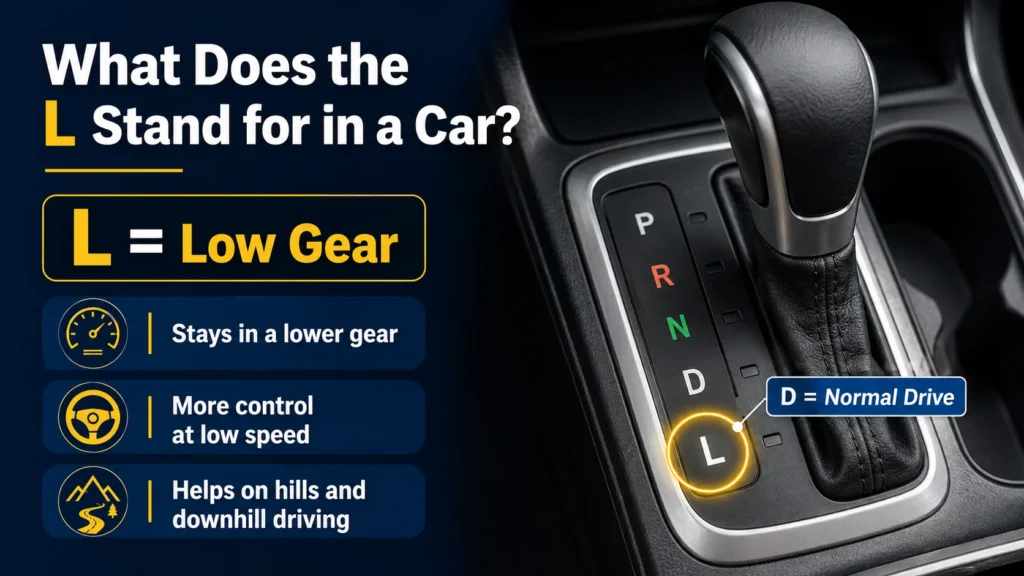
On a car gear shifter, L means the vehicle will use a low gear setting. This helps the car move slowly with more strength and better control. It is common in automatic cars, especially older automatic models, small SUVs, family cars, and vehicles made for mixed road conditions.
You may see L listed with other gear letters like P, R, N, and D. Here is what they usually mean:
- P means Park
- R means Reverse
- N means Neutral
- D means Drive
- L means Low gear
Some cars do not use the letter L. Instead, they may show numbers like 1, 2, or 3. These numbers also control lower gears. Other cars may have S, B, or manual shift mode instead. The exact label depends on the car model, but the idea is usually similar. The lower gear gives the driver more control in certain situations.
If your car has an L gear, it does not mean anything is wrong with the vehicle. It is simply an extra driving option. Most drivers do not need it every day, but it can be very useful when the road gets steep, slippery, or heavy.
What Happens When You Drive in L Gear?
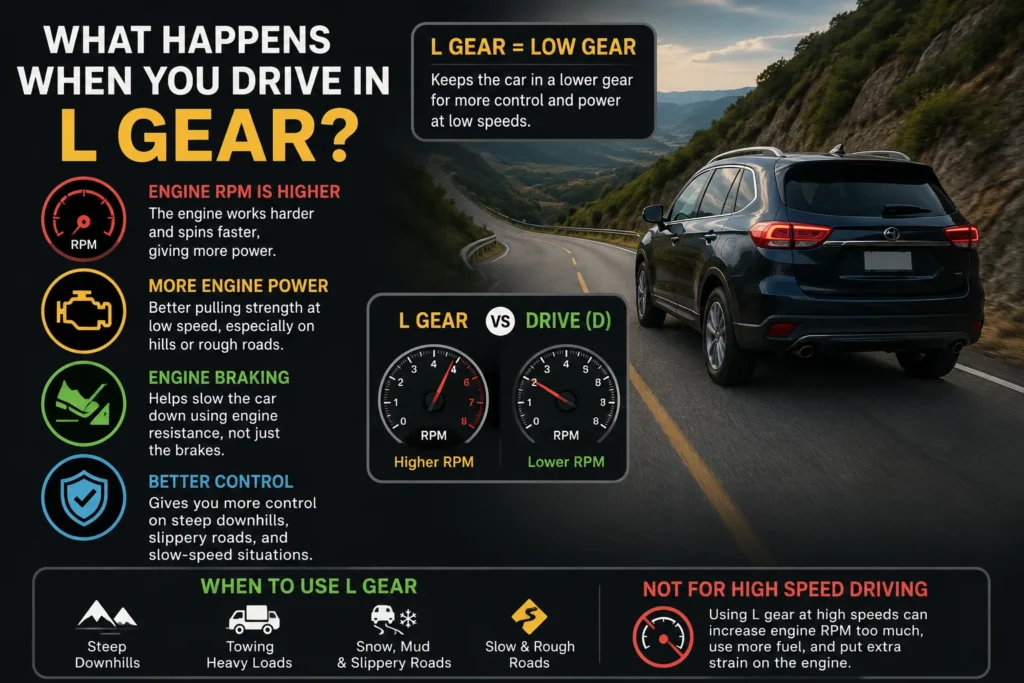
When you drive in L gear, your car stays in a low gear and does not shift up the same way it does in Drive. This means the engine may sound louder, the car may move slower, and the vehicle may feel stronger at low speed.
This is normal. In L gear, the engine works at a higher RPM compared to normal Drive mode. RPM means how fast the engine is spinning. A higher RPM can give the car more pulling strength, but it can also use more fuel if you keep driving like that for too long.
The main benefit is control. For example, if you are driving down a steep road, L gear can help slow the car using engine resistance. This is called engine braking. It does not replace your brakes, but it can reduce how much you need to press the brake pedal.
I have found L gear most useful on steep downhill roads where using only the brake pedal makes the car feel like it wants to roll faster. Shifting into a lower gear helps the car hold back naturally, which makes the drive feel calmer and safer.
That is the real purpose of L gear. It gives you slow-speed control when Drive feels too loose or too fast for the road.
What Does L Mean on a Car Compared With Drive?
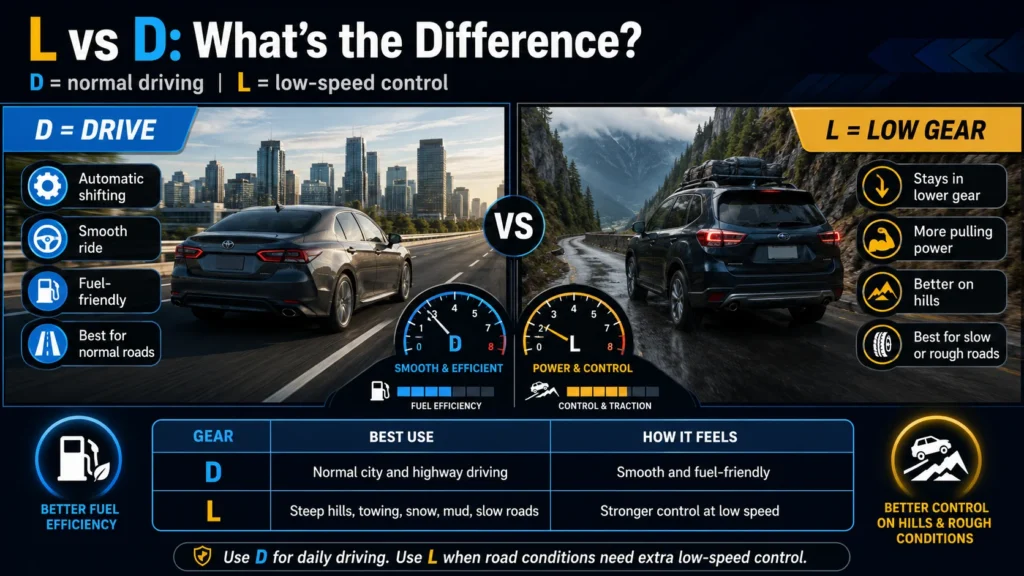
The main difference between L and D is simple. D is for normal driving. L is for low-speed control.
When you put the car in D, the transmission automatically shifts through the gears. It starts in a low gear, then shifts higher as you speed up. This keeps the engine smooth and helps save fuel during daily driving.
When you put the car in L, the transmission stays in a lower gear range. It does not shift up as freely. This gives the car more pulling power and helps control speed on slopes or rough roads.
| Gear | Best Use | How It Feels |
|---|---|---|
| D | Normal city and highway driving | Smooth and fuel-friendly |
| L | Steep hills, towing, snow, mud, slow roads | Stronger control at low speed |
For most daily trips, D is the right choice. Use D when you are driving on normal roads, highways, streets, or smooth traffic routes. Use L only when the road condition needs extra low-speed control.
When Should You Use L Gear in a Car?
You should use L gear when you need stronger control at low speed. It is not something you use all the time, but it can help in a few clear driving situations.
Use L Gear When Driving Down a Steep Hill
L gear can help control your speed when driving downhill. Instead of relying only on your brakes, the lower gear helps the engine slow the car. This can reduce brake strain, especially on long downhill roads.
Use L Gear When Going Up a Steep Hill
L gear can also help when climbing a steep hill at low speed. It gives the car more pulling strength and keeps the transmission from shifting too early. This can be useful when the car feels weak or keeps changing gears while going uphill.
Use L Gear When Towing Something
If your car is pulling a trailer or carrying a heavy load, L gear may help at low speeds. It gives the engine more control and can reduce unnecessary shifting. Always check your owner’s manual before towing because every vehicle has its own limits.
Use L Gear in Snow, Mud, or Rough Roads
L gear can help when you need slow, steady movement on slippery or rough surfaces. It lets you move with more control instead of letting the car shift up too quickly. This can help in mud, snow, loose gravel, or uneven roads.
Use L Gear in Slow Mountain Driving
Mountain roads often have sharp turns, steep drops, and sudden climbs. L gear can help keep the car steady at low speed. It is especially useful when you do not want the car to keep shifting between gears.
When Should You Avoid L Gear in a Car?
You should avoid L gear during normal high-speed driving. L gear is not made for cruising on highways or driving fast on open roads. If you use it at the wrong speed, the engine may rev too high and the car may feel strained.
Do not use L gear just because you see it on the shifter. It is not a better version of Drive. It is a special-use gear for certain road conditions.
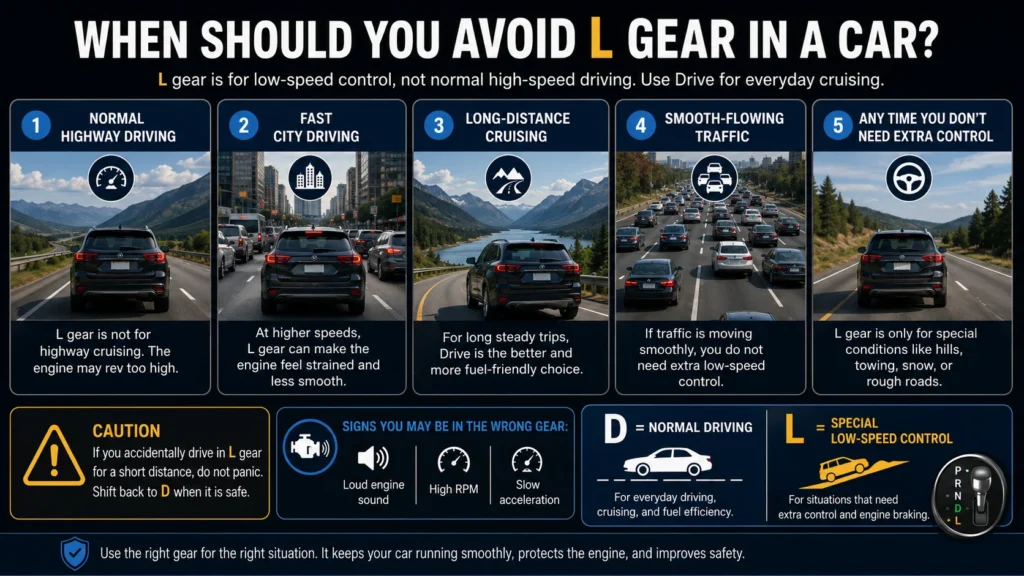
You should usually avoid L gear in these situations:
- Normal highway driving
- Fast city driving
- Long-distance cruising
- When traffic is moving smoothly
- When you do not need extra low-speed control
If you accidentally drive in L for a short distance, do not panic. Just shift back to D when it is safe. If the engine sounds very loud or the car feels like it does not want to speed up, that is a sign you may be in the wrong gear for your speed.
Is It Safe to Drive in L Gear?
Yes, L gear is safe when you use it for the right purpose. Car makers include it because it can help in certain driving conditions. The key is knowing when to use it and when to switch back to Drive.
L gear is safe for slow-speed control. It is useful when you are driving down a steep hill, climbing slowly, towing at low speed, or moving through slippery ground. In those situations, it can make the vehicle feel more controlled.
But L gear is not the right choice for high-speed driving. Keeping the car in low gear at higher speeds can make the engine rev too much. That may increase fuel use and put extra strain on the engine and transmission.
The safest rule is simple: use D for normal driving and use L only when you need extra control at low speed. If you are not sure, check your car owner’s manual because some cars handle low gear differently.
Can You Shift From D to L While Driving?
In many automatic cars, you can shift from D to L while moving slowly, but you should not do it at high speed. The safer choice is to slow down first, then shift into L when the car is already moving at a low speed.
Modern cars often have systems that protect the transmission from unsafe shifts. Still, you should not rely on that. If you force the car into a low gear while driving fast, the engine may rev hard and the car may slow suddenly.
For example, if you are about to go down a steep hill, slow the car before the slope begins. Then shift into L if your car manual allows it. This gives you better control before the car starts picking up speed.
If you are already on a highway or moving fast, stay in D. L gear is for low-speed situations, not fast traffic.
What Does L Means in Car for Beginner Drivers?
For beginner drivers, L simply means Low gear. It is a setting that helps your car stay slow and controlled. You do not need to use it for most daily driving.
If you are learning to drive, remember this simple rule: D is your normal gear. L is your special control gear. You will use D almost every day. You may only use L sometimes, such as on steep hills or rough roads.
Many new drivers worry that they might damage the car by touching the wrong gear. The best habit is to understand each gear before using it. Park is for stopping and parking. Reverse is for backing up. Neutral disconnects drive power. Drive moves the car forward normally. Low gear helps with slow-speed control.
Once you understand that, the L gear becomes much less confusing. It is not a mystery button. It is simply a low gear setting for special driving needs.
Common Mistakes When Using L Gear in a Car
The biggest mistake is using L gear like normal Drive. L gear is not meant for everyday cruising. It should only be used when road conditions call for low-speed control.
Another mistake is using L gear at high speed. If the engine gets loud and the car feels restricted, you may be driving too fast for L. Shift back to D when it is safe.
Some drivers also think L gear makes the car more powerful in every situation. That is not true. It gives better pulling strength at low speed, but it will not make the car faster. In fact, it can limit speed because the transmission stays in a lower gear.
A final mistake is ignoring the owner’s manual. Different cars use L gear in different ways. Some vehicles may have L, while others may have 1, 2, B, S, or manual mode. The best source for your exact car is always the manual that came with it.
FAQs About What Does L Mean on a Car
What does L mean on a car?
L means Low gear. It keeps the car in a lower gear so you have better control at low speed, especially on hills, rough roads, or slippery surfaces.
What does the L stand for in a car?
The L stands for Low. It tells the automatic transmission to stay in a lower gear instead of shifting up like it does in normal Drive mode.
What does L means in car when driving downhill?
When driving downhill, L gear helps slow the car through engine braking. This gives you more control and can reduce pressure on your brakes during steep descents.
Can I drive in L gear all the time?
No, you should not drive in L gear all the time. It is for low-speed control, not normal driving. Use D for regular city and highway driving.
Is L gear good for snow?
L gear can help in snow when you need slow and steady control. It may help prevent the car from shifting too quickly, but you still need to drive gently and avoid sudden braking or acceleration.
Is L gear the same as 1 or 2?
L gear is similar to lower gear settings like 1 or 2, but the exact function depends on the car. Some cars use L, while others use numbered gears or manual shift mode.
Conclusion: What Does the L Mean in a Car?
The L in a car means Low gear. It helps the car stay in a lower gear so you get better control at low speed. You may use it for steep hills, downhill driving, towing, snow, mud, or rough roads.
For normal driving, use D. That is the gear your car is designed to use on regular roads and highways. L gear is only for special situations where you need more control, not more speed.
If you are ever unsure, check your owner’s manual for your exact vehicle. Once you know what L gear does, it becomes easy to understand and simple to use safely.
Sources
- Your vehicle owner’s manual, transmission and gear selector section
- Car manufacturer driving guides for automatic transmission use
- Driver safety guidance on downhill driving, braking, and low-speed vehicle control