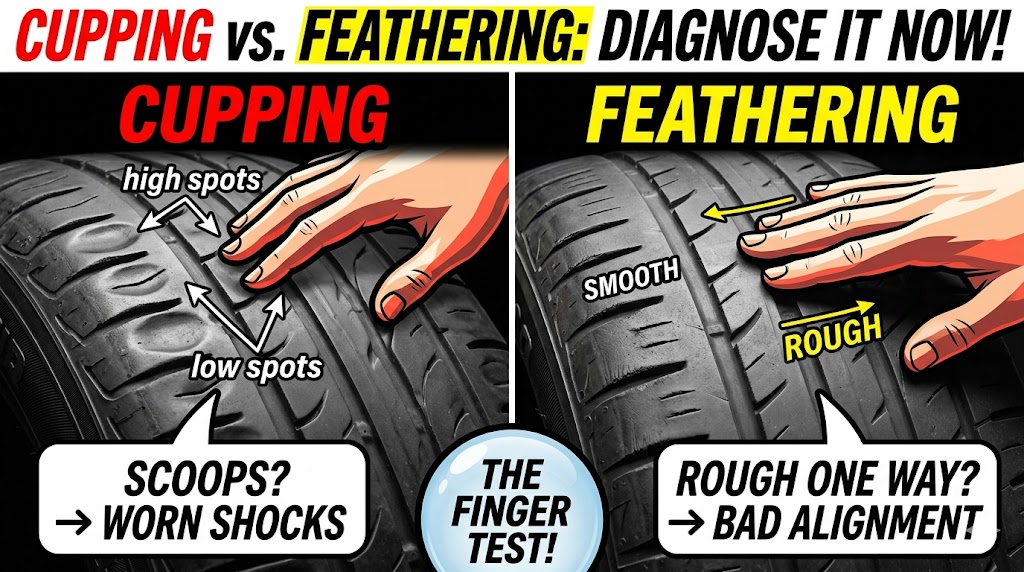
Cupping = scalloped, wavy dips across the tread (like someone scooped it with a spoon). Usually means worn shocks/struts.
Feathering = smooth one direction, rough the other when you run your hand across the tread. Usually means bad alignment.
Scroll down for diagrams to compare against your tire right now. 👇
1
What Tire Cupping Looks Like
Diagram: Cupped Tire Tread Pattern
What to Look For
Look for wavy, scalloped dips in the tread — like someone took an ice cream scoop to alternating tread blocks. The dips are typically 3–4 inches apart and feel like bumps when you run your hand along the tire. You’ll usually notice this pattern across the entire width of the tread, not just one edge.
In plain English: If your tire looks like a dog chewed on it in a regular pattern, that’s cupping. The “scoops” are the giveaway.
2
What Tire Feathering Looks Like
Diagram: Feathered Tire Tread Pattern
What to Look For
Each tread block is worn higher on one side and lower on the other, like a ramp. You often can’t see feathering easily — you have to feel it. Run your hand across the tread: it’ll feel smooth one direction and rough/sharp the other direction, like rubbing a cat’s fur the wrong way.
In plain English: If your tread feels like sandpaper in one direction but smooth in the other, that’s feathering. It’s sneaky because it doesn’t always look worn — you have to use the touch test.
3
The 30-Second Finger Test
You can diagnose both issues right now in the parking lot. No tools needed — just your hand.
Test for Cupping
Run your hand along the tread (front to back). If you feel high and low spots like a washboard road, that’s cupping.
✅ Feels like: a bumpy road under your fingers
Test for Feathering
Run your hand across the tread (side to side). Smooth one way, rough/sharp the other way? That’s feathering.
✅ Feels like: petting a cat backwards
4
Side-by-Side Comparison
Feature
Cupping
Feathering
Pattern
Scalloped dips/scoops across the tread
Angled edges on each tread block
Location
Entire tread width
Inner or outer edge
Detection
Visible + feel (high/low spots)
Mostly feel (smooth/rough)
Sound
Loud humming / droning at highway speed
Subtle whooshing or no sound
Root Cause
Worn shocks / struts
Incorrect toe alignment
Vibration?
Yes — steering wheel or seat
Rarely noticeable
Typical Fix Cost
$400–$900 (shocks + tires)
$75–$120 (alignment)
5
Root Causes & Mechanical Breakdown
For the DIY diagnoser: This section helps you pinpoint the exact component to replace — no “parts darts” needed.
Cupping Causes
Worn Shocks / Struts — The tire bounces instead of maintaining constant road contact. Each bounce removes rubber at a different spot, creating scallops. Most common cause (~80% of cases).
Unbalanced Tires — A heavy spot creates a rhythmic bounce at speed, wearing specific spots repeatedly.
Worn Wheel Bearings — Allow wheel wobble, causing irregular contact patches. Usually accompanied by grinding noise on turns.
Bent Rim — Creates the same bouncing effect as an unbalanced tire. Check for pothole damage.
Quick test: Push down hard on each corner of the car and release. More than 1–2 bounces = worn shocks.
Feathering Causes
Incorrect Toe Alignment — Tires pointed slightly inward or outward drag the tread sideways each revolution, shaving one edge of every block. Accounts for ~90% of feathering.
Worn Tie Rod Ends — Allow the toe angle to shift unpredictably. Feathering may be inconsistent or switch sides.
Worn Ball Joints / Control Arm Bushings — Let the wheel tilt during driving, creating a similar scrubbing action on the tread blocks.
Quick test: Jack up the front end, grab the tire at 3 and 9 o’clock, and wiggle. Play = worn tie rods. At 12 and 6 o’clock = ball joints.
6
What To Do Next
Step 1: Confirm with the bounce test
Push down hard on each corner and count the bounces. More than 1–2 bounces = worn shocks/struts.
Step 2: Replace shocks/struts FIRST
Never buy new tires before fixing the root cause. New tires + old shocks = cupped new tires within 10K miles. Budget: $200–$500 for parts, $200–$400 labor.
Step 3: Get an alignment after suspension work
New struts can shift alignment. Always get a 4-wheel alignment after replacing suspension parts (~$80–$120).
Step 4: Assess your tires
Mild cupping with plenty of tread left? Rotate and rebalance — they may smooth out. Severe cupping? Replace them.
Step 1: Get a 4-wheel alignment ASAP
This is the #1 fix for feathering. Cost: $75–$120. Every day you drive misaligned wears your tread faster.
Step 2: Ask the shop to check tie rods and ball joints
If these are worn, the alignment won’t hold. A good shop checks these before aligning — but ask to be sure.
Step 3: Rotate your tires
Mild feathering can often be reversed with an alignment + rotation. The tread blocks will even out over the next few thousand miles.
Step 4: Check tire pressure
Under-inflated tires accelerate feathering. Check the sticker in your driver’s door jamb for the correct PSI — not the number on the tire sidewall.
No worries — here’s a quick decision tree:
❓ Do you hear a humming/droning noise on the highway?
❓ Does the tire feel smooth one way and rough the other?
→ Yes: That’s feathering. Get an alignment. → No: Continue below.
❓ Do you see visible scalloped dips when looking at the tread?
→ Yes: Cupping — replace shocks, then tires. → No: Your wear may be from inflation or camber issues. Get a pro inspection.
7
How to Prevent It From Happening Again
For high-mileage drivers: These habits can add 15,000–20,000+ miles to a set of tires. At $600–$1,000 per set, that’s real money saved.
🔄 Rotate Every 5,000–7,500 Miles
Match it with every other oil change. Front tires wear faster on FWD vehicles. Rotation evens out the wear.
📈 Check Pressure Monthly
Use the PSI from your door jamb sticker — not the tire sidewall max. Check when cold. Even 5 PSI low accelerates edge wear.
🎯 Alignment Every 12 Months or 12K Miles
Also get one after hitting a major pothole or curb. A $100 alignment can save a $700 set of tires.
⚒ Replace Shocks at 50K–75K Miles
Shocks wear gradually — you won’t feel the difference day-to-day. But your tires will. Proactive replacement prevents cupping before it starts.
8
Frequently Asked Questions
It depends on severity. Mild cupping (barely visible, mostly felt) can often smooth out after fixing shocks and doing a rotation + rebalance. Drive 2,000–3,000 miles and reassess. Severe cupping (visible scoops, loud humming) means the tire’s structure is compromised — replace them.
Short term, yes — but get it addressed within a few weeks. Cupping reduces grip, especially in wet conditions. Feathering is less dangerous but accelerates further wear. Neither is a “pull over right now” emergency, but don’t ignore it for months.
It could be. A typical breakdown: Shocks/struts ($200–$500 parts + $200–$400 labor) + alignment ($80–$120) = $480–$1,020. Ask for an itemized estimate and compare 2–3 shops. The repair itself is legitimate if your tires are genuinely cupped — just verify the price is competitive.
Absolutely. If your alignment is off, new tires can start feathering within 5,000 miles. This is why you should always get an alignment when installing new tires. Many tire shops include it or offer a discount.
Flat spots are usually a single worn area from hard braking or sitting parked for months. Cupping is a repeating pattern of scoops around the circumference. Flat spots are a tire/brake issue; cupping is a suspension issue.
Still Not Sure? Do the Finger Test Now.
Go to your car, run your hand across each tire in both directions, and come back to compare. This guide isn’t going anywhere.
Usama
Usama is an ASE-Certified Automotive Technician with over 10 years of hands-on experience in tire diagnostics, suspension systems, and vehicle safety. Having successfully repaired, patched, and replaced thousands of tires, he writes strictly to empower drivers with transparent pricing and protect them from unsafe repair shop practices.