
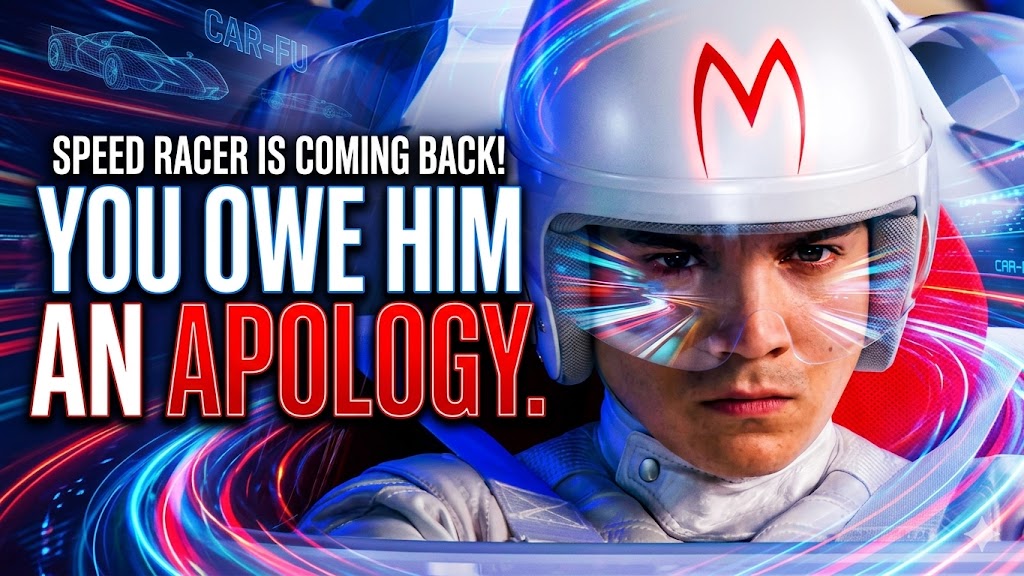

The Wachowskis’ neon-drenched visual masterpiece is finally getting the big-screen vindication it deserved 17 years ago. Here’s everything you need to know.
Let’s get one thing absolutely straight before we go any further: Speed Racer (2008) was always a masterpiece.
Not a guilty pleasure. Not a “so bad it’s good” curiosity. A genuine, boundary-annihilating work of pop art that fused anime grammar with live-action filmmaking in a way nobody had seen before — or, frankly, has managed to replicate since. The Wachowskis didn’t just adapt Speed Racer. They translated the feeling of watching anime into a new cinematic language.
And in 2008, the world wasn’t ready. Critics called it “a headache-inducing sugar rush.” Box office returns were catastrophic. Warner Bros. lost an estimated $80 million. It was declared one of the biggest flops of the decade.
“If you spent the last 15 years defending this movie in comment sections and group chats — congratulations. History has vindicated you.”
Now, the movie is returning to theaters for a limited theatrical run, and it’s time for everyone else to catch up.
The Cars Deserve Their Own Article
Let’s talk about why this movie belongs on a car site. The Wachowskis didn’t just design race cars — they designed an entire physics system for a fictional motorsport. The T-180 class vehicles are closed-cockpit, independently-wheeled machines with jump jacks, deflector shields, and weaponized chassis components. Every car in the WRL has a unique mechanical personality.
🏎️
The Mach 5
Jump jacks. Rotary saws. A trunk-mounted homing robot. The most over-engineered family car in cinema history.
⚡
The Mach 6
Built for the Grand Prix. Lighter, faster, and carrying the emotional weight of every Racer family tragedy.
🏎️
The Shooting Star
Racer X’s midnight-black instrument of controlled violence. Handles like a surgeon’s scalpel at 400 mph.
And then there’s “Car-Fu” — the Wachowskis’ term for the vehicular combat system where drivers use their cars as martial arts weapons. Cars flip over each other, barrel-roll mid-air, and slam into opponents with choreography that would make Jackie Chan nod in approval. The Casa Cristo 5000 rally sequence alone features more creative automotive action than the last five Fast & Furious movies combined.
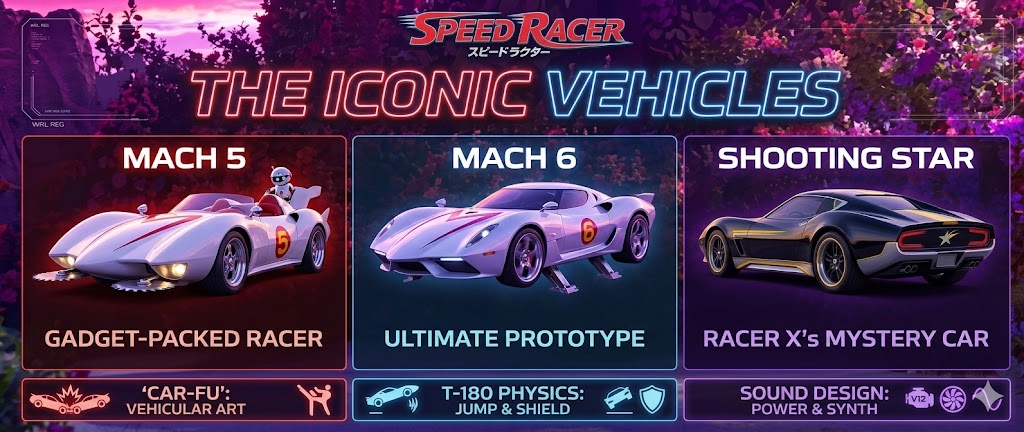
“The sound design team layered V12 howls with turbine whines and synthesizer stabs. Every engine in this movie sounds like a different angry musical instrument.”
Why Now? Why Finally?
The re-evaluation has been building for years. TikTok and YouTube video essayists turned Speed Racer into a Gen-Z discovery. The film’s maximalist aesthetic — its refusal to use a single muted color when fourteen neon ones were available — now reads as revolutionary rather than excessive. In an era of grey-brown CGI sludge, Speed Racer’s infinite-focus, hypercolor cinematography looks like it arrived from the future.
The Wachowskis used a technique called “deep canvas compositing” — layering foreground, midground, and background as independent planes that move at different speeds, exactly like a traditional anime pan. Every single frame is a painting. And on an IMAX screen? It’s going to be transcendent.