
A rolling mill is one of the most important machines used in metal manufacturing. It reshapes metal by passing it between rotating rolls that apply compressive force. The process can reduce thickness, change cross-sectional shape, improve dimensional consistency, and prepare steel for applications ranging from automotive panels to structural beams and railway tracks.
Rolling may look simple from the outside, but modern steel rolling involves carefully controlled roll gaps, speeds, temperatures, rolling forces, cooling systems, and multiple mill stands. Different rolling mill designs are used depending on whether the manufacturer needs thin sheet, heavy plate, bars, rails, structural sections, or other steel products.
What Is a Rolling Mill?
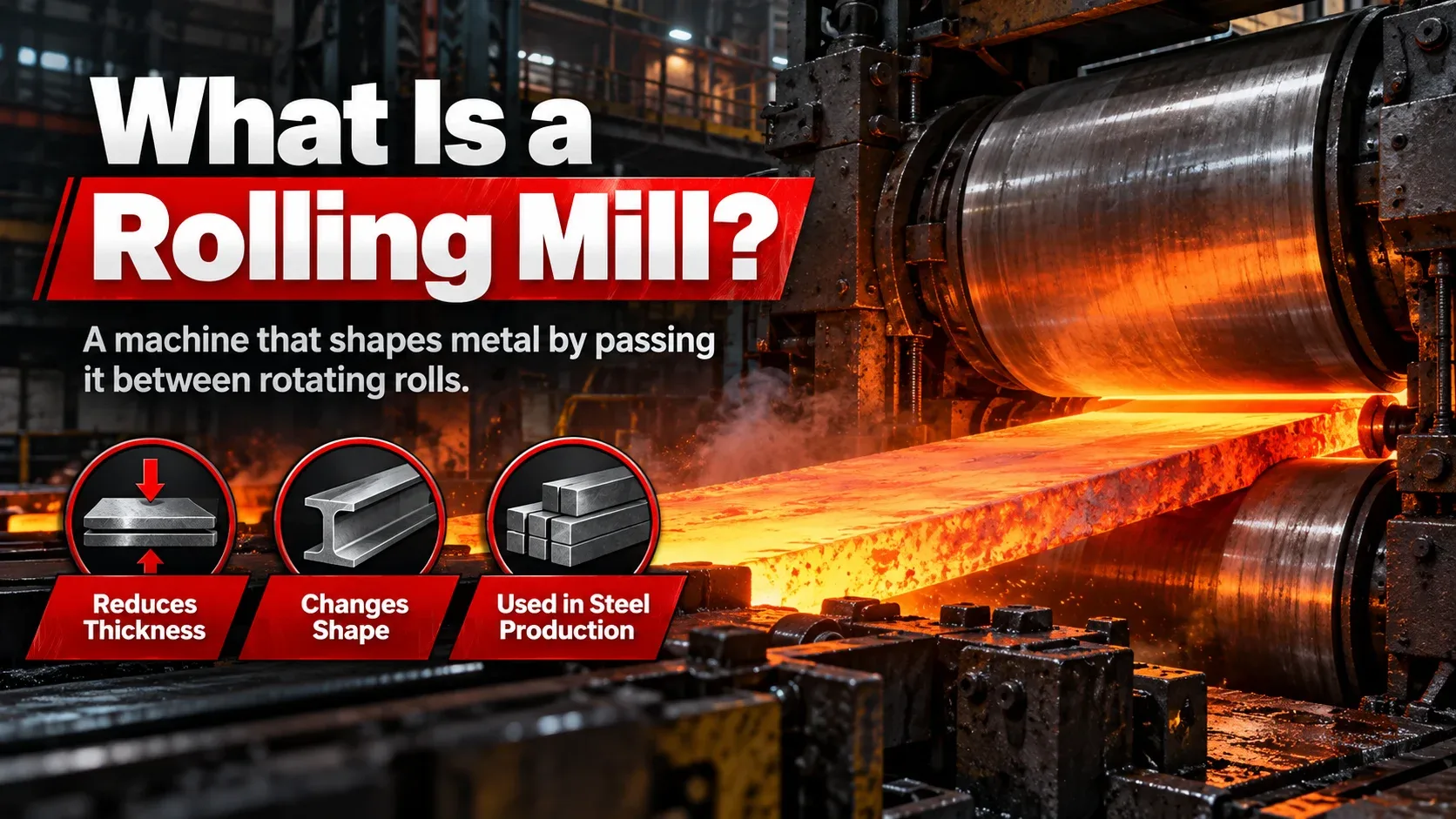
A rolling mill is industrial equipment designed to deform metal between one or more sets of rotating rolls. As the material enters the space between the rolls, friction helps pull it forward while compressive force changes its dimensions.
In flat rolling, the main objective is usually to reduce the thickness of the metal. In shape rolling, specially designed roll grooves gradually form the material into specific profiles such as rails, channels, angles, beams, rods, and bars.
Rolling can be performed while the metal is hot or at lower temperatures. The correct method depends on the material, required dimensions, surface finish, mechanical properties, and intended final application.
How Does a Rolling Mill Work?
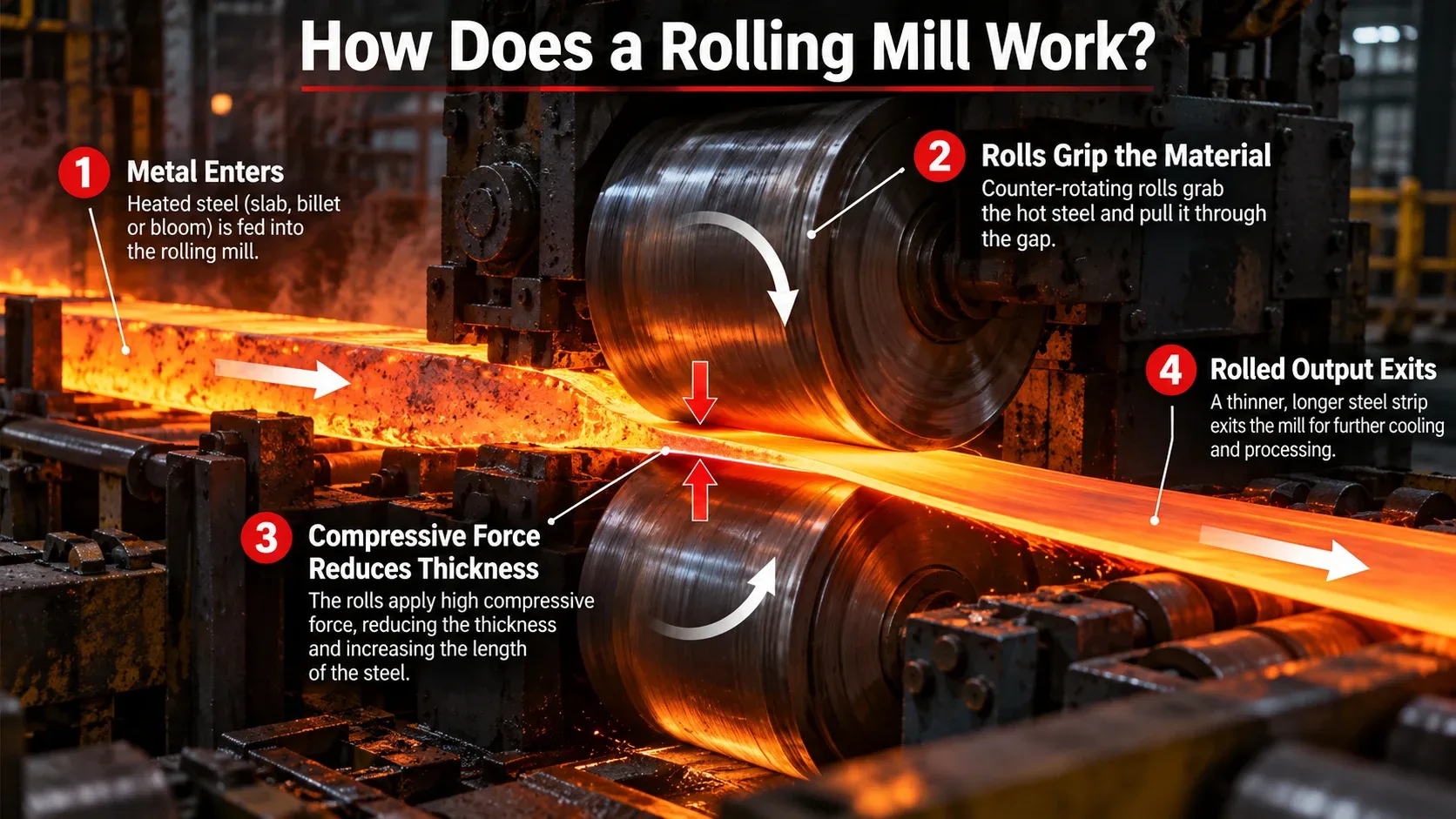
A rolling mill works on the principle of compressive deformation. Two opposing rolls rotate in opposite directions and draw the metal into the gap between them.
Because the roll gap is smaller than the incoming material thickness, the metal is compressed. In flat rolling, this reduction causes the workpiece to become thinner and generally longer.
- Metal enters the rolling stand.
A slab, billet, bloom, strip, bar, or other workpiece approaches the rotating rolls. - The rolls grip the material.
Friction between the rolls and metal draws the workpiece into the roll gap. - Compressive force is applied.
The rotating rolls squeeze the metal and cause plastic deformation. - The dimensions change.
Flat products become thinner, while shaped rolls produce controlled profiles. - Additional passes may be required.
Large reductions normally require multiple passes or several rolling stands. - The product is finished.
The rolled material may be cooled, straightened, cut, coiled, treated, or inspected.
Main Parts of a Rolling Mill
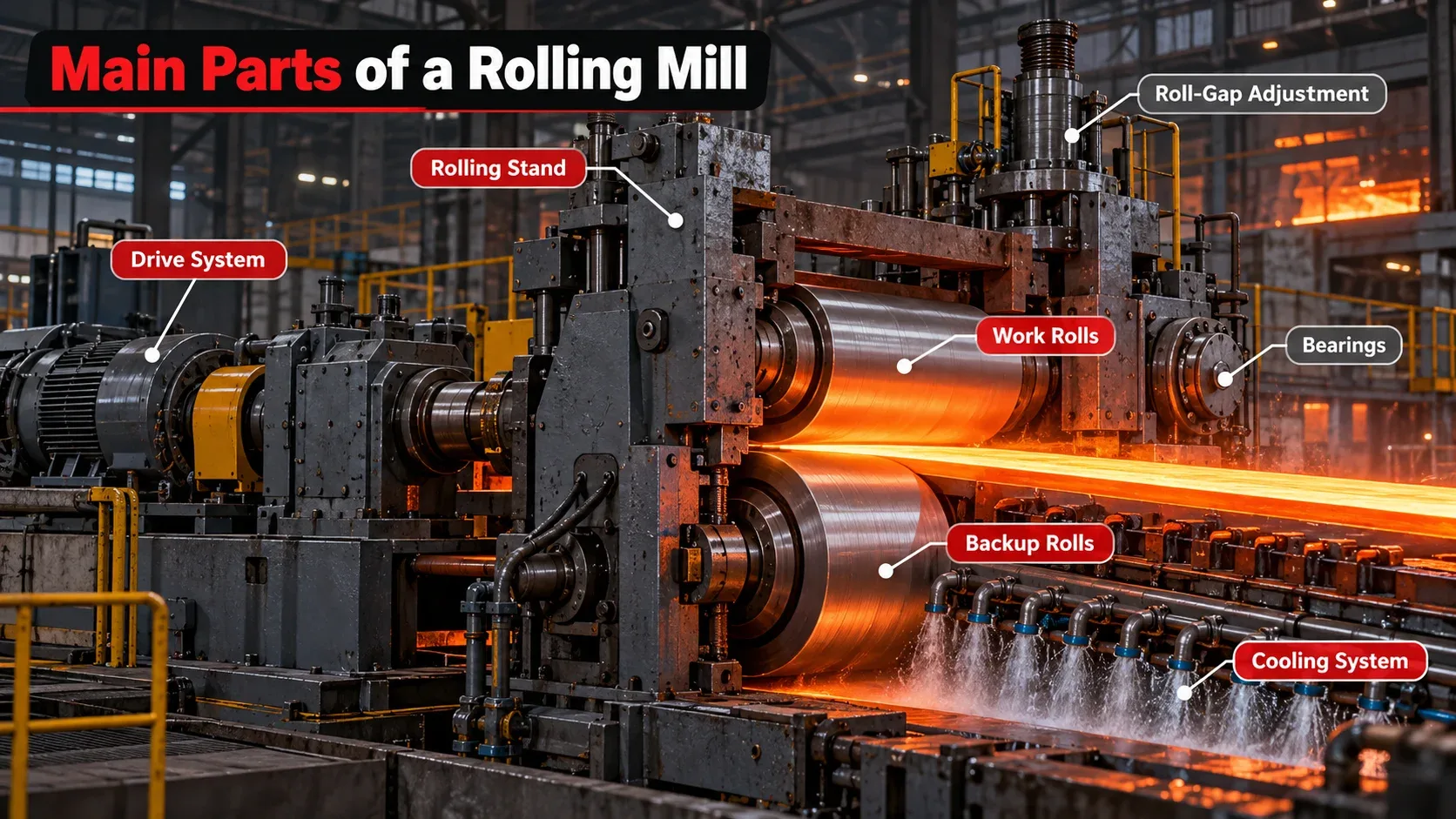
A complete rolling mill contains many mechanical, electrical, hydraulic, cooling, and material-handling systems. However, several components are fundamental to most rolling operations.
Work Rolls
Work rolls directly contact the metal and apply the force needed to deform it. Their size, profile, surface condition, and material affect the rolling process.
Backup Rolls
Backup rolls support smaller work rolls in four-high and cluster rolling mills. They help reduce unwanted bending under heavy rolling loads.
Rolling Stand
The rolling stand or housing supports the rolls, bearings, adjustment mechanisms, and related equipment while resisting rolling forces.
Bearings
Heavy-duty bearings support the rolls and allow smooth rotation while carrying significant operational loads.
Drive System
Electric motors, gearboxes, couplings, and spindles supply and transmit the torque required to rotate the rolls.
Roll-Gap Adjustment
Mechanical or hydraulic systems control the distance between the rolls and help maintain the required final dimensions.
Guides & Handling Equipment
Guides, conveyors, roller tables, and coilers help position and transport metal throughout the rolling line.
Cooling & Lubrication
Cooling and lubrication systems help control roll temperature, friction, wear, and surface quality.
Rolling Mill Process: Step by Step
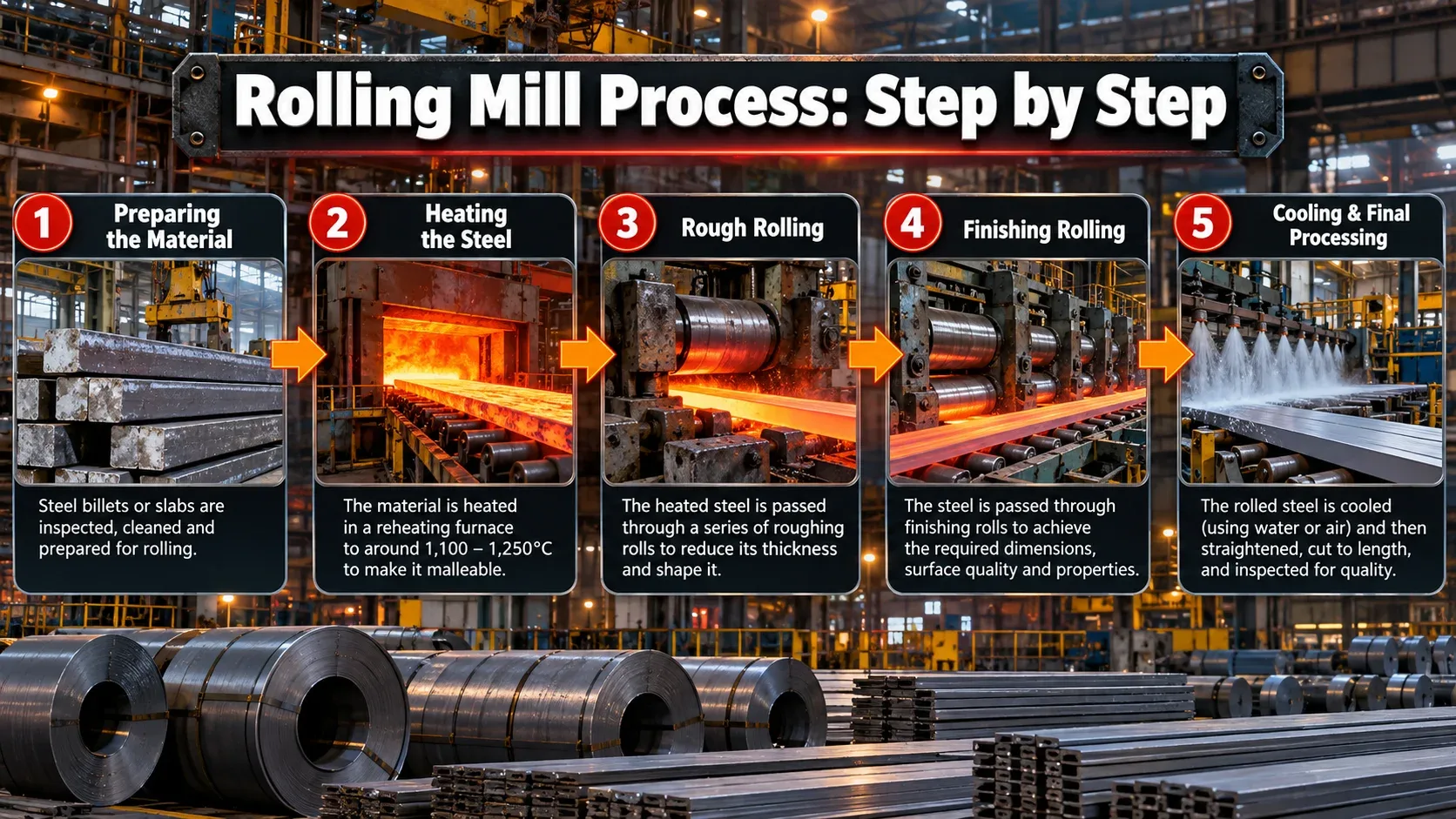
The exact rolling mill process depends on the material and final product. A steel plate mill, bar mill, hot strip mill, and cold rolling mill can all use different production sequences.
1. Preparing the Starting Material
Steel rolling commonly begins with a semi-finished product such as a slab, billet, or bloom.
- Slabs: Commonly used for plate, sheet, and strip.
- Billets: Often rolled into bars, rods, and smaller sections.
- Blooms: Often used for larger structural sections and heavy products.
2. Heating the Steel
For hot rolling, the steel is heated to a temperature that allows substantial deformation without requiring excessive rolling force.
3. Rough Rolling
Roughing passes make major reductions to the dimensions of the steel. The material is generally not reduced to its final size in one pass.
4. Intermediate and Finishing Rolling
Additional stands progressively bring the material closer to its specified thickness or shape. Finishing stands provide greater control over dimensions and surface characteristics.
5. Cooling and Final Processing
After rolling, the steel may undergo cooling, straightening, trimming, cutting, coiling, pickling, heat treatment, coating, or inspection.
Types of Rolling Mills
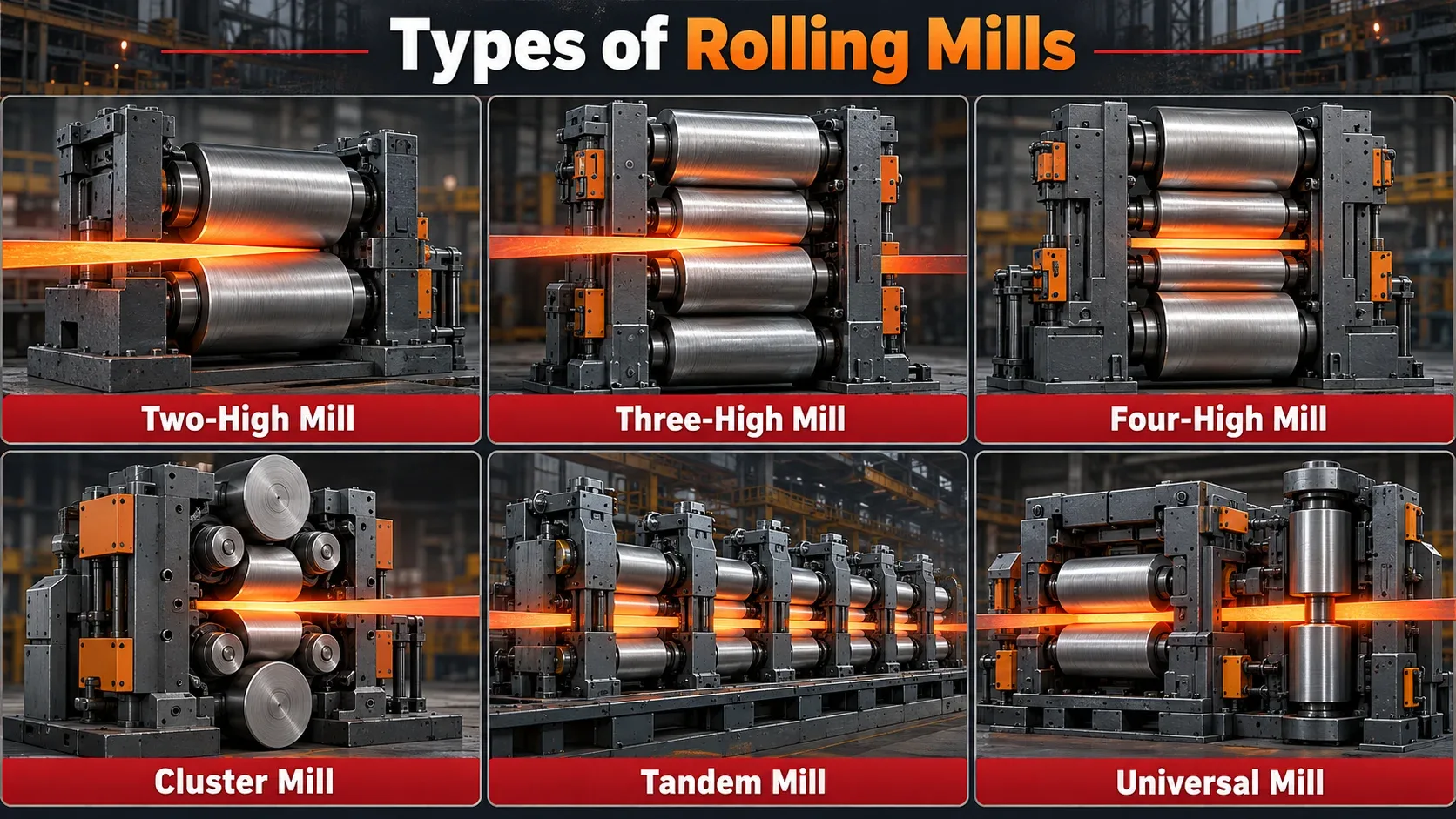
Rolling mills are commonly classified according to their roll arrangement. Each design provides different advantages in terms of rolling force, product thickness, dimensional accuracy, and production capacity.
| Rolling Mill Type | Roll Arrangement | Main Feature | Typical Use |
|---|---|---|---|
| Two-High Mill | Two opposing rolls | Simple and versatile | General rolling and roughing |
| Three-High Mill | Three vertically arranged rolls | Allows repeated rolling passes | Multiple reduction passes |
| Four-High Mill | Two work rolls and two backup rolls | Improved work-roll support | Sheet and strip |
| Cluster Mill | Small work rolls with multiple backup rolls | High roll support | Thin and precision strip |
| Tandem Mill | Multiple stands in sequence | High-volume continuous reduction | Steel sheet and strip |
| Universal Mill | Horizontal and vertical rolls | Controls multiple dimensions | Beams, rails, structural sections |
Two-High Rolling Mill
A two-high rolling mill uses two opposing rolls positioned one above the other. The rolls rotate in opposite directions and compress the metal between them.
Three-High Rolling Mill
A three-high rolling mill contains three vertically arranged rolls. The material can pass through the lower pair in one direction and then return through the upper pair.
Four-High Rolling Mill
A four-high rolling mill uses two small work rolls supported by two larger backup rolls. The backup rolls reduce work-roll bending and help improve thickness control.
Cluster Rolling Mill
A cluster rolling mill uses small work rolls supported by multiple backup rolls, allowing precise rolling of thin material.
Tandem Rolling Mill
A tandem rolling mill uses several rolling stands positioned one after another, making it suitable for high-volume sheet and strip production.
Universal Rolling Mill
A universal rolling mill combines horizontal and vertical rolls and is widely used for structural products such as beams and rails.
Hot Rolling vs. Cold Rolling
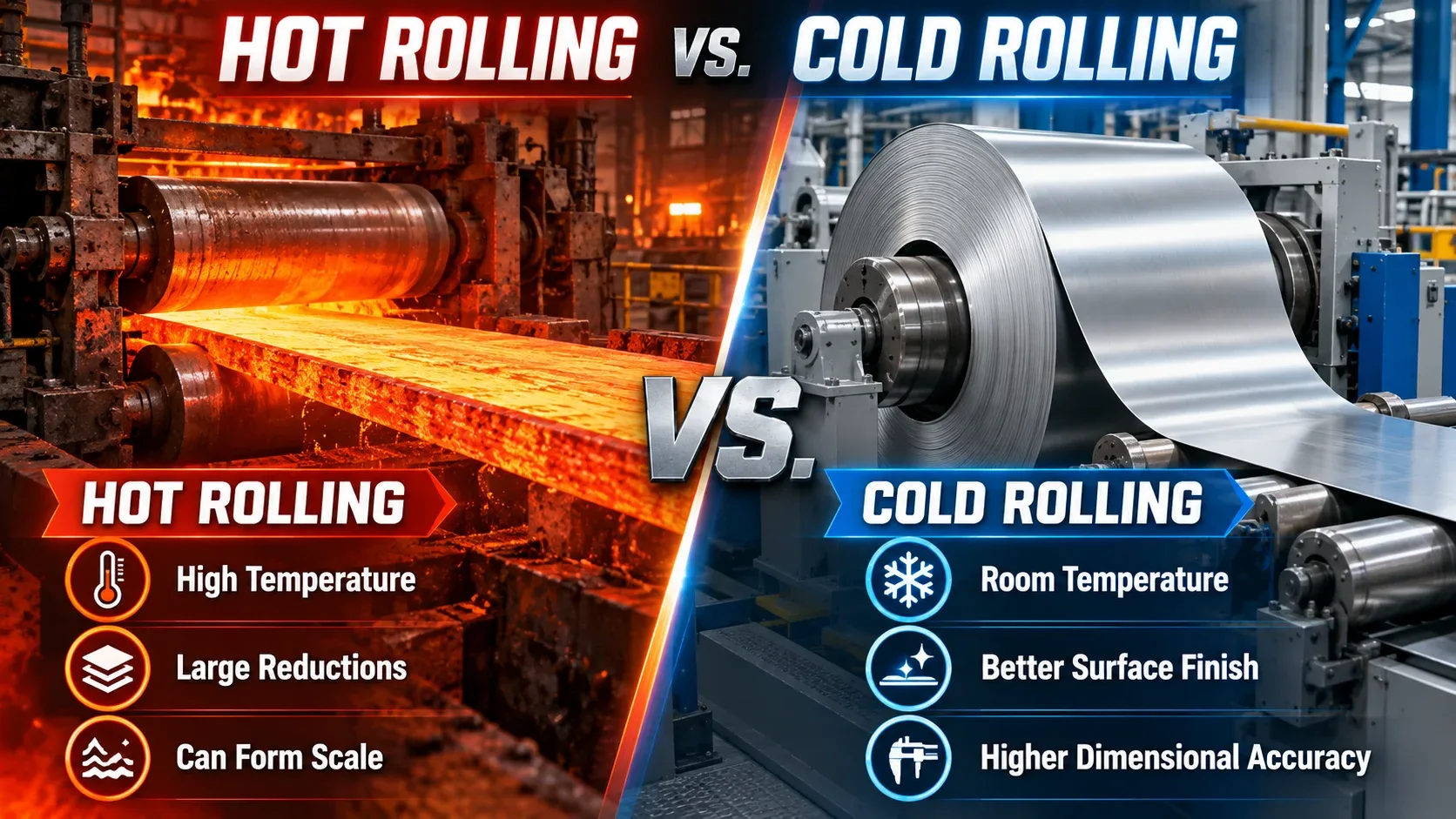
One of the most important distinctions in steel production is the difference between hot rolling and cold rolling.
| Factor | Hot Rolling | Cold Rolling |
|---|---|---|
| Temperature | Performed at elevated temperature | Usually performed at or near room temperature |
| Deformation | Large reductions are easier | Requires greater rolling force |
| Surface Finish | Can develop surface scale | Usually smoother and cleaner |
| Dimensional Accuracy | Suitable for primary shaping | Generally provides tighter control |
| Mechanical Effect | Depends on temperature, reduction, and cooling | Can increase strength through work hardening |
| Common Products | Plate, rails, beams, hot-rolled coil | Cold-rolled sheet and strip |
What Is Hot Rolling?
Hot rolling processes steel at elevated temperature. This allows substantial deformation and makes it possible to reduce large slabs, billets, and blooms into usable steel products.
What Is Cold Rolling?
Cold rolling is generally performed on steel that has already undergone hot rolling and surface preparation. It can improve surface finish, dimensional accuracy, and strength through work hardening.
How Steel Is Rolled in a Rolling Mill
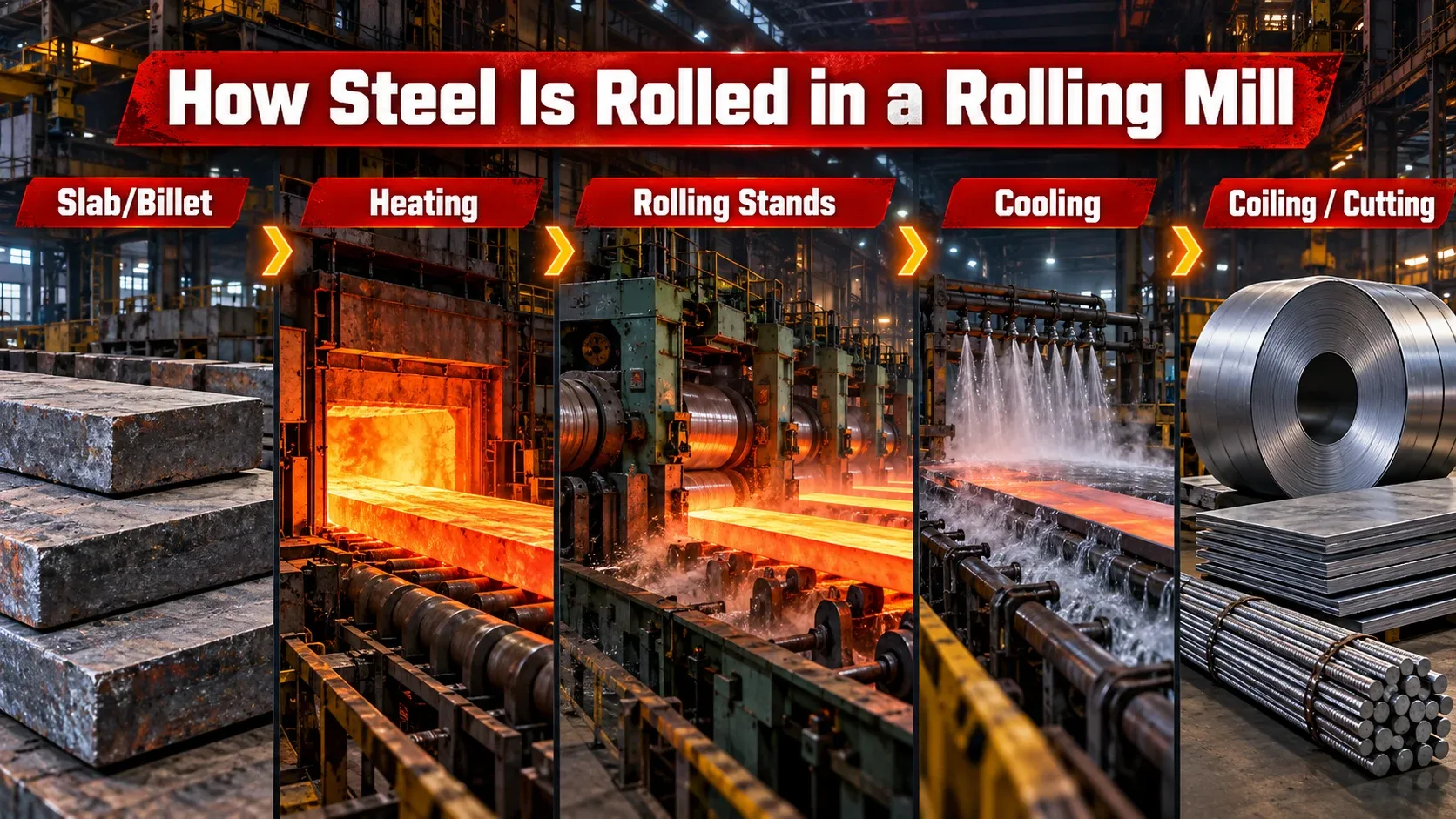
Steel rolling mills convert semi-finished steel into useful shapes and dimensions. The exact process depends on whether the manufacturer is producing flat products, long products, structural steel, or another form.
For flat steel products, production often begins with a slab. The slab passes through a series of rolling stands where its thickness decreases and its length increases.
Hot strip mills can produce long continuous strips that are eventually wound into coils. Some hot-rolled coil is then processed further in cold rolling mills.
For long products, billets or blooms pass through specially shaped rolls to produce bars, rods, rails, beams, channels, or other profiles.
Semi-finished steel → Heating → Rough rolling → Intermediate rolling → Finishing rolling → Cooling → Straightening, cutting, or coiling → Inspection
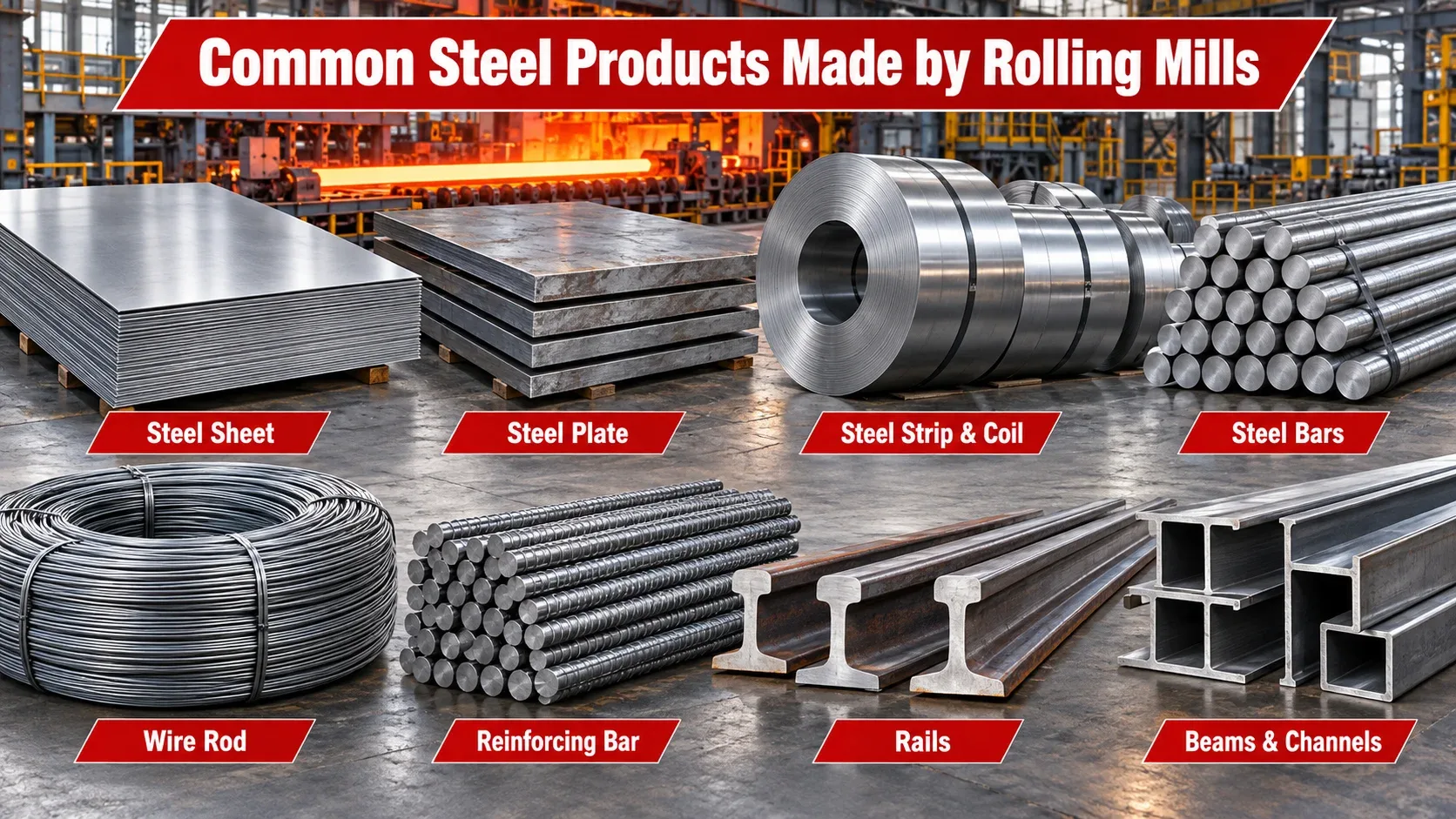
Common Steel Products Made by Rolling Mills
Applications of Rolling Mills
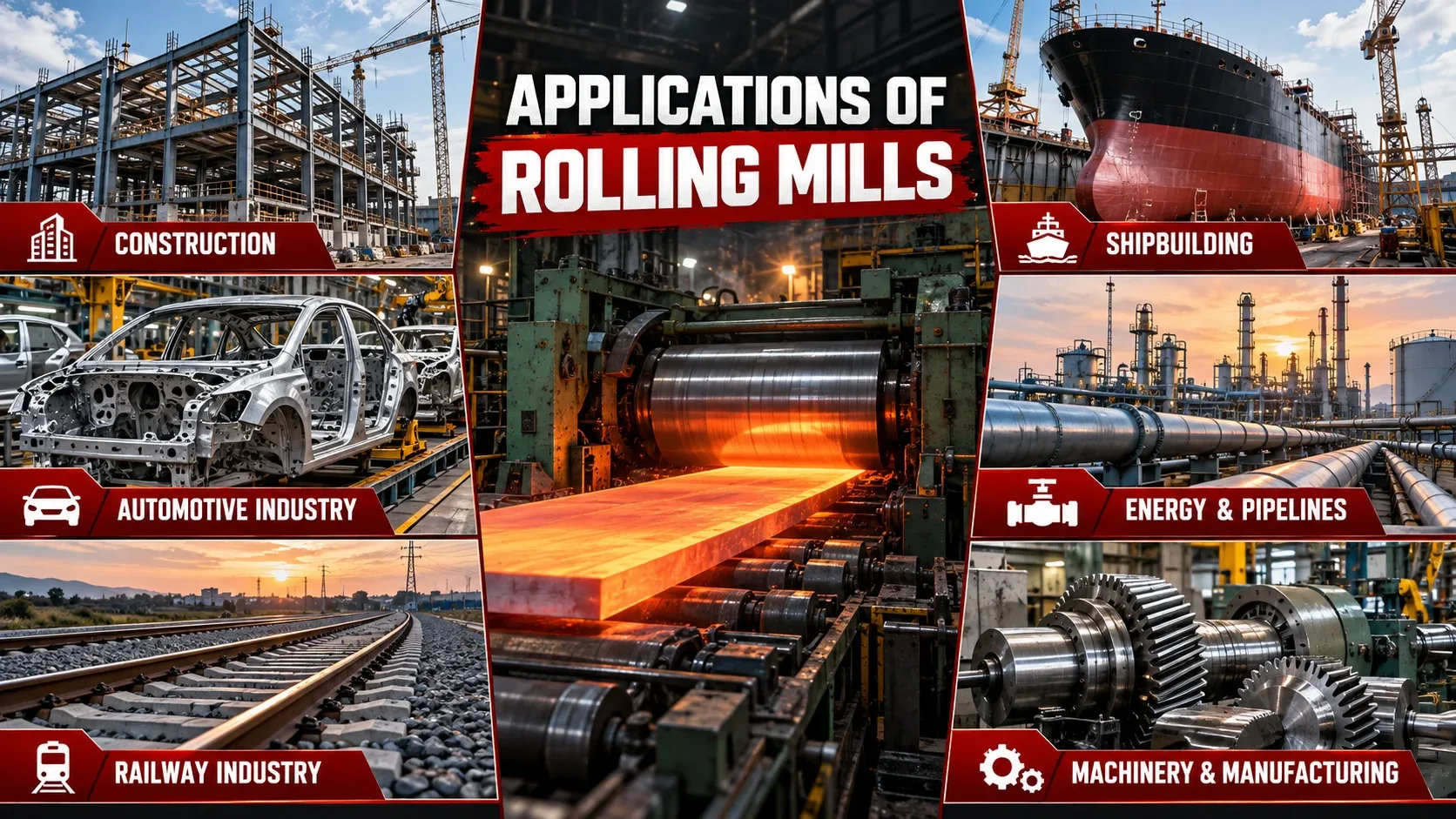
Construction
Rolling mills produce beams, channels, angles, plates, reinforcing bars, and structural steel used in buildings, bridges, factories, and infrastructure.
Automotive Industry
Rolled steel sheet is used for vehicle body panels, chassis components, structural parts, brackets, and wheels.
Railway Industry
Specialized rolling mills manufacture rails and structural sections used in railway infrastructure.
Shipbuilding
Heavy rolled steel plate and structural sections are widely used in ship hulls and marine structures.
Energy and Pipelines
Rolled plate and strip are used in pipelines, pressure vessels, storage equipment, energy infrastructure, and related applications.
Machinery and Manufacturing
Bars, plates, sheets, and structural sections are essential materials for industrial machinery, equipment frames, agricultural machines, and fabricated components.
Advantages of Rolling Mills
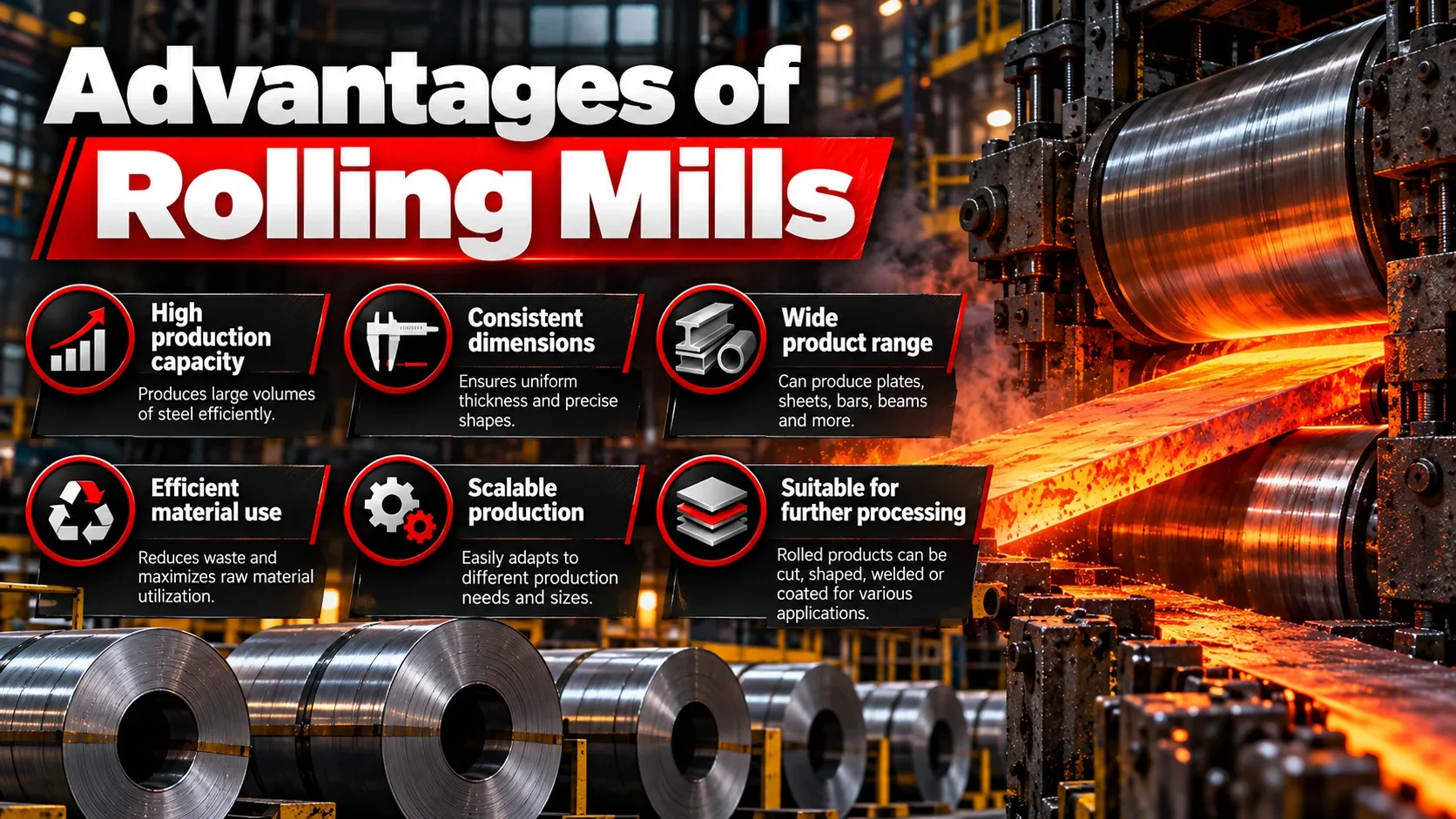
- High production capacity: Modern rolling mills can process large volumes of metal efficiently.
- Consistent dimensions: Automated controls help maintain accurate thickness and shape.
- Wide product range: Mills can produce thin sheet, heavy plate, bars, rods, rails, and structural sections.
- Efficient material use: Rolling reshapes metal without removing large amounts of material.
- Scalable production: Rolling mills can range from small specialized machines to large industrial production lines.
- Suitable for further processing: Rolled steel can be welded, machined, formed, coated, or heat treated.
Limitations and Challenges of Rolling Mills
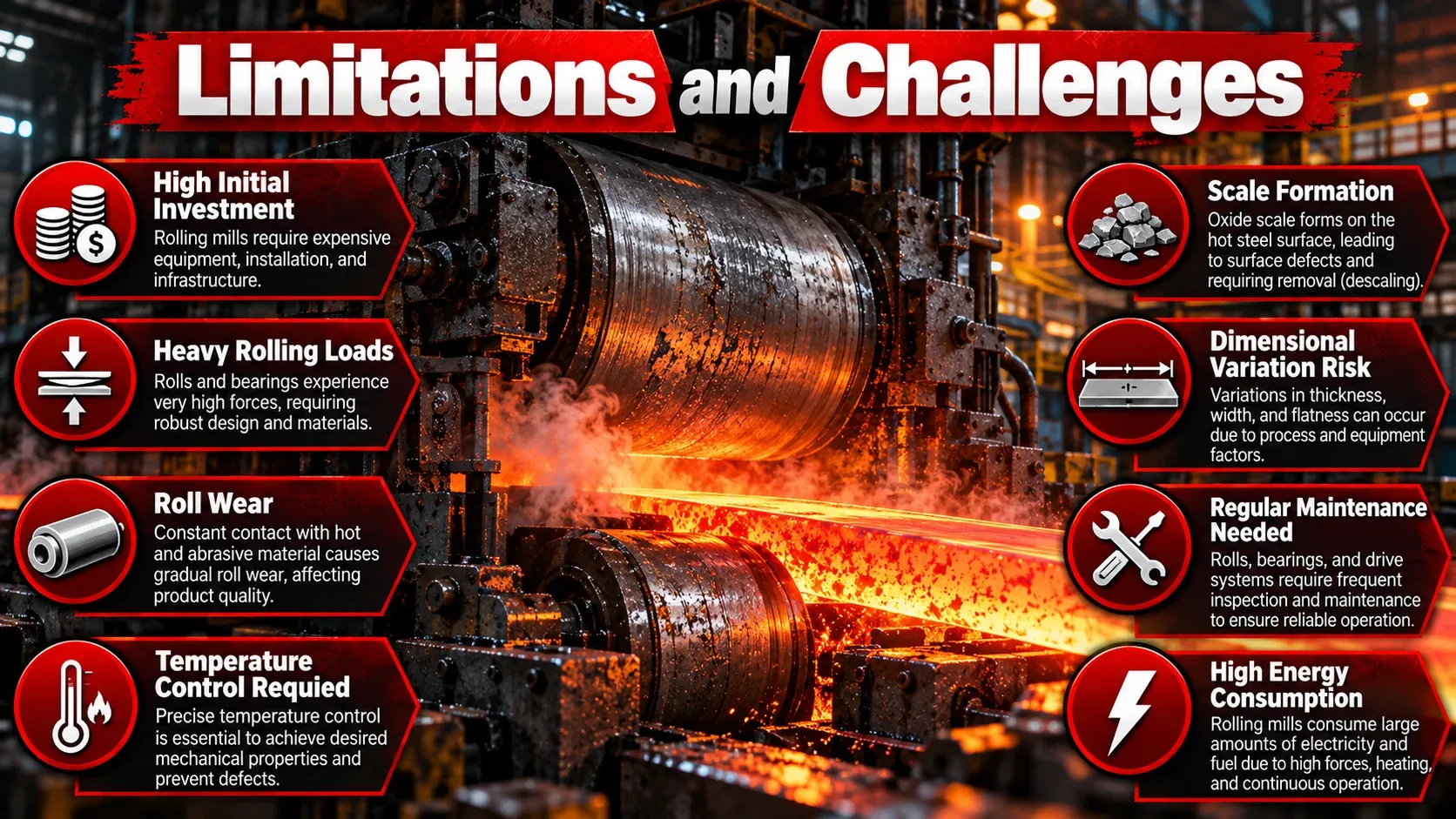
- Large rolling mills require significant investment.
- Heavy rolling loads create stress on rolls, bearings, and mill housings.
- Roll wear can affect product quality and dimensional accuracy.
- Hot rolling requires careful temperature control.
- Scale may form on steel during hot rolling.
- Incorrect roll settings can cause thickness and shape variation.
- Regular maintenance and roll replacement are essential.
- Large mills can consume significant amounts of energy.
Common Rolling Defects
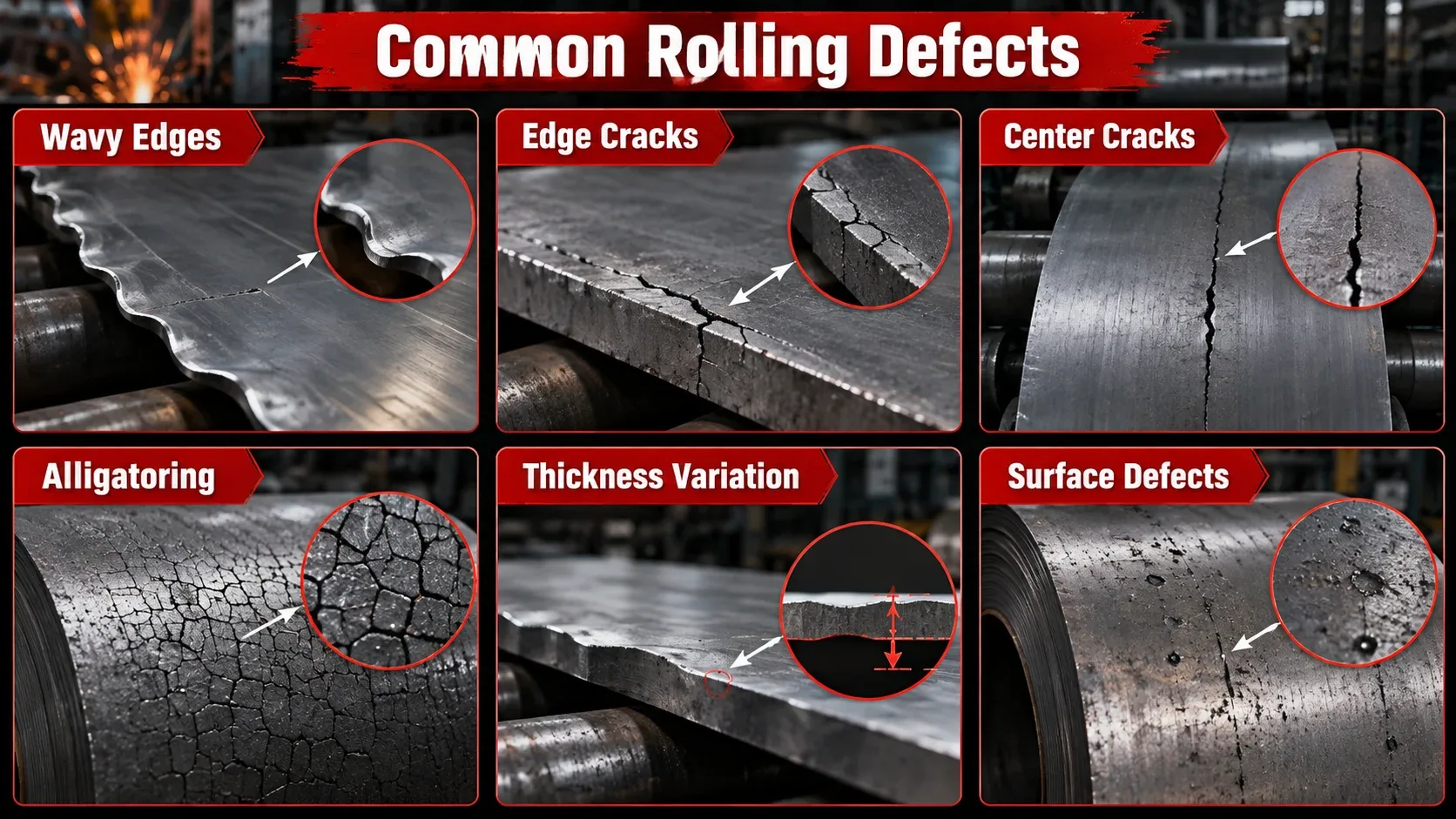
Wavy Edges
Uneven elongation across the width of a strip can make its edges longer than the center, creating a wavy appearance.
Edge Cracks
Cracks can develop along the edges because of excessive deformation, poor temperature control, or limited material ductility.
Center Cracks
Non-uniform deformation and unfavorable stress conditions can create cracking near the center of the material.
Alligatoring
The workpiece may split horizontally so the upper and lower parts separate in a shape resembling an open alligator mouth.
Thickness Variation
Roll deflection, wear, setup problems, or inconsistent rolling force can cause uneven thickness.
Surface Defects
Scale, scratches, inclusions, handling damage, or damaged roll surfaces can affect the final surface quality.
Rolling Mill vs. Forging
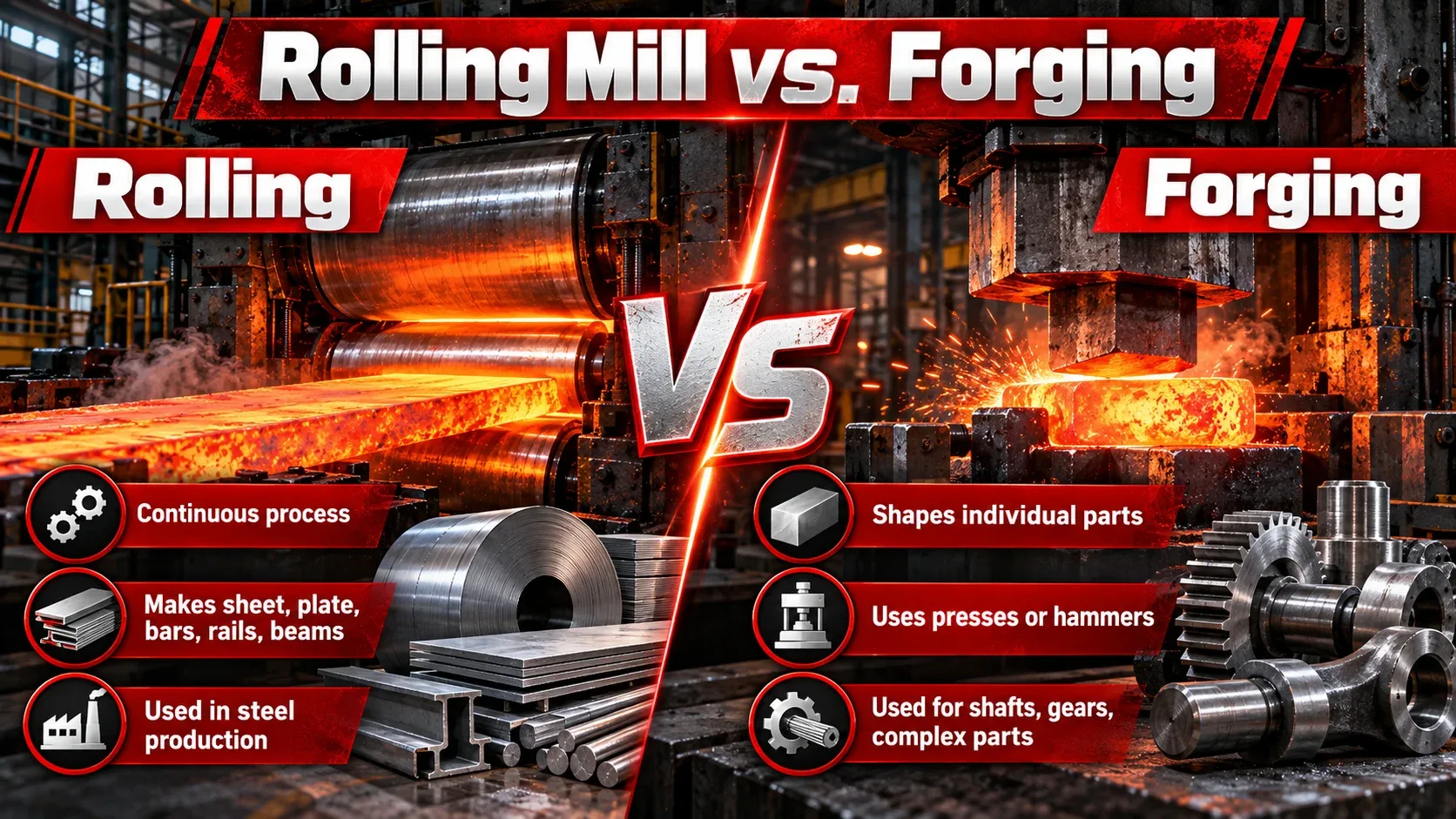
| Feature | Rolling | Forging |
|---|---|---|
| Force Application | Metal passes between rotating rolls | Metal is compressed using dies, presses, or hammers |
| Production Style | Can be continuous | Usually produces individual parts |
| Typical Products | Sheet, plate, bars, rails, beams | Shafts, gears, connecting rods, and complex components |
| Main Industries | Steel, construction, automotive, manufacturing | Automotive, aerospace, machinery, power generation |
How to Choose the Right Rolling Mill
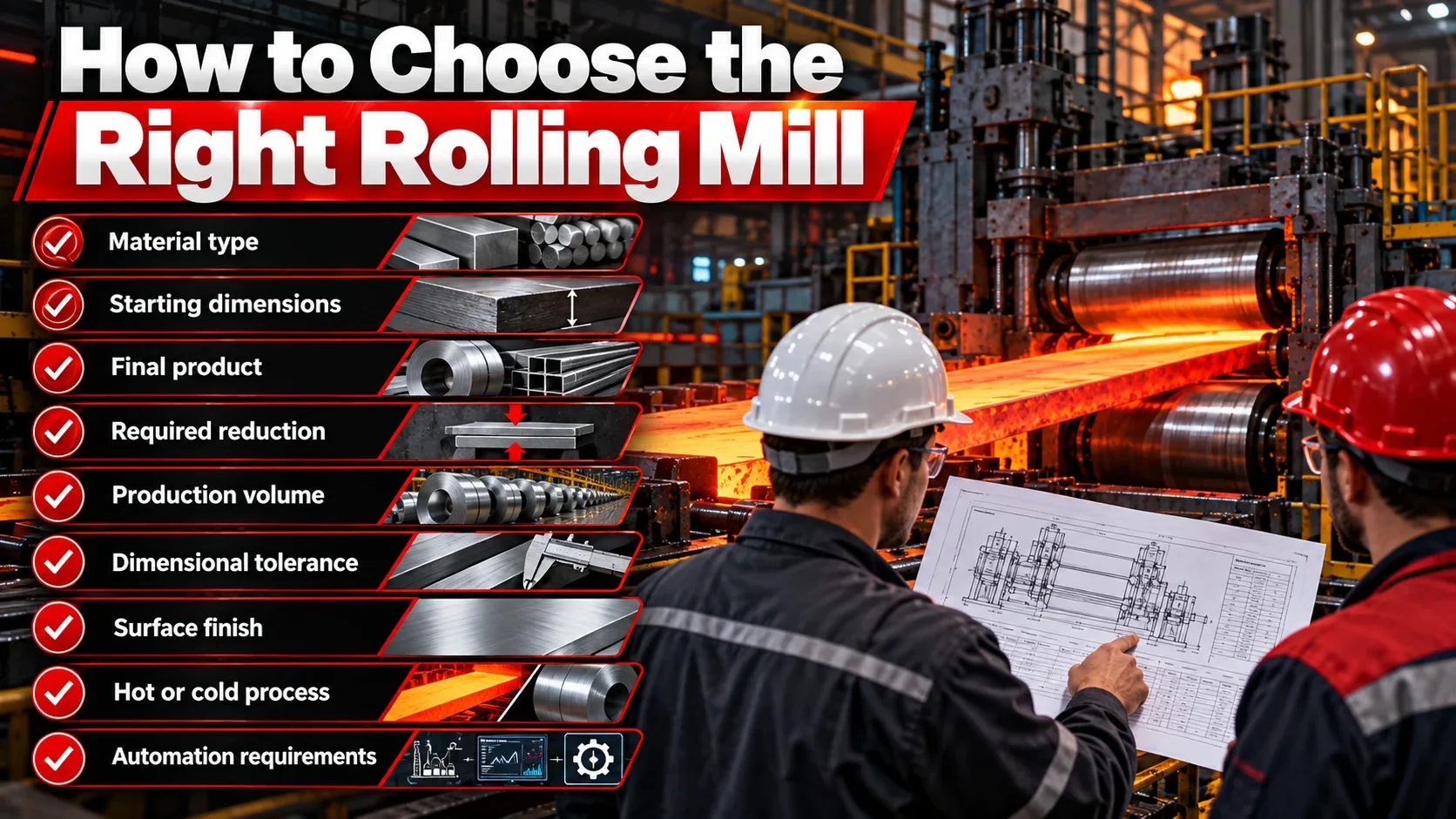
Selecting the correct rolling mill depends on the material, product dimensions, required accuracy, production capacity, and finishing requirements.
- Material type: Steel grade, alloy, strength, and ductility.
- Starting dimensions: Thickness, width, diameter, and initial shape.
- Final product: Sheet, strip, plate, bar, rail, beam, or rod.
- Required reduction: How much the material must be reduced.
- Production volume: Small batches and high-volume continuous production require different equipment.
- Dimensional tolerance: Tighter tolerances may require advanced mill controls.
- Surface finish: Some applications demand smoother surfaces than others.
- Hot or cold process: Processing temperature affects force, finish, and final properties.
- Automation: Modern mills may use automated gauge, shape, tension, and temperature control.
Safety Considerations in Rolling Mill Operations
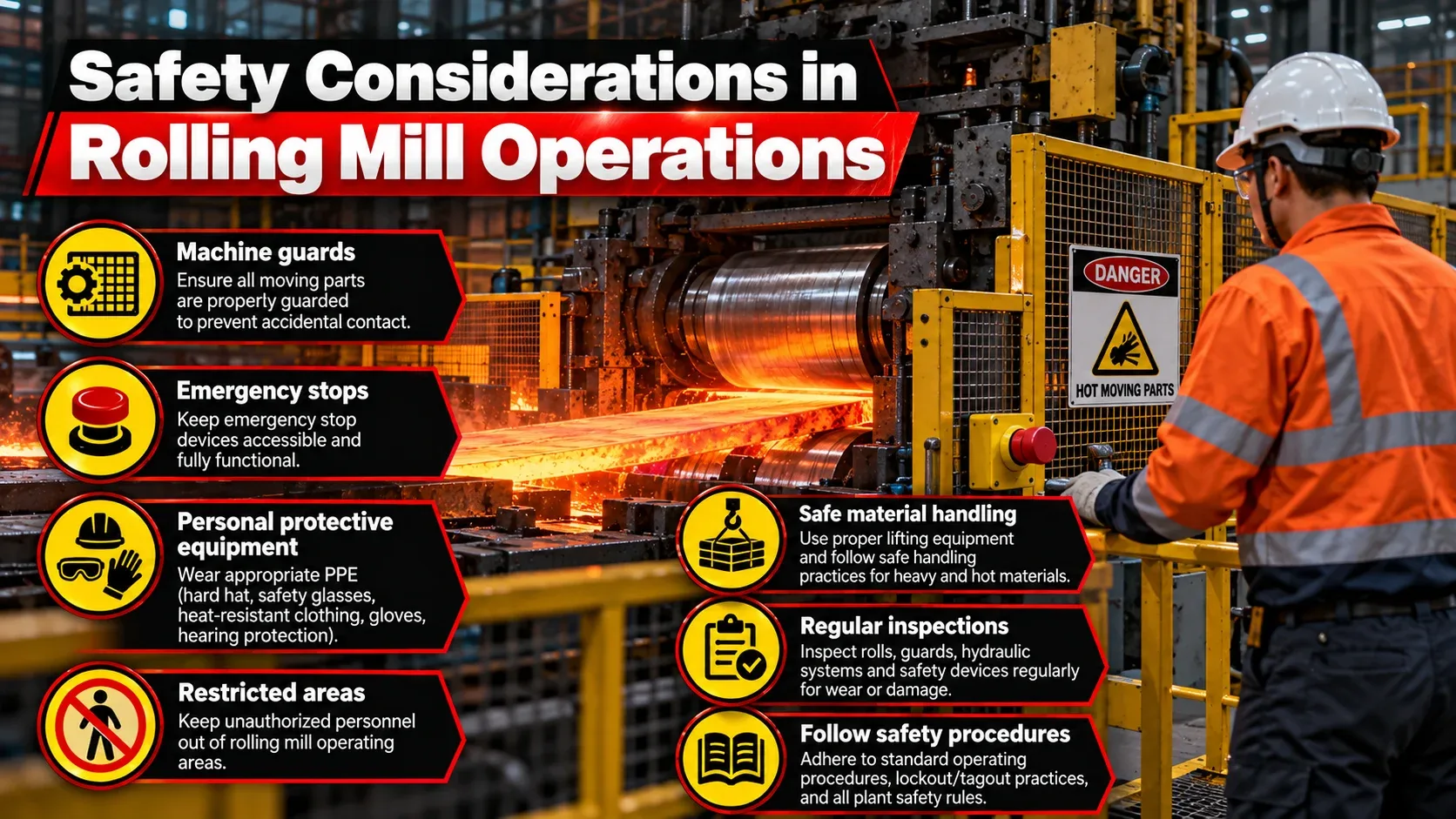
Rolling mills contain rotating machinery, high forces, hot metal, electrical systems, hydraulic equipment, and dangerous pinch points. Safe operation requires trained personnel and proper safety controls.
Common safety measures include machine guards, emergency stops, personal protective equipment, clearly marked restricted areas, safe material handling procedures, and scheduled equipment inspections.
Maintenance work should only be performed after hazardous energy sources have been properly isolated according to the facility’s approved safety procedures.
Frequently Asked Questions About Rolling Mills
What is a rolling mill?
A rolling mill is a machine that shapes metal by passing it between rotating rolls that apply compressive force.
What is a rolling mill used for in steel production?
Rolling mills convert slabs, billets, and blooms into products such as sheet, plate, bars, rods, rails, beams, channels, and coils.
What are the main types of rolling mills?
Common types include two-high, three-high, four-high, cluster, tandem, and universal rolling mills.
What is the difference between hot rolling and cold rolling?
Hot rolling takes place at elevated temperature and is ideal for major deformation, while cold rolling is performed at lower temperature and can provide improved surface finish and dimensional accuracy.
Why are backup rolls used?
Backup rolls support smaller work rolls and reduce bending under heavy rolling loads, helping improve thickness control.
Why does metal become longer during rolling?
As the thickness is reduced, the metal plastically flows and generally extends in the rolling direction.
Why are multiple rolling passes required?
Multiple passes help control rolling force, deformation, temperature, dimensions, and product quality.
What products are made by steel rolling mills?
Rolling mills manufacture sheet, plate, strip, coils, bars, rods, rails, beams, channels, angles, reinforcing bars, and many other steel products.
Final Summary
A rolling mill shapes metal by applying compressive force through rotating rolls. Depending on the roll arrangement and processing conditions, rolling can reduce material thickness or create specific cross-sectional shapes.
Two-high, three-high, four-high, cluster, tandem, and universal rolling mills are used for different manufacturing requirements.
In the steel industry, rolling mills transform slabs, billets, and blooms into products such as sheet, plate, strip, coils, bars, rods, rails, beams, and structural sections. Understanding how each rolling mill works makes it easier to understand why rolling remains one of the most important manufacturing processes in modern steel production.