
A plain-language guide to decoding every number and letter on your tire sidewall — so you can shop with confidence.
If you have ever looked at the side of your tire and seen a code like P205/55R16 91H, you are not alone in wondering what it all means. Each letter and number tells you something specific about the tire — its width, height profile, construction style, the wheel size it fits, how much weight it can carry, and how fast it can safely travel.
Understanding how to read tire size helps you choose the right replacement tires, avoid compatibility problems, and make informed decisions whether you are browsing online or standing in a tire store. Let’s break it down one piece at a time.
The Tire Size Code at a Glance
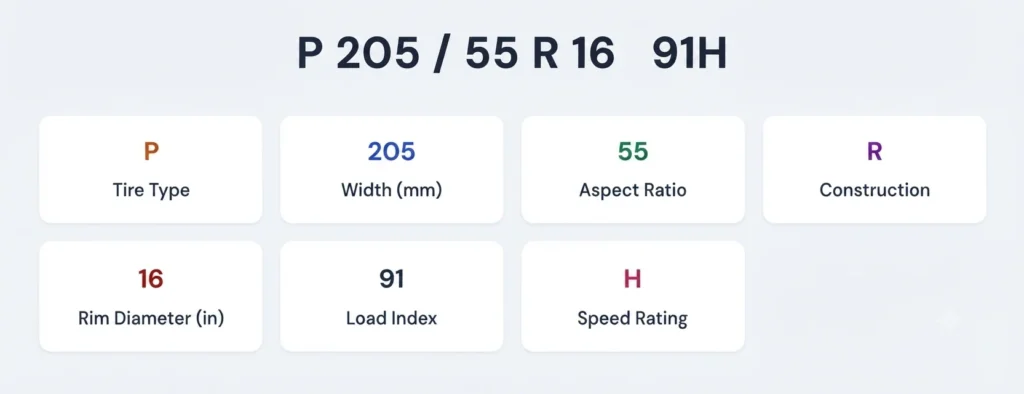
Each segment of the code P205/55R16 91H corresponds to a specific tire specification. Below we explain every part in detail.
The First Letter: Tire Type (P, LT, ST)
The letter at the very beginning indicates the type of vehicle the tire is designed for. “P” stands for P-Metric and means the tire is made for passenger vehicles — cars, crossovers, minivans, and some smaller SUVs. If you see “LT” instead, the tire is built for light trucks and may have a stronger sidewall for heavier loads. “ST” stands for Special Trailer and is used only on trailer wheels.
Some tires made under European standards may not have a letter prefix at all. These are called Euro-Metric tires and are generally equivalent to P-Metric for everyday passenger use.
The First Number: Section Width in Millimeters
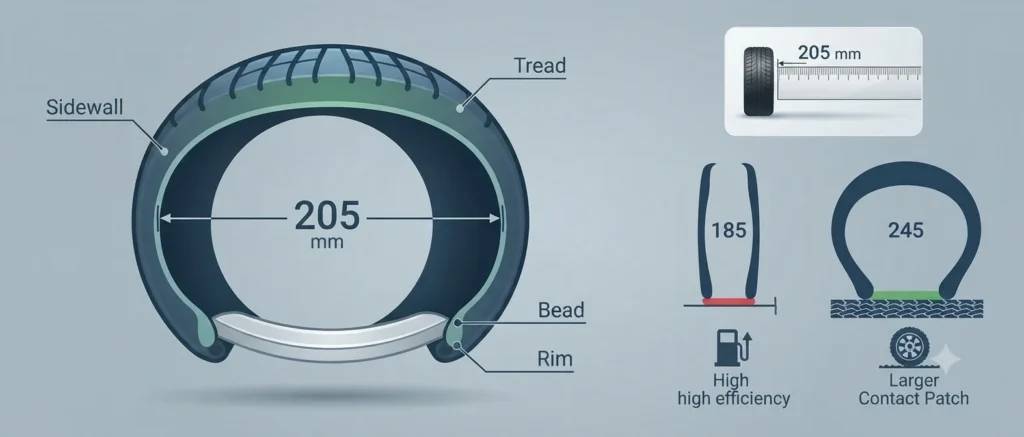
The three-digit number immediately after the letter — 205 in our example — is the tire’s section width measured in millimeters. This is the distance from one sidewall to the other when the tire is properly mounted and inflated. A wider tire (such as 225 or 245) provides a larger contact patch with the road, while a narrower tire (such as 185) may offer lower rolling resistance and better fuel economy.
The Aspect Ratio: Sidewall Height as a Percentage
After the slash you will find a two-digit number — 55 in P205/55R16. This is the aspect ratio, and it tells you how tall the sidewall is relative to the tire’s width. An aspect ratio of 55 means the sidewall height is 55 percent of 205 mm, which equals about 113 mm.
Lower aspect ratios (such as 40 or 45) give tires a sportier, low-profile look and sharper handling. Higher aspect ratios (such as 65 or 70) produce a taller sidewall that absorbs bumps more comfortably — common on SUVs and trucks.
The Letter R: Internal Construction Type
The letter between the aspect ratio and the rim diameter indicates how the tire is built internally. “R” means radial construction, where the internal cord plies run at 90 degrees to the direction of travel. Nearly all modern passenger tires are radial because this design offers better road grip, longer tread life, and a smoother ride. You may rarely see “D” for diagonal (bias-ply) construction on some trailer or vintage-vehicle tires.
Rim Diameter: The Wheel Size in Inches
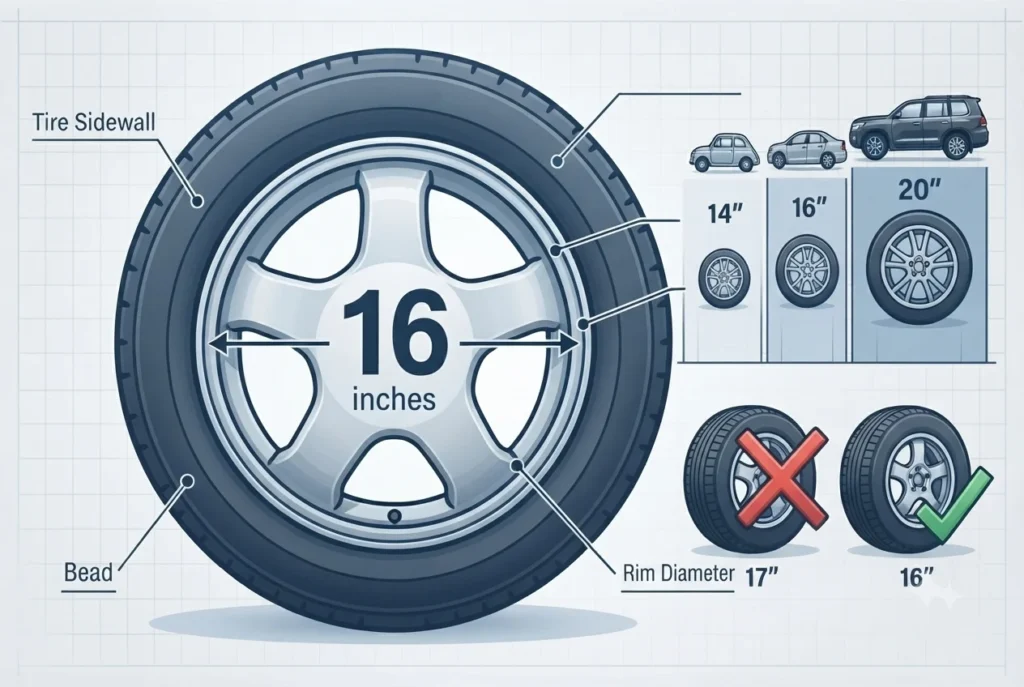
The number after the construction letter — 16 in our example — is the diameter of the wheel (rim) in inches that the tire is designed to fit. This must match the actual wheel on your vehicle. Common rim diameters range from 14 inches on older compact cars to 20 inches or more on modern trucks and luxury SUVs. Installing a tire on a rim of the wrong diameter is physically impossible or dangerous, so always confirm this number.
Load Index: Maximum Weight Capacity
After a space you will see a two- or three-digit number — 91 in our example. This is the load index, a standardized code that indicates the maximum weight one tire can support when properly inflated. A load index of 91 corresponds to 1,356 pounds (615 kg) per tire.
Never choose a replacement tire with a lower load index than the original specification. NHTSA recommends using the size and load capacity specified by the vehicle manufacturer to maintain safe handling and braking performance.
Speed Rating: Maximum Safe Speed
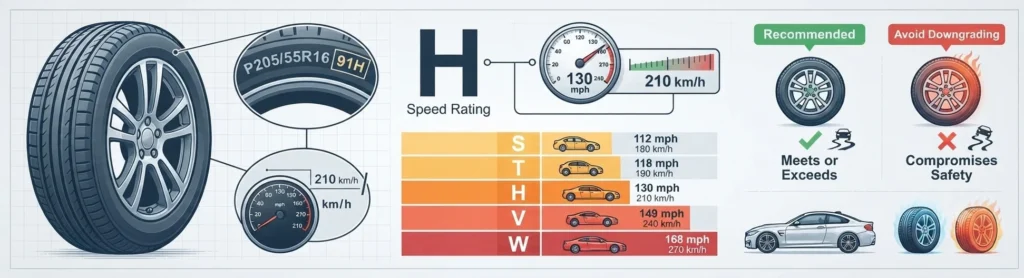
The final letter — H in P205/55R16 91H — is the speed rating. It indicates the maximum sustained speed the tire can handle under ideal conditions. An H rating means the tire is approved for speeds up to 130 mph (210 km/h). Common ratings include S (112 mph), T (118 mph), H (130 mph), V (149 mph), and W (168 mph).
Your replacement tire should meet or exceed the speed rating originally specified for your vehicle. Downgrading the speed rating may compromise high-speed stability and heat dissipation even if you rarely drive at those speeds.
Where to Find Your Recommended Tire Size
The most reliable place to find the correct tire size for your vehicle is the Tire and Loading Information placard. On most vehicles this sticker is located on the driver-side door jamb — the edge of the door frame visible when the door is open. It lists the manufacturer-recommended tire size, the correct cold inflation pressure, and the vehicle’s maximum load.
You can also find this information in the owner’s manual. Do not rely solely on the size printed on your current tires, because a previous owner may have installed a non-standard size.
Can I Use a Different Tire Size?
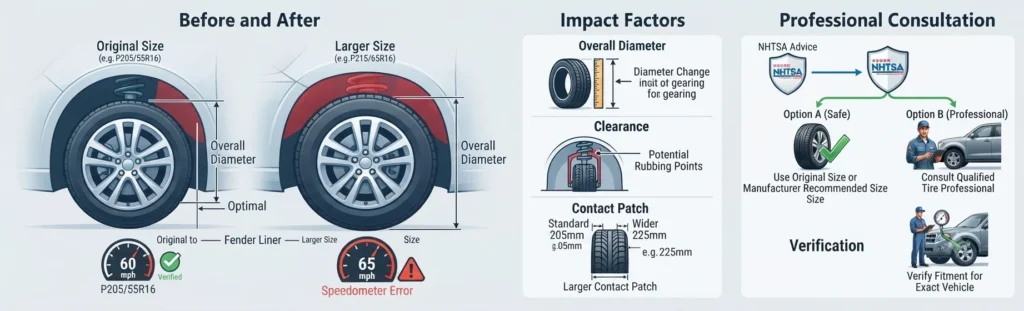
In some cases you can install a slightly different tire size — for example, going from 205/55R16 to 215/55R16 for a wider contact patch. However, even small changes affect the tire’s overall diameter, speedometer accuracy, and clearance inside the wheel well. A tire that is too wide or too tall may rub against suspension components or fender liners.
NHTSA advises drivers to use the original tire size or another size specifically recommended by the vehicle manufacturer. If you are considering a size change, consult a qualified tire professional who can verify fitment for your exact vehicle.
A Note on Tire Pressure
You may notice a maximum pressure number printed on the tire sidewall (for example, “Max Press 51 PSI”). This is the maximum pressure the tire itself can safely hold — it is not necessarily the pressure you should use every day. The correct everyday inflation pressure is the one listed on the door placard or in your owner’s manual.
Over-inflating to the sidewall maximum can reduce your contact patch, cause uneven center wear, and make the ride harsh. Under-inflating wastes fuel, generates excess heat, and shortens tire life. Stick to the vehicle manufacturer’s recommendation.
Finding Affordable Tires That Fit Correctly
Price matters, but fitment matters more. When shopping for affordable tires at a tire store or online, start by entering your exact tire size. This immediately narrows the results to products that physically fit your wheels and meet the basic specifications. From there you can compare brands, tread warranties, and customer reviews.
Budget-friendly tires from well-known manufacturers can still deliver reliable performance if they match your vehicle’s required size, load index, and speed rating. Avoid the temptation to buy a cheaper tire in the wrong size — the cost of premature wear, poor handling, or a potential safety issue far outweighs the initial savings.
Quick Recap: How to Read Tire Size
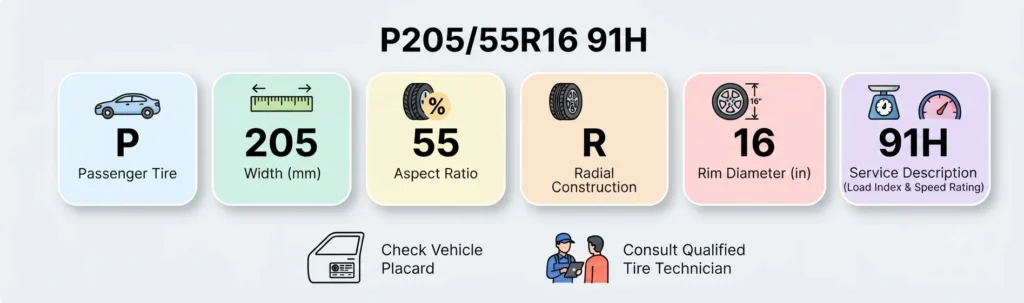
Reading a tire size like P205/55R16 91H is straightforward once you know what each part represents: P = passenger tire, 205 = width in millimeters, 55 = sidewall height as a percentage of width, R = radial construction, 16 = rim diameter in inches, 91 = load index (weight capacity), and H = speed rating.
Before you buy replacement tires, check your door placard for the manufacturer-recommended size and pressure. If anything is unclear or you want to explore a different size, ask a qualified tire technician. With the right information in hand, you can confidently choose tires that fit your vehicle, match your driving needs, and stay within your budget.
Frequently Asked Questions
What is the most common tire size?
The most common passenger car tire size in recent years is 205/55R16, widely used on compact cars and sedans like the Toyota Corolla and Honda Civic. However, 225/65R17 has also become extremely common due to the rising popularity of compact SUVs.
Can I put wider tires on my stock rims?
Generally yes, you can often go up 10mm in section width (e.g. from 205 to 215) on your original wheels without issues. However, changing sizes can affect speedometer accuracy and suspension clearance. Always consult a tire professional first.
How do I know when my tires need to be replaced?
Tires should be replaced if tread depth reaches 2/32 of an inch (use the penny test), or if you notice visible cracks, bubbles, punctures, or uneven wear patterns. Additionally, tire manufacturers recommend replacing any tire that is over 6 to 10 years old, regardless of tread wear.