

That yellow dashboard light doesn’t mean you’re a bad driver—it just means the weather got cold. Here’s exactly what it means and how to fix it in 5 minutes.
🚗Sound familiar?
You’re sitting in traffic on a cold morning. Your dashboard beeps. A yellow horseshoe with an exclamation mark appears. Your heart sinks. “Is my tire flat? Am I going to crash?” you think. But here’s the thing—it’s probably just a case of cold weather doing what cold weather does. And you can fix it yourself in five minutes with no tools.
What That Yellow Light Actually Means
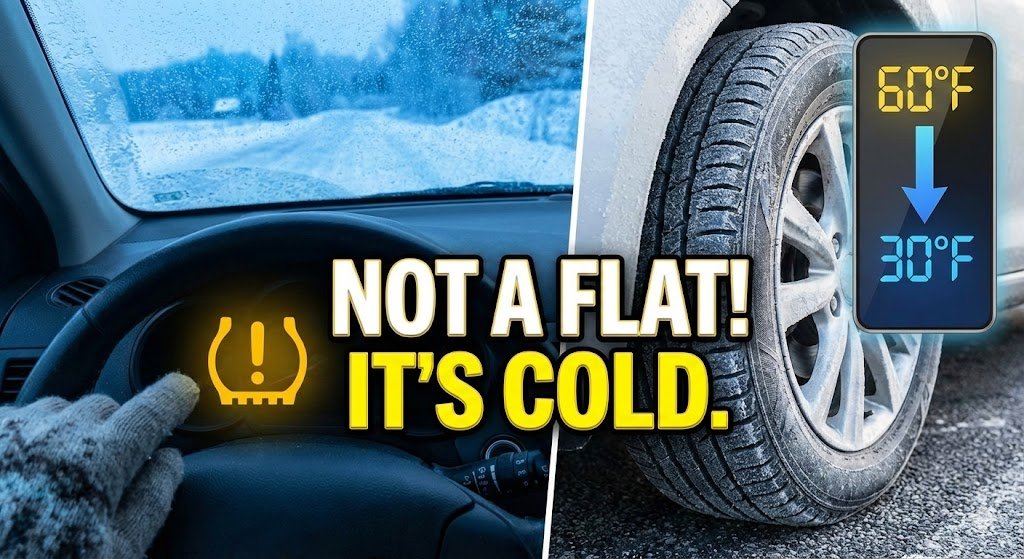
The symbol on your dashboard is your TPMS—Tire Pressure Monitoring System. It’s not saying “Your tire is flat.” It’s saying “Your tire pressure is 5-10% lower than it should be.” And on a cold morning? That’s completely normal.
Air contracts when temperatures drop. For every 10 degrees Fahrenheit your outside temperature falls, tire pressure can drop by about 1 PSI. So if you live somewhere that dropped from 60°F to 30°F overnight, your tires probably went from a comfortable 32 PSI to around 29 PSI. Your TPMS woke up and said, “Hey, that’s a problem,” and lit up your dashboard.
This is actually the system working exactly as it should. Your car is looking out for you.
Why This Matters (Beyond That Annoying Beep)
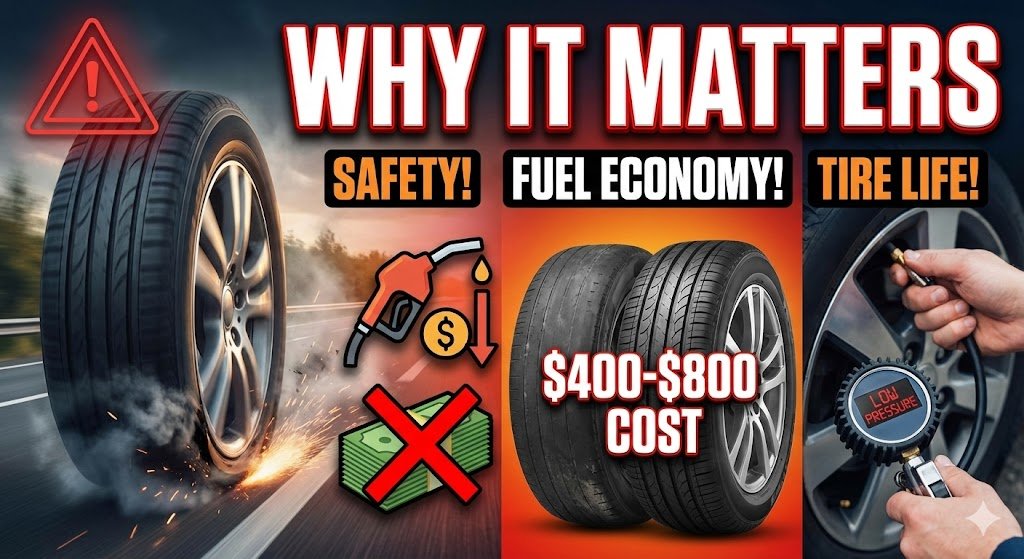
Low tire pressure isn’t just an inconvenience. It actually affects three things you care about:
🛡️ Safety
Under-inflated tires have more flex, which generates heat. Heat is the enemy of tire life. In extreme cases, it can lead to a blowout on the highway and that’s a genuinely scary situation.
⛽ Fuel Economy
When your tires are soft, there’s more rolling resistance. Your engine works harder. You burn more gas. With today’s fuel prices, those pennies add up.
🔧 Tire Lifespan
Tires run hot when they’re under-inflated. That heat breaks down the rubber compounds. Drive around with low pressure for weeks, and you’ll wear out your tires 20-30% faster. A new set costs $400-$800. A quarter’s worth of air at the gas station costs $0-$2.
The choice is pretty clear.
The Great PSI Confusion: 32 vs. 44
Here’s where most people get confused. You open your car door to check the sticker, and you see “Front: 32 PSI. Rear: 32 PSI.” You nod and walk to your tire. On the sidewall, you see stamped in big letters: “MAX PSI 44.”
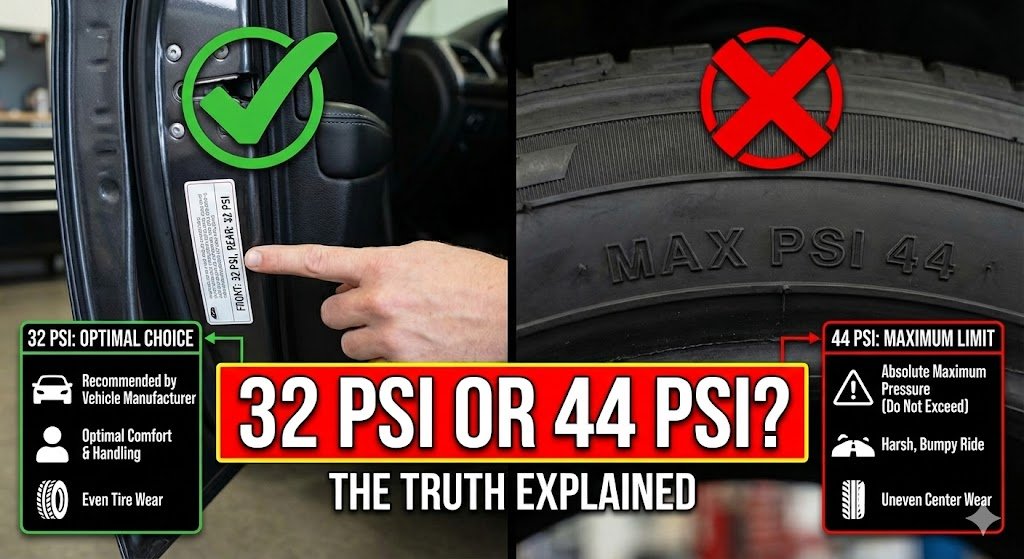
“Wait,” you think, “should I use 32 or 44?”
The answer is 32. Here’s why:
- The door jamb sticker (32 PSI) is YOUR number. This is what Bridgestone and your car’s engineer calculated as the optimal pressure for your vehicle’s weight, handling, braking, and ride comfort. It’s specifically tuned for your car.
- The tire sidewall number (44 PSI) is the tire’s maximum capacity. It’s like the speed limit on a highway. You *can* go 85 mph on a highway with a 75 mph speed limit, but you shouldn’t. The tire can safely handle up to 44 PSI, but running it that high would make your ride harsh, reduce grip, and wear the center of your tire faster.
⚠️ Common Mistake
Many people inflate their tires to the “MAX PSI” number on the sidewall. This is like eating nothing but steak because it’s “healthy”—technically something you could do, but it defeats the purpose of nutrition. Use the door jamb number. Always.
How to Fix It (5-Step Action Plan)
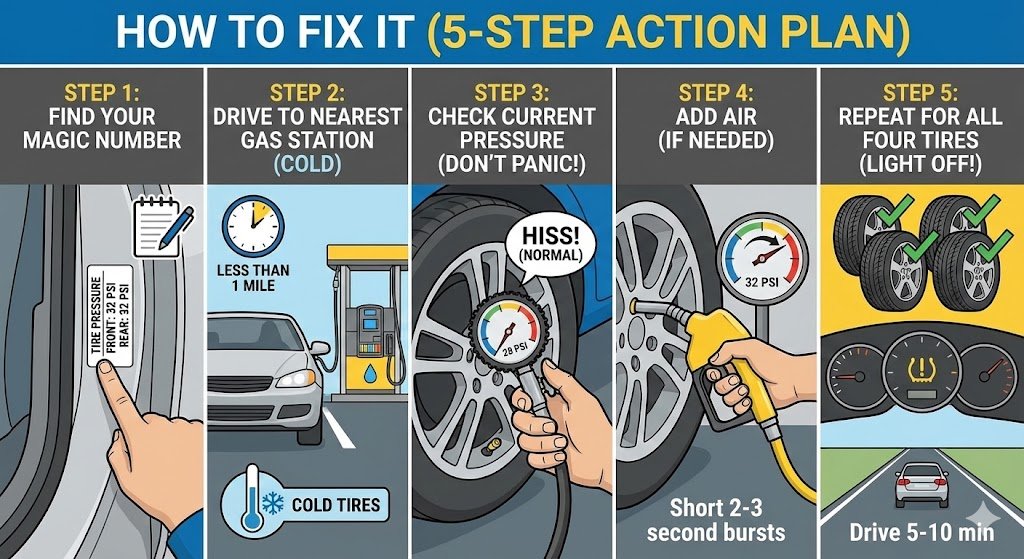
Step 1: Find Your Magic Number
Open your driver’s door and look at the edge where it closes. You’ll see a white or yellowish sticker with tire specifications. Write down the PSI number. (Most cars: 30-35 PSI.)
Step 2: Drive to Your Nearest Gas Station
You want to check your tires when they’re “cold”—that means driven less than a mile. Tire pressure rises when you drive because the rubber heats up. Checking them cold gives you an accurate reading.
Step 3: Check Your Current Pressure
At the air pump, remove the plastic cap from your first tire’s valve stem. Press a gauge firmly onto the valve stem. You’ll hear a brief hiss—that’s just air escaping before the seal forms. It’s less than 0.1 PSI. Don’t panic. This is normal.
Read the number on the gauge. Compare it to your target PSI.
Step 4: Add Air (If Needed)
If the pressure is low, press the air hose nozzle onto the valve stem. Add air in short 2-3 second bursts, then check with the gauge again. It’s easier to add a little more air than to let air out, so take your time.
Step 5: Repeat for All Four Tires
Don’t forget the spare if you have a full-size spare! Once all four are at the correct PSI, replace the valve caps and you’re done.
Now drive for 5-10 minutes. The TPMS light should disappear on its own.
The “Hiss” Doesn’t Mean You’re Doing It Wrong
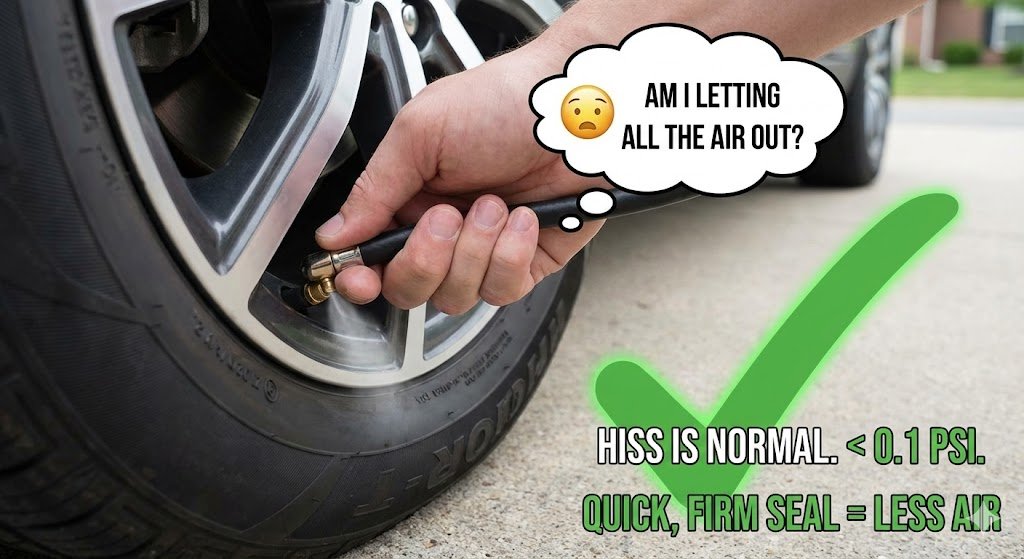
A lot of people worry about that hissing sound when they press the gauge onto the valve. “Am I letting all the air out?” they wonder. “Am I making it worse?”
No. The hiss is just a tiny amount of air escaping before the seal forms between the gauge and the valve. We’re talking about less than 0.1 PSI—roughly equivalent to a single breath. It’s completely insignificant.
If you’re paranoid about it (and hey, many of us are), just press the gauge on straight and firm, quickly. The faster you seal it, the less air escapes. You’ll master this by your second tire, guaranteed.
Digital or Stick Gauge?
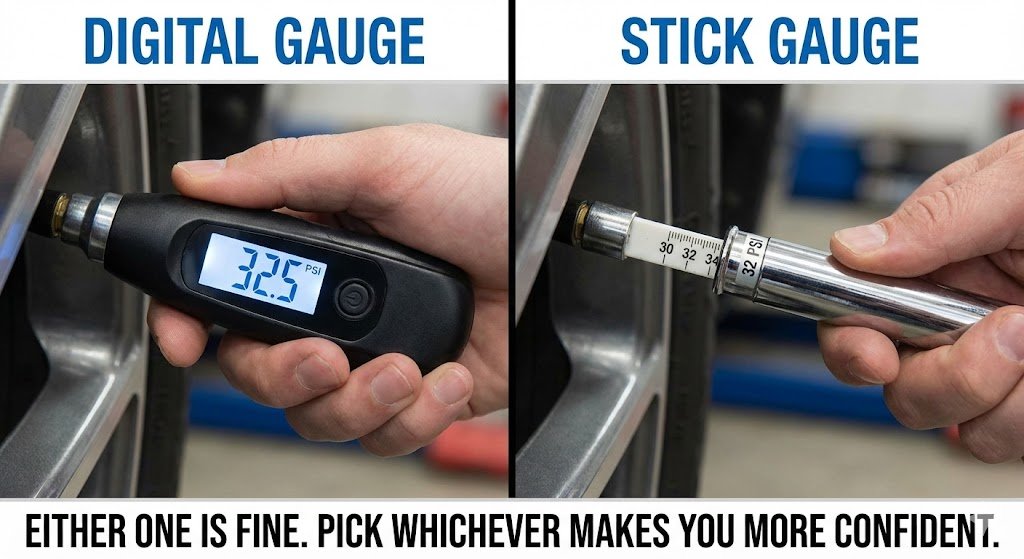
You’ll see two types of gauges at gas stations:
Digital gauge: Shows the PSI on a little screen. Easy to read. Accurate. Most people prefer these.
Stick gauge: A small white stick pops out as air enters. You read the number at the tip. Takes a tiny bit more practice, but works just fine.
Either one is fine. Pick whichever makes you more confident.
What If the Light Doesn’t Turn Off?
After you’ve inflated all four tires and driven for 10 minutes, the light should turn off. Sometimes it takes a drive around the block. But if it stays on:
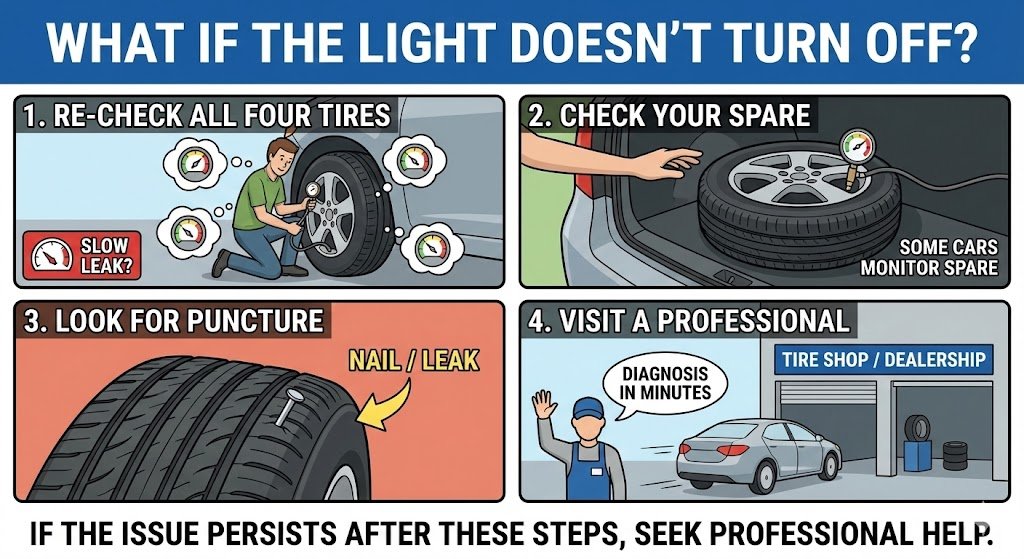
- Check all four tires again. You might have missed one, or one might have a slow leak.
- Check your spare. Some vehicles monitor the spare tire pressure too.
- Look for a puncture or leak. If a tire has a screw or nail in it, or if the valve stem is leaking, you’ll need to get it repaired.
- Visit a dealership or tire shop. If you can’t figure it out after rechecking, a professional can diagnose it in minutes.
The Winter Tip Nobody Talks About
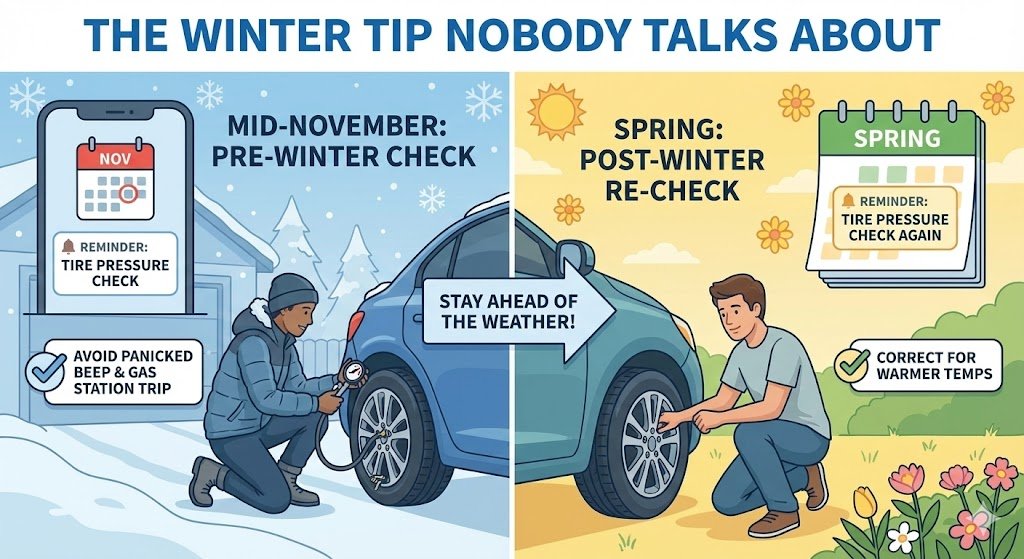
If you live somewhere with real winters, set a calendar reminder for mid-November. Before the big temperature drop, check your tire pressure preemptively. You’ll avoid that panicked dashboard beep on a cold morning and save yourself the trip to the gas station.
Also, check again in the spring when temperatures warm up. Tires that were perfect at 30°F will be slightly over-inflated at 60°F.
You’ve Got This
Checking tire pressure might feel intimidating the first time. You’ll stand at the gas station thinking, “What if I mess this up? What if I let all the air out? What if I look foolish fumbling with the hose?”
Here’s the truth: You won’t mess it up. The hose and valve are designed to work together—that’s literally what they’re made for. And everyone at the gas station has been exactly where you are. Nobody’s judging.
This single five-minute task will make your car safer, improve your fuel economy, and add months to your tire life. That yellow light on your dashboard? It’s not a problem. It’s just your car asking you to take care of it. And now you know exactly how.
So next time that light beeps, take a breath. You’ve got this.