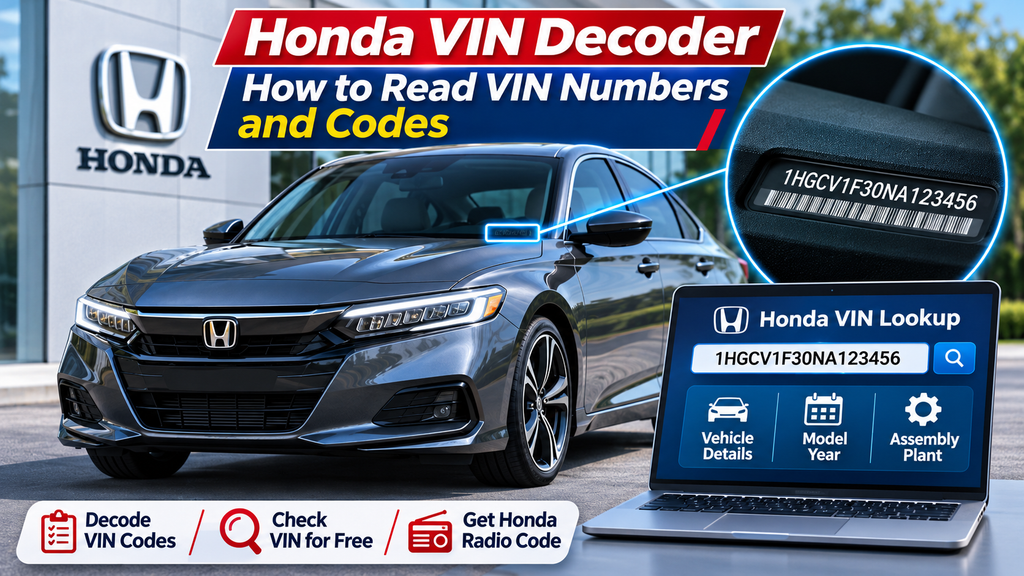
A Honda VIN decoder helps you understand the 17-character identification number assigned to your vehicle. Whether you drive a Civic, Accord, CR-V, Pilot, or Odyssey, a VIN lookup can help confirm the model year, manufacturer, assembly plant, and certain vehicle specifications.
To decipher Honda VIN information, you do not need to memorize every code. Start with the VIN’s basic structure, enter the complete number into a trustworthy decoder, and compare the results with your vehicle documents. This guide shows you how, including how to check your VIN for free and what to do if your Honda radio requests an anti-theft code.
Quick Answer: How to Read a Honda VIN
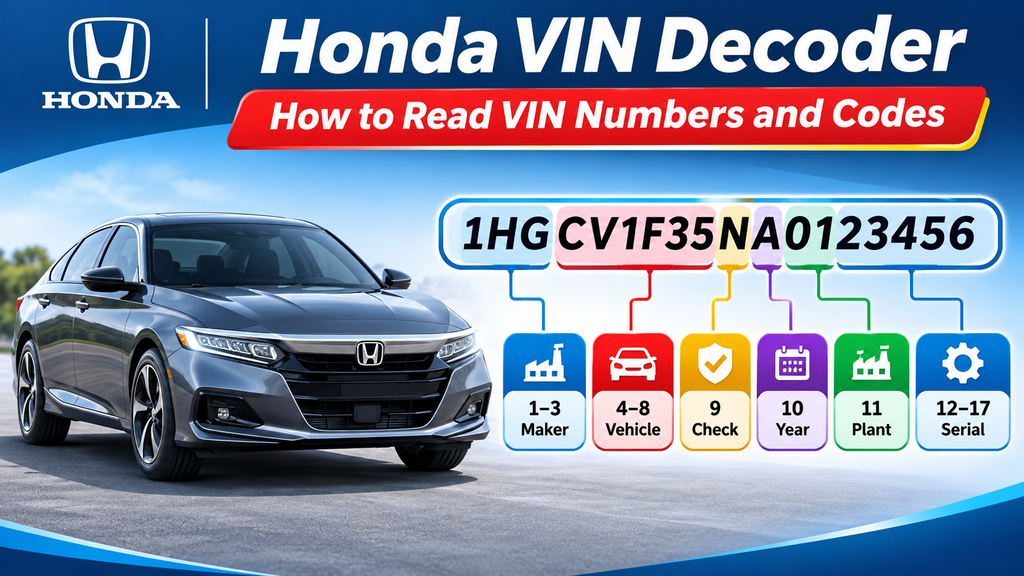
For modern U.S.-market Honda vehicles, each part of the standard 17-character VIN has a purpose:
| Characters | What they describe |
|---|---|
| 1–3 | Manufacturer identifier (WMI) |
| 4–8 | Vehicle descriptors |
| 9 | Check digit |
| 10 | Model year |
| 11 | Assembly plant |
| 12–17 | Production sequence |
What Is a Honda VIN Number?
A Vehicle Identification Number (VIN) is a unique identifier assigned to a motor vehicle. Modern Honda vehicles sold in the United States use a standardized 17-character VIN made from letters and numbers. The number is used in registration, insurance, recall tracking, parts research, and vehicle identification.
A VIN is not the same as a license plate or a vehicle history report. The plate may change, while the vehicle’s original VIN is intended to remain tied to that particular vehicle. A VIN decoder explains encoded identification data; it does not independently prove accident history, mileage accuracy, or mechanical condition.
How to Decipher a Honda VIN Number
The easiest way to decipher a Honda VIN is to divide the number into the six groups shown below. The general structure is standardized, but the exact manufacturer-defined vehicle and plant codes can change by Honda model and model year.

Characters 1–3: Manufacturer Identifier
The first three characters form the World Manufacturer Identifier (WMI). They identify the manufacturer and vehicle category. Some common Honda WMIs include:
| Prefix | Typical identification |
|---|---|
| 1HG | U.S.-built Honda passenger cars |
| 2HG | Canadian-built Honda passenger cars |
| JHM | Honda passenger cars associated with Japan |
| JHL | Honda multipurpose vehicles associated with Japan |
| 2HK | Canadian-built Honda multipurpose vehicles |
These are examples, not a complete Honda prefix list. Other identifiers exist for additional factories, vehicles, and markets.
Characters 4–8: Vehicle Description
Positions four through eight contain Honda-defined information about the vehicle. Depending on the model year, these codes may relate to the model line, body configuration, engine, restraint system, or other characteristics. A character does not necessarily mean the same thing across different Honda generations. Use model-year-specific manufacturer information rather than a universal engine-code chart.
Character 9: Check Digit
The ninth character is calculated using a standardized formula applied to the other VIN characters. It can help flag transcription mistakes. An X in this position represents the calculated value ten. A valid check digit does not guarantee that a VIN has not been copied or misused.
Character 10: Honda Model Year Code
The tenth character identifies the model year under the applicable VIN rules. A model year is not necessarily the same as the calendar year of assembly.
| Code | Year | Code | Year |
|---|---|---|---|
| A | 2010 | L | 2020 |
| B | 2011 | M | 2021 |
| C | 2012 | N | 2022 |
| D | 2013 | P | 2023 |
| E | 2014 | R | 2024 |
| F | 2015 | S | 2025 |
| G | 2016 | T | 2026 |
| H | 2017 | V | 2027 |
| J | 2018 | W | 2028 |
| K | 2019 | X | 2029 |
Example: The letter T in the tenth position identifies a 2026 model year in the current cycle. Model-year codes repeat approximately every 30 years, so the vehicle’s age and full VIN matter when identifying older Hondas. Standard VINs do not use the letters I, O, or Q.
Character 11: Assembly Plant
The eleventh position represents the factory where the vehicle was assembled. Plant-letter meanings vary by manufacturer documentation and production period, so confirm a plant through the applicable Honda decoder information instead of relying on a single generic chart.
Characters 12–17: Production Sequence
For a major manufacturer such as Honda, the final six characters typically serve as a manufacturer-assigned production identifier. They distinguish individual vehicles when interpreted with the remaining VIN characters. They do not directly reveal an exact assembly date or a worldwide production count.
Where to Find the VIN on a Honda Vehicle
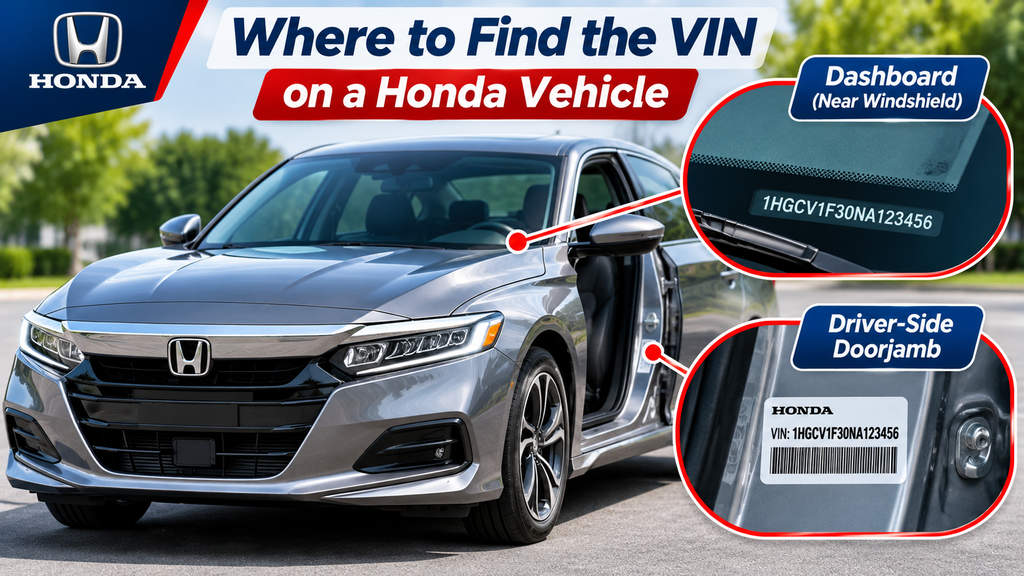
You can usually locate the VIN in more than one place. Check the number carefully before entering it into a decoder.
Driver-Side Dashboard
Stand outside the vehicle and look through the windshield near the lower driver’s-side corner. Many Hondas have a VIN plate visible at the base of the windshield.
Driver’s Doorjamb
Open the driver’s door and inspect the manufacturer label on the doorjamb or adjacent pillar. The VIN should agree with the dashboard identification.
Title, Registration, and Insurance Documents
Your vehicle’s paperwork typically includes the VIN. When buying a used Honda, compare the documents against the physical vehicle rather than relying only on a seller-provided number.
How to Perform a Free Honda VIN Lookup
The National Highway Traffic Safety Administration offers a public decoder that displays available manufacturer-reported VIN information. This is a practical starting point for a honda vin lookup.
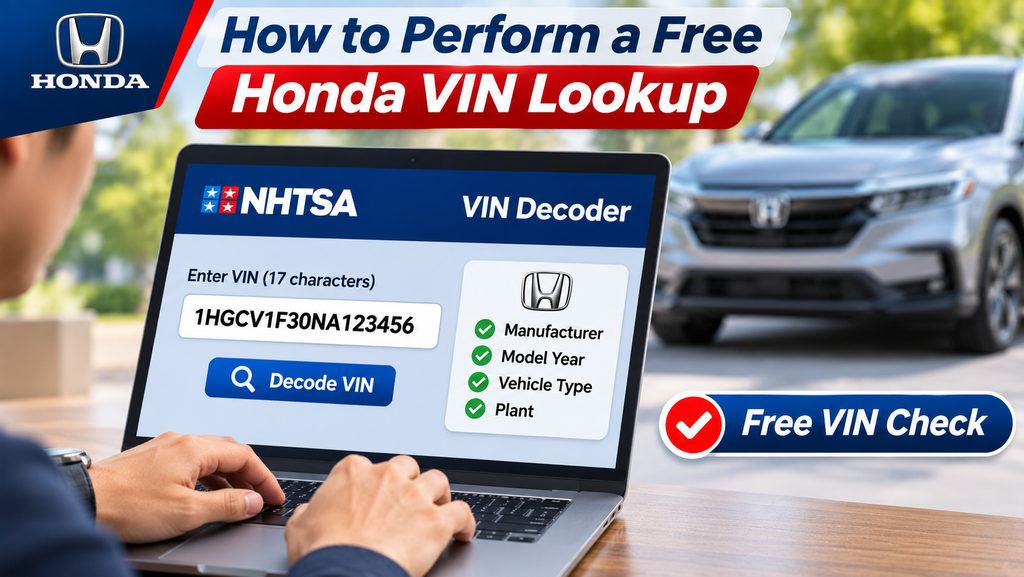
Some fields may be blank or marked unavailable, especially when manufacturer submissions do not contain the requested detail. A blank field does not automatically mean that the VIN is invalid.
What a Honda VIN Number Check Free of Charge Can and Cannot Do
| Information | Standard VIN decoder |
|---|---|
| Manufacturer and model year | Generally available |
| Plant and engine-related specifications | Often available, but varies |
| Exact trim and optional packages | Not always identified |
| Accident, ownership, and title history | Not provided by decoding alone |
| Outstanding recalls | Check separately using a recall tool |
Can You Find a Honda Radio Code by VIN?
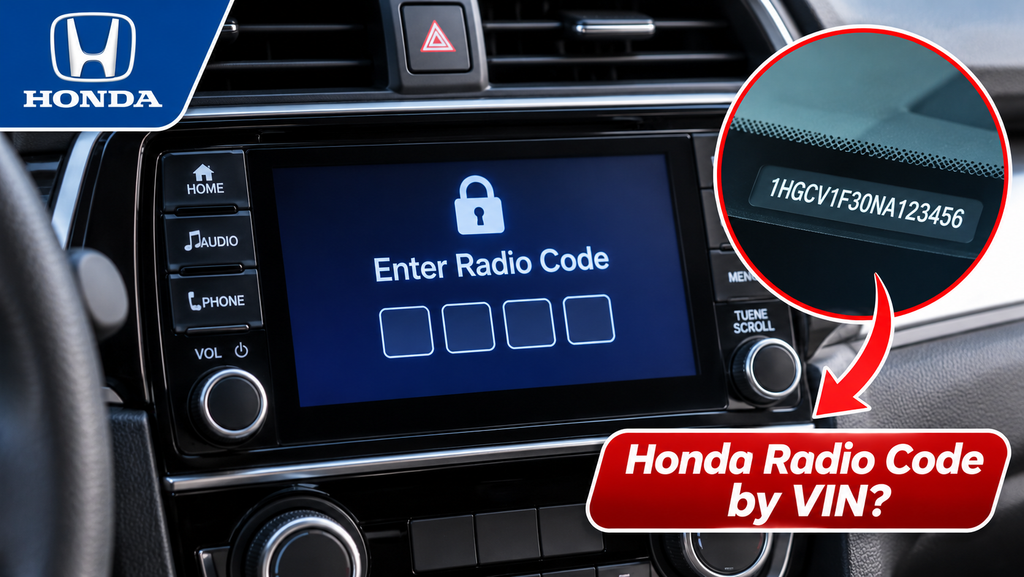
Some Honda radios and navigation systems use an anti-theft security feature. If electrical power is interrupted during a battery replacement or disconnection, the audio unit may request a security code before operating normally.
People searching for a honda radio code by vin should know that the VIN is generally only one part of the retrieval process. Honda may also ask for the audio unit’s serial number and other verification details. The VIN itself does not encode a universal radio unlock code.
How to Retrieve a Honda Radio Security Code
- Check the owner’s documentation and glove compartment for a radio anti-theft card or sticker.
- Consult your model’s instructions. Some newer Honda systems can be reactivated by holding the audio power button for several seconds, rather than entering a code.
- If a code is needed, find the radio or navigation unit’s serial number using the manufacturer-approved method for your model.
- Use Honda’s official MyGarage service or contact an authorized Honda dealer for code retrieval.
- Enter the correct code as directed by the appropriate Honda owner’s manual.
Avoid guessing radio codes. Repeated incorrect attempts can cause a temporary lockout on some systems. If the code cannot be verified, seek official assistance.
How to Verify a Honda VIN Before Buying a Used Car
Before purchasing a used Honda, treat VIN decoding as the first step of a broader verification process. A matching VIN can support identification, but it does not guarantee the vehicle’s condition or history.
Compare the VIN in Multiple Locations
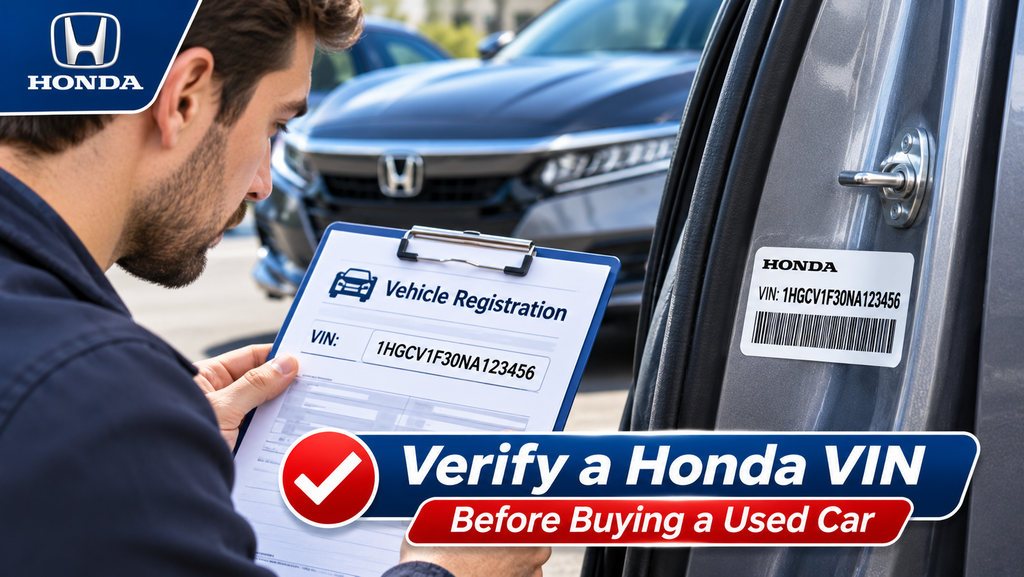
Make sure the dashboard VIN, doorjamb label, and title or registration match exactly. Investigate damaged labels, altered fasteners, or unexplained differences.
Confirm the Advertised Vehicle Specifications
Compare the reported model year, body configuration, and available engine information with the seller’s description. Verify any discrepancy using Honda documentation rather than assuming one source is correct.
Review History and Arrange an Inspection
Look into title records, available service documents, theft history, and a reputable vehicle history report where appropriate. Arrange an independent pre-purchase inspection to evaluate brakes, tires, engine operation, leaks, warning lights, and other safety-related conditions.
Used Honda VIN Checklist
- ☐ Dashboard and doorjamb VINs match.
- ☐ VIN matches ownership documents.
- ☐ Decoded model year and vehicle description agree.
- ☐ Outstanding safety recalls have been checked.
- ☐ Title and history records have been reviewed.
- ☐ Independent mechanical inspection is complete.
- ☐ Unexplained discrepancies have been resolved.
Common Honda VIN Decoder Problems
The VIN Is Not Recognized
Verify that you entered all 17 characters on a modern vehicle and did not mistake 0 for another character. Standard VINs exclude the letters I, O, and Q. Older vehicles may have shorter, nonstandard identifiers.
The Model Year Looks Wrong
Check the tenth character, the VIN’s complete context, and the correct 30-year year-code cycle. Remember that model year may differ from the calendar year in which the vehicle was assembled.
The Engine or Trim Is Missing
Not all public lookup services display every factory-installed option. For exact parts compatibility, consult Honda’s model-specific records or a knowledgeable parts department.
The Seller’s VIN Does Not Match the Vehicle
Do not ignore an unexplained mismatch. Recheck the transcription, verify the documents, and seek independent assistance before deciding whether to purchase the vehicle.
Frequently Asked Questions
Can I decode my Honda VIN for free?
Yes. NHTSA’s public VIN decoder provides available manufacturer-reported vehicle information free of charge.
What does the first character of a Honda VIN mean?
The first character contributes to the vehicle’s manufacturer and geographic identification. It must be interpreted as part of the complete three-character WMI.
Can a Honda VIN identify the engine?
It can identify engine-related characteristics where the relevant manufacturer decoding information is available, but results vary by model and year.
Does the VIN show the exact Honda trim?
Not always. A standard decoder may omit exact trim levels or optional equipment, so Honda-specific documentation may be required.
Can I get a Honda radio code with only my VIN?
Usually not. The official retrieval process may also require the radio’s serial number and additional verification information.
Does a free Honda VIN lookup show accident history?
No. Standard VIN decoding shows identification data, not a complete accident, ownership, or title history.
How do I check Honda recalls using the VIN?
Enter the VIN into Honda’s official recall lookup or NHTSA’s recall search and review the available results for open safety recalls.
Why does an older Honda have fewer than 17 VIN characters?
Vehicles built before the standardized 17-character system may use a different manufacturer identification format. Consult documentation specific to that model and year.
Final Thoughts
A Honda VIN decoder provides a straightforward way to learn about the identity of a vehicle. Understanding the VIN structure helps you read the model-year code, recognize manufacturer identifiers, and interpret the details reported by official decoders.
For dependable results, start with NHTSA’s free lookup, verify important details with Honda, and use separate checks for recalls and vehicle history. If you are considering a used Honda, combine VIN research with document verification and an independent inspection rather than relying on a decoder alone.