
Friction is a force that resists relative motion, or the tendency for relative motion, between surfaces in contact. It is involved when you walk, drive a car, apply brakes, write with a pencil, slide a box, or move an object through air or water.
If you are searching for what are the friction, the different types of friction, useful examples of friction, or the basic friction formula, this guide explains each concept step by step.
What Is Friction?
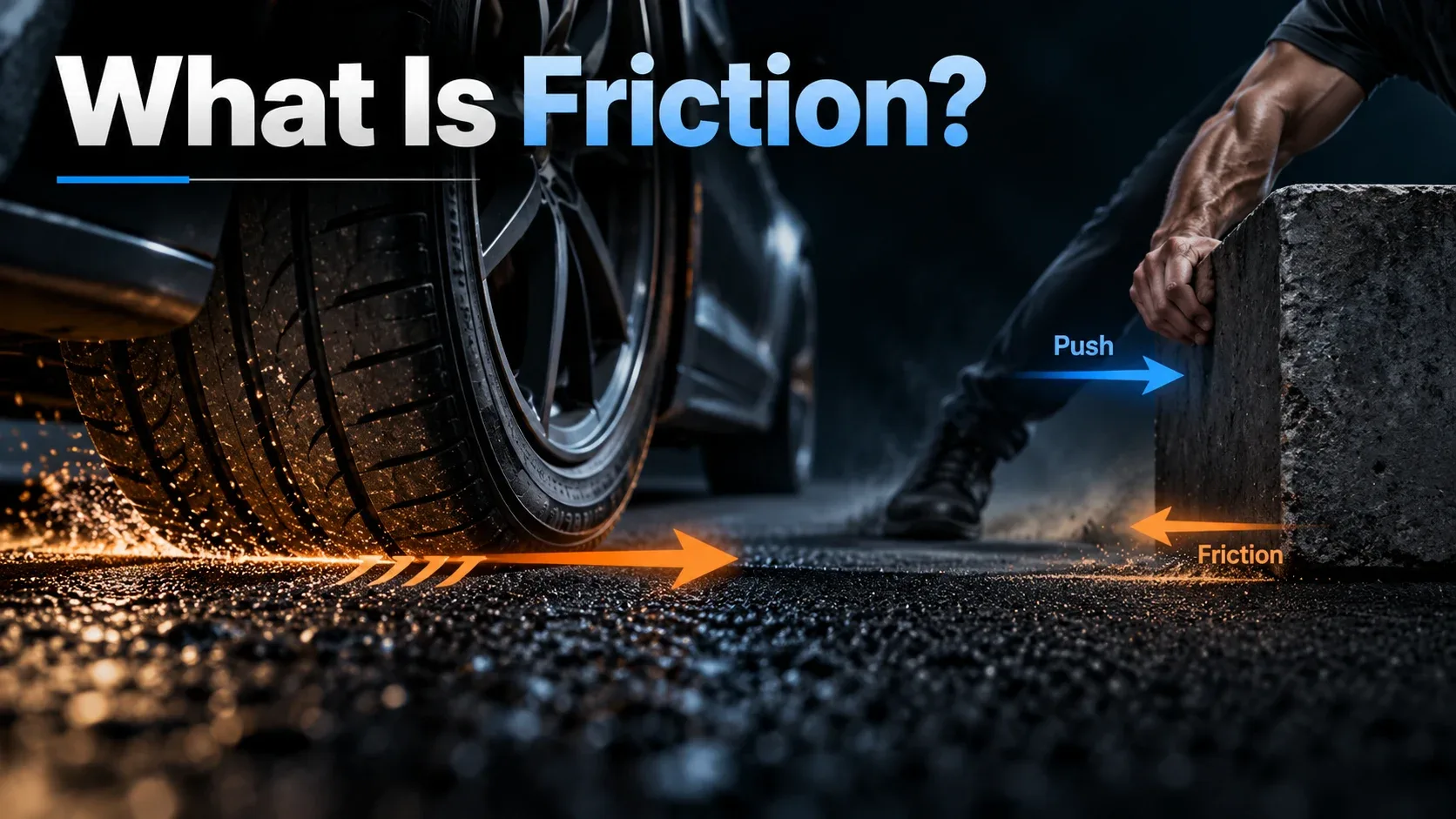
Friction is a force that acts when two surfaces interact. In many situations, it acts in a direction that opposes sliding or the tendency to slide between those surfaces.
Suppose you place a heavy box on the floor and push it. At first, the box may remain stationary. The contact between the floor and the bottom of the box produces a frictional force that resists the tendency for the box to slide.
If you push hard enough and the box begins moving, friction continues acting between the two surfaces, but the type of friction changes.
Why Does Friction Occur?
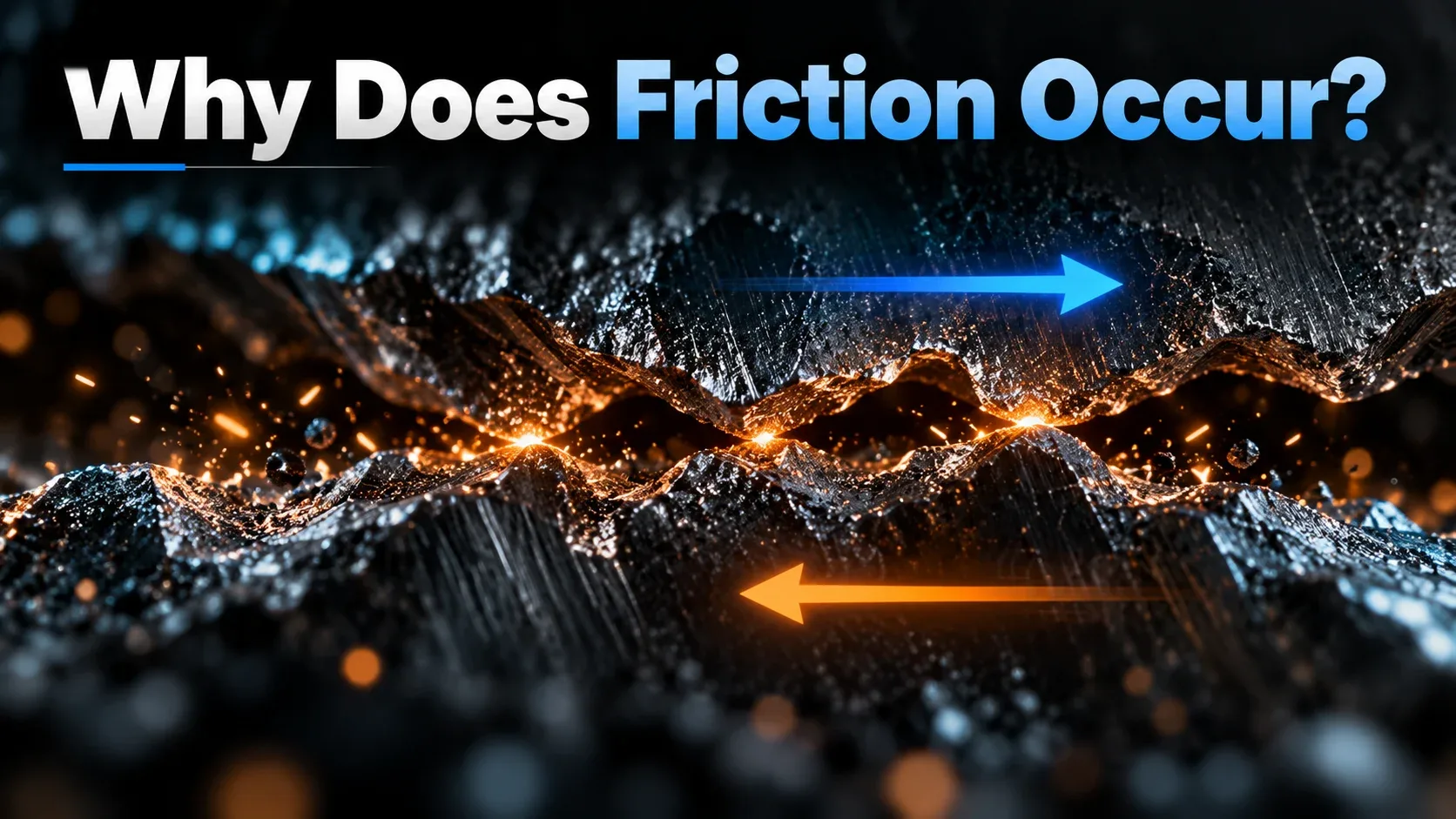
Surfaces that appear perfectly smooth to the eye contain microscopic irregularities. When two surfaces touch, their high points interact with one another.
Friction can arise from several microscopic effects, including surface roughness, deformation, adhesion, and interactions between the materials at their contact points.
This is why different combinations of materials can produce different amounts of friction. Rubber on dry pavement, for example, behaves very differently from metal sliding on ice.
Main Factors That Affect Friction
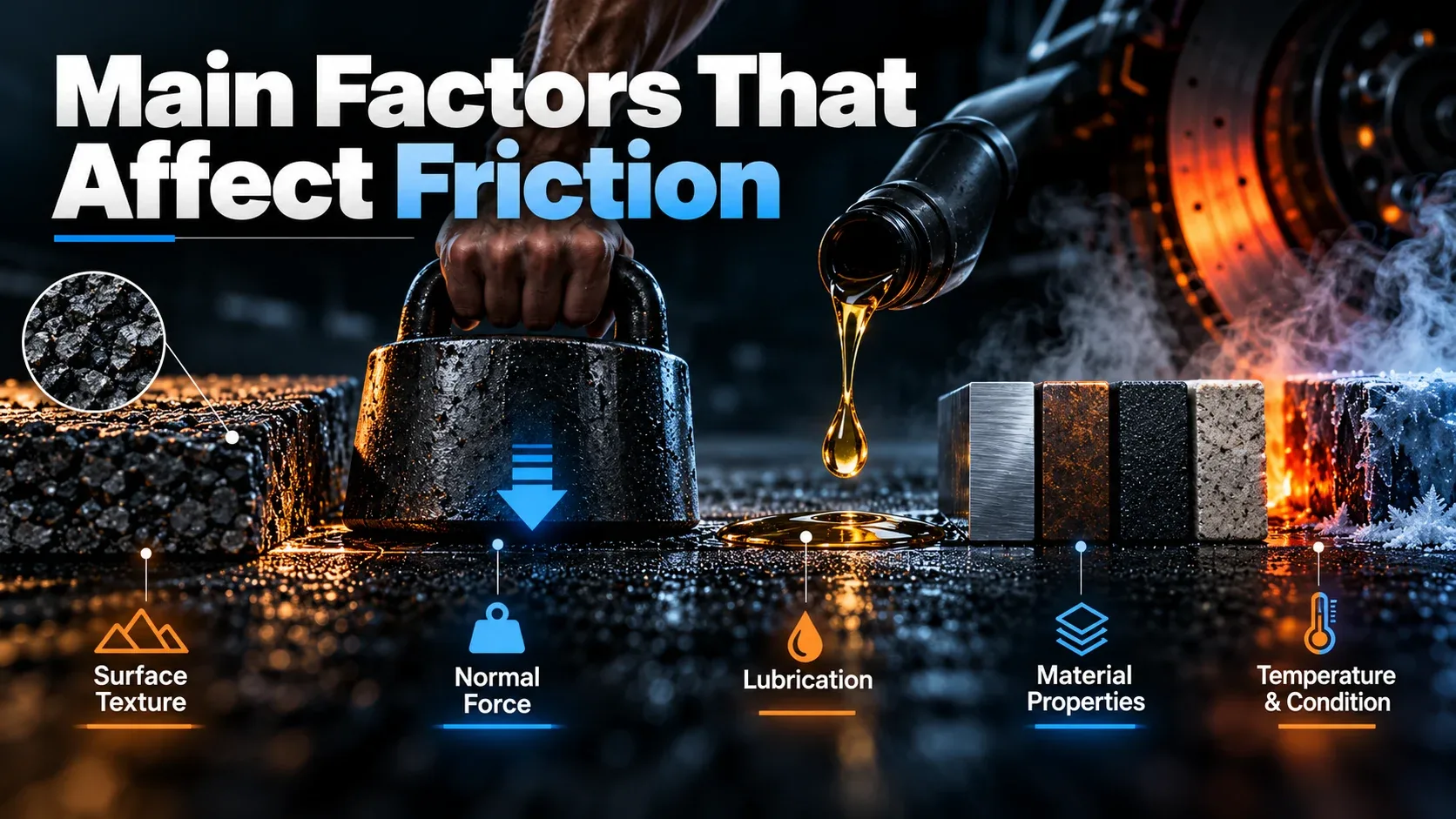
The amount of friction produced in a real system depends on the materials, forces, and conditions involved.
1. Surface Materials
Different combinations of materials have different friction characteristics.
2. Normal Force
In the simplified dry-friction model, increasing the normal force between two surfaces generally increases the available frictional force.
3. Surface Condition
Water, dirt, oil, corrosion, wear, and surface contamination can change how two surfaces interact.
4. Lubrication
Lubricants can separate surfaces and reduce direct contact, helping lower friction and wear in machines.
5. Temperature
Temperature can change material properties, lubricant viscosity, tire behavior, and other conditions that influence friction.
6. Motion Conditions
Whether surfaces are stationary, sliding, rolling, or moving through a fluid affects the kind of resistance that occurs.
Friction and Types of Friction
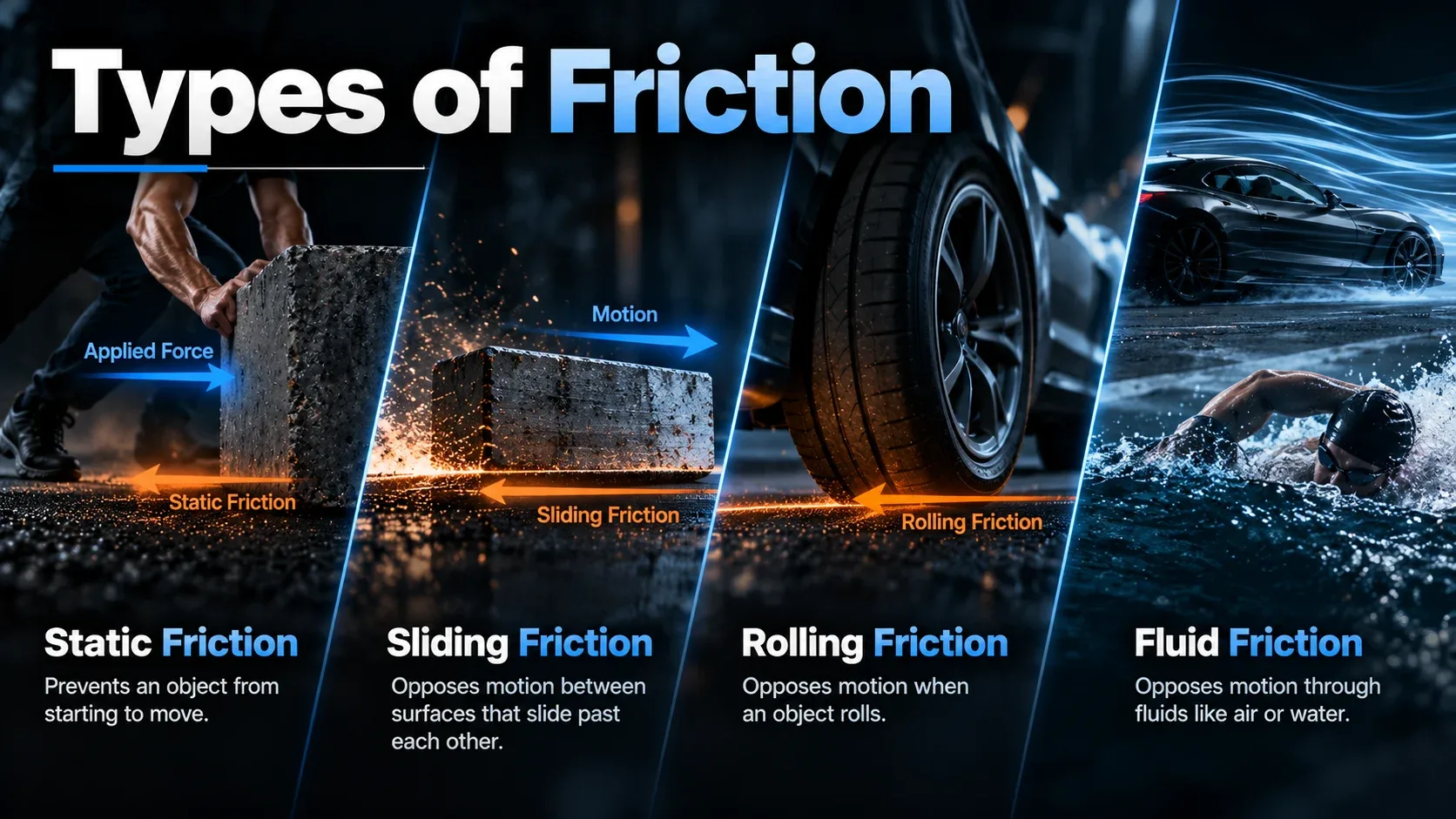
When learning about friction and types of friction, four categories are commonly introduced in basic physics:
Static Friction
Acts between surfaces that are not sliding relative to one another and can prevent sliding from beginning.
Sliding or Kinetic Friction
Acts when two surfaces slide relative to each other.
Rolling Resistance
Resists rolling motion and often involves deformation of the wheel, tire, or surface.
Fluid Friction
Resistance experienced by an object moving through a fluid such as air or water.
1. Static Friction
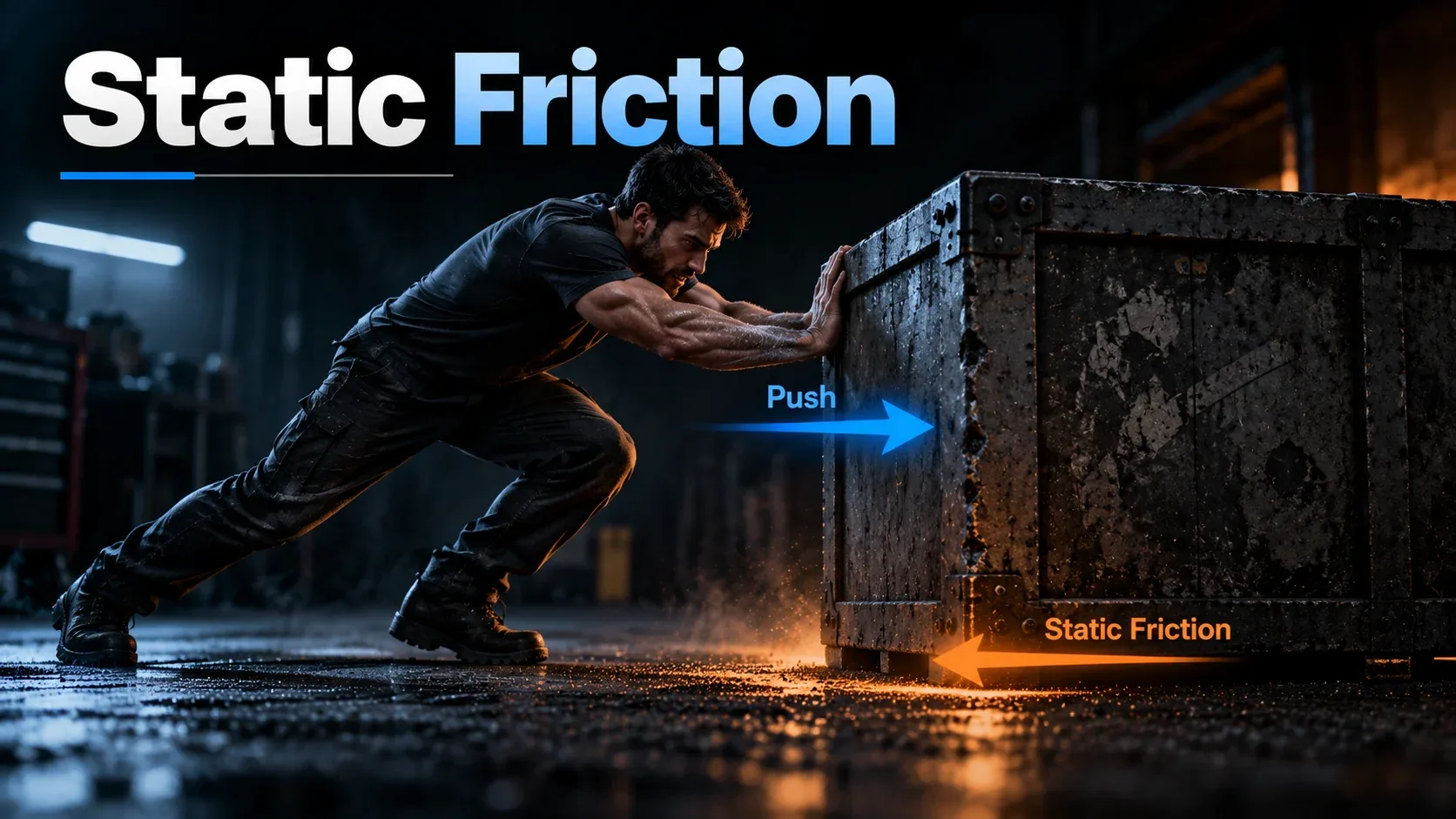
Static friction acts between surfaces that are not sliding relative to each other. It adjusts as needed up to a maximum value to prevent sliding.
Imagine pushing horizontally on a heavy box. If the box does not move, static friction is helping oppose the tendency for the box to slide.
Examples of Static Friction
- Shoes gripping the ground while walking
- Car tires gripping the road during normal rolling without slipping
- A parked vehicle remaining on an incline
- A box remaining stationary while being pushed lightly
- Your hand gripping a tool without slipping
2. Sliding or Kinetic Friction
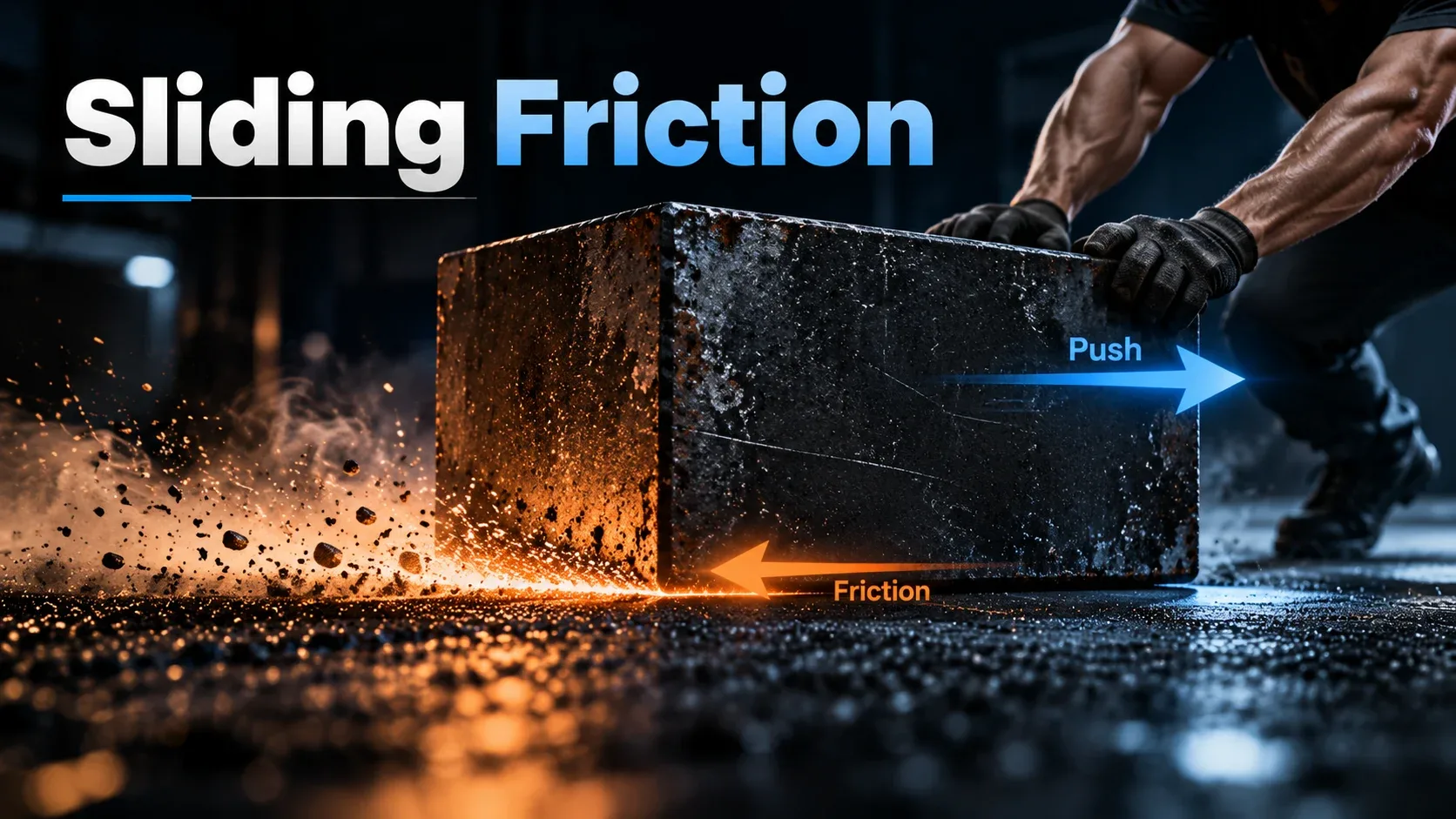
Sliding friction, often called kinetic friction, acts when two solid surfaces slide relative to one another.
Once the heavy box in the previous example begins sliding across the floor, the friction acting between the box and floor is kinetic friction.
Examples of Sliding Friction
- A book sliding across a desk
- A box sliding across the floor
- A sled sliding over snow
- Brake pads rubbing against a brake rotor
- A metal component sliding against another surface
3. Rolling Friction
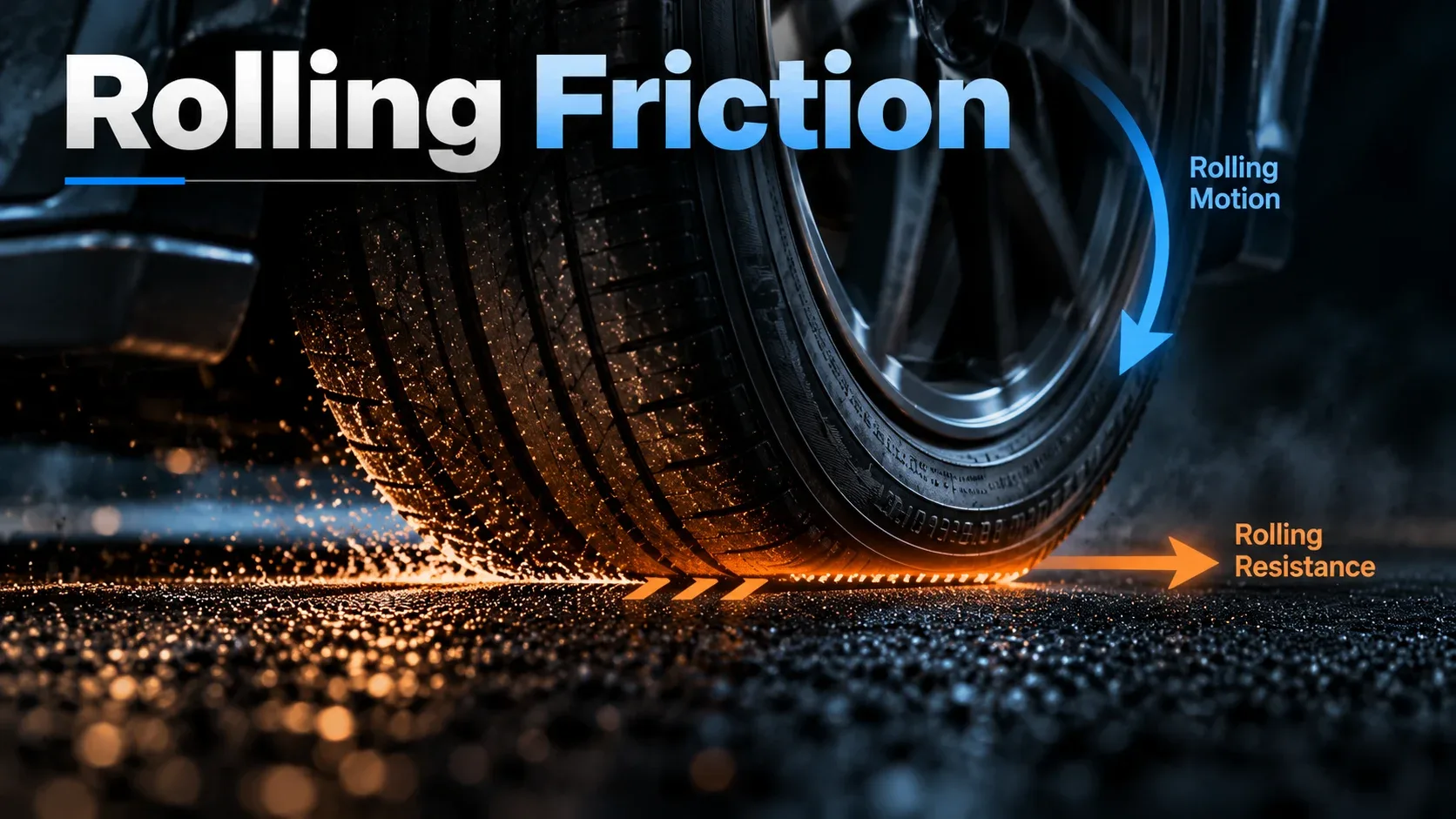
Rolling objects experience resistance called rolling resistance. This resistance can come from deformation of the wheel, tire, bearing, or surface, as well as other losses.
Rolling generally requires less force than dragging the same object across a surface, which is one reason wheels and rollers are so useful.
Examples of Rolling Resistance
- Car tires rolling on pavement
- Bicycle tires rolling on a road
- A ball rolling across the floor
- Casters moving furniture
- Rollers moving heavy equipment
4. Fluid Friction
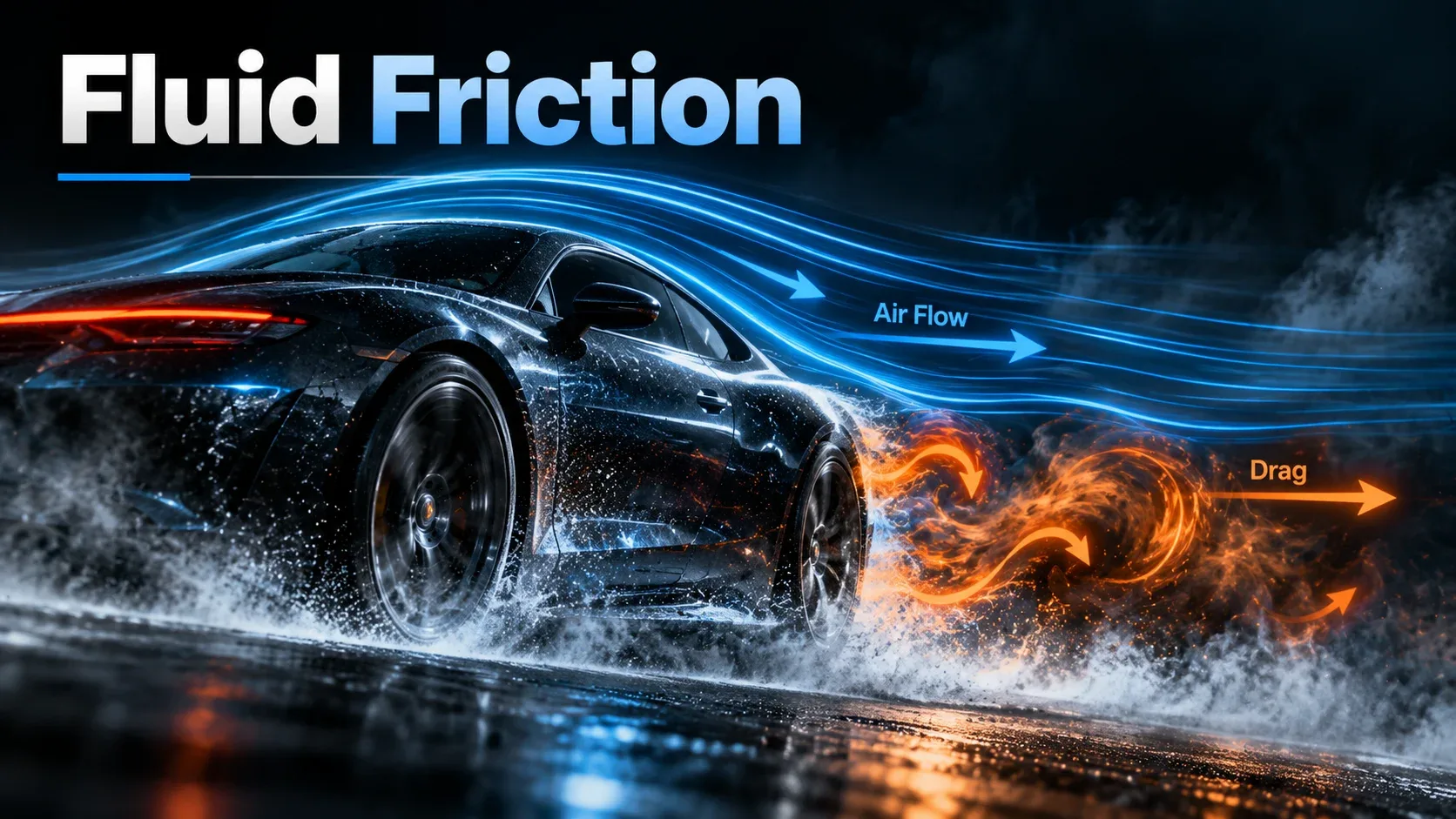
A fluid can be a liquid or a gas. When an object moves through a fluid, the fluid can resist that motion. This resistance is commonly associated with drag.
Unlike the simplified dry-friction relationship used for solid surfaces, fluid resistance can depend strongly on speed, shape, fluid density, viscosity, and flow conditions.
Examples of Fluid Friction
- Air resistance acting on a moving car
- Drag on an aircraft
- A swimmer moving through water
- A boat moving through a lake
- A falling object moving through air
Static Friction vs Kinetic Friction
| Feature | Static Friction | Kinetic Friction |
|---|---|---|
| When it acts | Before surfaces begin sliding | While surfaces are sliding |
| Motion between surfaces | No relative sliding | Relative sliding occurs |
| Typical relationship | Fs ≤ μsN | Fk = μkN in the simplified model |
| Common example | Pushing a box that does not move | Box sliding across the floor |
| Relative magnitude | Maximum static friction is commonly higher | Usually lower than maximum static friction for the same dry surfaces |
Friction Formula
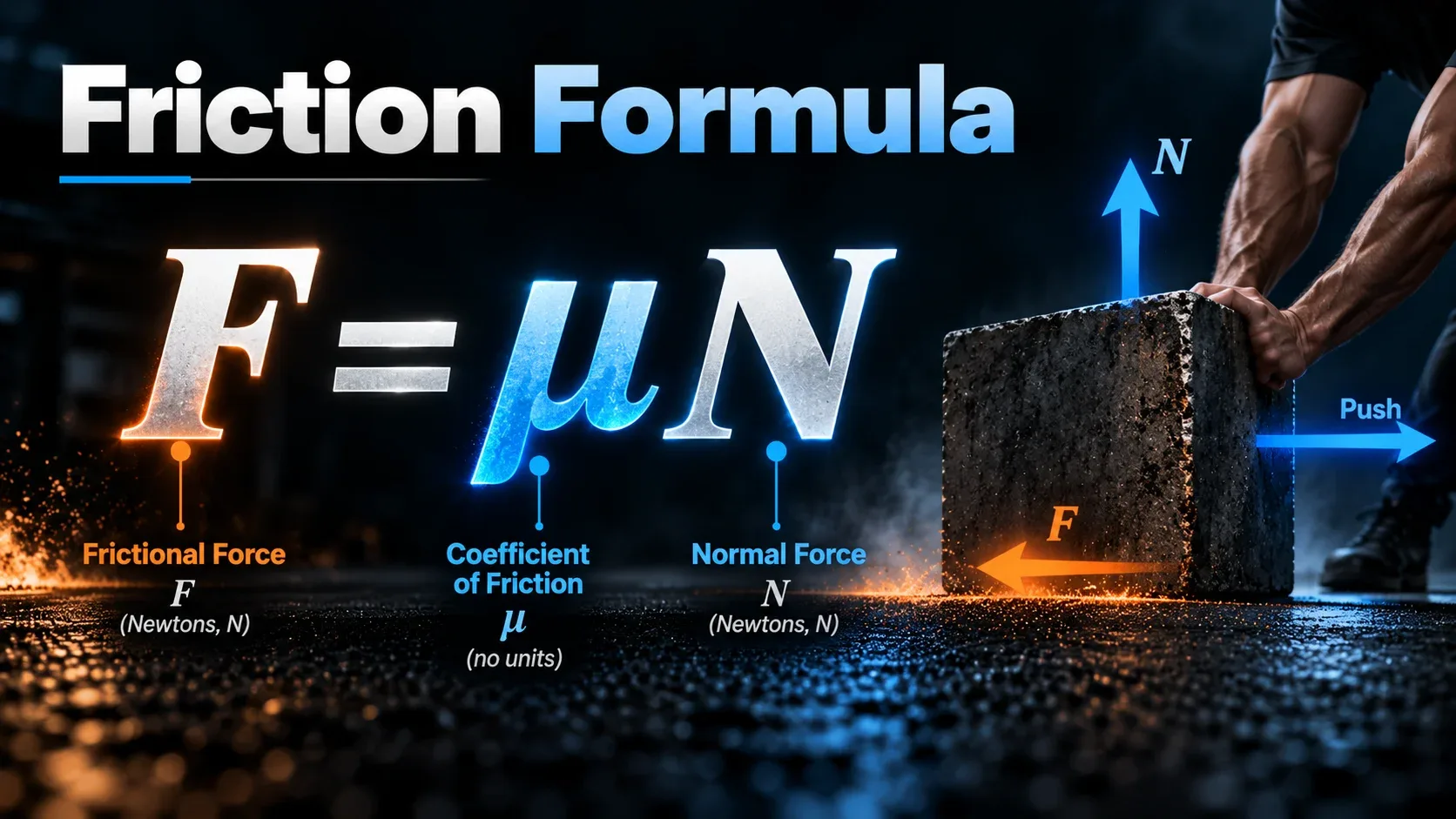
For many introductory problems involving dry surfaces, friction is modeled using the relationship:
μ is the Greek letter mu and represents a dimensionless coefficient describing the friction behavior of the surface pair in this simplified model.
Static Friction Formula
Static friction does not always equal one fixed value. Instead, it adjusts to oppose the tendency for sliding until it reaches a maximum.
Maximum static friction:
Fs,max = μsNμs = coefficient of static friction
Kinetic Friction Formula
Once two surfaces are sliding relative to each other, kinetic friction is often modeled as:
μk = coefficient of kinetic friction
For many material pairs under ordinary dry conditions, the coefficient of kinetic friction is lower than the coefficient of static friction.
Example Friction Calculation
Suppose a block is sliding across a horizontal surface.
Given:
- Normal force = 100 N
- Coefficient of kinetic friction = 0.30
Fk = μkN
Fk = 0.30 × 100 N
Fk = 30 N
The simplified model therefore gives a kinetic frictional force of 30 newtons.
Examples of Friction in Everyday Life
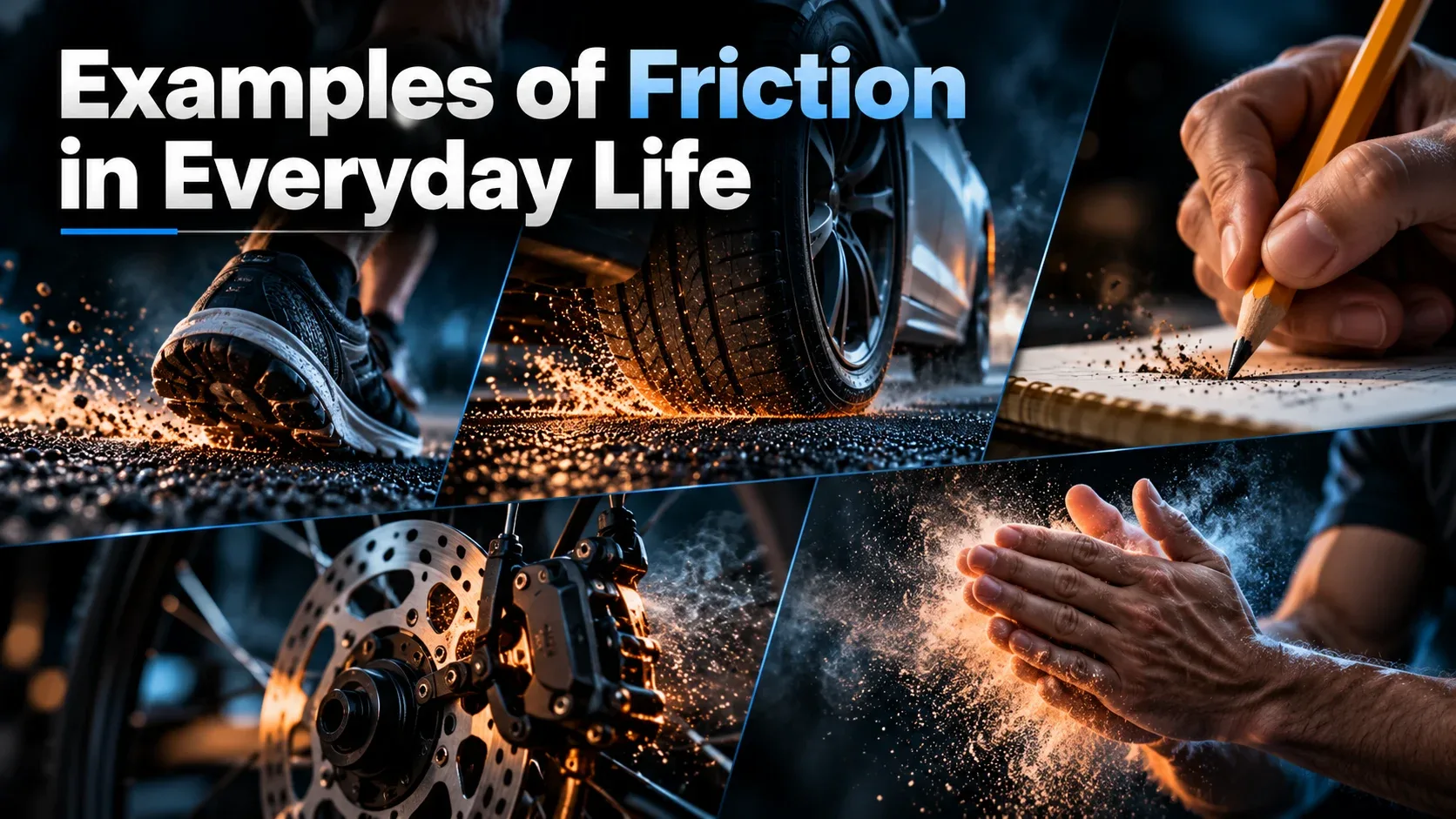
Friction is present in countless everyday activities. Some of the easiest examples of friction to recognize include:
Walking
Static friction between your footwear and the ground helps prevent your foot from slipping backward.
Car Tires
Tire-road interaction provides the grip needed for acceleration, braking, and cornering.
Vehicle Brakes
Brake pads press against rotating components, generating friction and converting much of the vehicle’s kinetic energy into thermal energy.
Writing With a Pencil
Interaction between the graphite-based pencil core and paper helps material transfer onto the page.
Rubbing Your Hands
Rubbing surfaces produces thermal energy, making your hands feel warmer.
Opening a Jar
Friction between your hand and the lid helps create enough grip to apply torque.
Bicycle Tires
Tire-road grip helps a bicycle accelerate, turn, and stop without unwanted slipping.
Machine Bearings
Bearings are designed to manage motion and reduce unwanted friction compared with direct sliding contact.
How Friction Helps You Walk
Walking is one of the clearest real-world examples of useful friction.
When your foot pushes backward against the ground, static friction between your shoe and the ground helps provide a forward force on your body.
On very slippery surfaces such as ice, the available friction can be much lower, which makes slipping more likely.
Friction Between Tires and the Road
Vehicle control depends heavily on the interaction between the tires and road surface.
During normal rolling without tire slip, static friction can provide the forces required for acceleration, braking, and turning.
Available grip can be affected by tire condition, road material, temperature, water, snow, ice, contaminants, and other conditions.
How Friction Works in Brakes
Braking systems use friction intentionally.
In a disc brake system, brake pads press against the rotating brake rotor. This interaction produces a force that opposes the rotor’s motion.
Much of the vehicle’s kinetic energy is transformed into thermal energy, which is why braking components can become very hot.
Why Does Rubbing Your Hands Make Them Warm?
When you rub your hands together, frictional interactions convert some mechanical energy into internal thermal energy.
As a result, the temperature of the skin can rise slightly and your hands feel warmer.
Advantages of Friction
Friction is essential in many everyday and engineering applications.
Provides Grip
Friction allows shoes, tires, tools, belts, and many other objects to grip surfaces.
Makes Walking Possible
Ground friction helps prevent your feet from slipping during normal walking.
Allows Vehicles to Stop
Braking systems depend on controlled friction to reduce wheel rotation and vehicle speed.
Enables Writing
Friction helps pencils, chalk, and similar materials interact with writing surfaces.
Transfers Power
Belts, clutches, tires, and other systems can use friction to transmit forces and torque.
Helps Hold Objects
Friction between your fingers and an object helps you maintain grip.
Disadvantages of Friction
Friction can also create problems when it occurs where it is not wanted.
Wear
Repeated contact can gradually remove or damage material from moving surfaces.
Heat Generation
Friction can increase component temperatures and may require cooling or heat-resistant materials.
Energy Loss
Unwanted friction can convert useful mechanical energy into heat.
Reduced Efficiency
Machines may require additional energy to overcome unwanted resistance.
Noise and Vibration
Friction can contribute to squeaking, vibration, and other mechanical noise.
Component Damage
Insufficient lubrication or excessive friction can shorten the life of mechanical components.
How to Increase Friction
In some situations, engineers intentionally increase friction to improve grip or control.
- Use surfaces or materials designed for greater grip.
- Add tread patterns to tires or footwear.
- Use textured handles and grip materials.
- Remove unwanted oil or other slippery contaminants when appropriate.
- Increase normal force when the application safely allows it.
- Use friction materials designed for brakes or clutches.
How to Reduce Friction
Reducing unwanted friction can improve efficiency and decrease component wear.
Lubrication
Oil, grease, and other lubricants help separate interacting surfaces and reduce direct contact.
Bearings
Bearings can replace some sliding contact with rolling contact and carefully controlled lubrication.
Surface Treatment
Appropriate polishing, coatings, or surface treatments can reduce unwanted friction in some systems.
Streamlining
Aerodynamic shapes can reduce drag when moving through air.
Friction in Machines and Engineering
Engineers must carefully control friction rather than simply eliminate it.
Some components need high friction to function properly, while others need low friction to reduce energy losses and wear.
| Component | Role of Friction |
|---|---|
| Brakes | Uses friction intentionally to slow rotation. |
| Clutches | Uses friction to transmit torque between rotating components. |
| Bearings | Designed to reduce unwanted friction while supporting loads. |
| Gears | Require lubrication and suitable surface design to manage contact friction and wear. |
| Belts and Pulleys | Often depend on friction to transmit motion. |
| Seals | May experience friction while preventing fluid leakage. |
Friction in Vehicles
Vehicles contain many systems where friction must be carefully controlled.
Tires
Tire-road interaction produces the forces required for braking, accelerating, and cornering.
Brakes
Brake friction is intentionally high enough to slow rotating components effectively.
Clutch
Friction materials help transmit engine torque through the drivetrain in manual-transmission systems.
Engine Components
Lubrication helps control friction and wear between moving components.
Bearings
Bearings support rotating parts while minimizing unwanted resistance.
Aerodynamic Drag
Air resistance increases the energy required to move a vehicle, particularly at higher speeds.
Is Friction Always Bad?
No. Friction is neither automatically good nor bad.
Whether friction is useful depends on the application.
Useful Friction
- Tire grip
- Walking
- Braking
- Holding tools
- Clutch operation
Unwanted Friction
- Bearing losses
- Mechanical wear
- Excessive heat
- Energy loss
- Noise and vibration
Common Misconceptions About Friction
Friction only acts on moving objects
Incorrect. Static friction can act even when two surfaces are not sliding relative to each other.
Smooth surfaces have no friction
Incorrect. Even apparently smooth surfaces can produce friction because of microscopic interactions and adhesion.
More friction is always better
Not true. High friction is useful for brakes and tire grip but can be undesirable inside bearings and other moving machinery.
Friction always points opposite the object’s motion
Oversimplified. Friction opposes relative sliding or the tendency for relative sliding at the contact surface.
Quick Comparison of the Types of Friction
| Type of Friction | When It Occurs | Example | Main Effect |
|---|---|---|---|
| Static Friction | Surfaces are not sliding relative to each other | Shoe gripping pavement | Prevents or resists the start of sliding |
| Sliding / Kinetic Friction | Two solid surfaces slide relative to each other | Box sliding on a floor | Resists sliding motion |
| Rolling Resistance | An object rolls across a surface | Car tire rolling on a road | Resists rolling motion |
| Fluid Friction / Drag | An object moves through air or liquid | Car moving through air | Resists motion through the fluid |
Frequently Asked Questions About Friction
What is friction in simple words?
Friction is a force that resists relative motion or attempted relative motion between surfaces that interact.
What are the friction types?
In introductory physics, the commonly discussed types are static friction, sliding or kinetic friction, rolling resistance, and fluid friction or drag.
What are 5 examples of friction?
Five examples of friction are walking on the ground, car tires gripping a road, brakes slowing a vehicle, a pencil writing on paper, and a box sliding across the floor.
What is the formula for friction?
A common simplified dry-friction formula is F = μN, where F is frictional force, μ is the coefficient of friction, and N is the normal force.
What is static friction?
Static friction acts between surfaces that are not sliding relative to each other and can prevent sliding from beginning.
What is kinetic friction?
Kinetic friction acts when two surfaces slide relative to one another.
What is rolling friction?
Rolling resistance is the resistance to motion experienced by a rolling wheel, tire, ball, or similar object.
What is fluid friction?
Fluid friction is resistance associated with motion through a liquid or gas and is commonly experienced as drag.
What is the difference between static and kinetic friction?
Static friction acts before relative sliding begins, while kinetic friction acts after two surfaces begin sliding relative to each other.
Which type of friction is greater?
For many pairs of dry materials, the maximum static friction is greater than kinetic friction, although the exact relationship depends on the surfaces and conditions involved.
Can friction be useful?
Yes. Walking, braking, tire grip, gripping tools, writing, and power transmission all depend on useful friction.
How can friction be reduced?
Friction can often be reduced using lubrication, bearings, suitable surface treatments, rolling elements, or aerodynamic design depending on the application.
Friction at a Glance
Friction is a force that resists relative motion or attempted relative motion between interacting surfaces. It plays an essential role in everyday life, transportation, machines, sports, and engineering.
- Static friction acts before sliding begins.
- Kinetic friction acts while surfaces slide.
- Rolling resistance opposes rolling motion.
- Fluid friction creates resistance in liquids and gases.
- The common simplified dry-friction relationship is F = μN.
- Friction can provide useful grip but can also create heat, wear, and energy loss.
Common examples of friction include walking, braking, tire grip, writing with a pencil, sliding objects, rolling wheels, and resistance experienced while moving through air or water.