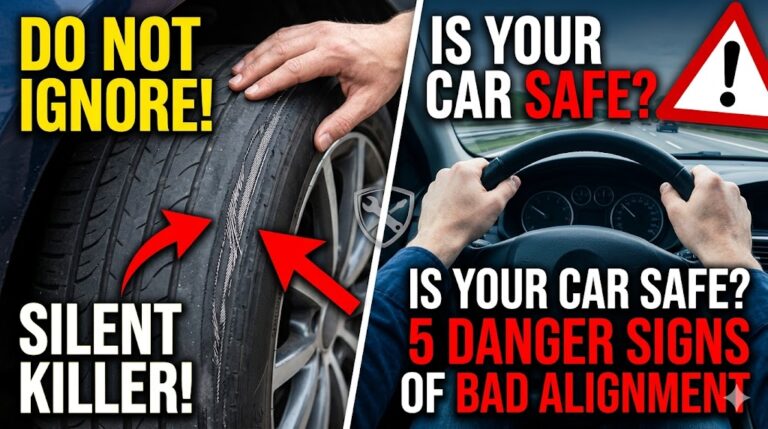

A working mechanic gives you the straight answer — no upsell, no B.S. — so you know exactly what to tell the service advisor.
Quick Answer
No — putting new tires on your car does not physically change your alignment. Your alignment angles are set by the suspension, not the tires. However, an alignment check is genuinely smart insurance if you haven’t had one in 12+ months, or if your old tires showed any uneven wear. It’s not always a scam — but it’s not always necessary either.
Why Every Tire Shop Recommends an Alignment

Let’s address the elephant in the room: yes, alignment services are profitable for shops. A typical alignment takes 30–45 minutes of labor and costs $80–$150 at most chain shops. The margins are good. That’s a fact.
But here’s what most “Is this a scam?” articles won’t tell you: the recommendation itself isn’t dishonest. It’s a blanket policy. Big-box tire stores tell their service advisors to recommend an alignment with every tire purchase because they can’t predict which customers actually need one and which don’t. It’s easier (and legally safer) to recommend it to everyone.
The question isn’t “Are they trying to rip me off?” The question is: “Does MY specific car actually need one right now?”
Mechanic’s Take
“I’ve done this for 18 years. Most shops aren’t trying to scam you. But do I think every single car needs an alignment at tire changeover? Absolutely not. About 40% of the cars I see are already within spec.”
What a Wheel Alignment Actually Is (30-Second Version)
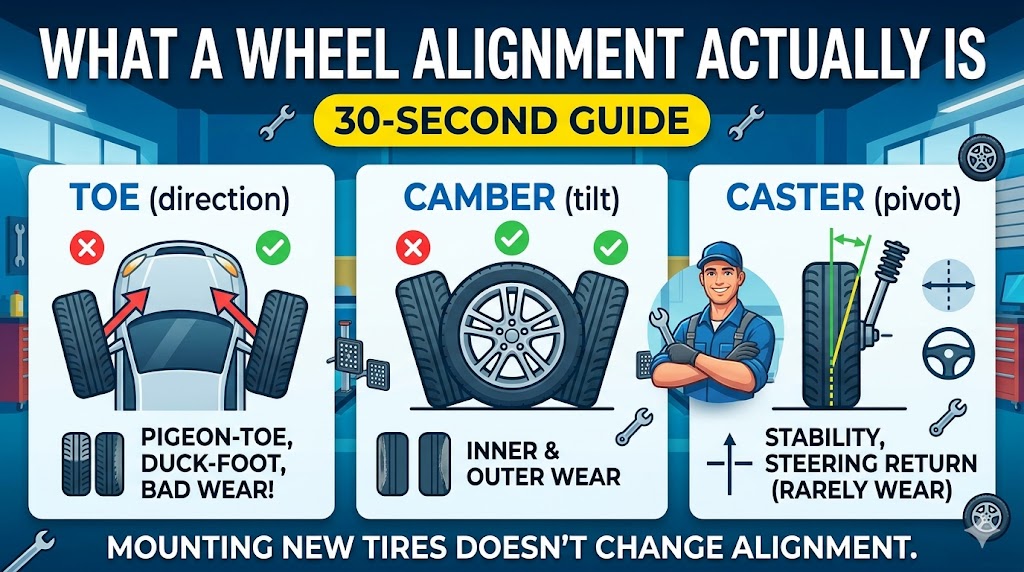
A wheel alignment adjusts three angles of your suspension — not your tires, not your wheels. The tires just happen to be what touches the road, so they show the symptoms when those angles are off.
Toe
Are your tires pointed straight ahead, or pigeon-toed/duck-footed? This is the #1 cause of uneven tire wear.
Camber
Viewed from the front: is your tire tilted inward or outward? Causes the inner or outer edge to wear fast.
Caster
The angle of your steering pivot. Affects straight-line stability and steering return. Rarely causes tire wear.
Key point: Mounting new tires does not change these angles. Period. Your alignment was whatever it was before the tires came off, and it’s the exact same after they go on.
When You Definitely Need an Alignment
There are situations where skipping the alignment would be genuinely foolish. If any of these apply, spend the money:
Your old tires had uneven wear — bald on the inside edge, outside edge, or one side of the car wore faster.
- Your car pulls to the left or right when you let go of the steering wheel on a flat road.
- Your steering wheel is off-center (crooked when driving straight).
- You hit a major pothole, curb, or road hazard in the last few months.
- You’ve had any suspension or steering work done (tie rod, ball joint, strut replacement).
- It’s been more than 2 years or 25,000 miles since your last alignment.
- You’re installing premium tires ($800+) and want to protect your investment.
Mechanic’s Take
“If you just dropped $1,200 on a set of Michelins and your old tires had inner edge wear? You’d be crazy to skip the alignment. That’s like buying a new suit and refusing to get it hemmed. You’ll ruin it in 15,000 miles.”
When You Can Safely Skip the Alignment
Not every car needs one. Here’s the checklist. If all of these are true, you’re probably fine to decline:
- Your old tires wore evenly across the entire tread on all four corners.
- Your car drives perfectly straight with no pull or drift.
- Your steering wheel is centered when driving on a flat road.
- You haven’t hit any major potholes or curbs recently.
- No suspension or steering components have been replaced.
- Your last alignment was less than 1–2 years ago.
Mechanic’s Take
“Your old tires are the best alignment report you’ll ever get — and they’re free. If they wore perfectly even, your alignment is almost certainly fine. That evidence is more trustworthy than any sales pitch.”
⚠️ Important caveat: “Car drives straight” isn’t the whole picture. A car can track straight and still have a slight toe misalignment that causes premature edge wear. The old tire wear pattern is the more reliable indicator.
Will Skipping an Alignment Void My Tire Warranty?
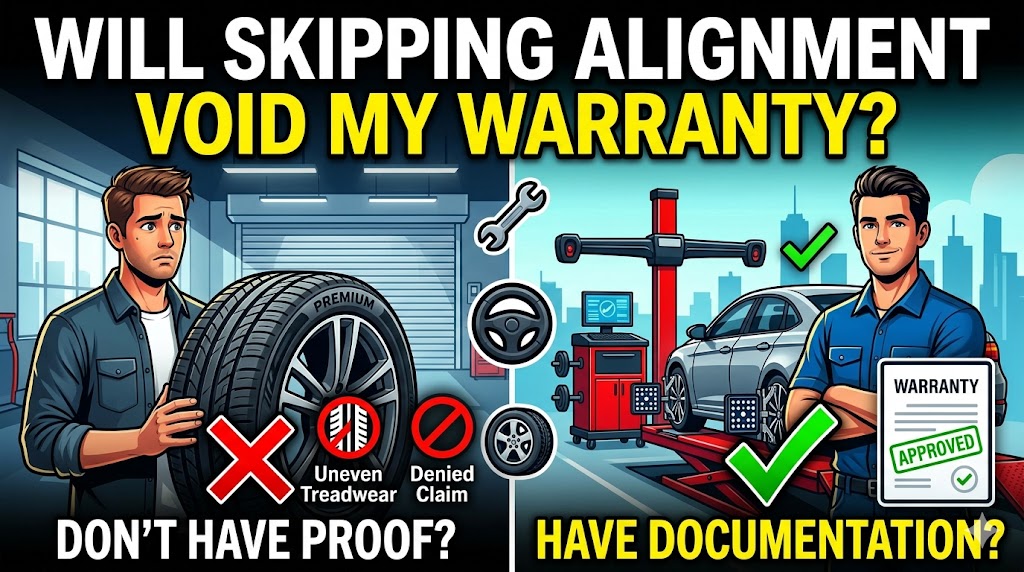
This is the question that keeps premium tire buyers up at night. Here’s how it actually works:
Most tire manufacturer mileage warranties require:
- ●Proof of regular tire rotations (typically every 5,000–7,500 miles)
- ●Proof of at least one alignment during the warranty period (some brands require at installation)
- ●Proper inflation pressure maintenance
Here’s the catch:
If you file a warranty claim for premature wear and the tires show uneven treadwear, the manufacturer will almost certainly deny the claim and point to alignment as the cause. At that point, whether you had an alignment or not, you’ll need documentation proving your alignment was within spec.
Mechanic’s Take
“If you bought $1,200 in tires, think of the $100 alignment as a $100 insurance policy. Even if your alignment is already perfect, you’ll get a printout proving it — and that printout is gold if you ever need to make a warranty claim.”
What Actually Happens If You Skip the Alignment
Let’s be real about the consequences. This isn’t a safety emergency — but it can be expensive:
If your alignment was already fine:
Absolutely nothing. You saved $100 and your tires will wear normally. This is the most common outcome.
If your alignment was slightly off:
Your new tires will start developing uneven wear. You probably won’t notice for 10,000–15,000 miles. By then, the damage to the tread is permanent — you can’t “unwear” a tire.
If your alignment was significantly off
You could chew through a brand-new tire in as little as 15,000–20,000 miles instead of the expected 50,000–70,000. That’s $200–$350 per tire wasted. The $100 alignment would have been the cheapest thing you did all year.
Real Cost Breakdown: Alignment vs. Premature Tire Replacement
| Scenario | Cost | Tire Life | Cost Per Mile |
|---|---|---|---|
| New tires + alignment ✓ | $820 | 60,000 mi | $0.014/mi |
| New tires, skipped alignment (alignment was fine) | $700 | 60,000 mi | $0.012/mi |
| New tires, skipped alignment (alignment was bad) | $700 + $700* | 25,000 mi | $0.056/mi |
*Assumes premature replacement of 2 tires at 25,000 miles due to inner edge wear from bad camber/toe.
Frequently Asked Questions
Is a wheel alignment the same as wheel balancing?Can I get a free alignment check instead of paying for a full alignment?How often should I get an alignment?Can a bad alignment damage anything besides my tires?I’m worried the shop will mess up my currently perfect alignment. Is that possible?
The Bottom Line
Here’s my honest, no-B.S. recommendation after 18 years of doing this:
BEST
Ask for an alignment check first. If the readings are in the green, decline the service and save your money. You now have proof your alignment is fine. If they’re off, you’ve caught it before your brand-new tires pay the price.
GOOD
Just get the alignment if you bought expensive tires, it’s been more than a year, or your old tires had any uneven wear. The peace of mind and warranty protection are worth $100.
FINE
Skip it confidently if your old tires wore perfectly even, your car tracks dead straight, and you’ve had a recent alignment. Your tires are the best diagnostic tool — trust them.
The real pro move? Tell the service advisor: “Can you check the alignment readings first and show me the printout before we decide?” Any honest shop will say yes.