
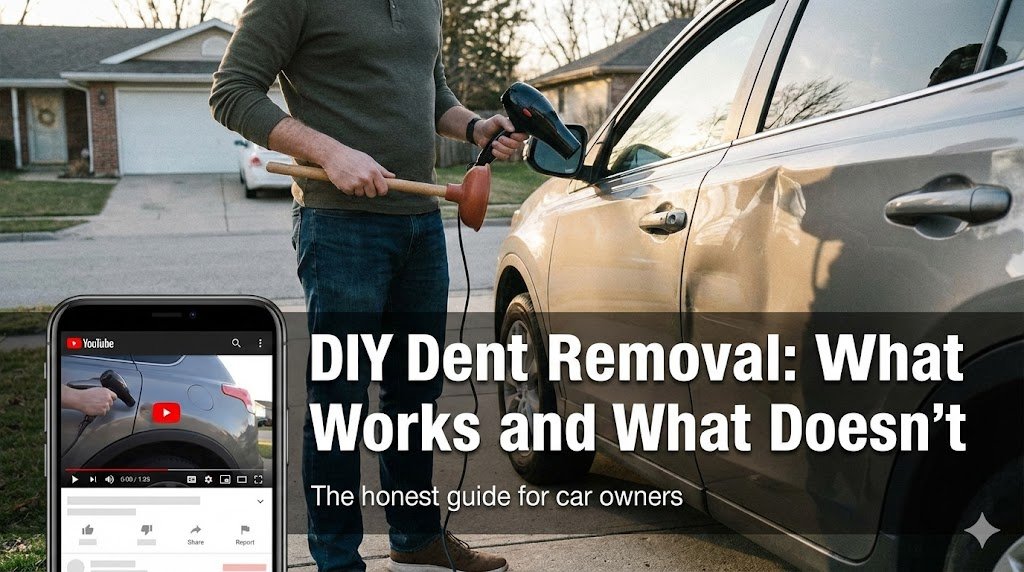

The honest guide for budget-conscious car owners who want to know if that viral TikTok hack actually works—before they make things worse.
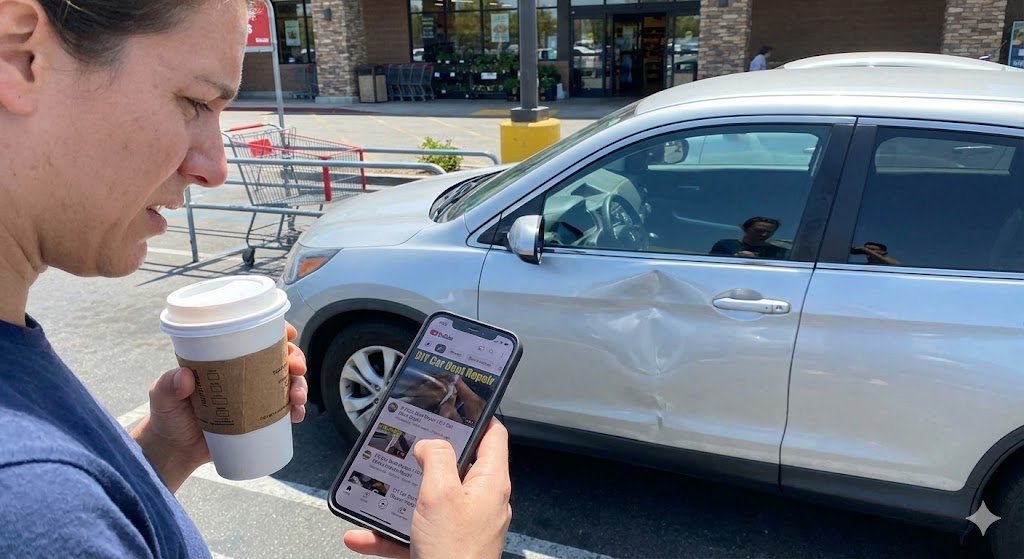
You just walked out of the grocery store, coffee in hand, ready to conquer the rest of your Saturday. Then you see it: a fresh door ding on your otherwise pristine Honda Civic. Your stomach drops. You know exactly what’s coming—a body shop quote that makes you wince, an insurance deductible that costs more than the repair, or days without your daily driver.
So you do what any resourceful person would do: you pull out your phone and search “how to fix a dent in a car” at home. And suddenly, you’re down a rabbit hole of YouTube tutorials, Amazon gadgets, and viral TikTok videos showing someone magically popping out a massive bumper dent with nothing but boiling water and sheer willpower.
But here’s the question that brought you here: Does any of this actually work? And more importantly—will you make it worse?
We’re going to give you the straight answer. Not the “never try anything yourself” gatekeeping you’ll get from some shops, and not the overly optimistic “anyone can do this!” hype from influencers selling affiliate links. Just the honest truth about what works, what doesn’t, and when spending $150 on professional help is actually the smartest budget decision you can make.
The Reality Check You Need First
Before you grab that plunger from under the sink, let’s establish something important: not all dents are created equal. The success of any DIY attempt depends entirely on understanding what you’re actually dealing with.
The Three Things That Determine DIY Success
- Dent Type: Is it a soft, round indent or a sharp crease along a body line?
- Panel Material: Steel, aluminum, or plastic? (Hint: this matters more than you think)
- Paint Condition: Is the clear coat intact, or is there chipping and cracking?
Understanding Your Dent: A Quick Assessment
Walk outside and really look at that dent. Run your fingers over it. Ask yourself:
Potentially DIY-Friendly
- Smooth, rounded shape
- Located on a flat or gently curved panel
- No sharp creases or body line damage
- Paint is completely intact
- On a plastic bumper cover
Call a Professional
- • Sharp crease through the dent
- • Located on a body line or edge
- • Metal feels stretched or thin
- • Paint is cracked, chipped, or flaking
- • On an aluminum panel (most newer vehicles)
The Steel vs. Aluminum vs. Plastic Question
Here’s something most YouTube tutorials conveniently skip: modern cars use a mix of materials, and they don’t all respond the same way to DIY methods.
Steel Panels
Found on many mid-range vehicles. Steel has “memory” and can sometimes be persuaded back into shape. This is where most DIY success stories come from.
Aluminum Panels
Increasingly common in newer cars for fuel efficiency. Aluminum doesn’t have the same “memory” as steel and requires specialized techniques. DIY attempts often cause more damage.
Plastic Bumper Covers
This is actually your best bet for DIY. Plastic responds well to heat and can often regain its shape. But remember—the bumper cover is plastic; what’s behind it might not be.
What Actually Works (Sometimes)
Let’s be honest: some DIY methods do work—under very specific circumstances. Here’s what might actually help, along with the critical conditions for success.
Method 1: Boiling Water on Plastic Bumpers
The Verdict: This can work, but only on plastic bumper covers.
When It Works:
- • The dent is on a plastic bumper cover (not a metal fender or door)
- • The dent is a smooth, round indent without sharp creases
- • You act quickly—plastic “memory” decreases over time
How it works: Boiling water heats the plastic, making it pliable. You then push from behind (if accessible) while the plastic is warm. Some people combine this with a plunger on the front for suction.
Method 2: Professional-Grade Suction Dent Pullers
The Verdict: Better than plungers, but still limited.
What to Buy:
Skip the cheap $15 Amazon suction cups. Look for a kit with:
- • Multiple tab sizes for different dent shapes
- • A proper bridge puller (not just a suction cup)
- • Glue gun and glue tabs for pulling
Realistic expectations: These can improve shallow dents on flat, steel panels by 50-70%. Rarely will they achieve 100% removal without professional finishing.
⚠️ Important Warning About DIY Pulling
Every time you pull on a dent, you risk:
- Over-pulling: Creating a “high spot” that’s actually worse than the original dent
- Paint damage: Cracking the clear coat, which leads to peeling and rust
- Stretched metal: Making the dent impossible to repair with PDR later
If you pull too hard and crack the paint, you’ve just turned a $150 PDR job into a $600+ respray. This is the #1 reason DIY attempts backfire.
Viral Hacks: Fact or Fiction?
Time for some myth-busting. You’ve seen these all over social media—but do they actually work?
Hair Dryer + Compressed Air
MOSTLY MYTH
The Claim: Heat the dent with a hair dryer, then spray compressed air upside-down to rapidly cool it. The temperature shock pops the dent out.
The Reality: A hair dryer typically doesn’t get hot enough to make metal or thick plastic pliable enough to move. This might work on very thin plastic in direct sunlight conditions—but we’ve never seen it work on actual car panels in a Canadian climate. The videos you see are often staged or show results on materials that aren’t automotive-grade.
Toilet Plunger Method
MOSTLY MYTH
The Claim: Wet a toilet plunger, stick it to the dent, and pull. The suction pops it right out.
The Reality: Toilet plungers aren’t designed for this. They don’t create consistent suction on curved automotive surfaces, and the soft rubber can slip, potentially scratching your paint. More importantly, even if you get suction, the pulling force isn’t controlled—you’re as likely to over-pull and create new damage as you are to fix anything.
Dry Ice Method
DANGEROUS MYTH
The Claim: Apply dry ice to the dent and the extreme cold will cause the metal to contract and pop back out.
The Reality: Not only does this rarely work on actual car dents, but dry ice is dangerous to handle without proper equipment. It can cause severe frostbite instantly and can damage automotive paint and clear coat through thermal shock. Please don’t try this.
Boiling Water + Push from Behind
CAN WORK
The Claim: Pour boiling water on a plastic bumper dent, then push from behind while it’s warm.
The Reality: This is the one viral method that actually has merit—on plastic bumper covers only. The heat genuinely makes the plastic more pliable, and if you can access the back of the bumper, you can often push out smooth dents. Success rate is genuinely decent for the right type of damage.
When to Stop and Call a Professional
Here’s the section that might save you hundreds of dollars. These are the situations where DIY attempts will almost certainly make things worse:
The “Never DIY” List
Sharp Creases or Body Line Damage
If the dent has a visible crease line through it, or if it’s on one of your car’s character lines (those sharp edges that give the car its shape), no DIY method will fix this. The metal has been stretched and folded. Only professional PDR technicians with specialized tools can address these.
Aluminum Body Panels
If you drive a newer vehicle (especially Ford F-150 2015+, most Audis, Tesla, newer Hondas), many panels are aluminum. This metal doesn’t respond to heat the same way, doesn’t have “memory” like steel, and requires completely different repair techniques. DIY pulling can permanently warp aluminum.
Any Cracked or Chipped Paint
If you see any spider-web cracking, chips, or flaking around the dent, stop immediately. The paint has already been compromised. Any pulling or pushing will make it worse, and you’ll need body work plus repainting regardless of whether you fix the dent shape.
Dents on Edges or Near Seams
Panel edges and seams have structural reinforcement that makes them nearly impossible to move back with DIY methods. Attempting to pull these often causes the metal to crease or the seam to separate.
Large Dents (Bigger Than a Baseball)
The larger the dent, the more the metal has been stretched. DIY suction cups simply don’t have the control needed to evenly reshape large areas without creating high spots or waves in the panel.
The Smart Way to Think About It
Ask yourself: “If I mess this up, what’s the worst-case scenario?” If the answer is “turn a $150 PDR job into a $600 respray”—and you’re working to save maybe $100—the math doesn’t add up. The risk isn’t worth the reward.
Paintless Dent Repair: The Budget-Smart Choice
If you’ve made it this far and realized your dent falls into the “call a pro” category, here’s the good news: professional repair doesn’t have to mean a massive body shop bill.
What is Paintless Dent Repair (PDR)?
PDR is a specialized technique where trained technicians use precision metal rods and specialized tools to massage dents out from behind the panel—without touching your paint. The result is:
- Factory-original finish preserved (no color matching issues)
- Same-day service for most repairs
- Significantly cheaper than traditional body work
- No insurance claim needed for minor dents
The Real Cost Comparison
| Repair Option | Typical Cost | Timeline | Risk Level |
|---|---|---|---|
| DIY Attempt | $20-50 for tools | 1-2 hours | High – may cause damage |
| Professional PDR | $75-250 | 1-3 hours | Low – guaranteed results |
| Traditional Body Shop | $500-1,500+ | 2-5 days | Low – but expensive |
| DIY Gone Wrong + Respray | $600-1,000+ | 3-7 days | N/A – damage already done |
When PDR Makes the Most Sense
- Door dings and parking lot dents (the most common type)
- Hail damage (PDR is the gold standard for hail repair)
- Minor creases that haven’t cracked the paint
- Any dent where you want to preserve the original finish
- When your deductible is higher than the repair cost
The Final Verdict
So, should you try to fix that dent yourself? Here’s our honest assessment:
The Decision Tree
Plastic bumper with a soft, round indent?
Try the boiling water method. Low risk, decent chance of improvement.
Small dent on flat steel panel, paint intact?
You could try a quality suction kit, but manage expectations—50-70% improvement is realistic.
Anything else—creases, body lines, aluminum, cracked paint?
Stop. Call a PDR professional. You’ll save money in the long run.
