
⚠ Safety First — Read This Now
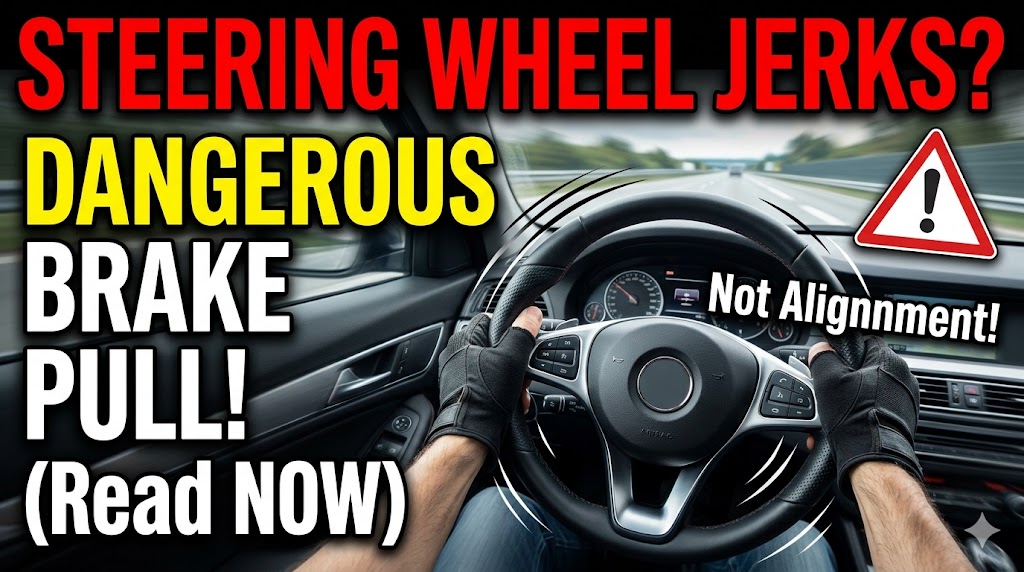
If your steering wheel violently jerks to one side under hard braking at highway speed, your brakes are not functioning evenly. Do not drive at highway speed. Take surface streets to the nearest shop, or call a tow if the pull is severe.
First Things First: Is Your Car Safe to Drive?
Take a breath. We know how terrifying it feels when your steering wheel suddenly has a mind of its own. Here’s the honest answer:
|
✓ Probably OK to drive slowly Mild drift to one side during normal braking. Car goes straight when coasting. No warning lights. |
✗ Call a tow truck Violent steering yank. Grinding or burning smell. Brake pedal feels spongy or sinks to the floor. ABS light is on. |
“A car that pulls under braking means one side is doing more stopping than the other. That’s an unbalanced braking system—and it always gets worse, never better.”
No, It’s Probably Not Your Alignment
If a shop told you the pull is caused by bad alignment and you need four new tires, you have every right to be skeptical. Here’s the key question that separates an alignment problem from a brake problem:
The One Question That Tells You Everything
|
Drifts while coasting? Hands off the wheel, car drifts on a flat road. → Alignment issue |
Only pulls when braking? Drives straight until you touch the brake pedal. → Brake problem |
What to tell the mechanic
“The car tracks straight while cruising. The pull only happens under braking. I’d like you to inspect the calipers, brake hoses, and pad condition on both sides before we talk about tires or alignment.”
An alignment issue causes a constant drift. A brake pull only happens the moment you apply pressure to the brake pedal—because one side of your car is gripping harder than the other. These are two completely different systems.
The 5 Real Causes of Brake Pull
Ranked from most common to least common.
Seized or Sticking Brake Caliper
The #1 culprit. A caliper’s piston or slide pins corrode and seize, preventing the brake pad on one side from engaging (or releasing) properly. One wheel stops harder than the other, yanking the car sideways.
How to spot it
After a short drive, carefully touch each wheel’s rim near the center. If one side is dramatically hotter than the other, that caliper is likely sticking.
Unlubricated or Frozen Caliper Slide Pins
Floating calipers rely on two greased slide pins to center the pads evenly on the rotor. If you reassembled without fresh high-temp brake grease—or the rubber boots are torn—the caliper can’t float and the inner pad does all the work.
🔨 DIY fix
Pull the caliper, remove the pins, clean off old grease with brake cleaner, apply fresh silicone-based caliper grease, and reinstall. 20-minute fix.
Collapsed or Kinked Flexible Brake Hose
The rubber brake hose that connects to each caliper can internally collapse with age—or get twisted during a brake job. It acts like a one-way valve: fluid pushes in but can’t return. The brake stays partially clamped after you release the pedal.
Warning sign
Pull gets worse after repeated braking (like coming down a mountain). The affected wheel may also drag or feel hot after you park.
Glazed or Contaminated Brake Pads
If one set of pads overheated (from a sticking caliper) or got contaminated with grease or fluid, their friction level drops. Now the left side grabs normally while the right side just slides. Car pulls toward the side that’s actually working.
Quick check
Glazed pads look shiny and smooth instead of rough. Contaminated pads may have a greasy sheen or discoloration.
Worn Suspension Bushing (Control Arm)
A worn lower control arm bushing allows the wheel to shift forward or backward under the force of braking, changing the effective toe angle on that side. It mimics a brake pull but it’s actually the geometry shifting under load.
How mechanics find it
They’ll jack up the wheel and push/pull on it looking for play. If the control arm moves but the ball joint is tight, the bushing is the problem.
DIY Troubleshooting Checklist
If you did your own brake job and now have a pull, work through these in order.
Did you grease the caliper slide pins?
Use high-temp silicone brake grease, not general purpose grease. Reinstall with fresh rubber boots.
Did you twist or kink the flexible brake hose?
When you swung the caliper out of the way, the hose may have twisted. Inspect for kinks or bulges.
Are the pads installed on the correct sides?
Some pad sets have inner and outer-specific pads. Check the box or manufacturer’s instructions.
Did you open the bleeder valve or crack a brake line?
Air in one brake line reduces clamping force on that side. You may need to bleed that caliper.
Did you compress the caliper piston correctly?
Rear calipers on many cars require a twist-and-push tool. Forcing them straight back can damage the seal.
Are your new rotors the same spec on both sides?
Mismatched rotor diameter or thickness between left and right will cause uneven braking force.
What To Do Right Now
If you’re scared to drive it
Call a tow. It’s $75–$150 and worth every penny compared to the alternative. Tell the shop “brake pull to the right under braking only.”
If a shop quoted you for alignment & tires
Get a second opinion. Specifically ask: “Can you inspect the calipers, hoses, and pad condition side-to-side?” A brake inspection should be $50–$100, not $800.
If you did the brake job yourself
Go back through the checklist above. In 90% of cases, it’s the slide pins or a twisted hose. You’ve got this—it’s a 30-minute fix once you find it.
Don’t ignore a brake pull.
It won’t fix itself, and it will get worse. Whether you fix it yourself or take it to a trusted shop, handle it this week—not next month.