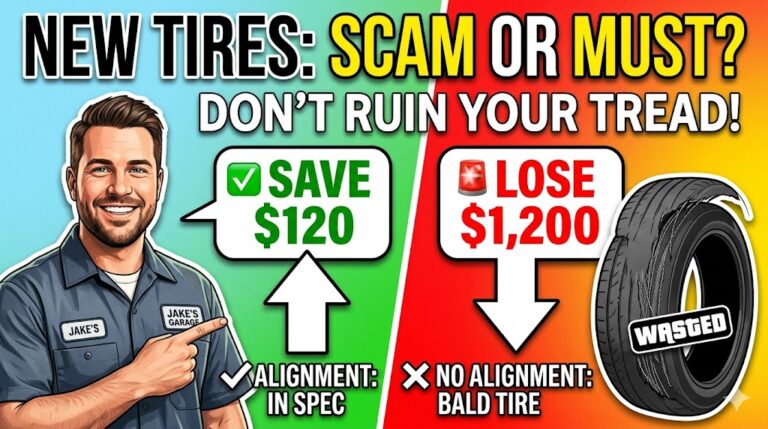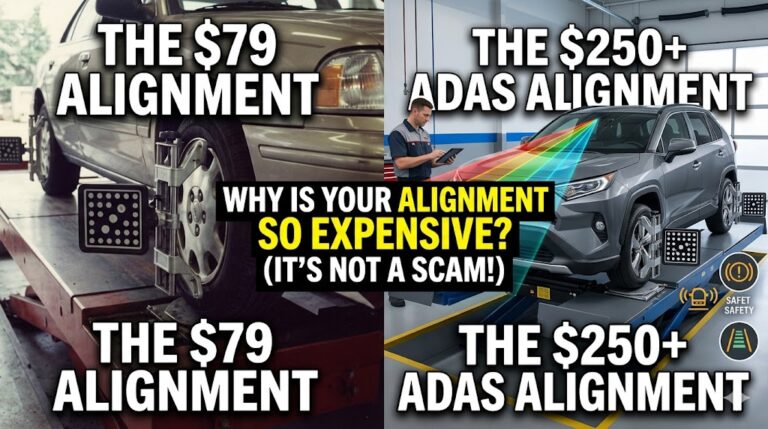
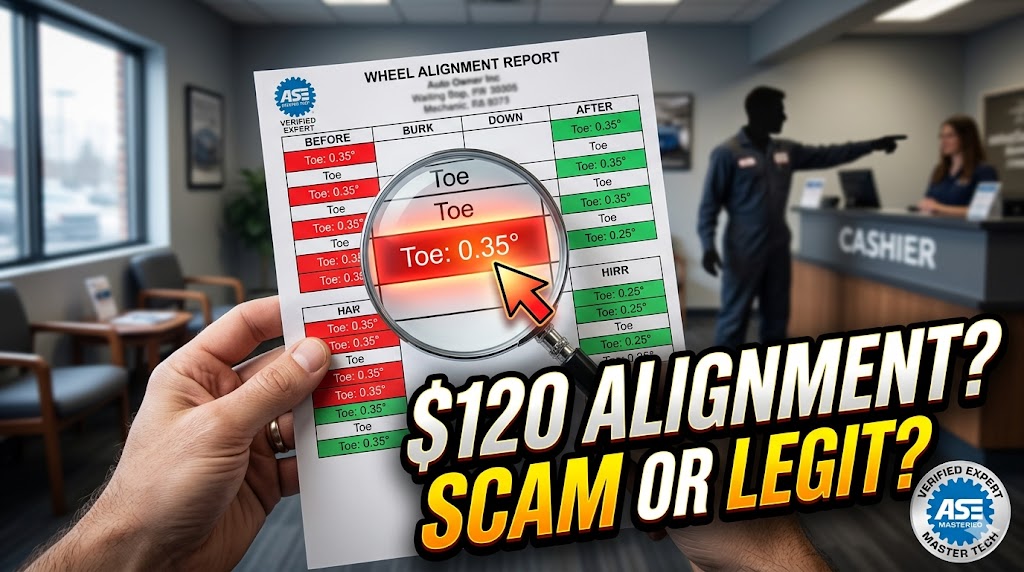

You’re sitting in the waiting room. The mechanic just handed you a sheet covered in red and green boxes and says you need a $120 alignment. Here’s how to tell if he’s right — or if you’re getting upsold.
⚡ Quick Answer — Are You Getting Scammed?
🟢 Green boxes = Within factory spec. You’re fine.
🔴 Red boxes = Out of spec. But not all red is created equal.
The real question: How far into the red? A toe reading of 0.25° when the max is 0.20° is barely out — your tires will survive for months. A reading of 0.80° will chew through a tire in weeks.
👉 Keep reading. In 5 minutes you’ll know exactly how to decode every number on that sheet.
In This Article
1. How to Read an Alignment Printout
Every alignment machine — whether it’s a Hunter, John Bean, or Snap-on — spits out a sheet that looks nearly identical. Here’s the anatomy of what you’re staring at:
📄 Sample Alignment Printout — Annotated
🔍 Sitting in the waiting room?
Look at the “Before” column on your sheet. If everything is green, you probably don’t need an alignment today. If there’s red, check how far the number is from the spec range. Slightly red (within 0.1° of the limit)? You can safely wait. Way into the red? Get it done.
What “Red” and “Green” Actually Mean
The alignment machine compares your car’s current angles to the factory specification range set by the manufacturer. Every vehicle has its own spec sheet.
- 🟢 Green means the angle falls within the factory-approved range. No action needed.
- 🔴 Red means the angle falls outside the factory range. But “outside” could mean 0.02° past the limit or 1.5° past — and those are very different situations.
Think of it like a speed limit. Going 67 in a 65 zone is technically speeding. Going 95 in a 65 zone is a different conversation entirely. Context matters.
2. Toe Explained — The #1 Tire Killer
Bird’s-Eye View: Toe Angle
Imagine looking straight down at your car from above
Toe is the angle of your tires when viewed from directly above the car. Think of it like your feet:
- Toe-in: Tires point slightly toward each other (pigeon-toed)
- Toe-out: Tires point slightly away from each other (duck-footed)
Why Toe Matters the Most
Of the three angles, toe destroys tires the fastest. Even a small amount of toe misalignment means your tires are literally being dragged sideways every mile you drive. Imagine pushing a shopping cart with one locked wheel — that’s essentially what bad toe does to your tread.
⚠ Real-world impact:
A toe misalignment of just 0.5° on a single wheel can scrub off thousands of miles of tread life. At 0.8°+ you may see visible feathering on the tire edges within 3,000–5,000 miles.
What Symptoms Does Bad Toe Cause?
- Crooked steering wheel when driving straight (the most common sign)
- Feathered tire wear — run your hand across the tread; if it feels smooth one direction and rough the other, that’s toe
- Slight wandering feeling at highway speeds
🔍 Bottom line on Toe:
If your printout shows toe in the red by more than 0.15° past the spec limit, the alignment is worth the money. Toe is the one angle that will actually cost you more in tire replacement than the alignment itself.
3. Camber Explained — The Edge Wear Angle
Front View: Camber Angle
Imagine standing in front of your car, looking at the wheels
Camber is the inward or outward tilt of the wheel when viewed from the front of the car.
- Negative camber: Top of tire tilts inward (toward the engine). Most modern cars run a slight negative camber by design — typically -0.5° to -1.5°.
- Positive camber: Top of tire tilts outward. Rare on modern cars.
What Symptoms Does Bad Camber Cause?
- Inside or outside edge wear on the tire (one edge wears faster than the other)
- Mild pulling to one side (if left and right camber are significantly different)
Camber wear is slower than toe wear. A moderate camber issue might take 10,000–15,000 miles to become visible on the tire, compared to toe which can show damage in a few thousand miles.
🚗 Did you hit a curb?
A hard curb hit or pothole can bend a suspension component and throw your camber way off on one side. If your alignment printout shows one wheel at -2.5° while the other is at -0.8°, that’s a red flag that something might be bent — not just misaligned. The shop may need to inspect your control arm or strut before the alignment can even be performed.
4. Caster Explained — The Pulling Angle
Side View: Caster Angle
Imagine looking at the car from the side — this is the tilt of the steering axis
Caster is the hardest of the three angles to visualize. It’s the forward or rearward tilt of the steering axis when viewed from the side. Think of a bicycle fork — it’s angled rearward so the bike naturally tracks straight.
- Positive caster (normal): Steering axis tilts rearward. The steering wheel naturally returns to center after a turn. Most modern cars run +3° to +6° of positive caster.
- Negative caster: Steering axis tilts forward. Makes the car feel unstable. Very rare unless something is damaged.
The Key Thing About Caster: Left-to-Right Difference
The individual caster number matters less than the cross-caster — the difference between left and right. If your left side has +3.0° and your right has +5.0°, that’s a 2.0° cross difference, and your car will pull toward the side with less caster.
🚗 THIS is why your car pulls to one side
If the cross-caster difference is more than 0.5°, you’ll feel a noticeable pull. Caster misalignment doesn’t usually wear tires, but it makes the car feel terrible to drive. Get it fixed for safety.
Does Caster Wear Tires?
Almost never. Caster affects steering feel, not tire contact angle. You won’t see tire wear from caster alone. But unequal caster will make the car pull, which many people mistake for a camber or toe problem.
5. Symptom → Angle Cheat Sheet
Use this table to match what you’re feeling to what’s likely wrong on the printout:
| Symptom | Most Likely Angle | Urgency | Tire Damage? |
|---|---|---|---|
| Steering wheel off-center | Toe | Medium | Yes — fast |
| Feathered tire wear | Toe | High | Already happening |
| Car pulls to one side | Caster (cross-caster) | Medium | No |
| Inside or outside edge wear only | Camber | Low-Med | Yes — slow |
| Steering doesn’t return to center | Caster (low positive) | Medium | No |
| Car wanders / feels “loose” on highway | Toe-out + low Caster | High | Yes |
6. For Modders: Custom Alignment Specs
🔨 This section is for you if you’ve lowered your car
You just installed coilovers and your wheels look tilted. Here’s how to walk into the alignment shop knowing exactly what numbers to ask for — and why.
Why Lowering Changes Everything
When you lower a car, the suspension geometry changes. The lower control arms angle upward more steeply, which typically pushes camber negative and shifts caster. The factory alignment specs are based on factory ride height — they no longer apply to your car.
Street Performance Alignment Specs
These are general starting points for a lowered street/weekend car. Your specific vehicle and driving style may require adjustment.
| Angle | Street Performance | Aggressive Track | Notes |
|---|---|---|---|
| Front Camber | -1.5° to -2.0° | -2.5° to -3.5° | More negative = more cornering grip, but faster inner edge wear |
| Rear Camber | -1.0° to -1.8° | -2.0° to -2.5° | Rear should always be less aggressive than front |
| Front Toe | 0° (zero) | 0.05°–0.10° toe-out | Zero toe for stability; slight toe-out for turn-in response |
| Rear Toe | 0.05°–0.10° toe-in | 0.05°–0.10° toe-in | Rear toe-in = stability. Never run rear toe-out on street |
| Front Caster | +5° to +7° | Max available | More caster = better high-speed stability & steering feel |
💡 Pro tip:
Print this table out and hand it to the alignment tech. Say: “I want these specs, not factory. Can you get there with my current setup?” If they can’t hit the numbers, you may need camber bolts, adjustable control arms, or camber plates.
The Camber vs. Tire Wear Trade-off
This is the fundamental compromise every modder needs to understand:
|
More negative camber →
|
But the cost →
|
The sweet spot for street driving is usually -1.5° to -2.0° front camber. You get noticeably better cornering without chewing through tires every 10,000 miles.
7. The Verdict — Should You Pay for the Alignment?
Here’s the decision framework I give to every customer who asks:
|
1️⃣ Is everything green on the “Before” column? → No alignment needed. You’re within factory spec. Tell the advisor “I’ll pass for now” and feel good about it. |
1. Is everything green on the “Before” column?
→ No alignment needed. You’re within factory spec. Tell the advisor “I’ll pass for now” and feel good about it.
2. Is Toe in the red?
→ Probably worth fixing. Especially if it’s more than 0.15° outside the spec range. The $120 alignment will save you $400–$800 in premature tire replacement.
3. Is only Camber slightly red?
→ You can wait. Camber wear is slow. If it’s less than 0.3° past the limit, monitor your tire edges at your next oil change and reassess.
4. Is only Caster in the red?
→ Depends on how it drives. If the car doesn’t pull and the steering feels normal, caster alone isn’t a tire emergency. If it pulls, get it fixed for safety and comfort.
🚨 Multiple angles way into the red?
→ Get the alignment AND ask about damaged parts. If multiple angles are significantly out on the same corner, something may be bent. A good shop will tell you if they found a bent tie rod, control arm, or strut before they align it.
8. Frequently Asked Questions
How often should I get an alignment?
Most manufacturers recommend checking alignment every 12 months or 12,000 miles, whichever comes first. You should also get it checked after any major pothole hit, curb strike, or if you notice pulling or uneven tire wear. If you’ve replaced suspension components (struts, control arms, tie rods), an alignment is mandatory.
Can I align the car myself at home?
You can do a rough toe adjustment with string and tape measures (the “string method”), and it’s a common technique in the enthusiast community. However, camber and caster typically require a professional alignment rack to measure accurately. For daily drivers, it’s worth the $80–$150 for a professional 4-wheel alignment.
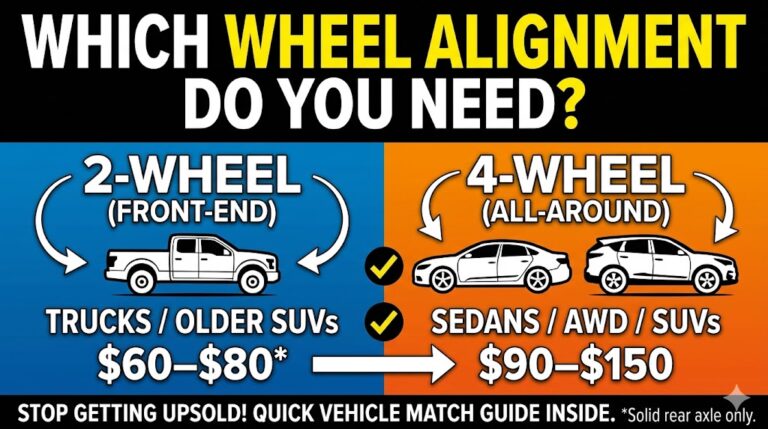
What’s the difference between a 2-wheel and 4-wheel alignment?
A 2-wheel (front) alignment only adjusts the front axle. A 4-wheel alignment adjusts all four corners and also sets the “thrust angle” — making sure the rear axle points straight ahead. Most modern cars (especially AWD and independent rear suspension vehicles) need a 4-wheel alignment. Always ask for the 4-wheel if your car supports it.
My alignment printout shows “Thrust Angle” — what is that?
The thrust angle is the direction the rear axle is pointing relative to the centerline of the car. Ideally it’s 0°. If it’s off, the rear end is “dog-tracking” — the car drives straight but looks slightly angled. A 4-wheel alignment corrects this. If your car has a solid rear axle (some trucks and older cars), the thrust angle usually can’t be adjusted.
The shop says I need a $300 tie rod before they can align. Is that legit?
It can be. Worn or damaged tie rod ends, ball joints, and control arm bushings create play in the suspension. If there’s play, the alignment machine can set perfect angles — but they won’t stay. The car will drift out of alignment within days or weeks. A good shop will show you the worn part by grabbing the tire and demonstrating the looseness. If they can’t show you the play, get a second opinion.