BMW ownership & maintenance guide
Learn how to recognize a weak battery, choose a compatible replacement, understand BMW battery registration, and avoid common electrical-system mistakes.
A BMW that cranks slowly or displays a battery discharge warning can make an ordinary repair feel complicated. The confusing part isn’t always removing the old battery: many BMWs also need a diagnostic procedure after the new one is installed. Before changing BMW battery components, confirm the fault, the correct battery specifications, and the service requirements for your exact model and year.
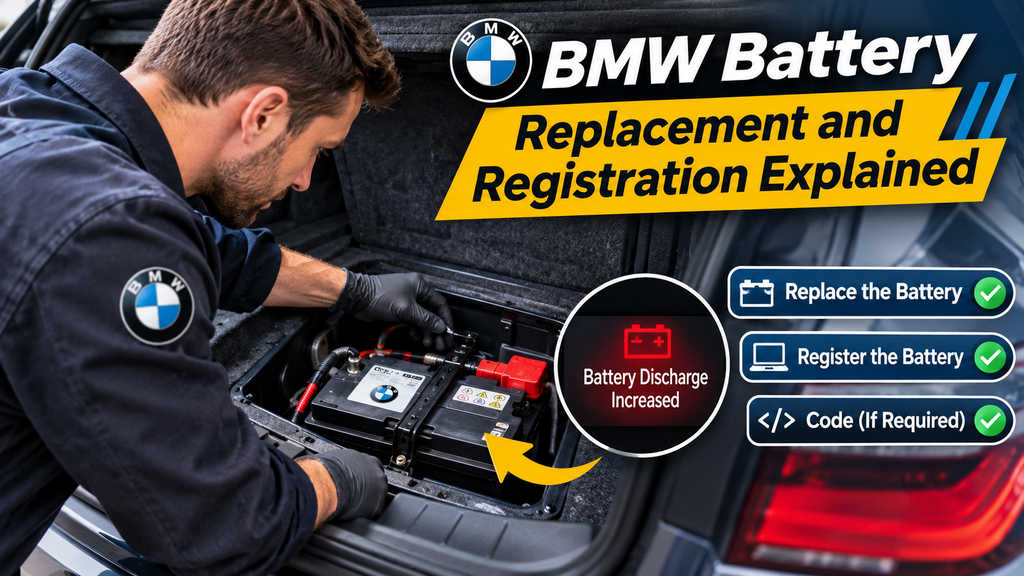
Quick answer: On BMWs equipped with a battery-management system that requires registration, BMW battery replacement involves selecting and installing the correct battery and registering it afterward. Registration tells the vehicle that a replacement battery is fitted. If the new battery has a different supported capacity or chemistry, coding or programming may also be required. The procedure varies by model, year, and equipment.
Signs Your BMW Battery May Need Replacement
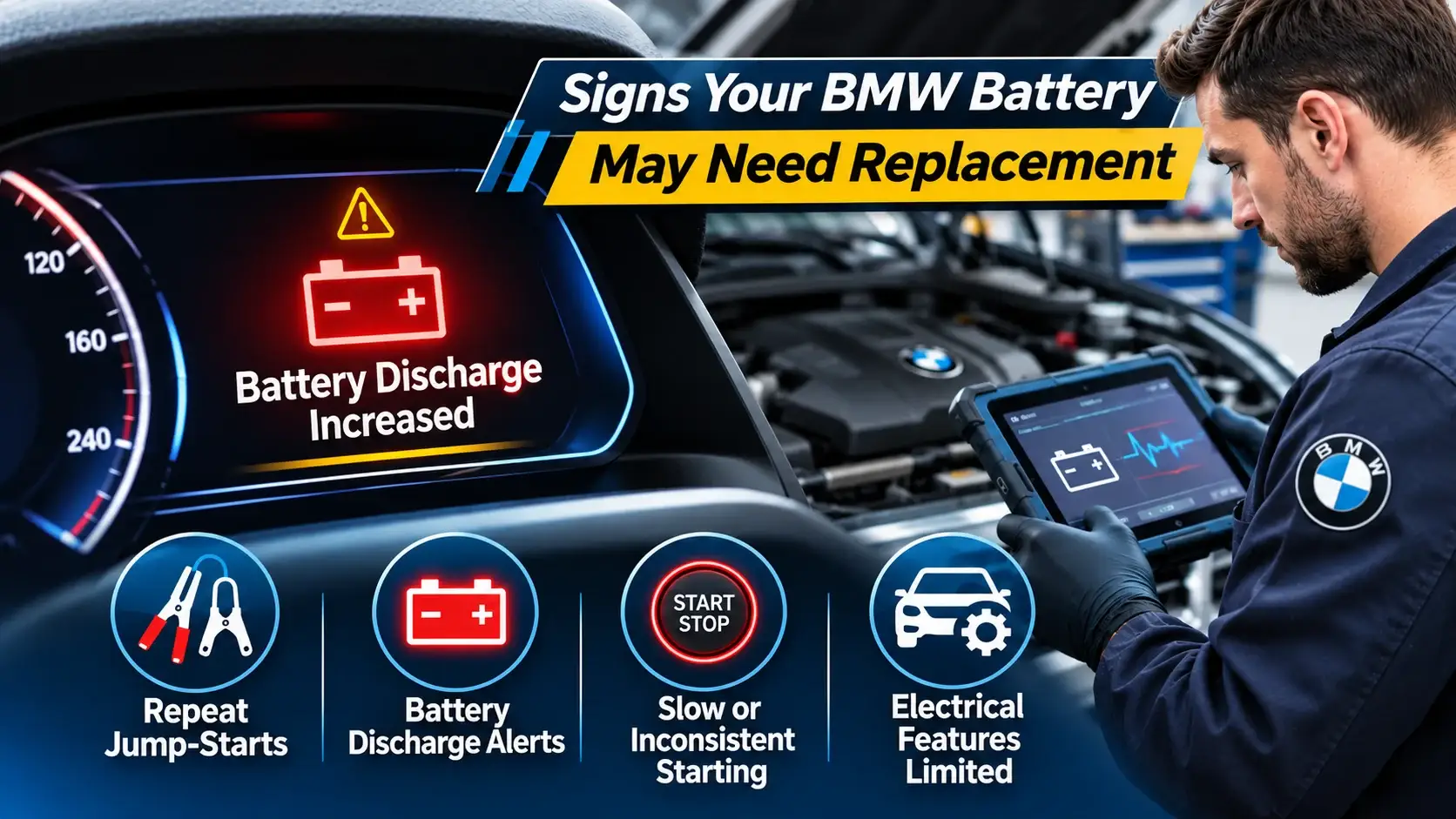
A failing battery is one possibility when your BMW struggles to start, but the charging system, parasitic electrical draw, loose connections, and infrequent driving can cause similar symptoms. Don’t replace the battery based on a warning message alone.
Repeat jump-starts
If the battery repeatedly loses charge, a professional test can help distinguish a worn battery from an underlying problem.
Battery discharge alerts
Messages about increased battery discharge or reduced electrical power can signal low state of charge or another power-management fault.
Slow or inconsistent starting
The starter turns the engine more slowly than usual, especially after the car has been parked overnight.
Electrical features limited
Convenience features may be reduced as the vehicle manages available electrical energy.
Have battery condition, charging output, connection integrity, and potential excessive key-off draw checked when appropriate. A battery may be discharged but recoverable; a new battery can also drain quickly if the real fault remains.
Where Is the Battery Located in a BMW?
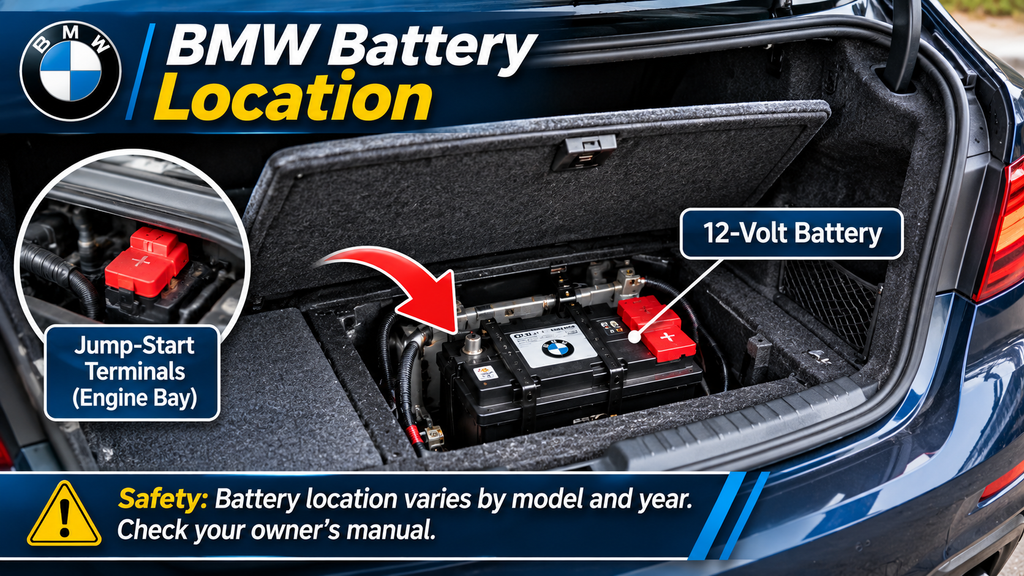
Battery location depends on the model, year, body style, and powertrain. In many BMW sedans and SUVs, the 12-volt battery is in the trunk or rear luggage area, frequently behind a trim panel or beneath the cargo floor. Other models use different locations. Consult your owner’s manual rather than assuming the battery is under the hood.
BMWs can also have remote jump-start terminals in the engine compartment. These terminals are not necessarily the physical battery location. Hybrid and electric BMWs have additional high-voltage components that are not part of an ordinary 12-volt battery DIY procedure.
Safety note: Never disconnect, probe, or touch orange high-voltage cables or high-voltage battery components. If you cannot confidently identify the 12-volt battery and the manufacturer’s service procedure, use a qualified technician.
How to Choose the Correct BMW Replacement Battery
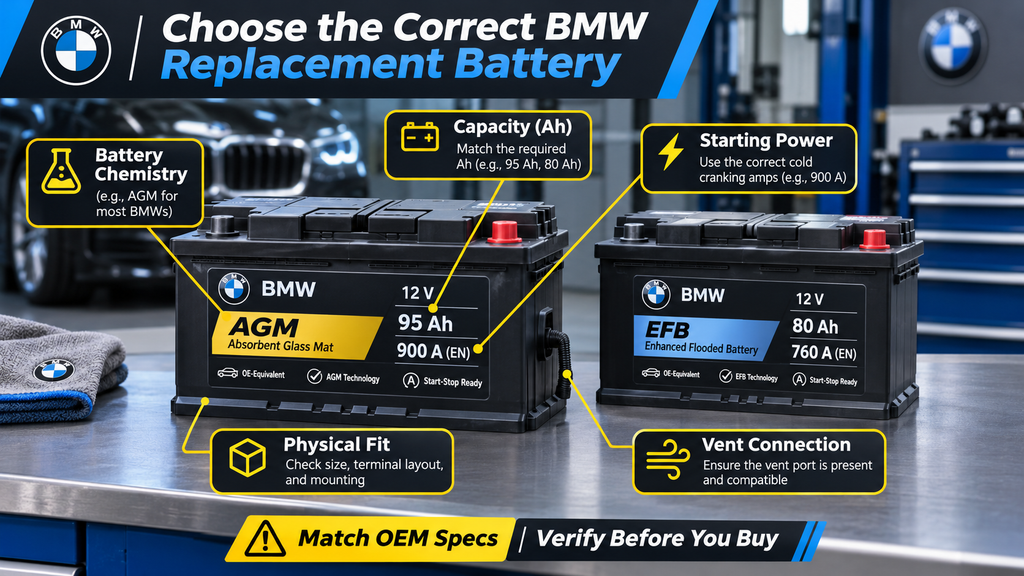
A battery that fits physically is not automatically electrically compatible. Use the VIN, original equipment specifications, current battery label, and BMW-approved application information to determine what belongs in your vehicle. A previous owner may have fitted an incorrect battery, so the old label alone is not conclusive.
| Specification | What to check | Why it matters |
|---|---|---|
| Battery chemistry | AGM or the other exact specified type | Affects charging and battery-management configuration |
| Capacity (Ah) | Approved capacity for the specific model | Capacity changes may require vehicle coding |
| Starting performance | Manufacturer-specified CCA or equivalent rating | Must meet starting demands in expected conditions |
| Physical fit | Dimensions, terminal position, hold-down and access clearance | Prevents unsafe mounting or cable strain |
| Vent connection | Correct vent provision where required | Supports safe installation in enclosed compartments |
Many BMWs specify an AGM battery, but not every BMW uses the same chemistry or capacity. Do not switch between AGM and a conventional flooded battery without verifying the manufacturer’s supported configuration. Do not select a battery by price alone.
How to Change a BMW Battery Safely
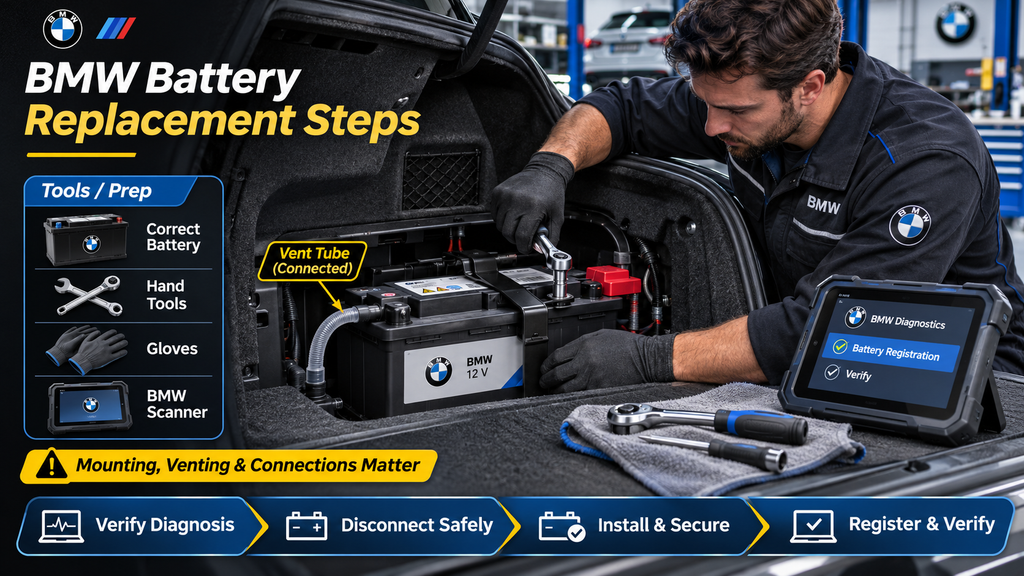
A BMW battery change can be reasonable for an experienced DIY owner on some models, but exact trim removal, terminal hardware, venting, safe power-down, torque specifications, and post-installation procedures differ. Use the model-specific repair manual for the actual installation instructions.
Tools and information to prepare
- Correct, verified replacement 12-volt battery
- Vehicle-specific service instructions and appropriate hand tools
- Approved eye protection and gloves
- Suitable battery lifting support if needed
- BMW-capable diagnostic equipment for registration, or a booked workshop appointment
- Verify the diagnosis. Confirm that testing supports replacing the battery rather than addressing charging faults, corrosion, or excessive electrical draw.
- Identify the correct battery. Check the VIN-specific type, capacity, fit, venting, and any required coding plan before removing anything.
- Prepare the vehicle. Park safely, switch off the vehicle, keep the key away, and follow BMW’s prescribed sleep or power-down instructions for your model.
- Access and disconnect the battery. Follow the service procedure, including the specified terminal disconnection order and precautions around the intelligent battery sensor on the negative side. Do not improvise around unfamiliar electrical equipment.
- Remove and inspect. Release the factory hold-down and carefully lift the battery. Check for corrosion, damaged cables, loose mounting, or a compromised vent connection.
- Install the correct replacement. Secure it with the specified hardware, reconnect terminals in the service-manual order, use specified tightening torques, and restore any required battery vent tube.
- Register and verify. Perform the prescribed diagnostic registration and any necessary coding, then check for warnings, stored faults, and normal electrical operation.
Important: Battery systems can deliver extremely high current. An accidental short, reversed connection, unsecured battery, or damaged IBS wiring can cause serious problems. Do not use generic torque figures or terminal instructions in place of BMW’s service information.
What Is BMW Battery Registration?
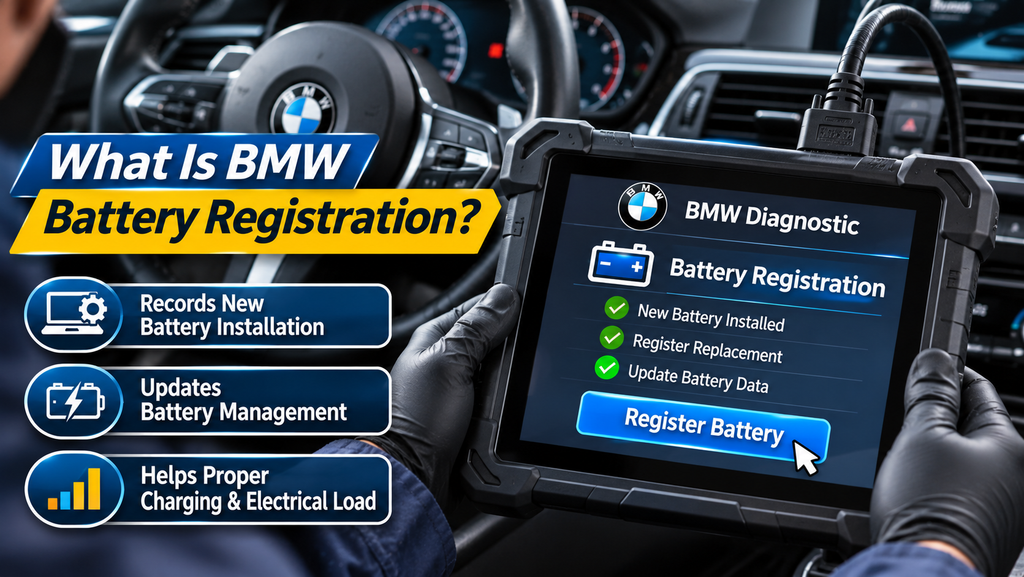
BMW battery registration is a diagnostic service function that records a new battery installation in the vehicle’s energy-management system. Depending on the BMW architecture, the system uses battery-related operating data to manage charging and electrical loads. Registration helps the control system treat the installed battery as a replacement rather than continuing with historical information associated with the previous battery.
BMW service instructions specify registration for vehicles equipped with the applicable battery-management systems. Registration is not the same as testing battery health, physically installing a battery, or repairing an alternator problem.
BMW Battery Registration vs. Battery Coding
The words registration and coding are often used interchangeably, but the operations address different information. Understanding the distinction can prevent an incorrect repair or purchase.
| Procedure | Main purpose | Typical situation |
|---|---|---|
| Physical replacement | Remove the old 12-volt battery and correctly install a compatible new unit. | Battery testing confirms replacement is necessary. |
| Registration | Inform the energy-management system that a new battery was installed. | Required on applicable BMW battery-management systems after replacement. |
| Coding / configuration | Update supported stored battery specifications, such as chemistry or capacity. | A different battery specification is installed and the vehicle supports that change. |
Simple example: Replacing an approved 90 Ah AGM battery with an equivalent approved 90 Ah AGM battery may call for registration only on an applicable vehicle. Installing a supported battery of a different capacity or chemistry may call for coding/configuration plus registration. Confirm the exact procedure by VIN.
How to Register a New BMW Battery
Battery registration generally requires BMW’s diagnostic system or an aftermarket scan tool with confirmed support for the vehicle’s battery service function. A generic code reader that only reads and clears engine trouble codes may not perform registration.
- Confirm tool compatibility. Check the BMW model, year, ECU coverage, and availability of the actual battery registration function.
- Connect safely. Follow the diagnostic tool’s instructions for its connection and ignition or operating state. Use approved power support if the procedure requires it.
- Open the battery service function. Navigate to the vehicle’s battery management or service functions, not merely the clear-codes menu.
- Enter verified information. Select the supported replacement type or capacity when requested. If the battery specification changed, follow the correct coding process first or as directed.
- Confirm completion. Read the tool’s success message and check the vehicle for power-management faults or warnings.
Menu names differ between manufacturers and scan tool software versions. If your equipment does not explicitly support the model’s battery registration, a BMW specialist or independent repair shop is the more reliable option.
What Happens If You Skip Battery Registration?
On a BMW that requires registration, the energy-management system may retain data associated with the previous battery. BMW service guidance warns that power management may not operate as intended, with possible Check Control messages or reduced availability of certain electrical consumers. The exact effects vary by model and condition; skipping registration does not guarantee immediate failure, but it is not recommended.
Registration also does not fix a wrong battery type, incorrect capacity coding, bad electrical connections, or an ongoing parasitic drain. If symptoms remain after replacement and registration, further diagnosis is needed.
BMW Battery Replacement Cost: What Affects the Price?
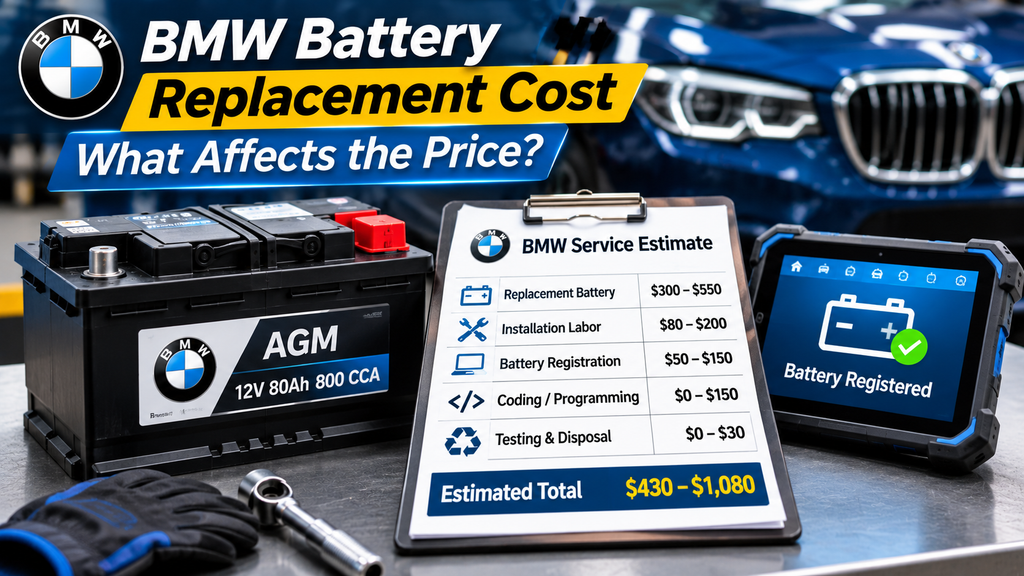
The total depends on battery specifications, vehicle access, local labor rates, whether coding is needed, and whether registration is bundled into installation. Instead of assuming one fixed nationwide price, compare an itemized written quote from a dealership, a BMW specialist, and an independent repair facility.
| Cost component | What to ask before approving work |
|---|---|
| Replacement battery | Is it the correct approved chemistry, capacity, and fit? Is a warranty included? |
| Installation labor | Does it cover difficult rear-trim access, securing hardware, and vent reconnection? |
| Battery registration | Is the diagnostic registration included or charged separately? |
| Coding or programming | Is it actually required for the chosen battery specifications? |
| Testing and disposal | Are pre-replacement testing and battery-core return or recycling included? |
Buying a cheaper battery can turn expensive if it is incompatible or lacks the correct configuration. Ask for a quote that includes everything required to finish the job correctly, not just the battery itself.
Common BMW Battery Replacement Mistakes
- Replacing the battery without first checking for charging problems or key-off battery drain.
- Assuming all BMW models use the same battery location or capacity.
- Fitting a different battery chemistry or capacity without confirming coding requirements.
- Confusing battery registration with simply clearing fault codes.
- Leaving a battery unsecured or failing to reinstall the required vent connection.
- Damaging battery sensor wiring or tightening terminals without the correct specifications.
- Assuming that a successful registration will cure unrelated electrical faults.
BMW Battery Replacement FAQs
Can I replace my BMW battery myself?
Some experienced owners can, provided they follow the exact vehicle service procedure, use a compatible battery, and arrange any required registration or coding. If the battery is difficult to access, high-voltage components are nearby, or the process is unclear, choose a qualified technician.
Does every BMW need battery registration?
No single rule applies to every BMW ever built. Many BMWs with modern energy-management systems require it. Verify the requirement for your model, model year, and battery management equipment.
Is BMW battery registration the same as coding?
No. Registration records the installation of the replacement battery; coding or configuration updates battery specifications when the supported replacement differs from the stored configuration.
Can a regular OBD2 scanner register a BMW battery?
Not necessarily. Basic OBD2 code readers usually cannot perform manufacturer-specific battery service functions. Confirm explicit battery-registration support for your specific BMW before purchasing or using a scan tool.
Will my BMW start without battery registration?
It may start and run, but on vehicles that require registration the battery-management system may not function as intended. Complete the required procedure rather than treating a successful start as proof that installation is finished.
Can I switch from a standard battery to AGM?
Only when BMW’s specifications and supported vehicle configuration permit it. A chemistry change may require coding in addition to registration, so check the VIN-specific service information first.
Does registering the battery erase warning lights?
It may resolve battery replacement-related messages on applicable vehicles, but it cannot fix unrelated electrical faults. Persistent warnings require diagnosis rather than repeated registration or fault-code clearing.