How much does the average car weigh, and does that weight change how many miles you can drive on a gallon of gas? Both questions matter when comparing vehicles or planning fuel expenses. Here is how car weight is measured, what typical vehicles weigh, and how to calculate your own gas mileage.
Quick answer: The U.S. Environmental Protection Agency (EPA) reports an average weight of 4,354 pounds for new model-year 2024 light-duty vehicles, using its inertia-weight methodology. Individual sedans may be much lighter and full-size trucks much heavier. To calculate gas mileage, divide the miles traveled by the U.S. gallons of fuel used.
How Much Does the Average Car Weigh?
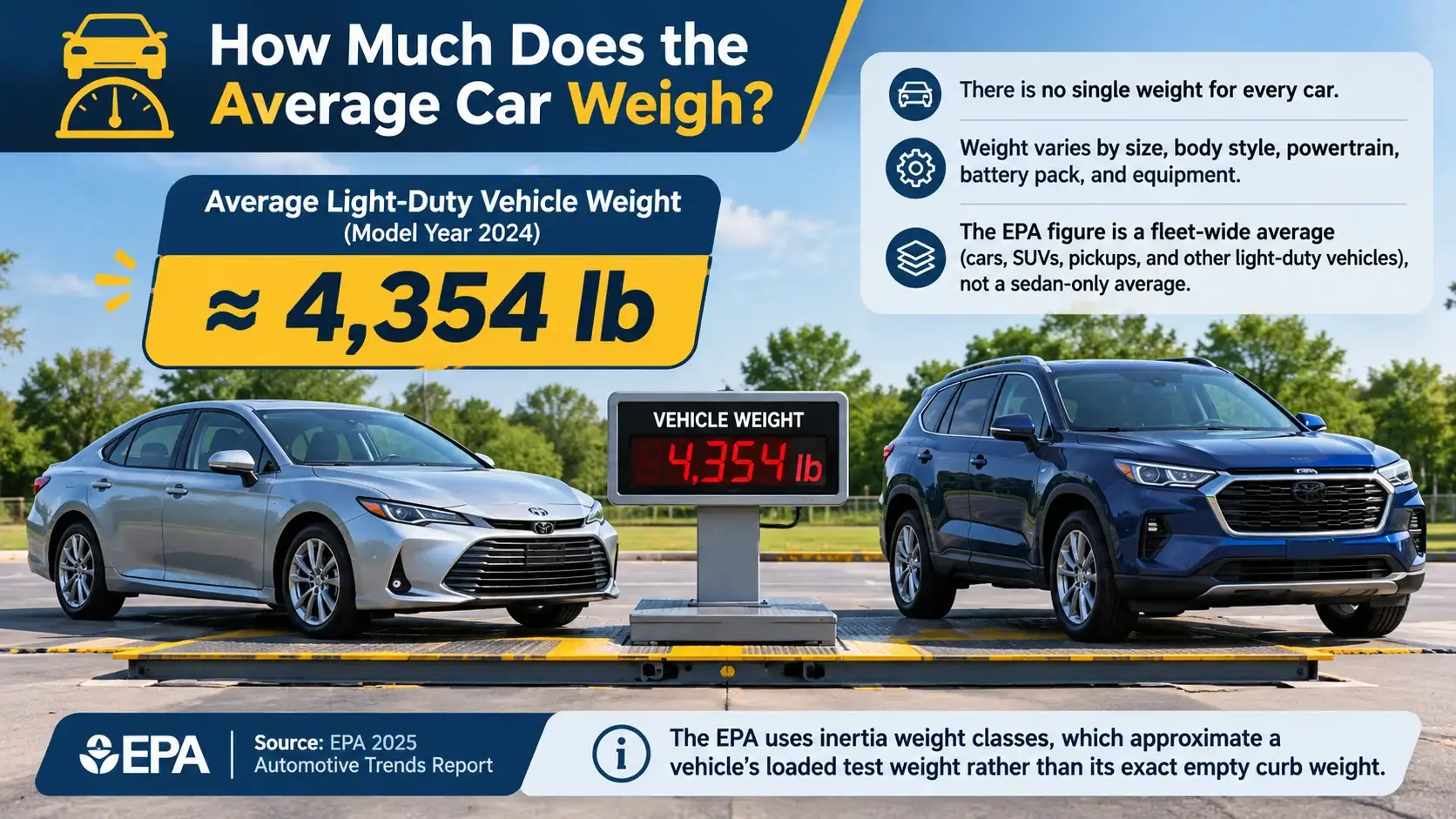
There is no single weight that represents every car. Vehicle size, body design, powertrain, battery pack, and equipment all matter. In the EPA’s 2025 Automotive Trends Report, the average model-year 2024 new light-duty vehicle weighed approximately 4,354 lb. That fleet-wide measure includes cars, SUVs, pickups, and other light-duty vehicles; it is not a sedan-only average.
The EPA report uses inertia weight classes, which approximate a vehicle’s loaded test weight rather than its exact empty curb weight. For your own vehicle, consult the manufacturer’s curb-weight specification for the correct model year and trim.
Average Car Weight by Vehicle Type
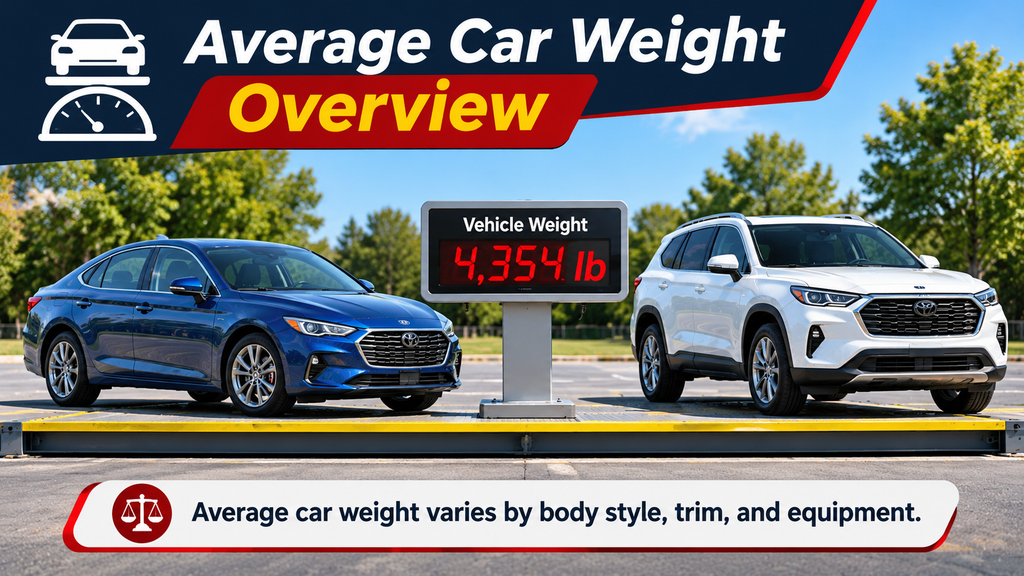
The following are illustrative curb-weight ranges to help you understand how heavy a car can be. They are not statistical averages; actual weights vary by model, trim, drivetrain, and equipment.
| Vehicle type | Illustrative curb weight | Typical use |
|---|---|---|
| Small hatchback / compact car | 2,400–3,200 lb | Commuting, city travel |
| Midsize sedan | 3,200–3,900 lb | Daily driving, family trips |
| Compact SUV / crossover | 3,200–4,200 lb | Family transport, mixed driving |
| Midsize SUV | 3,900–5,000 lb | Passengers and cargo |
| Full-size pickup truck | 4,500–6,500+ lb | Hauling and towing |
These broad ranges are examples for orientation, not EPA-certified class averages. Certain electric vehicles, heavy-duty pickups, and special configurations fall outside them.
What Does a Car’s Weight Actually Mean?
Curb Weight
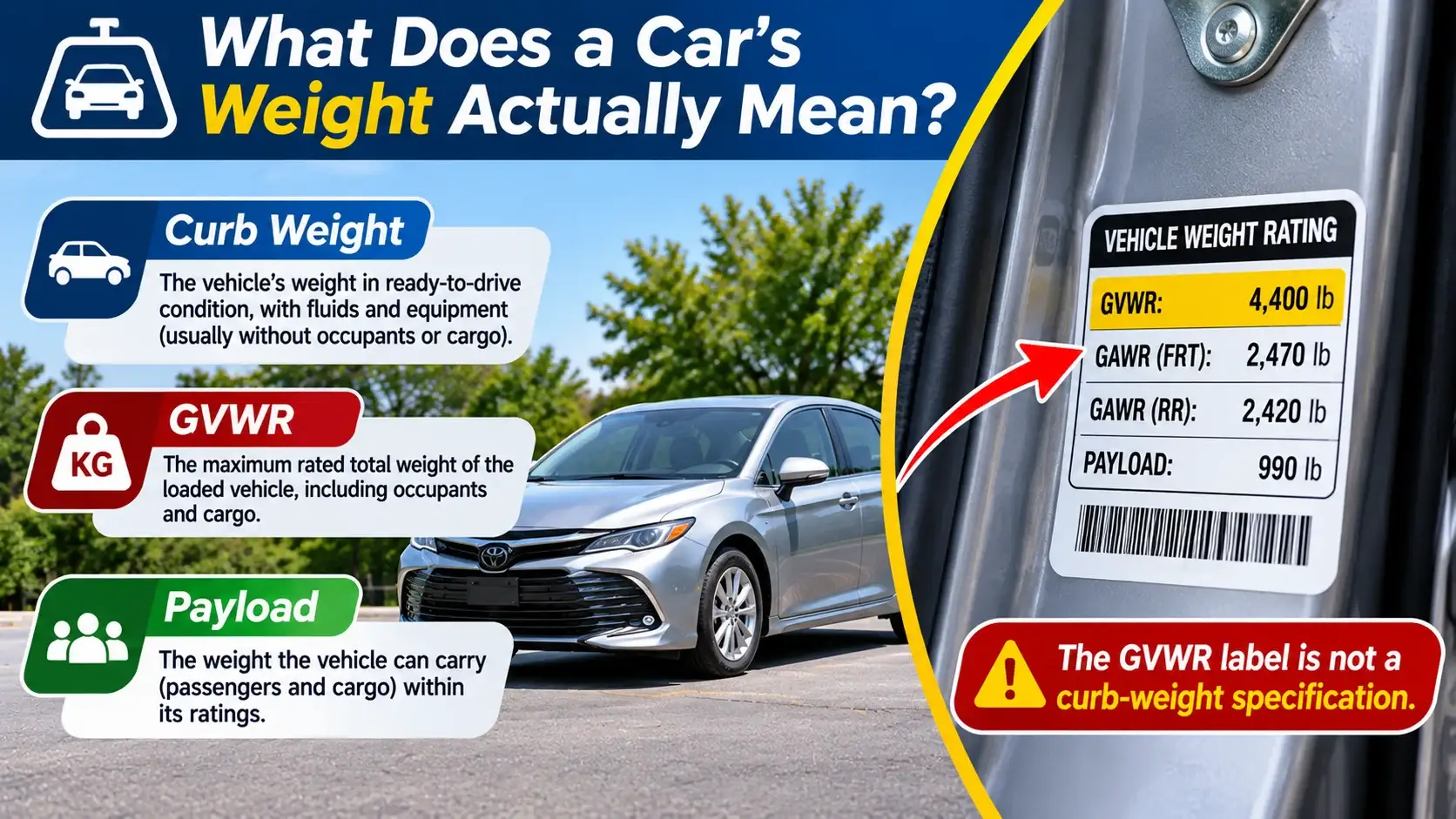
Curb weight is the vehicle’s weight in its ready-to-drive condition, with standard operating fluids and equipment but generally without occupants or cargo. Manufacturer conventions can vary, so check the definition accompanying a published specification.
Gross Vehicle Weight Rating (GVWR)
GVWR is the manufacturer’s maximum rated total weight of the loaded vehicle, including its occupants and cargo. It is not the car’s actual curb weight. The GVWR is often printed on a label on the driver’s doorjamb.
Payload
Payload is the weight the vehicle can carry, including passengers and cargo, within its applicable ratings. A vehicle’s published payload rating should be used rather than assuming every version has the same capacity.
How Does Car Weight Affect MPG?
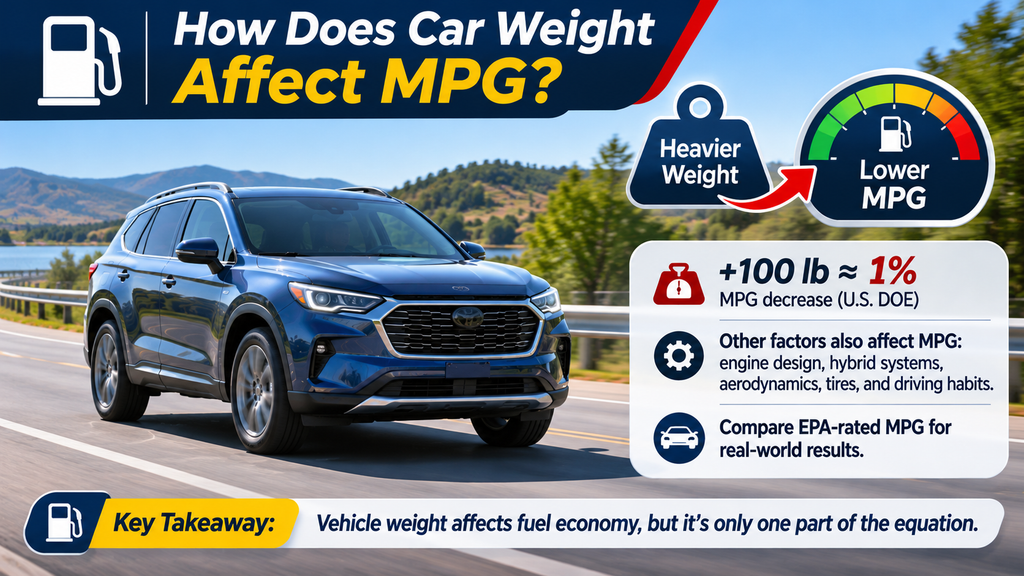
A heavier vehicle usually needs more energy to accelerate and climb hills, all else being equal. But vehicle weight is only part of fuel economy. Engine design, hybrid systems, aerodynamic drag, tires, gearing, road conditions, temperature, and driving habits also affect results.
For example, a modern hybrid SUV may deliver better MPG than an older, lighter gasoline sedan. Compare actual EPA-rated vehicles instead of assuming the lighter car always wins. The U.S. Department of Energy notes that carrying an extra 100 pounds can reduce MPG by around 1%, although the effect depends on the vehicle and circumstances.
How to Calculate MPG
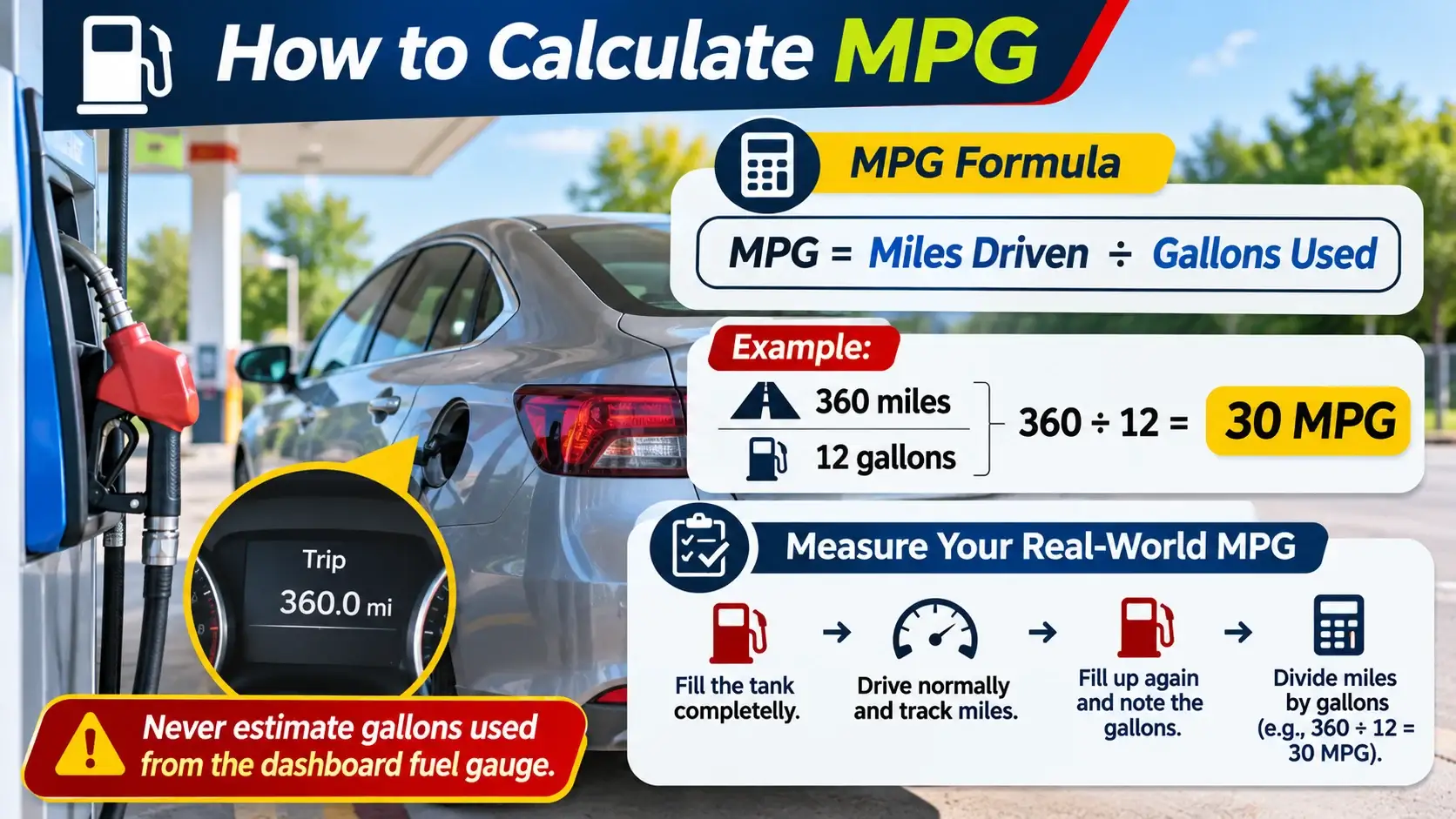
MPG stands for miles per gallon. It tells you how far your vehicle travels on one U.S. gallon of fuel.
MPG = Miles Driven ÷ U.S. Gallons Used
Suppose you travel 360 miles and use 12 gallons of gasoline. Divide 360 by 12 to get 30 MPG. This means your vehicle averaged 30 miles per U.S. gallon over that driving period.
How to Measure Your Real-World MPG
- Fill the fuel tank completely and reset the trip odometer.
- Drive normally until your next fill-up.
- Fill completely again and record the trip miles and gallons pumped.
- Divide miles by gallons. Repeat across several complete fill-up intervals for a more representative average.
Never estimate gallons used from the dashboard fuel gauge alone. Because pump shutoff levels can vary, a single fill-up result is an estimate rather than a laboratory measurement.
How to Calculate Your Annual Gas Cost
You can estimate yearly fuel spending in two steps. Divide your annual mileage by your MPG to estimate gallons used; then multiply the gallons by the assumed price per gallon.
Annual fuel cost = (Annual miles ÷ MPG) × Price per gallon
For example, at 12,000 miles per year and a hypothetical fuel price of $3.50 per gallon, a vehicle returning 30 MPG would cost approximately $1,400 per year for fuel. The same distance at 25 MPG would cost $1,680, a difference of $280 annually. These values are examples, not current pump-price quotes.
Does a Lighter Car Always Save More Gas?
Not necessarily. Weight changes the amount of energy required, but it does not determine fuel economy by itself. A light car with an inefficient engine can use more gasoline than a heavier hybrid. Highway speeds also make aerodynamics especially important, while repeated acceleration makes mass more influential.
When shopping, compare EPA combined MPG estimates for the actual model, model year, engine, and drivetrain. For an existing car, track several fill-ups to see how your real-world MPG compares with its published rating.
How to Find Your Car’s Actual Weight
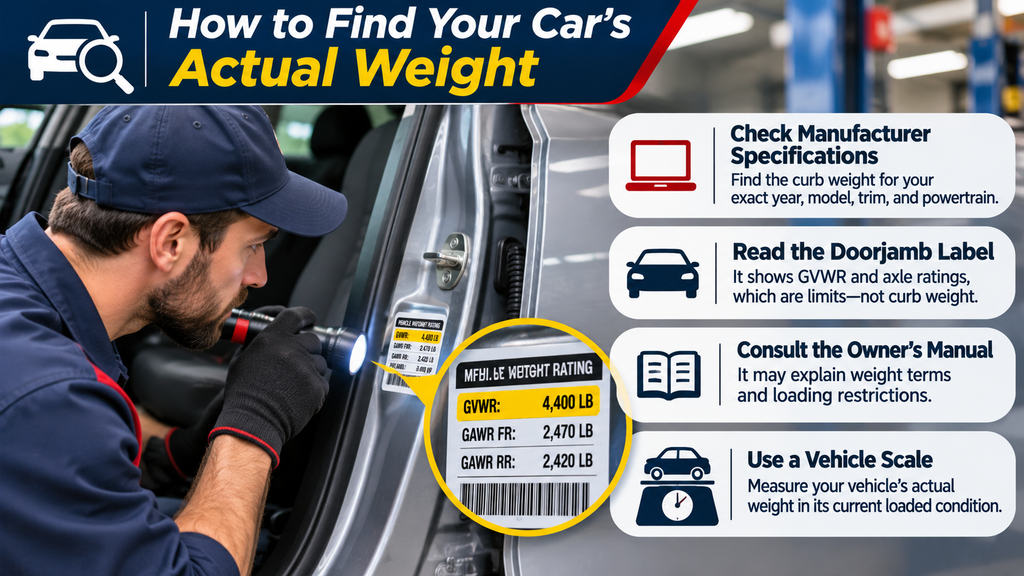
- Check manufacturer specifications: Search for your exact year, model, trim, and powertrain’s curb weight.
- Read the doorjamb label: It usually displays GVWR and axle ratings, which are limits—not curb weight.
- Consult the owner’s manual: It may explain weight terms and loading restrictions.
- Use a vehicle scale when necessary: A scale can measure your vehicle’s actual weight in its current loaded condition.
Practical Ways to Improve Fuel Economy
- Remove unnecessary heavy cargo rather than routinely carrying unused equipment.
- Keep tires at the manufacturer-recommended cold inflation pressure on the vehicle placard; do not use the tire sidewall maximum as your target.
- Accelerate and brake smoothly when road conditions allow.
- Remove an unused roof cargo box that adds aerodynamic drag.
- Stay current with appropriate maintenance and investigate significant MPG drops.
Never remove required safety equipment or exceed vehicle loading limits in an effort to improve MPG.
Frequently Asked Questions
How much does the average car weigh in pounds?
The EPA reports about 4,354 pounds for the average new model-year 2024 light-duty vehicle using its inertia-weight method. That fleet average includes SUVs and pickups, not just passenger sedans. Your own car’s curb weight depends on its specifications.
How heavy is a typical sedan?
Many midsize sedans have curb weights in the approximate 3,200–3,900-pound range, although the exact value depends on the vehicle and configuration.
How do I use an MPG calculator?
Enter the miles driven since a complete fill-up and the gallons needed at the next complete fill-up. Divide the distance by the gallons to estimate miles per gallon.
Does adding 100 pounds reduce MPG?
The U.S. Department of Energy estimates that an extra 100 pounds can reduce fuel economy by around 1%, but the effect is variable and may be more noticeable in smaller vehicles.
Is curb weight the same as GVWR?
No. Curb weight is the vehicle’s unladen ready-to-drive weight, while GVWR is the maximum rated weight of the vehicle when loaded.
Is EPA MPG the same as my actual gas mileage?
No. EPA estimates are standardized comparison figures. Your measured MPG can differ because of traffic, driving behavior, weather, terrain, tires, and vehicle condition.
Final Takeaway
Vehicle weight is a helpful comparison point, but it tells only part of the fuel-economy story. Find the correct curb weight for your particular car, use EPA MPG estimates to compare models, and calculate your own MPG from consecutive complete fill-ups. Combining these measures gives you a clearer picture of ownership costs.