Battery buying & fitment guide
Compare popular battery sizes, understand BCI group numbers, and find a replacement that fits your vehicle safely.
Includes a battery dimension chart, fitment checklist and common questions.
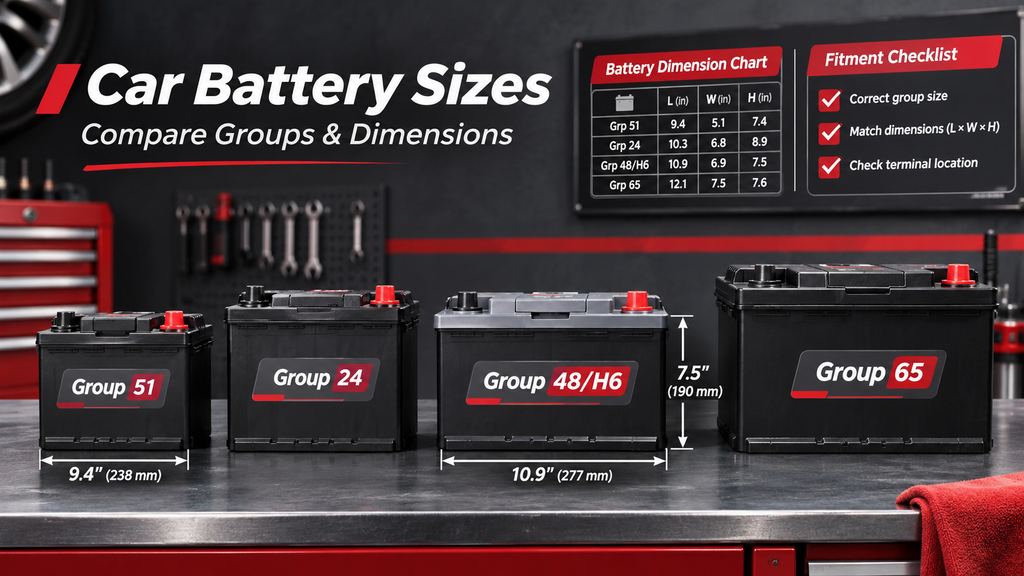
Car batteries look similar at first glance, but even a small difference in car battery sizes can affect the tray, hold-down clamp, cable reach, or clearance under the hood. Battery Council International (BCI) group numbers help buyers compare common replacement configurations.
Whether you are replacing a weak battery or shopping before winter, this guide explains the numbers, compares battery group dimensions and shows how to verify fitment before spending money.
Quick answer: A battery group size describes a standardized fitment configuration, including dimensions and terminal layout. Start with the group recommended for your vehicle, then confirm battery chemistry, electrical ratings, hold-down design and terminal orientation. Similar dimensions alone do not prove interchangeability.
The basics
What Is a Car Battery Group Size?
A battery group size is a designation used to identify the physical and configuration requirements of a battery. In North America, BCI group numbers such as 24, 35, 48 and 94R simplify replacement selection by giving manufacturers and retailers a standardized reference.
The number is not a measure of voltage, starting power or overall quality. A Group 48 battery and a Group 94R battery may both be 12-volt models, but they have different lengths and may require different mounting arrangements.
Size
Overall length, width and height
Connections
Terminal type, placement and cable reach
Fitment
Mounting, technology and vehicle needs
At-a-glance reference
Automotive Battery Size Chart
This automotive battery size chart lists frequently encountered BCI groups. The measurements are reference maximum overall dimensions, shown as length × width × height. They are intended for comparison, not as approval to install a specific battery in your car.
| BCI group | Dimensions (mm) | Dimensions (inches)* | Common equivalent |
|---|---|---|---|
| 24 | 260 × 173 × 225 | 10.24 × 6.81 × 8.86 | — |
| 24F | 273 × 173 × 229 | 10.75 × 6.81 × 9.02 | — |
| 27 | 306 × 173 × 225 | 12.05 × 6.81 × 8.86 | — |
| 34 | 260 × 173 × 200 | 10.24 × 6.81 × 7.87 | — |
| 35 | 230 × 175 × 225 | 9.06 × 6.89 × 8.86 | — |
| 47 | 242 × 175 × 190 | 9.53 × 6.89 × 7.48 | H5 / LN2 |
| 48 | 278 × 175 × 190 | 10.94 × 6.89 × 7.48 | H6 / LN3 |
| 49 | 353 × 175 × 190 | 13.90 × 6.89 × 7.48 | H8 / LN5 |
| 51R | 238 × 129 × 223 | 9.37 × 5.08 × 8.78 | — |
| 65 | 306 × 192 × 192 | 12.05 × 7.56 × 7.56 | — |
| 94R | 315 × 175 × 190 | 12.40 × 6.89 × 7.48 | H7 / LN4 |
Visual explanation
How Are Car Battery Dimensions Measured?
When comparing car battery dimensions by group, read the measurements in the order length × width × height (L × W × H). Height can include the terminals, depending on how the reference specification is defined.
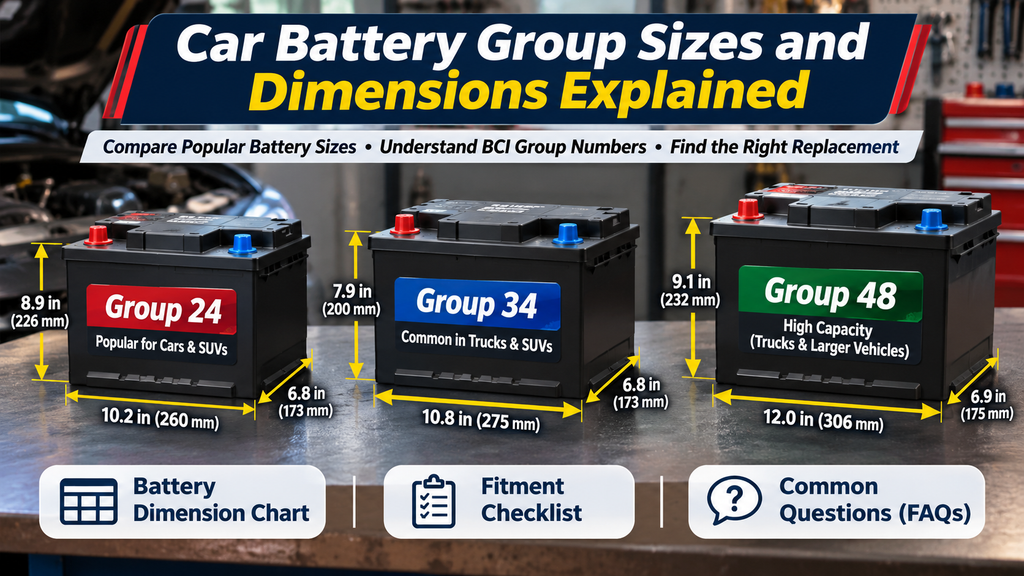
Length and width
These determine whether the case fits the battery tray or compartment. They also affect where the hold-down bracket can grip the case.
Height and clearance
Check the distance to the hood, cover or surrounding components. Allow room for the actual terminal connections and protective covers.
For instance, a Group 48 (H6) reference battery is about 278 × 175 × 190 mm. That is not enough to confirm compatibility: the positive and negative terminals must also match the vehicle’s wiring layout.
Popular sizes
Common Automotive Battery Sizes Explained
The following groups appear frequently in passenger-car, crossover and light-truck battery catalogs. These are size families, not guaranteed assignments for any particular model.
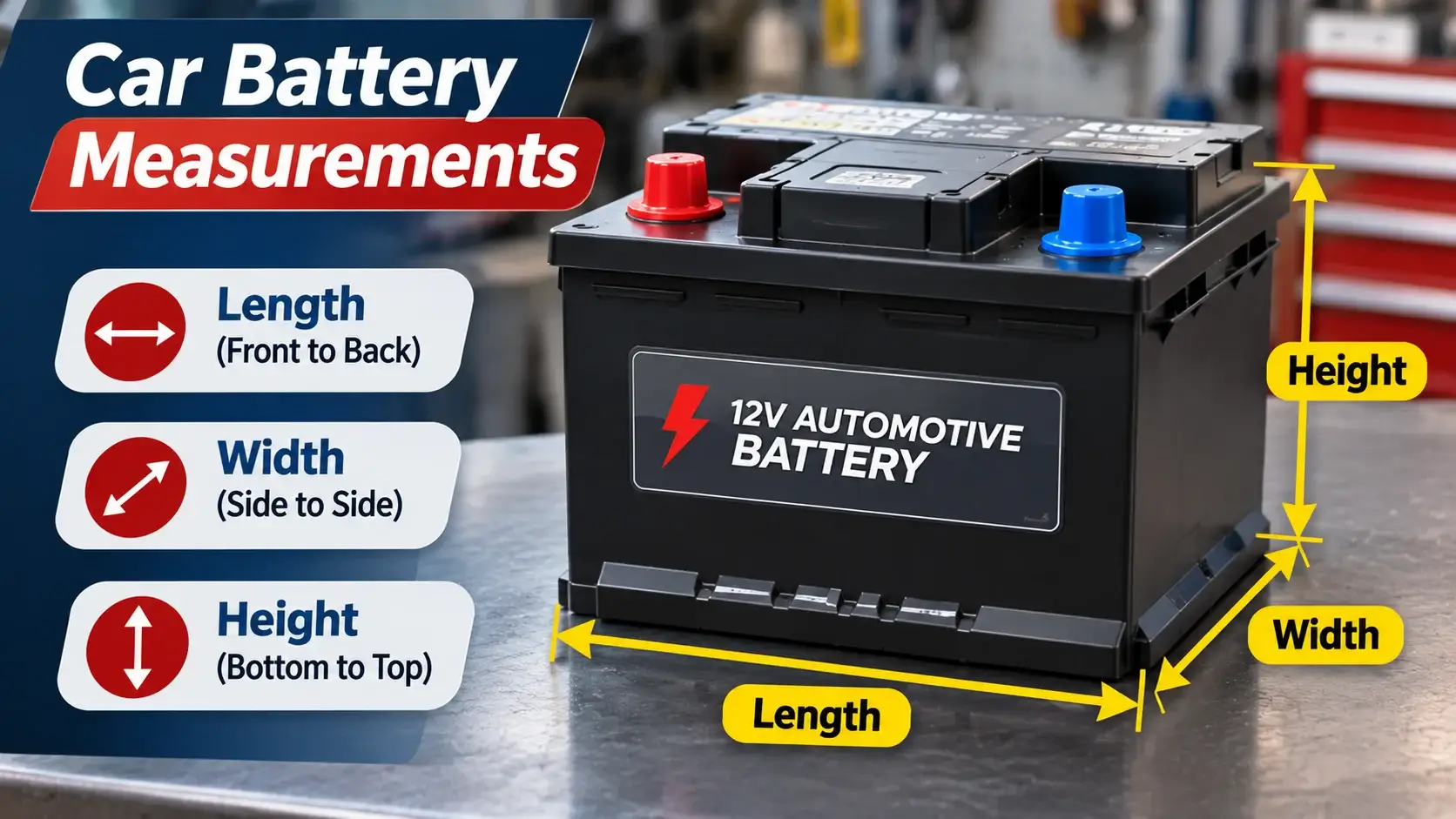
Group 24 and Group 24F
Although their names look similar, these groups have different published dimensions and fitment arrangements. Do not assume 24F can replace 24 merely because the battery will sit in the tray.
Group 35
A compact group with reference dimensions of 230 × 175 × 225 mm. Its fitment depends on the exact vehicle year, engine and factory battery configuration.
Group 47 (H5) and Group 48 (H6)
H5 and H6 batteries share a similar width and height but differ in length: approximately 242 mm versus 278 mm. Group 48 is also labeled H6 or LN3 in many catalogs.
Group 65
This relatively wide group measures roughly 306 × 192 × 192 mm and appears in some larger vehicle applications. Check the original tray dimensions and hold-down setup carefully.
Group 94R (H7) and Group 49 (H8)
These are longer European-style battery groups. A Group 94R is about 315 mm long, while Group 49 is about 353 mm long. Extra length does not make either an automatic upgrade for a smaller group.
How-to guide
How to Find the Correct Battery Size for Your Car
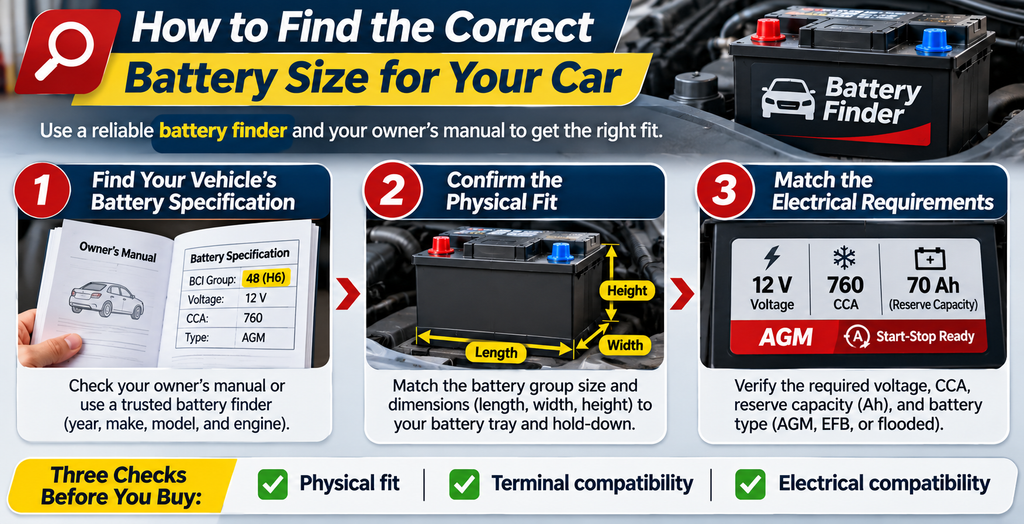
Use a reliable battery finder together with your owner’s manual, rather than choosing by the old battery’s label alone. A previously installed battery might itself be incorrect.
Step 1: Identify your vehicle precisely
Record the model year, make, model, engine and relevant equipment such as automatic start-stop. Check the owner’s manual and manufacturer service information for the specified battery type and rating.
Step 2: Check a vehicle-specific fitment catalog
Use an established battery manufacturer or auto parts retailer’s lookup and compare its recommendations with the vehicle specifications. Several products may fit, but they are not necessarily equivalent in chemistry or performance.
Step 3: Examine the installed battery
With the vehicle off, look for the group number and labels showing voltage, cold cranking amps (CCA), reserve capacity (RC) and battery technology. Do not touch exposed electrical connections or use metal tools near the terminals unnecessarily.
Step 4: Verify the mounting and terminals
Make sure the new battery uses the proper hold-down system and that the terminal layout allows the factory cables to connect without stretching or crossing.
Step 5: Confirm electrical requirements
Check CCA and any specified amp-hour or reserve-capacity rating. Some vehicles also require battery registration or charging-system adaptation after replacement; follow the applicable service procedure.
Important safety check
Why Terminal Position and Hold-Down Fit Matter
Two batteries can look almost identical while having their positive and negative posts arranged differently. The suffixes on group designations are important, but their meanings should be verified from the exact product specification rather than guessed.
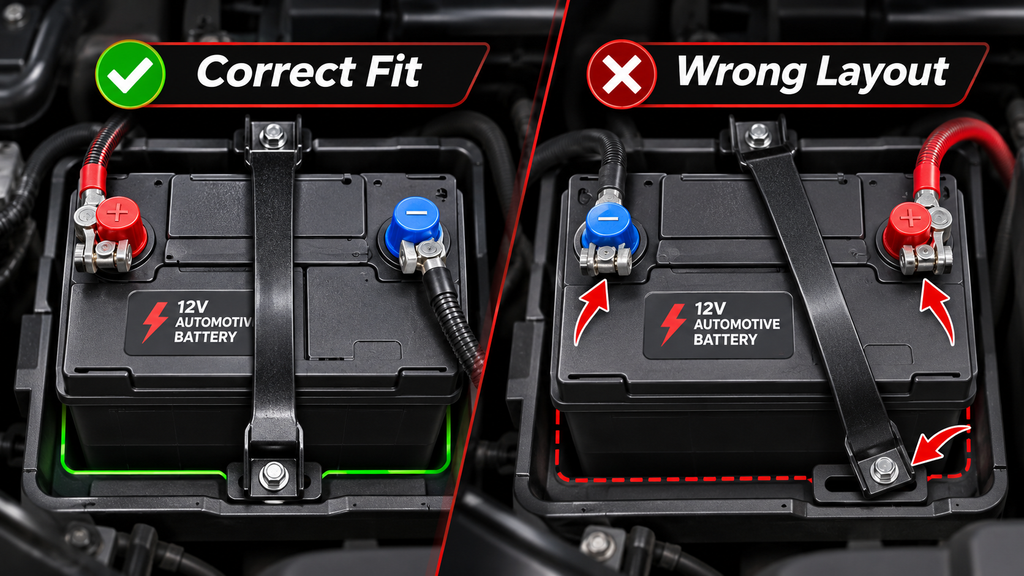
Safety reminder: Do not reverse battery connections, modify the original hold-down bracket, or operate a vehicle with an unsecured battery. If you are unsure about cable routing, venting or installation, consult a qualified technician.
Electrical specs
Battery Group Size vs. CCA, Ah and Reserve Capacity
A group size is primarily a fitment reference; battery performance depends on the specific product. This distinction is especially useful when comparing two batteries sold under the same group designation.
| Specification | Meaning | Buying decision |
|---|---|---|
| Group size | Physical dimensions and configuration | Will it fit and connect correctly? |
| CCA | Starting-current capability under specified cold conditions | Does it meet the vehicle’s minimum requirement? |
| Ah | Rated charge capacity under specified test conditions | Is the rated capacity suitable? |
| RC | Reserve-capacity rating under a defined load | Does it meet the specified reserve requirement? |
For example, two H6 batteries may share dimensions but have different CCA ratings. Choosing the physically correct case does not remove the need to verify its performance rating.
Battery technology
AGM vs. EFB vs. Flooded: Same Size, Different Requirements
Some automotive battery sizes are offered with more than one battery technology. A conventional flooded battery and an absorbent glass mat (AGM) battery may fit the same tray, yet the vehicle’s charging strategy may require one specific type.
Flooded and EFB
Traditional flooded batteries are widely used in starting applications. Enhanced flooded batteries (EFB) are designed for certain higher-cycling applications, including some start-stop systems.
AGM
AGM batteries immobilize the electrolyte in glass mat separators and are specified by many vehicles with demanding electrical loads or start-stop systems.
Do not downgrade battery technology just to save money. Match the manufacturer’s specified type and follow any required registration or programming procedure.
Before you buy
Car Battery Replacement Checklist
- Correct year, make, model and engine
- Manufacturer-approved group designation
- Length, width and height confirmed
- Terminal layout and cable reach checked
- Hold-down and protective cover fit
- CCA and capacity requirements met
- AGM, EFB or flooded type matched
- Registration or reset needs reviewed
Avoid buying from an automotive battery sizes chart alone. The chart is a helpful starting point; vehicle-specific fitment is the final check.
Quick answers
Frequently Asked Questions
How do I find my vehicle battery group size?
Check the owner’s manual, the current battery label and a trusted vehicle-specific fitment catalog. Verify all three against the vehicle manufacturer’s recommendations.
Are Group 24 and 24F batteries interchangeable?
Not automatically. They have different reference dimensions and can differ in terminal and installation configurations. Only substitute when approved for your vehicle.
What is the difference between H6 and H7 batteries?
H6 (Group 48) is approximately 278 mm long, while H7 (Group 94R) is approximately 315 mm long. Both are commonly 175 mm wide and 190 mm high.
Does higher CCA mean a larger battery?
No. CCA measures cold-starting performance under a standardized test. Batteries in the same group may have different CCA ratings.
Can I use a physically larger battery?
Only if its fitment, terminals, battery technology and electrical specifications are approved for your vehicle. Physical room in the tray does not guarantee suitability.
Are AGM and flooded batteries interchangeable?
Not simply because their dimensions match. Follow the manufacturer-specified chemistry and replacement procedure, especially on start-stop vehicles.
The Bottom Line
Choosing the right replacement means matching more than a box’s measurements. Use the battery group size to narrow your options, consult the dimension reference, and then confirm vehicle-specific electrical and mounting requirements. A little verification can prevent a wasted purchase and a potentially unsafe installation.