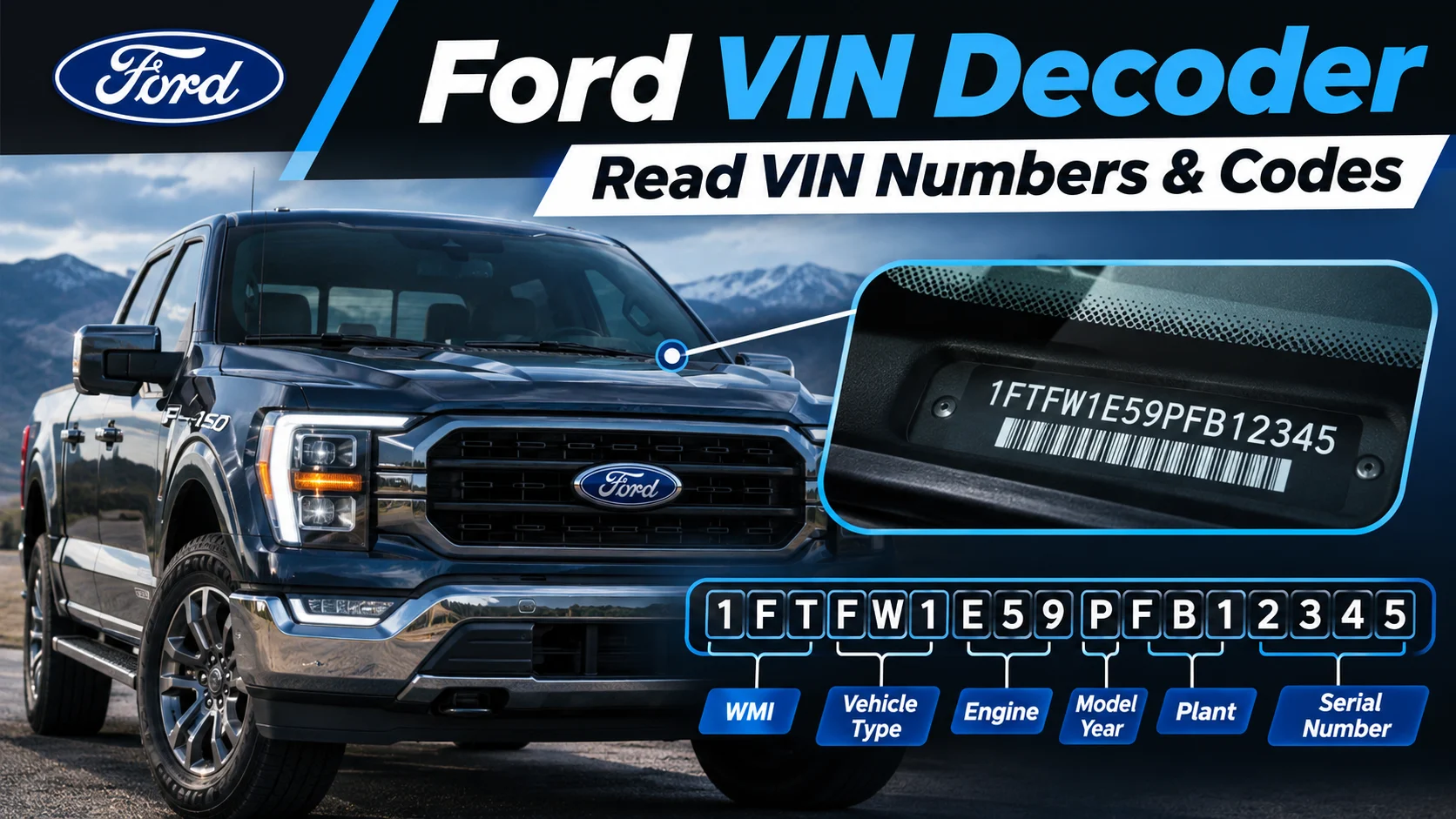
Every Ford vehicle has a unique identification number that can help you verify its factory specifications, production details, and model year. Whether you own a Ford F-150, Mustang, Explorer, or Escape, knowing how to read this number is useful when buying a used vehicle, checking records, or ordering replacement parts.
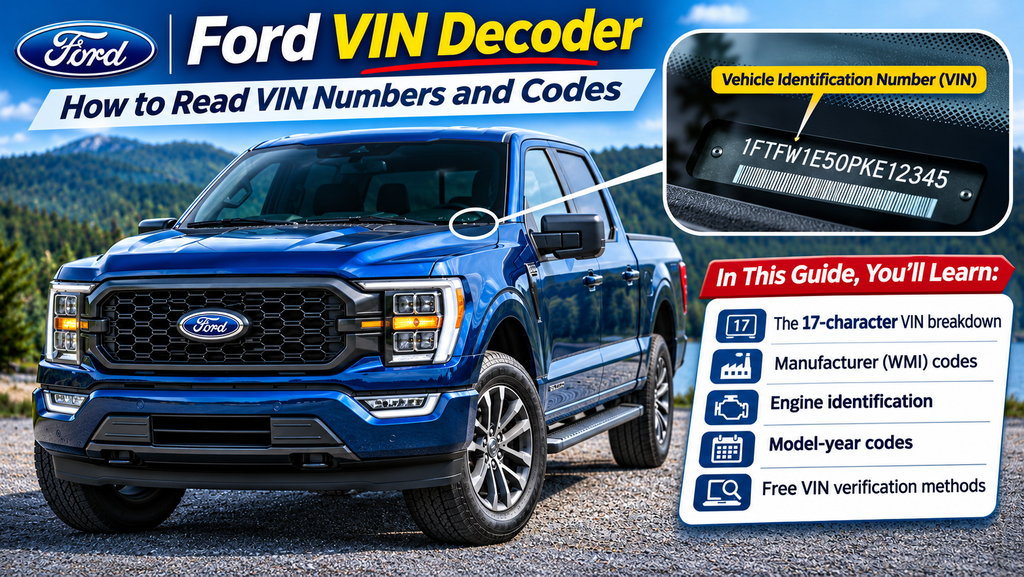
This guide explains the ford vin number breakdown, including all 17 character positions, manufacturer codes, engine identification, model-year codes, and free VIN verification methods.
Quick Answer: How Do You Read a Ford VIN?
A modern Ford VIN has 17 characters. Positions 1–3 identify the manufacturer, 4–8 describe vehicle attributes, position 9 is a check digit, position 10 identifies the model year, position 11 identifies the assembly plant, and positions 12–17 contain production identification information.
What Is a Ford VIN Number?
A Vehicle Identification Number (VIN) is a unique identifier assigned to a vehicle during manufacturing. Modern Ford vehicles sold in the United States generally have a standardized 17-character VIN containing letters and numbers.
VIN information is used for vehicle identification, registration, recall searches, insurance records, and parts verification. The standardized characters exclude I, O, and Q to reduce confusion with similar-looking numbers.
Older Ford vehicles may use different identification formats, especially those manufactured before the standardized 17-character system became mandatory for relevant U.S. vehicles beginning with the 1981 model year.
Ford VIN Number Breakdown: All 17 Characters Explained
Understanding the ford vin number breakdown becomes easier when you divide the identification number into its main sections. Each position has a defined purpose, although some vehicle-specific character meanings depend on the Ford model and year.
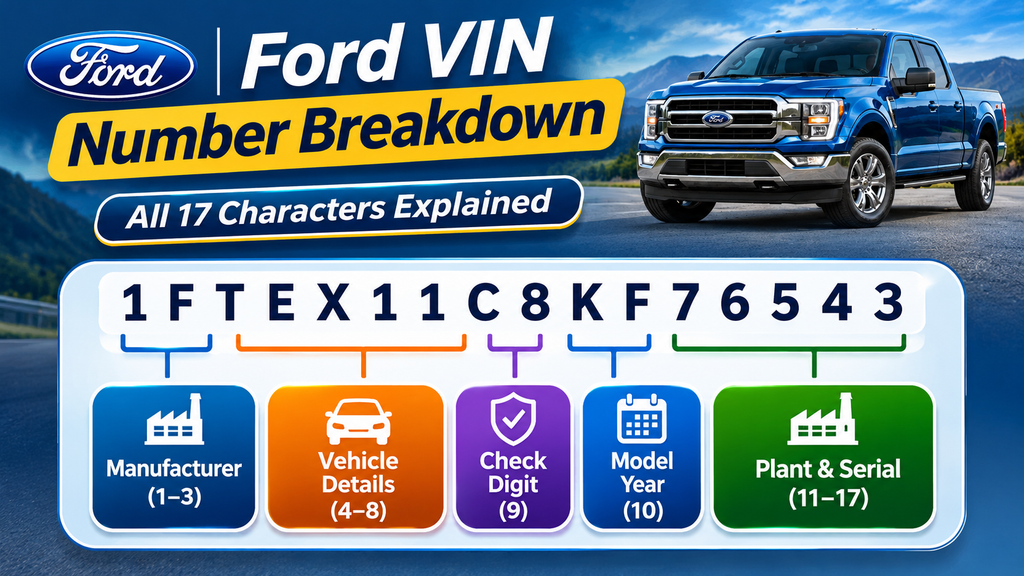
| VIN Position | Section | Meaning |
|---|---|---|
| 1–3 | WMI | Manufacturer identification |
| 4–8 | VDS | Vehicle characteristics, including applicable body and engine information |
| 9 | Check Digit | VIN validation character |
| 10 | Model Year | Designated vehicle model year |
| 11 | Plant Code | Manufacturing assembly plant |
| 12–17 | Production ID | Manufacturer-assigned production sequence |
Positions 1–3: World Manufacturer Identifier
The first three characters form the World Manufacturer Identifier (WMI). This section identifies the manufacturer and its assigned vehicle category or division.
| WMI | Common Identification |
|---|---|
| 1FA | Ford passenger cars, United States |
| 1FT | Ford trucks, United States |
| 1FM | Ford multipurpose vehicles, United States |
| 3FA | Ford passenger cars, Mexico |
These are examples rather than a complete list. Always interpret the full WMI instead of making assumptions from a single character.
Positions 4–8: Vehicle Description Section
Characters four through eight describe manufacturer-defined vehicle attributes. Depending on the Ford model and year, these may include body configuration, engine type, restraint system, vehicle line, and related characteristics.
The same character can have different meanings across different model years or vehicle lines. A Ford Mustang code should not automatically be interpreted using an F-150 decoding chart.
Position 9: VIN Check Digit
The ninth character is a mathematically calculated check digit. It helps identify certain transcription mistakes and may be a number from 0 through 9 or the letter X.
A valid check digit does not prove legal ownership, verify the physical vehicle’s identity, or establish that the VIN has never been tampered with.
Position 10: Model Year Code
The tenth character identifies the vehicle’s designated model year. This is not necessarily the calendar year when the vehicle was manufactured or first sold.
Position 11: Assembly Plant
The eleventh character represents the assembly plant through a manufacturer-assigned code. Plant-code meanings can vary over time, so confirm them using documentation for the relevant production year.
Positions 12–17: Production Sequence
The last six positions generally provide a manufacturer-assigned production identifier for Ford vehicles produced in normal-volume categories. They help distinguish vehicles sharing similar specifications.
How to Decode a Ford VIN Step by Step
Reading a Ford VIN involves identifying its standard sections and confirming the manufacturer-specific information with an official decoder.
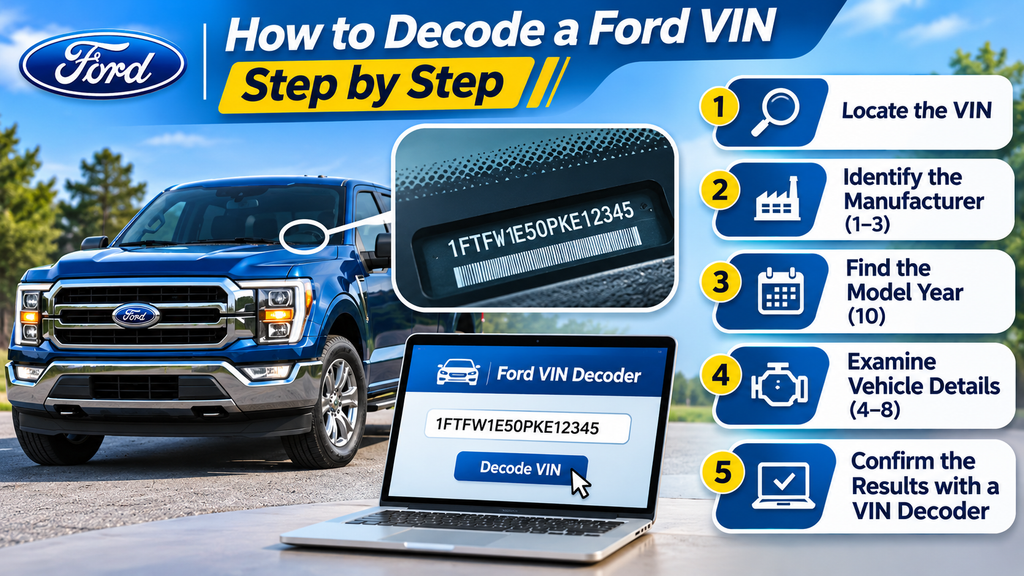
- Locate the VIN: Find the full 17-character number on the dashboard, certification label, or vehicle documents.
- Identify the manufacturer: Check positions 1–3 to determine the WMI.
- Find the model year: Read position 10 and compare it with the correct model-year code chart.
- Examine vehicle attributes: Decode positions 4–8 using the appropriate Ford model-year specifications.
- Confirm the results: Enter the complete VIN into an official decoder and compare the information with the actual vehicle.
Ford VIN Model Year Chart
Ford vehicles using the standardized U.S. VIN system follow model-year character codes. The table below covers model years 2010 through 2039.
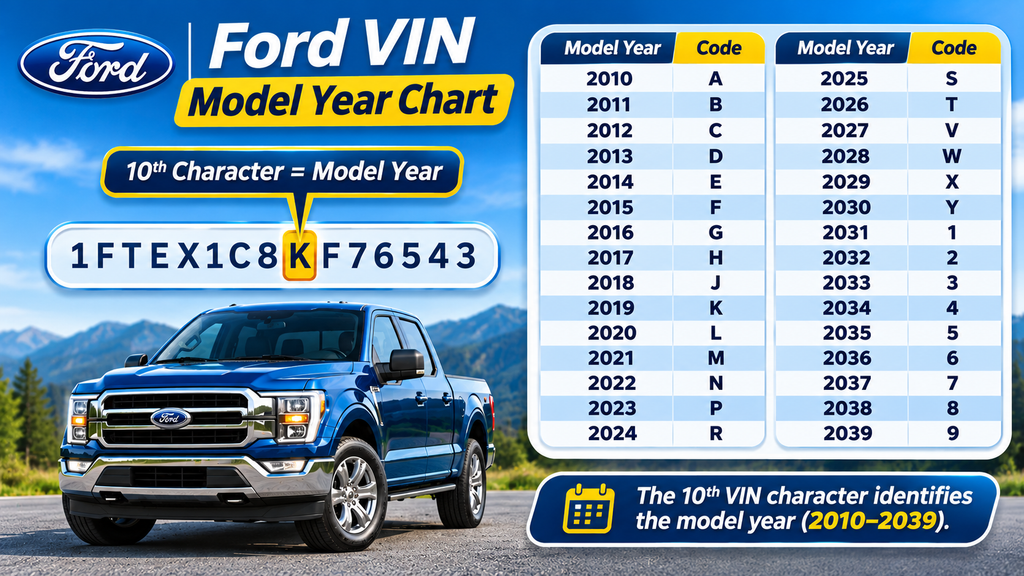
| Year | Code | Year | Code |
|---|---|---|---|
| 2010 | A | 2025 | S |
| 2011 | B | 2026 | T |
| 2012 | C | 2027 | V |
| 2013 | D | 2028 | W |
| 2014 | E | 2029 | X |
| 2015 | F | 2030 | Y |
| 2016 | G | 2031 | 1 |
| 2017 | H | 2032 | 2 |
| 2018 | J | 2033 | 3 |
| 2019 | K | 2034 | 4 |
| 2020 | L | 2035 | 5 |
| 2021 | M | 2036 | 6 |
| 2022 | N | 2037 | 7 |
| 2023 | P | 2038 | 8 |
| 2024 | R | 2039 | 9 |
For example, S indicates model year 2025 and T indicates 2026 in the current cycle. Because the codes repeat every 30 years, the VIN must be interpreted within the appropriate model-year range.
Ford VIN Breakdown Example
Consider the following illustrative VIN structure. It demonstrates how a modern Ford truck’s VIN is organized without assigning unverified vehicle-specific codes.
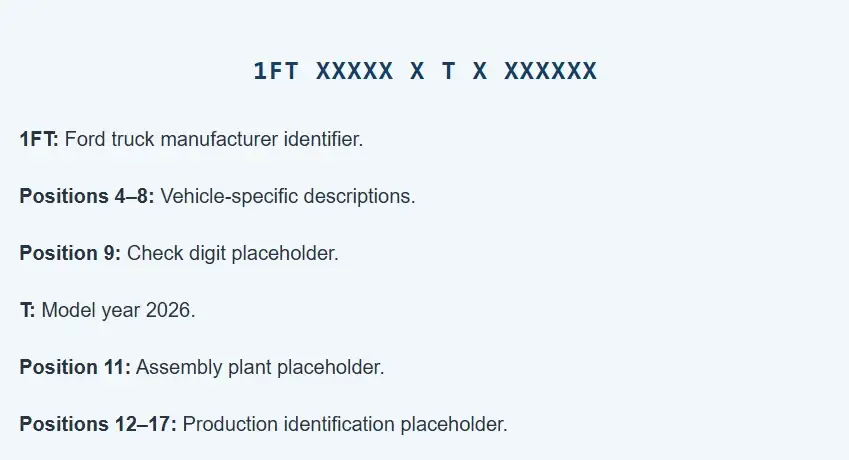
This example is a structural illustration, not an actual or validated VIN. X characters represent unspecified positions.
How to Identify Ford Engine Information Using a VIN
A Ford VIN can help identify the vehicle’s original engine configuration, but engine identification depends on the model, model year, and manufacturer decoding rules.
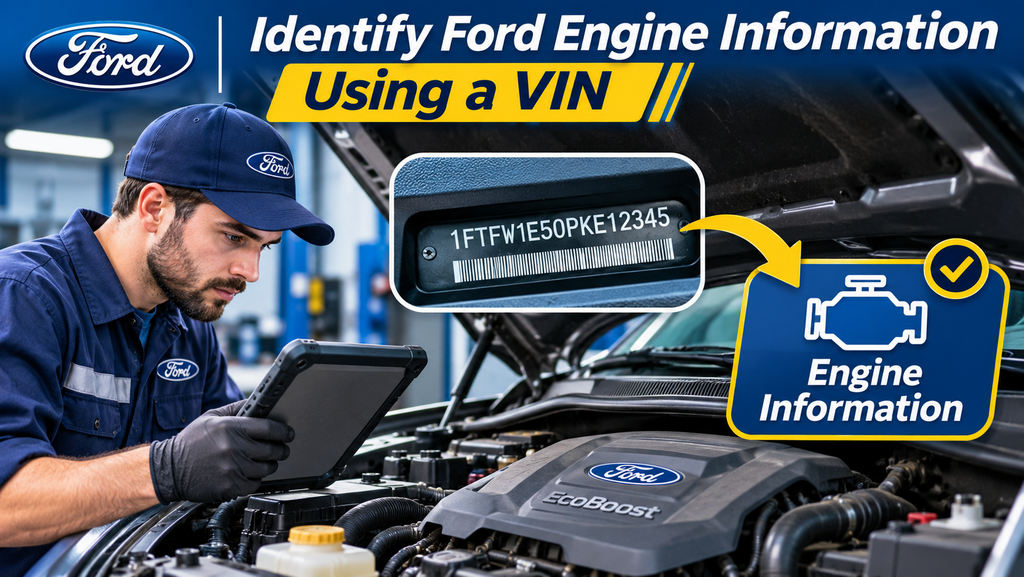
How to Verify Engine Details
- Find the complete VIN on the vehicle.
- Enter it into the official NHTSA VIN Decoder.
- Review the available engine information.
- Compare the results with Ford documentation and the physical vehicle.
- Confirm part compatibility before ordering replacement components.
Keep in mind that a replacement engine or previous modifications may cause the vehicle’s current mechanical configuration to differ from its original factory specifications.
Where to Find the VIN on a Ford Vehicle
Before completing a ford vin number breakdown, make sure you have copied the correct identification number. Ford VINs can be found in several common locations.
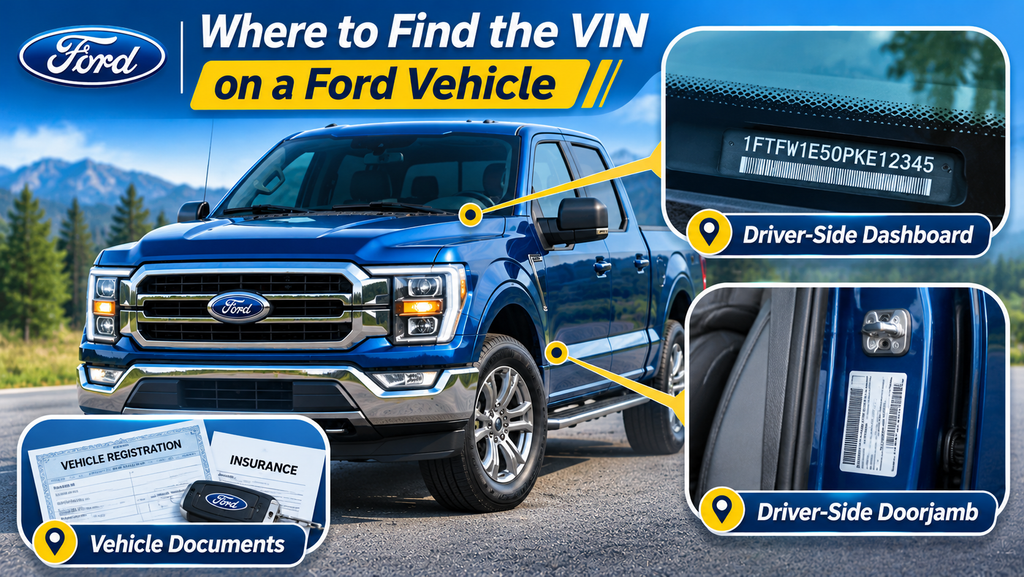
Driver-Side Dashboard
Stand outside the vehicle and look through the lower driver’s-side portion of the windshield. The VIN plate is often visible near the dashboard edge.
Driver-Side Door or Doorjamb
Open the driver’s door and inspect the certification label. Depending on the Ford model, it may be attached to the door or doorjamb.
Registration and Insurance Documents
The VIN should also appear on registration paperwork, title records, and relevant insurance documents.
If the VIN cannot be found in these locations, refer to the owner’s manual for the particular Ford model and year.
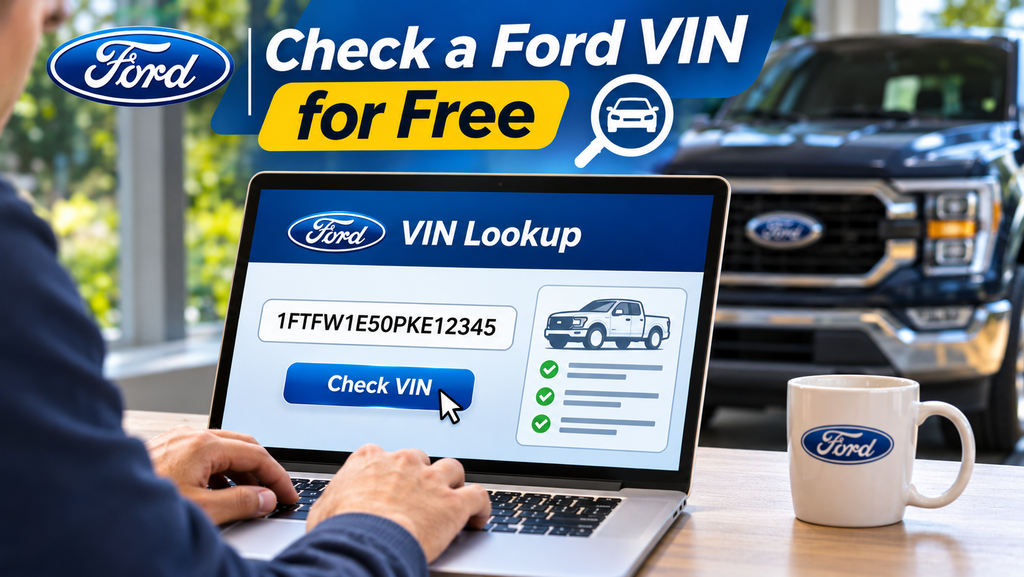
How to Check a Ford VIN for Free
The National Highway Traffic Safety Administration offers an official VIN decoder that provides available manufacturer-reported vehicle information.
What a Ford VIN Cannot Tell You
VIN decoding identifies factory-related information, but it is not a complete vehicle history report or mechanical inspection.
| Information | Available Through VIN Decoding? |
|---|---|
| Manufacturer | Generally yes |
| Model Year | Yes, when correctly interpreted |
| Original Engine Type | Often, depending on available records |
| Assembly Plant | Generally yes |
| Accident History | No, separate records required |
| Current Mileage | No |
| Maintenance History | No, service records required |
| Current Mechanical Condition | No |
How to Verify a Ford VIN Before Buying a Used Vehicle
A VIN check is an important step when evaluating a used Ford. It helps confirm whether the vehicle’s identification details agree with its paperwork and reported specifications.
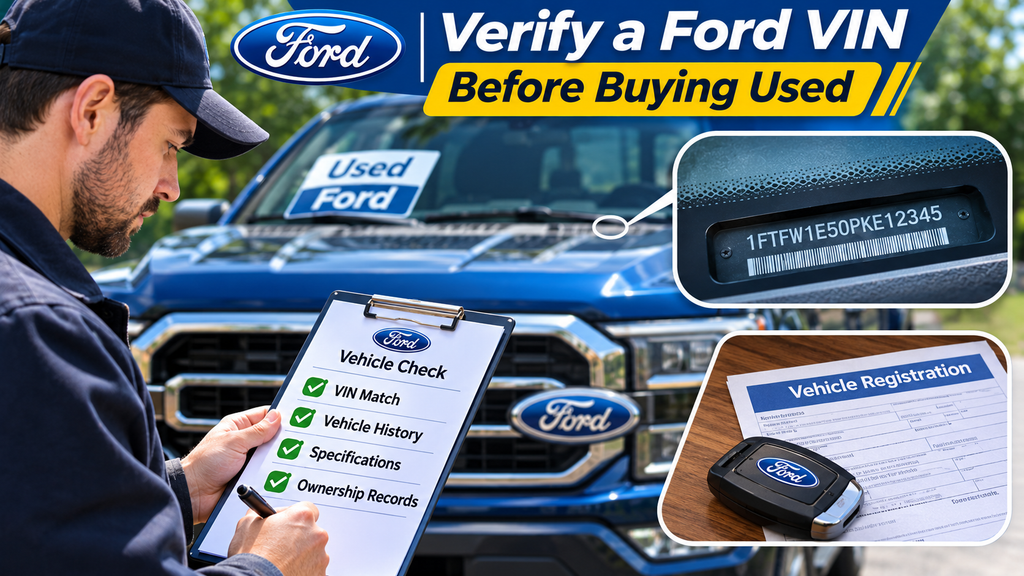
Used Ford VIN Verification Checklist
☐ Compare dashboard and door-label VIN information.
☐ Confirm the VIN matches the title and registration.
☐ Verify the model year and vehicle configuration.
☐ Investigate mismatched engine or model information.
☐ Check available safety recall information.
☐ Review relevant title and vehicle history records.
☐ Arrange an independent pre-purchase inspection.
Be cautious of visibly altered identification labels, conflicting documentation, or unexplained VIN discrepancies. Investigate these issues before completing a transaction.
Common Ford VIN Decoding Mistakes
- Using the wrong year cycle: Model-year characters repeat every 30 years.
- Misreading characters: Standardized VINs exclude the letters I, O, and Q.
- Guessing engine codes: Engine-related character meanings vary by vehicle and production year.
- Assuming a decoded VIN proves vehicle condition: Mechanical condition requires inspection.
- Ignoring modifications: Replacement engines and other changes may differ from factory records.
Frequently Asked Questions
How do I decode my Ford VIN number?
Enter the complete VIN into NHTSA’s official VIN Decoder. It can display available manufacturer-reported information such as model year, vehicle type, and engine specifications.
Which Ford VIN character identifies the model year?
The tenth character identifies the designated model year. For example, R represents 2024, S represents 2025, and T represents 2026 in the current cycle.
Can a Ford VIN tell me which engine I have?
It can often identify the original engine configuration when interpreted with the correct Ford model-year data. It cannot confirm that the engine has never been replaced.
What does 1FT mean on a Ford VIN?
1FT is a World Manufacturer Identifier commonly associated with Ford trucks manufactured in the United States.
Is a Ford VIN lookup free?
Yes. NHTSA offers a free VIN decoder for available manufacturer-reported vehicle data. More extensive vehicle history reports may involve separate services.
Do older Ford vehicles have 17-character VINs?
Not always. Older Ford vehicles, particularly those produced before the standardized 1981 model-year system, may have different identification formats.
Final Thoughts
Learning the ford vin number breakdown makes it easier to understand your Ford’s identification codes and verify important manufacturer information.
Begin with the WMI, identify the model-year position, and confirm vehicle-specific details using a reliable VIN decoder. If you are purchasing a used Ford, ordering replacement parts, or investigating conflicting information, use the VIN as a starting point rather than relying on it alone.