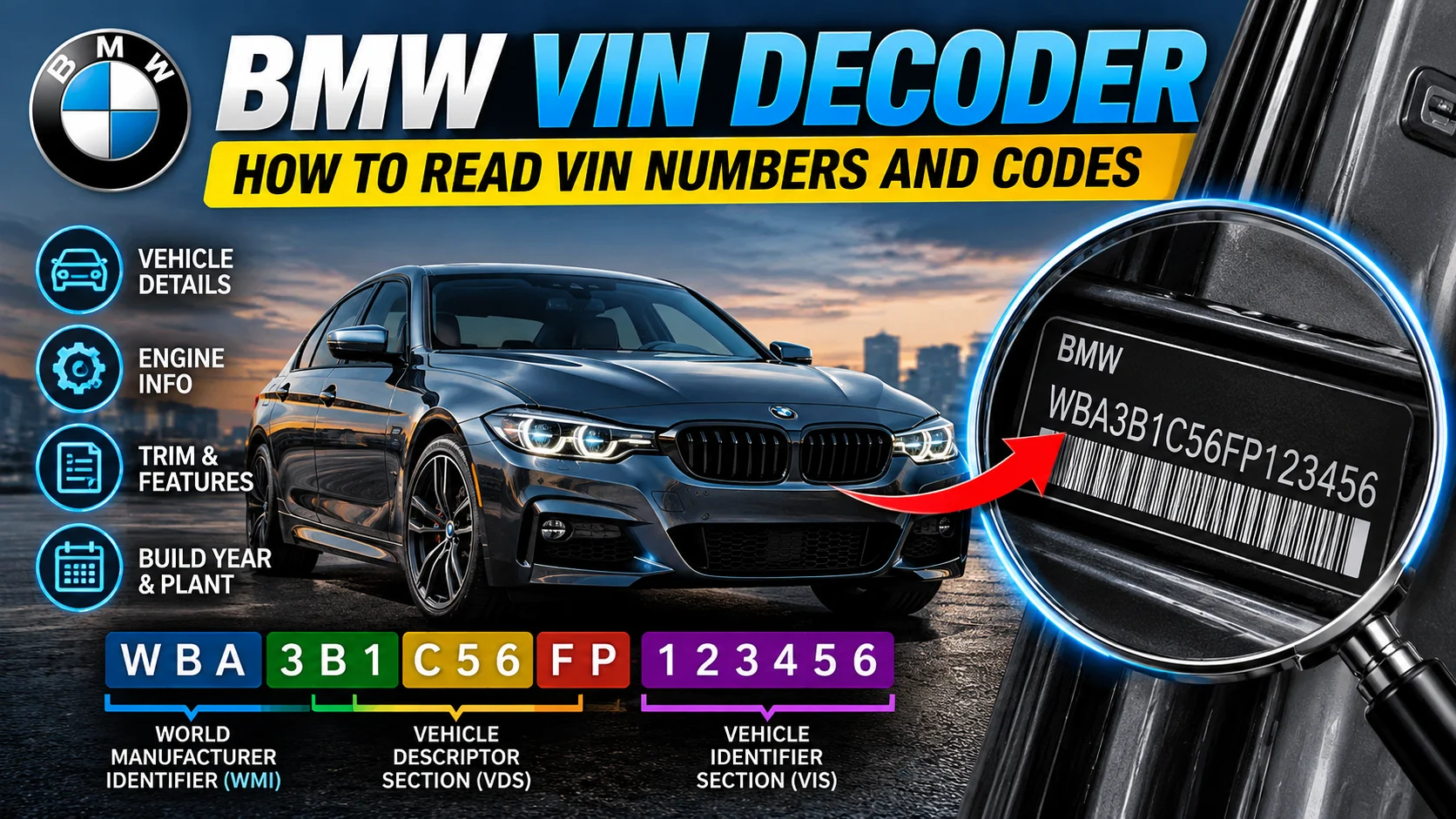
A BMW VIN decoder helps you identify important details about your vehicle using its Vehicle Identification Number. Whether you’re shopping for a used BMW, checking original specifications, or verifying information before ordering parts, learning how to read the VIN can help you avoid identification mistakes.
Most modern BMW vehicles carry a unique 17-character VIN. A BMW VIN lookup can help identify the manufacturer, model, model year, production information, and selected vehicle specifications. The depth of information varies according to the vehicle and the decoder’s data source.
To decode a BMW VIN, find the full 17-character identifier on the vehicle or its documents, enter it into a reputable decoder, and compare the results with the car. In the US-standard format, positions 1–3 identify the manufacturer, 4–8 describe the vehicle, position 9 is the check digit, position 10 indicates the model year, position 11 identifies the assembly plant, and positions 12–17 form the production sequence.
What Is a BMW VIN Decoder?
A BMW VIN decoder is a service that interprets the letters and numbers within a BMW’s Vehicle Identification Number. This number uniquely identifies the vehicle and is used in registration, insurance, service, recall, and ownership records.
Two cars with similar badges, such as 330i or X5, may have different powertrains, production years, or original equipment. A VIN helps distinguish the individual vehicles rather than relying only on a model name or a seller’s description.

Why Do BMW Owners Use VIN Decoders?
- To verify a vehicle’s identity before purchasing it.
- To check its model and available original specifications.
- To compare a vehicle listing with manufacturer information.
- To assist with identifying compatible replacement parts.
- To find vehicle-specific recall and service information.
A VIN lookup is valuable, but it cannot determine a vehicle’s complete mechanical condition or independently prove its ownership or accident history.
Where to Find the VIN Number on a BMW
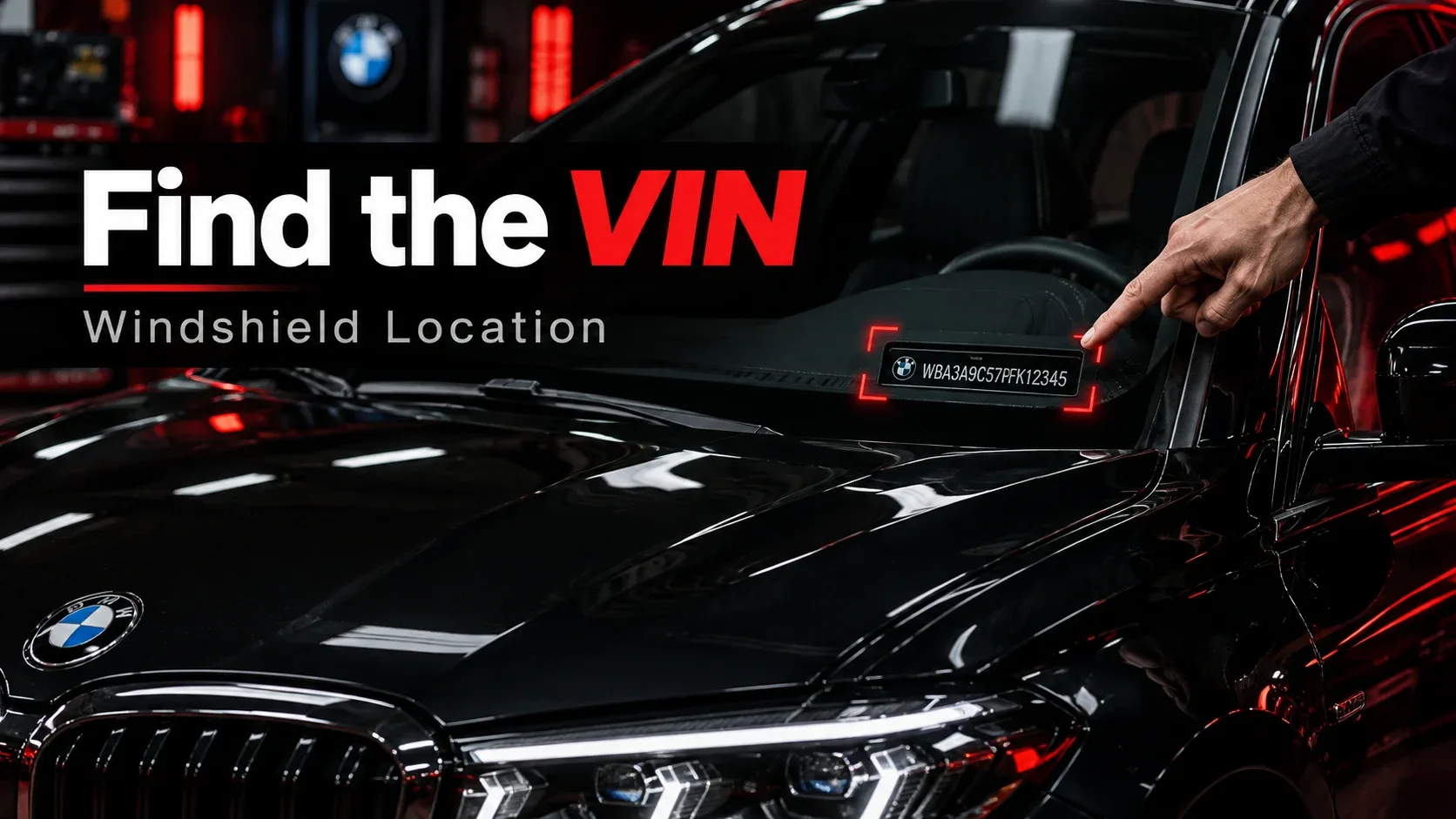
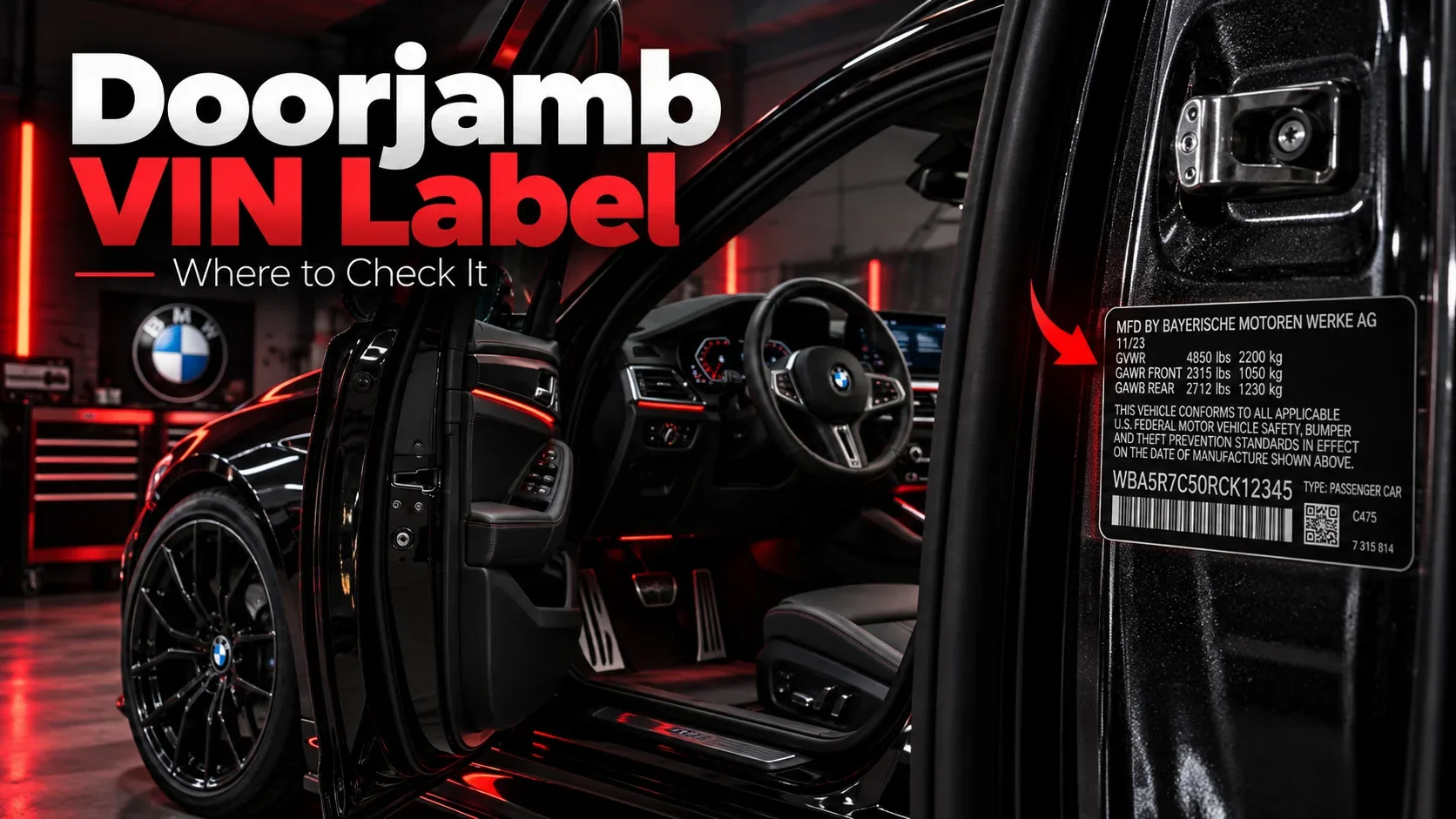
A VIN finder BMW owners can use begins with the vehicle itself. On many US-market BMWs, the identifier is visible through the lower driver’s-side windshield or on a manufacturer’s label near the driver’s door. Locations can differ by market and model.
1. Dashboard Near the Windshield
Stand outside the vehicle and look through the lower driver’s-side corner of the windshield. Many BMW models display the VIN in a small window at the base of the dashboard.
2. Driver’s Doorjamb
Open the driver’s door and examine the door pillar or frame. You may find a manufacturer certification label showing the VIN along with other vehicle information.
3. Title, Registration, and Insurance Documents
The VIN generally also appears on official ownership and registration documents, insurance papers, and relevant vehicle records. This makes it possible to check a vehicle’s recorded identification before an in-person inspection.
4. Other Model-Dependent Locations
Some BMW vehicles have additional stamped or marked identifiers on the body or in the engine compartment. Consult the applicable owner’s manual or manufacturer documentation for model-specific locations.
Before buying: Compare the visible VIN with title and registration information. If identifiers are missing, altered, or inconsistent, obtain qualified or official verification before paying.
How to Read a BMW VIN: All 17 Characters Explained
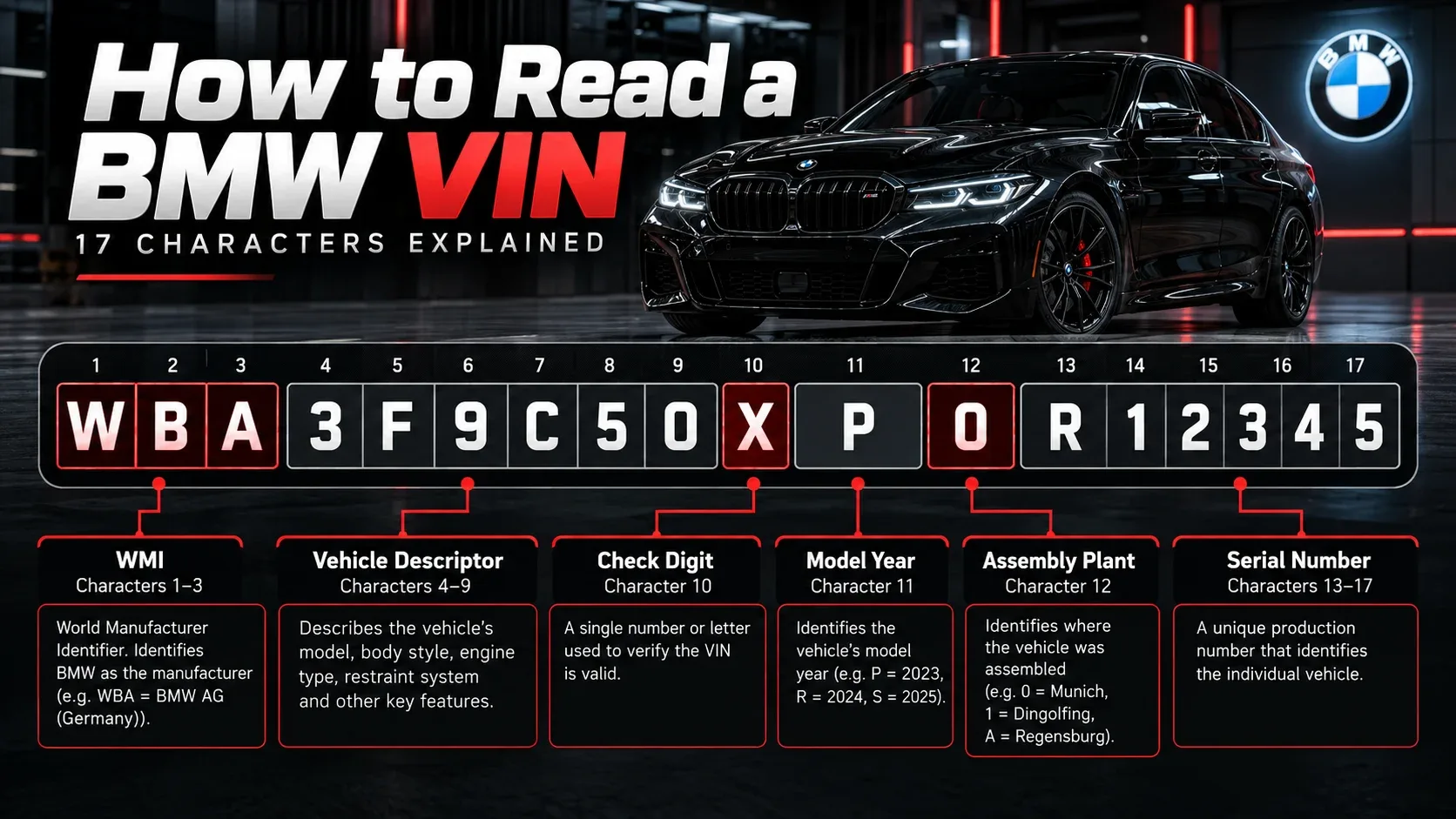
A modern VIN consists of 17 letters and numbers. For vehicles following the US-standard format, groups of characters have defined purposes. The World Manufacturer Identifier (WMI), Vehicle Descriptor Section (VDS), and Vehicle Identifier Section (VIS) together form the full VIN.
| Position | Meaning | Purpose |
|---|---|---|
| 1–3 | WMI | Manufacturer identification |
| 4–8 | Vehicle attributes | Manufacturer-defined vehicle description |
| 9 | Check digit | VIN validation for US-standard VINs |
| 10 | Model year | Model-year code in the US-standard format |
| 11 | Assembly plant | Manufacturer-defined plant identifier |
| 12–17 | Production sequence | Serial identification assigned by manufacturer |
Positions 1–3 form the WMI, positions 4–9 form the VDS, and positions 10–17 form the VIS. In some non-US markets, VIN conventions and decoding interpretations differ. Do not assume every BMW worldwide uses the same model-year or check-digit rules.
Note: The letters I, O, and Q are excluded from standardized modern VINs to help avoid confusion with similar-looking numbers.
BMW VIN Codes and What They Mean
A BMW vehicle identification number VIN decoder may identify manufacturer, vehicle description, model-year, plant, and serial information, but interpreting BMW-specific codes requires data appropriate to the model, market, and production period.

Common BMW Manufacturer Identifiers
| Prefix | Typical association | Qualification |
|---|---|---|
| WBA | BMW passenger vehicles | Common BMW WMI |
| WBS | Certain BMW M passenger vehicles | Varies by model and production |
| 5UX | Certain BMW multipurpose vehicles made in the US | Verify model and period |
| 5YM | Certain BMW M multipurpose vehicles | Not a complete list of BMW identifiers |
The Model-Year Character
In the US-standard VIN structure, the tenth character typically represents model year. The code cycle repeats, so interpretation must account for the vehicle’s age. For example, P corresponds to 2023, R to 2024, S to 2025, and T to 2026 within the current cycle. Model year and assembly date are not necessarily identical.
The Check Digit and Plant Character
For US-standard VINs, the ninth character is a calculated check digit that helps identify certain transcription errors. The eleventh position is a manufacturer-defined assembly-plant code. Neither a matching check digit nor a decoded plant establishes ownership legitimacy or accident-free condition.
How to Perform a BMW VIN Lookup Step by Step
For a basic BMW VIN lookup, a suitable public decoding resource can provide identifying vehicle information. US drivers can use NHTSA’s public VIN decoder; BMW-specific services may provide additional data where available.

Locate the complete VIN
Find the 17-character number on the car or its documents and copy it in the original sequence.
Check every character
Recheck easily confused letters and digits. Do not substitute I, O, or Q for similarly shaped numbers.
Choose a reputable decoder
Use a decoder appropriate for the vehicle’s market. The US public NHTSA decoder is available at vpic.nhtsa.dot.gov/decoder/.
Review the returned information
Look for manufacturer, model, model year, body style, engine-related fields, and manufacturing information. Some fields may be missing.
Compare with the actual BMW
Confirm that the decoder’s information matches the physical vehicle and supporting records. Investigate meaningful mismatches.
Remember: A decoded VIN is an identification result, not a complete factory build sheet or proof of the vehicle’s mechanical or accident history.
BMW VIN Decoder Example: Understanding the Results
When interpreting a VIN BMW number, begin with the character positions rather than trying to guess the model directly from a short sequence. A reliable example should show exactly which fields were returned by a validated lookup.
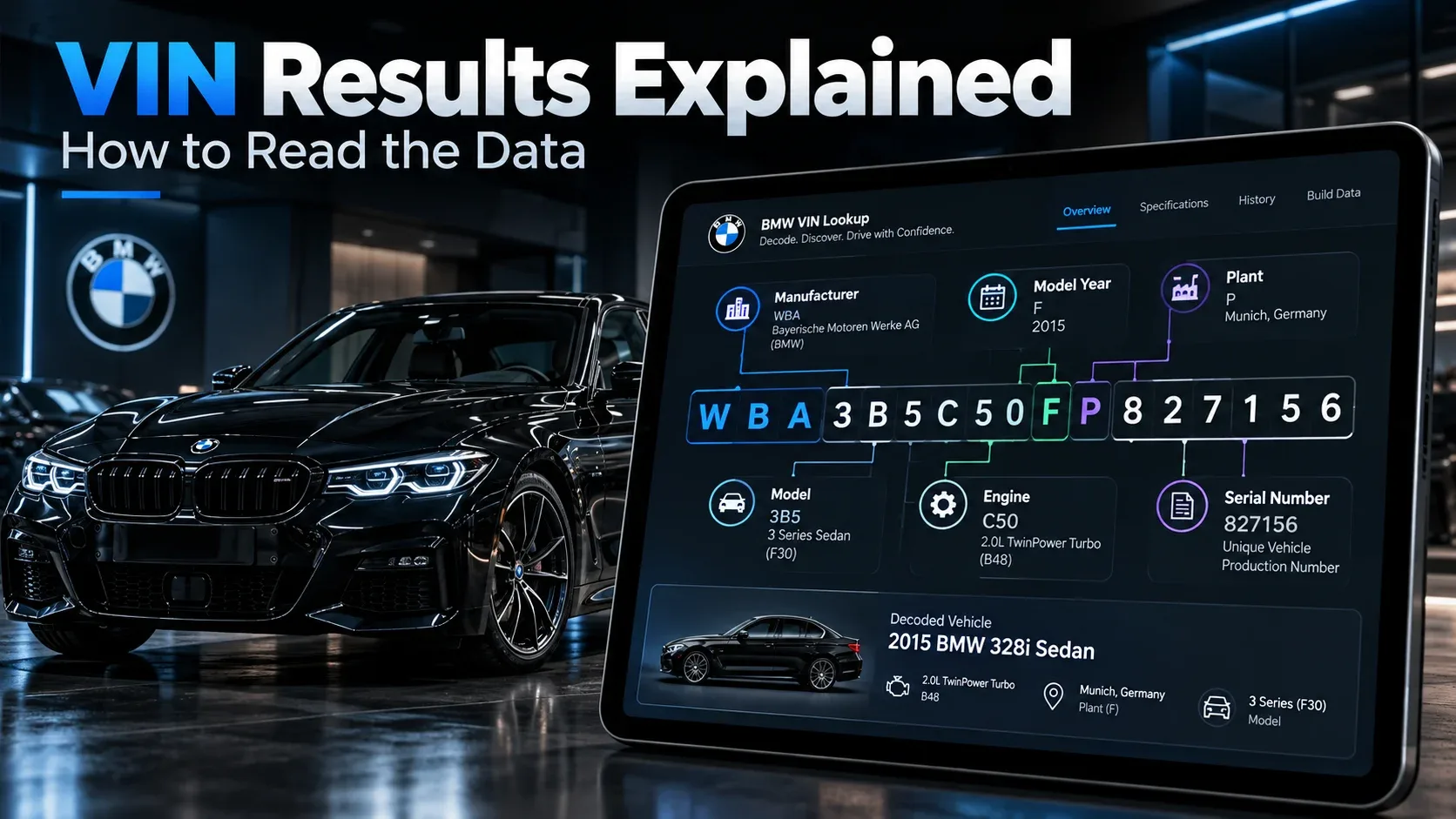
| VIN part | What to check | Why it matters |
|---|---|---|
| 1–3 | Manufacturer identifier | Confirms the expected manufacturer assignment |
| 4–8 | Vehicle descriptor | Supports identification of model and attributes |
| 9 | Check digit | Helps detect some entry errors |
| 10 | Model year | Identify the relevant coding cycle |
| 11 | Plant | Use BMW-specific plant decoding |
| 12–17 | Production sequence | Identifies an individual vehicle within manufacturer records |
A recognized WBA prefix, for example, can indicate a BMW-assigned manufacturer category, but the remaining information needs correct interpretation. Do not infer precise engine output, optional packages, or factory build details without supporting manufacturer data.
BMW Chassis Number vs VIN: What’s the Difference?
In everyday vehicle documentation, the term chassis number BMW may refer to the vehicle’s VIN. In BMW enthusiast discussions, however, “chassis code” often means a platform or generation designation such as E90, F30, or G20.

| Identifier | Example | Meaning |
|---|---|---|
| Full VIN | 17-character code | Unique individual vehicle identification |
| BMW chassis/platform code | E90 | Earlier 3 Series sedan generation |
| BMW chassis/platform code | F30 | Later 3 Series sedan generation |
| BMW chassis/platform code | G20 | Subsequent 3 Series sedan generation |
| VIN suffix | Last seven characters | Accepted by some BMW-specific identification systems |
For parts compatibility, the chassis/platform code may help narrow the model, but accurate fitment can also depend on the engine, drivetrain, production date, and installed equipment.
What Information Can a BMW VIN Decoder Reveal?
Depending on the vehicle and data source, a VIN decoder BMW users consult may return the model, manufacturer, model year, selected drivetrain or engine details, assembly information, and sometimes original equipment. Not every database contains every field.
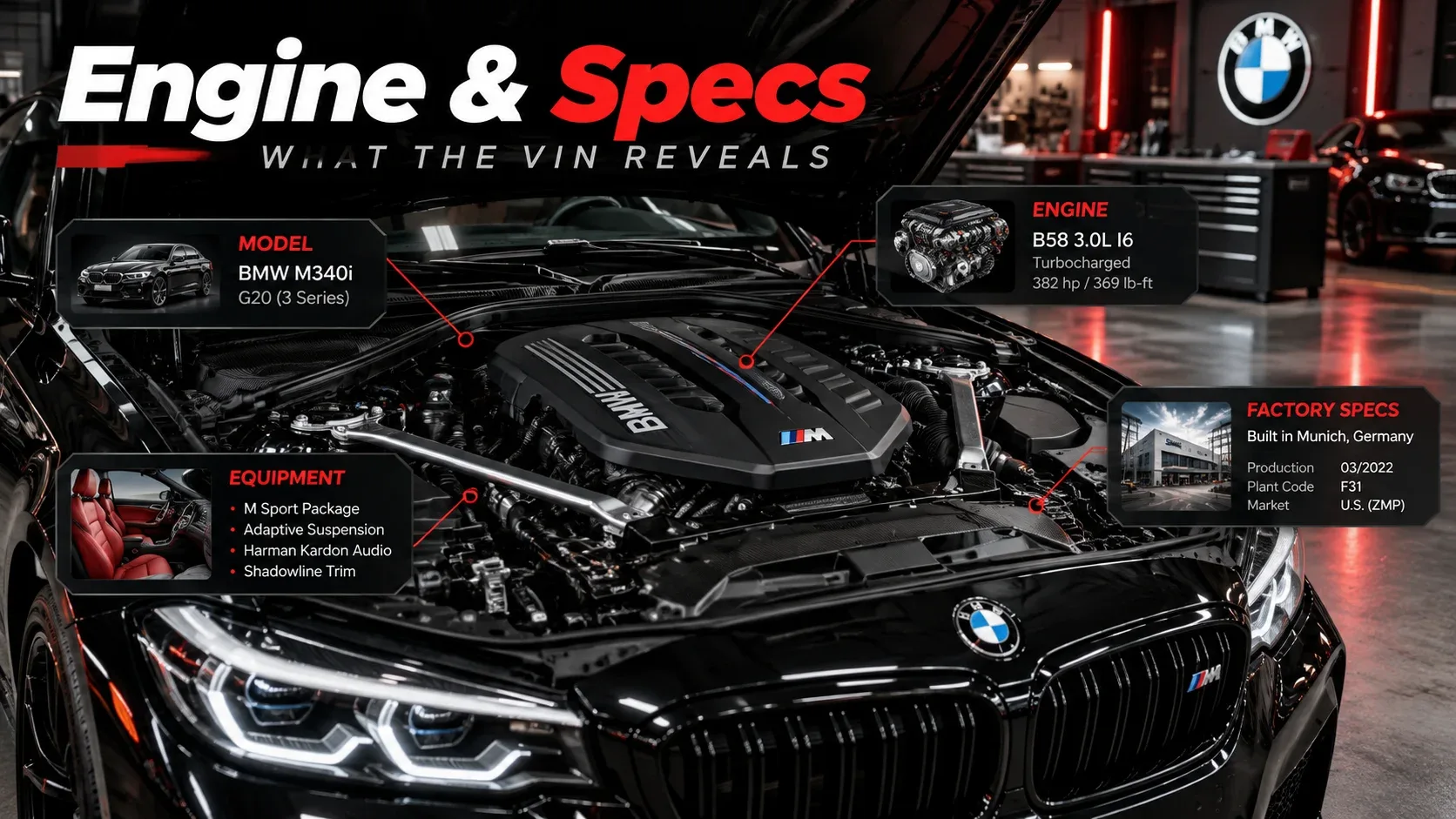
| Information | Availability | Limitation |
|---|---|---|
| Manufacturer | Typically available | Requires accurate WMI interpretation |
| Model and model year | Usually available | Market and data coverage vary |
| Engine information | Sometimes available | Exact engine variant may require BMW records |
| Assembly plant | Often available | Plant codes are manufacturer-specific |
| Factory equipment | May be available | Not included in every basic decoder |
| Accident history | Not from VIN decoding alone | Separate reported-history data required |
| Mechanical condition | Not available | Requires inspection and testing |
Can a BMW VIN Reveal the Exact Engine?
Some BMW-specific databases can identify the engine configuration originally linked to the vehicle. Basic public decoders may be less detailed. Also, an engine currently installed in a used BMW could differ from its factory configuration after a replacement or modification.
Can I See the Original Factory Options?
Some manufacturer-supported or specialist systems can associate the VIN with factory options, packages, transmission, and interior details. A general decoder is not guaranteed to return a complete build sheet.
How to Check BMW Vehicle History and Recalls Using a VIN
A VIN number check BMW buyers conduct should go beyond the manufacturer and model. Decoding a VIN, researching recorded vehicle history, and checking safety recalls are separate verification tasks.
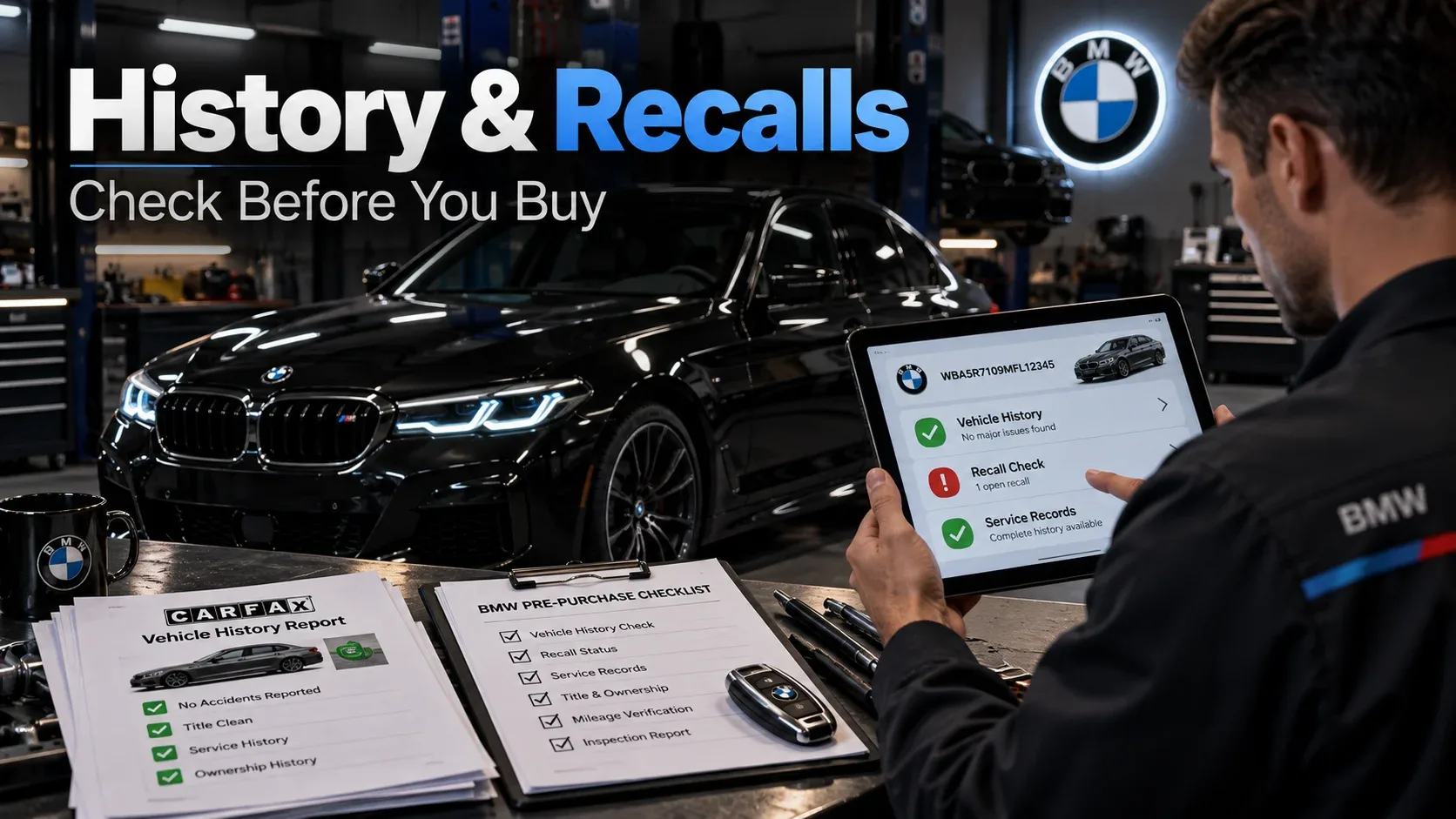
Vehicle-History Records
Depending on the reporting service and available records, a vehicle-history report may show reported accidents, title branding, recorded mileage, ownership events, and some service or inspection entries. Reports may omit unreported incidents and should not be treated as proof that a BMW has never suffered damage.
Checking Safety Recalls
BMW provides official recall checking for eligible vehicles, including a US VIN lookup service through BMW USA. NHTSA also provides vehicle safety recall information for the United States. Drivers in other markets should use the appropriate regional BMW resources.
Safety reminder: If a safety recall is outstanding, follow the manufacturer’s instructions and contact an authorized service facility about the applicable remedy. VIN decoding alone does not identify all safety issues or diagnose vehicle condition.
Common BMW VIN Decoder Problems and Solutions
Sometimes a BMW VIN lookup returns incomplete, unexpected, or conflicting information. This does not automatically mean the VIN is fraudulent; entry mistakes, older vehicles, regional differences, and limited database coverage can all affect results.
| Problem | Possible reason | What to do |
|---|---|---|
| VIN not recognized | Typing error or unsupported vehicle | Recheck the number and try a suitable decoder |
| Wrong model listed | Incomplete data or incorrect lookup | Compare official vehicle records |
| Unexpected model year | Market coding or model-year confusion | Check region and production documentation |
| Factory options missing | Database lacks manufacturer build data | Consult BMW-specific records |
| VIN shorter than 17 characters | Older identification format | Use historic BMW identification guidance |
| Physical labels disagree | Documentation issue or possible alteration | Obtain professional or official verification |
Why Does My BMW VIN Not Work?
First make sure the identifier was copied correctly, and verify that you are using a decoder suitable for the market and vehicle year. A valid VIN can still produce incomplete results if the data source does not include that vehicle.
Do Older BMWs Always Have 17 Characters?
No. BMW vehicles built before modern standardized identification requirements may use different or shorter formats. Classic vehicles may require specialist documentation rather than a modern VIN lookup tool.
BMW VIN Check: What to Verify Before Buying a Used BMW
Before agreeing to buy a used BMW, treat the VIN check as one stage of a broader assessment. The goal is to confirm identity and investigate discrepancies, not to substitute database results for physical inspection.
- Find and record the complete VIN.
- Compare windshield and doorjamb identification.
- Check the VIN against title and registration documents.
- Decode the VIN using a reputable service appropriate to the market.
- Confirm model, model year, and available powertrain information.
- Research available vehicle-history records.
- Check open safety recalls with the appropriate official resource.
- Inspect the vehicle for damage, altered identification labels, and repairs.
- Arrange an independent pre-purchase mechanical inspection.
- Resolve identification discrepancies before making payment.
Buying tip: A successfully decoded VIN does not establish that a car is legally owned, accident-free, or mechanically reliable. Verify important claims using the vehicle and appropriate records.
Frequently Asked Questions About BMW VIN Decoding
Is there a free BMW VIN decoder?
Yes. NHTSA offers a public VIN decoder for basic identifying data, particularly useful for US-market vehicles. BMW-specific services may provide additional equipment information depending on the source.
Where can I find my BMW VIN?
On many US-market BMW vehicles, check the lower driver’s-side windshield, driver’s doorjamb label, and title or registration paperwork. Locations vary by market and model.
Can I decode a BMW using only the last seven VIN characters?
Some BMW-specific systems support identification using the last seven characters, but many standard VIN decoders require the full 17-character identifier.
Does a BMW VIN show its exact engine?
BMW-specific manufacturer records may identify the original engine configuration. A basic decoder may only show general engine details, and an engine swap would not automatically be reflected.
Can the VIN show factory options?
Some specialized or manufacturer-supported databases provide factory equipment information. It is not guaranteed from a basic VIN decode.
Can BMW VIN lookup show accident history?
VIN decoding itself does not show accidents. Separate history services may provide reported incidents, but their coverage can be incomplete.
Are chassis number and VIN the same?
“Chassis number” is commonly used to refer to the vehicle identifier. BMW platform codes such as E90, F30, and G20 are different: they describe generations rather than unique individual cars.
Why is my decoder returning incorrect information?
Check for transcription errors, regional code differences, incomplete database entries, or an unsupported model. Compare the results with the physical vehicle and manufacturer documentation.
Can I check BMW recalls using the VIN?
Yes. Official BMW regional recall resources and, in the United States, NHTSA recall checking tools allow VIN-based recall research.
Do older BMW models have 17-character VINs?
Not always. Some older vehicles use identification formats predating the modern standardized 17-character VIN.
Final Thoughts: Decode and Verify Your BMW VIN
A BMW VIN decoder helps you understand a BMW’s identity and certain factory-linked details. By learning where to locate the identifier, how the character groups work, and what the resulting data actually confirms, you can make better decisions about vehicle ownership, repairs, and used-car purchases.
Always cross-check critical information against the actual vehicle and appropriate documentation. Vehicle-history reporting, safety recall verification, and professional inspection provide additional information that decoding alone cannot establish.
Technical References
For further fact-checking, consult official resources directly. No external hyperlinks are included in this article.
- National Highway Traffic Safety Administration (NHTSA): VIN Decoder and vehicle identification information.
- 49 CFR Part 565: US vehicle identification requirements.
- BMW USA: Official safety recall lookup and vehicle documentation.
- BMW Group: Regional safety campaign and technical update information.
Editorial note: This article provides general information about vehicle identification. The illustrations are explanatory, not authenticated VIN records or evidence of a specific vehicle’s history. For a disputed VIN or legal/registration issue, consult the appropriate authorities or qualified professionals.