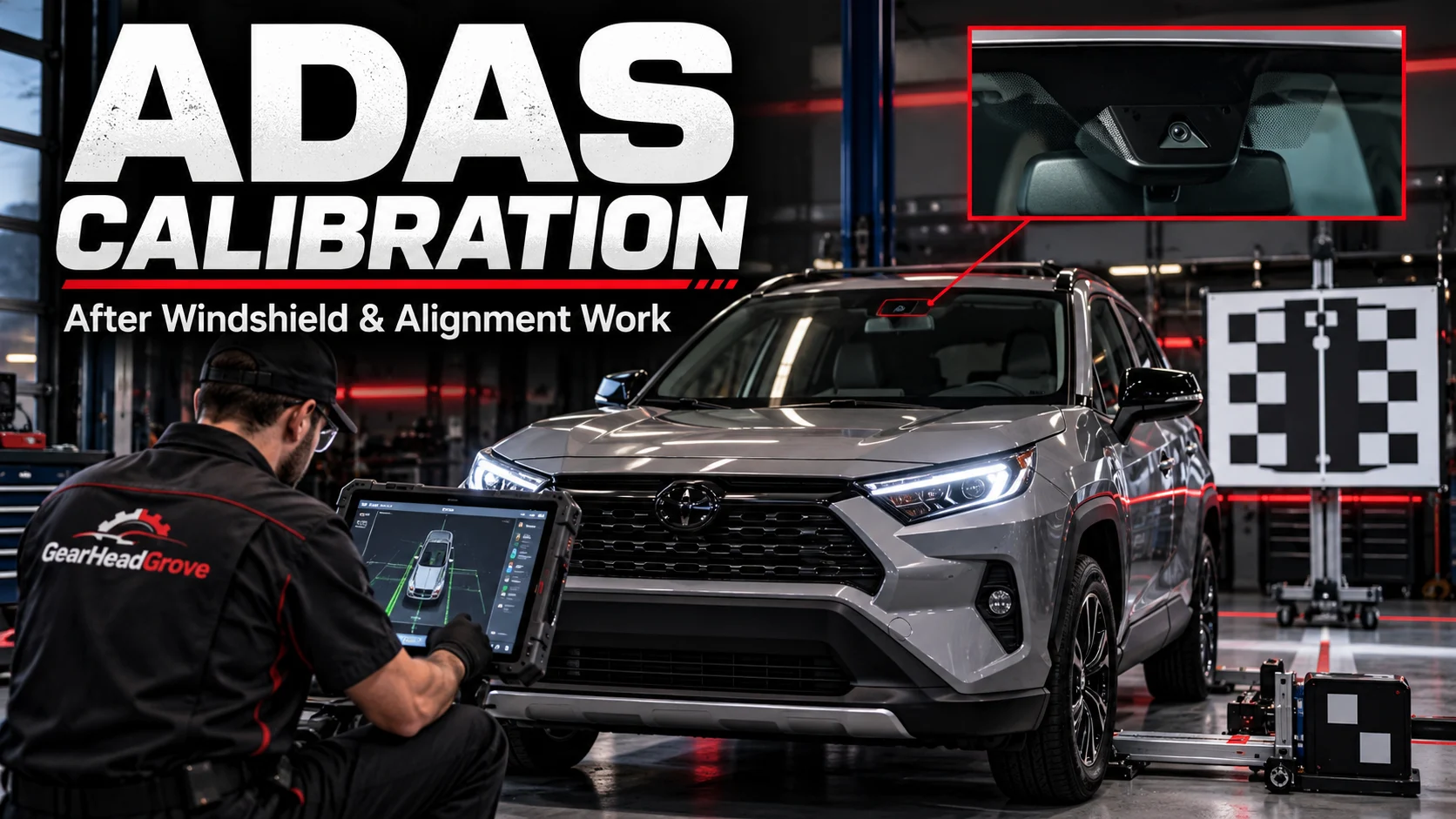
A windshield swap looks like a glass job, and a wheel alignment looks like a suspension job. To the driver-assistance systems built into most recent vehicles, both are changes to the geometry those systems depend on. Forward cameras, radar units, and steering angle sensors are aimed with tight tolerances, and a small physical shift can send their readings off by enough to matter at highway speed. Lane keeping may drift, automatic braking may trigger late, and adaptive cruise control may misjudge the gap to the car ahead. Shop owners and technicians who understand why these systems need attention afterward can protect customers, limit liability, and offer a service that many vehicles now require. The sections below explain how sensors shift, what each type of work affects, and how static and dynamic calibration differ.
How Small Physical Changes Throw Sensors Off
Driver-assistance sensors work by comparing what they see against where they believe they are pointing. A forward camera mounted behind the rearview mirror expects to look straight down the vehicle’s centerline at a specific angle. A radar unit behind the bumper cover expects to scan a precise horizontal and vertical arc. When the aim changes, the sensor still reports data, but the data describes the wrong stretch of road.
Geometry makes small errors expensive. A camera pointed just one degree off true is wrong by roughly 1.7 meters at a distance of 100 meters, which is enough to place a stopped vehicle in the neighboring lane as far as the software is concerned. At the distances where automatic braking and lane centering make decisions, even smaller errors can matter.
The failure often goes unnoticed. A system that is slightly misaimed does not necessarily set a warning light, and the driver may see nothing unusual until the feature behaves oddly or fails to act in an emergency. That silent nature explains why manufacturers publish specific rules about when calibration is required. Work that moves a sensor, changes the angle of the structure it is mounted to, or alters the vehicle’s direction of travel can all invalidate the stored aim values the modules rely on.
Collision repairs, bumper removal, and even replacing a wheel bearing or a radar bracket can have the same effect, which is why the triggering events extend well beyond glass and alignment.
Windshield Replacement and the Forward Camera
Most vehicles with lane departure warning or emergency braking mount a camera on a bracket bonded to the windshield. Replacing the glass moves that bracket. Even a premium replacement windshield can differ slightly in bracket position, curvature, and optical properties, so the camera may need to be removed and refitted during the job. Manufacturers often call for ADAS recalibration after glass replacement, even when no warning light appears.
The glass itself matters. Cameras look through a specific zone of the windshield, and distortion, tint, or coatings in that area can affect image quality. Using glass that meets the manufacturer’s specification for the camera area, and keeping that zone clean and free of debris or adhesive residue, supports a successful calibration. Rain sensors, heated elements, and head-up display features add further requirements on some models.
Responsibility is a practical question. Glass shops may perform the calibration themselves, partner with a dedicated calibration facility, or hand the vehicle to a dealer. Whichever route is chosen, customers should know the work is part of the repair and not an optional extra. Releasing a vehicle without it leaves the shop exposed if a system fails to perform later, and documentation of the completed procedure is the best protection for everyone involved.
Insurance claims add another layer. Collision and glass claims increasingly list calibration as a separate line item, and adjusters may ask for the calibration report before approving payment. Having the paperwork ready speeds approval and reduces back-and-forth over whether the work was necessary.
Alignment, Suspension, and the Thrust Line
Alignment work looks far removed from camera aiming, but the two are linked through the direction the vehicle travels. Forward-facing sensors assume the car moves along its centerline. If the rear axle points slightly to one side, the vehicle tracks at a small angle to that centerline, called the thrust angle, and the sensors aim a little off from where the car is actually heading. Adjusting toe and camber changes this relationship.
Steering angle sensors add another dependency. Lane keeping and stability systems need to know exactly where straight ahead is, and an alignment that changes the steering wheel’s center position without resetting the sensor leaves the modules working from a false reference. Many procedures require the sensor to be re-zeroed after alignment.
Suspension repairs matter in the same way. Replacing control arms, struts, springs, or subframes can change ride height and wheel geometry, while a different tire size can change how the vehicle measures speed and distance. Technicians should check the manufacturer’s guidance for the specific model after an alignment, since some call for an inspection or calibration. Doing the alignment first puts the work in the right order; calibrating before correcting alignment could mean repeating the procedure.
Static and Dynamic Calibration Explained
Calibration comes in two main forms, and a given vehicle may require one or both. Static calibration takes place in a controlled space, with the vehicle parked and specific targets placed at exact distances, heights, and offsets from the car. A scan tool commands the sensor to learn its aim by reading those targets. Floor level, lighting, and clearance in the space all affect the result, and measurement tools such as lasers or plumb references position the targets accurately.
Dynamic calibration happens on the road. The technician drives the vehicle at specified speeds on well-marked roads in suitable weather while a scan tool monitors the sensor as it learns from lane markings and other vehicles. The process can finish in minutes or take much longer, since traffic, road conditions, and faded paint can interrupt it.
Each method has trade-offs. Static work is repeatable and independent of weather, but it demands floor space, equipment, and trained staff. Dynamic work needs less equipment, though it depends on conditions that cannot be controlled and requires a technician willing to drive. The manufacturer decides which method applies, and some models call for both in sequence. Following the published procedure, instead of choosing the more convenient method, is what keeps the result valid.
Environmental limits apply to both methods. Static work can fail when lighting changes or when a target is set a few centimeters off its specified position, while dynamic work can stall on faded lane markings, heavy rain, or a road with too few straight sections. Recording the conditions on the report helps explain any retry.
Building a Reliable Process Around the Work
A repeatable workflow prevents missed steps and makes results easy to verify. Shops handling this work commonly follow a sequence like this:
- Identify which systems the vehicle carries and which repair triggers calibration under the manufacturer’s procedure.
- Run a pre-repair scan to record existing fault codes and system status.
- Complete mechanical work first, including alignment, then confirm tire pressure, ride height, and fuel level meet the procedure’s conditions.
- Perform the required calibration, static, dynamic, or both, with a stable battery voltage supported by a maintainer.
- Run a post-repair scan and clear any faults related to the work.
- Save the calibration report and photographs in the job file, and review results with the customer.
Communication deserves effort. Many customers have never heard of calibration, and a clear explanation of why it protects safety features turns an apparent upsell into a reasonable part of the repair. Estimates should list the calibration line items from the start, which avoids disputes with insurers and surprises at pickup. Staff training keeps the process consistent, and periodic audits of completed jobs confirm that the paperwork matches the work performed.
Key Takeaways
Windshield replacement and alignment work both alter the geometry that driver-assistance systems depend on, and the resulting errors can hide behind a dark dashboard. Camera aim, thrust angle, and steering angle references must be restored to manufacturer specification before the vehicle returns to the road.
Static and dynamic methods each have a place, and the manufacturer’s procedure decides which applies. Shops that scan before and after, follow the documented steps, and keep records protect their customers, their reputations, and their businesses while meeting a need that grows with every new model year.