Pull the outer panel off a late-model truck or luxury sedan and the structure underneath looks nothing like the steel body of two decades ago. Aluminum panels, ultra-high-strength steel, bonded joints, and rivets have replaced much of the spot welding and straightening that earlier generations of technicians relied on. Manufacturers made these choices to cut weight, improve crash performance, and meet fuel economy targets, and the materials do their jobs well. Repairing them is a different matter. Methods that worked on mild steel can weaken, contaminate, or quietly damage newer structures. This article explains why, focusing on aluminum handling, contamination control, self-piercing rivets, OEM procedures, and the training that holds it together.
A Different Kind of Vehicle on the Frame Rack
Mild steel forgives mistakes. It can be heated, pulled, hammered, and welded with generous tolerances, and it tends to show visible warning signs when stressed. Modern structures offer far less leniency. High-strength and ultra-high-strength steels can lose their engineered properties when heated beyond limits, which is why many manufacturers prohibit heat on certain components. Some sections must be replaced rather than straightened, and cutting locations are specified to the millimeter.
Aluminum introduces additional differences. It is lighter than steel, yet it does not behave the same way under impact or repair. Panels can crack when worked cold beyond a certain point. Heat input changes the metal’s strength, and aluminum gives no color cue when it reaches a critical temperature, so a technician cannot judge heat by eye as they might with steel. Crush zones are designed to absorb energy in particular ways, so a repair that alters the structure may change how the vehicle performs in the next collision.
Because safety systems depend on the structure, a poor repair is not merely cosmetic. It can affect airbag timing, sensor positioning, and occupant protection. That connection explains why manufacturers publish detailed repair instructions and why shops that skip them take on real liability.
Repair history matters too. A vehicle that has been poorly fixed once may carry hidden problems into a second repair, such as filler used where a section should have been replaced or a weld placed where the manufacturer calls for a rivet. Technicians who check earlier work before starting avoid inheriting those defects.
Handling Aluminum and Preventing Contamination
Contamination is one of the most misunderstood risks in aluminum repair. Steel particles from grinding, cutting, or sanding can embed in aluminum surfaces. Once moisture reaches them, the two dissimilar metals form a galvanic cell, and corrosion begins beneath paint where nobody can see it. The damage may not appear for months, which makes it a comeback problem long after the customer has left.
Shops that repair aluminum properly separate the work. A dedicated area, or at least a physically screened zone, keeps steel dust away from aluminum panels. Dedicated tools, including sanders, hammers, clamps, and brushes, stay with aluminum and are never used on steel. Many shops use separate abrasives, stainless steel brushes reserved for the job, and filtered extraction systems to capture dust at the source. Even a shared workbench can transfer particles, so clean surfaces and protective covers matter.
Handling affects quality too. Aluminum work hardens, so repeated reshaping can crack a panel. Technicians use specific straightening techniques, controlled heat only where the manufacturer allows it, and temperature-indicating methods where heat is permitted. Welding aluminum calls for pulse-capable equipment, appropriate shielding gas, and clean prep, since oxides and oils produce porous, weak welds. Skipping any of these steps often yields a repair that looks acceptable and fails under load.
Corrosion protection continues after the metal work ends. Bare aluminum should be treated and primed according to the manufacturer’s guidance, with attention to sealing seams and edges where moisture collects. Skipping those steps leaves the repaired area as the first place for corrosion to appear.
Self-Piercing Rivets and the Role of Riveting Tools
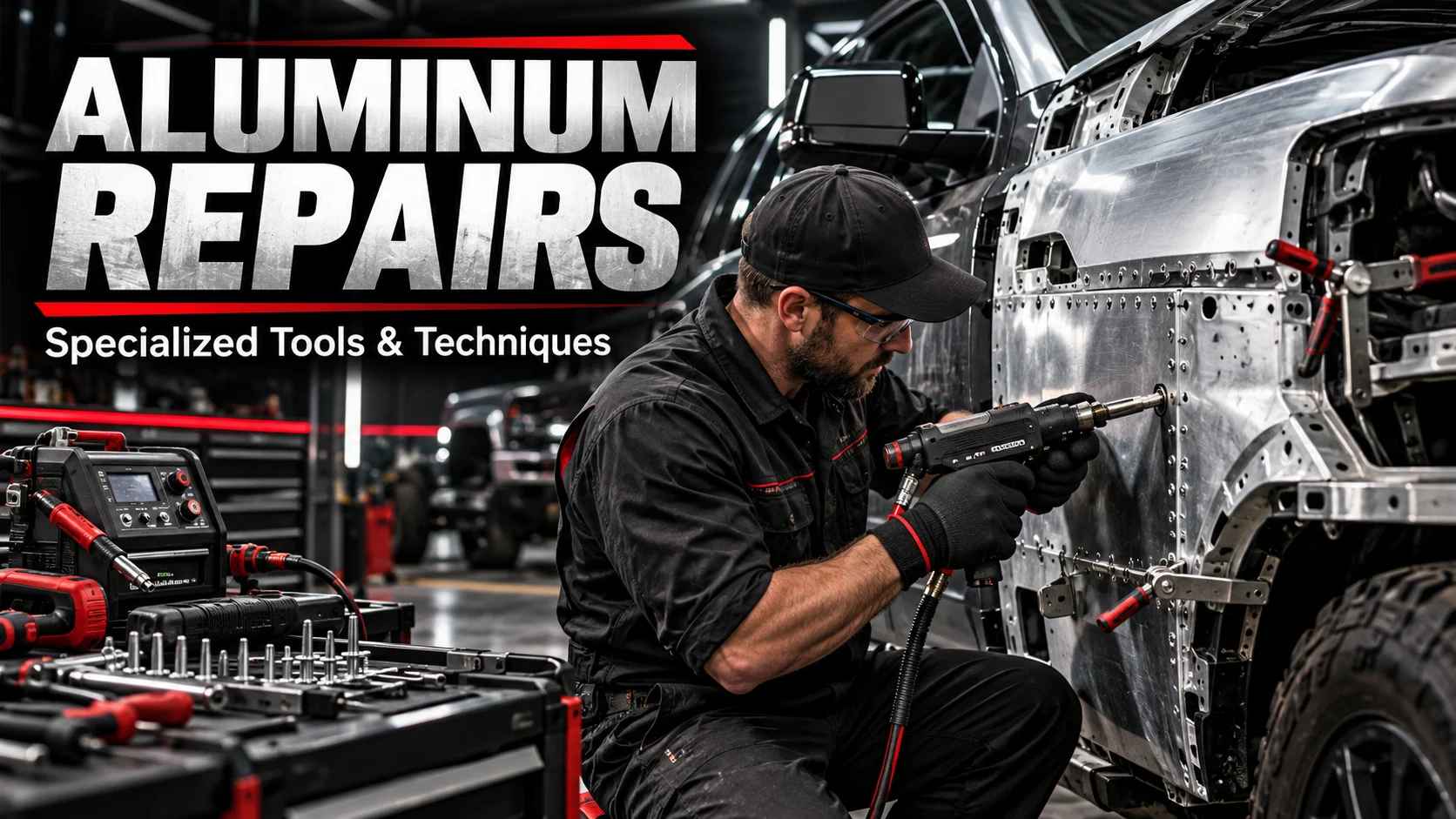
Welding is often unsuitable for joining aluminum to steel or for working near adhesives and sensitive electronics, so manufacturers specify mechanical fasteners and bonding. Self-piercing rivets are the most common. The rivet is driven through the top layer and flares inside the bottom layer without passing all the way through, forming a mechanical interlock with no pre-drilled hole. The joint is typically combined with structural adhesive for added strength and sealing.
Proper riveting tools are central to doing this correctly. Each tool must deliver the setting force required, hold the correct die for the joint stack, and allow access to both sides of the panel. Rivet length, hardness, and coating depend on material thickness and combination, and a mismatch can lead to a poor interlock or cracked material. A frequent mistake is trying to reuse a rivet or hole location, which weakens the joint. Technicians also need the right drilling and removal methods so that old rivets come out without damaging surrounding metal.
Shops researching riveting tools should confirm that equipment is approved or recommended by the vehicle makers they service, because many OEMs list specific systems in their procedures. Adhesive handling is the partner skill: surfaces must be cleaned and prepared, adhesive applied within its working time, and cure times observed before the vehicle moves on. Skipping the cure invites joint failure.
Following OEM Repair Procedures
OEM repair procedures tell technicians which parts can be repaired, which must be replaced, where sectioning is allowed, which fasteners and adhesives to use, how to torque and set them, and what to do after the repair. They also list required calibrations and tests. Following them is the clearest defense against liability, and many insurers and manufacturers expect it.
Procedures change. A tool or technique accepted for one model year may be replaced the next, and the same make may specify different rules for different platforms. Checking the current document for each job, instead of relying on memory, prevents expensive errors. Free and subscription access to manufacturer repair information exists, and good shops integrate that lookup into estimating and work order steps.
Documentation completes the loop. Photographs of the damage, measurements before and after structural work, rivet and adhesive batch information, and calibration reports prove that the repair followed the procedure. If a question arises years later, the file answers it. Insurers reviewing claims, lawyers reviewing accidents, and customers asking about quality all benefit from such records. Shops that treat the procedure as part of the repair, rather than paperwork, tend to see fewer comebacks, fewer disputes, and stronger relationships with manufacturers that run certified repair networks.
Training, Certification, and Building the Capability
Equipment without skill is an expensive ornament. Technicians need hands-on training to use riveting systems, aluminum welders, and measuring tools properly, and the training should cover why each step matters as well as how to perform it. Industry programs such as I-CAR offer structured courses, and many manufacturers run certified collision network programs with their own requirements for training, tools, and facility standards.
A practical path usually follows this sequence:
- Assess the vehicle mix coming through the shop and identify the materials involved.
- Obtain the OEM procedures for the makes serviced most often.
- Invest in the dedicated tools and workspace separation that those procedures require.
- Train technicians and estimators together so that estimates match repairable operations.
- Audit completed repairs against the procedures and record the findings.
Ongoing refresh matters because vehicles keep changing. Annual reviews of certifications, tool calibration, and training needs keep the capability current. The investment tends to pay back by allowing the shop to accept work that competitors must refuse, by lowering comebacks, and by supporting claims for appropriate repair operations during insurer negotiations.
Estimators need the training as much as technicians. An estimator who understands which operations the procedures require writes complete repair plans and can justify them to adjusters with specific references. Gaps in estimator knowledge show up as supplements, delays, and unpaid work.
Key Takeaways
Aluminum and modern high-strength structures cannot be repaired with habits built on mild steel. Contamination control, correct heat management, self-piercing rivets with approved equipment, and adhesive bonding all require specific tools and attention to detail.
OEM procedures provide the rules, documentation proves compliance, and training turns equipment into reliable results. Shops that commit to all three protect vehicle safety, limit liability, and position themselves for the complex repairs that will make up a growing share of the work.