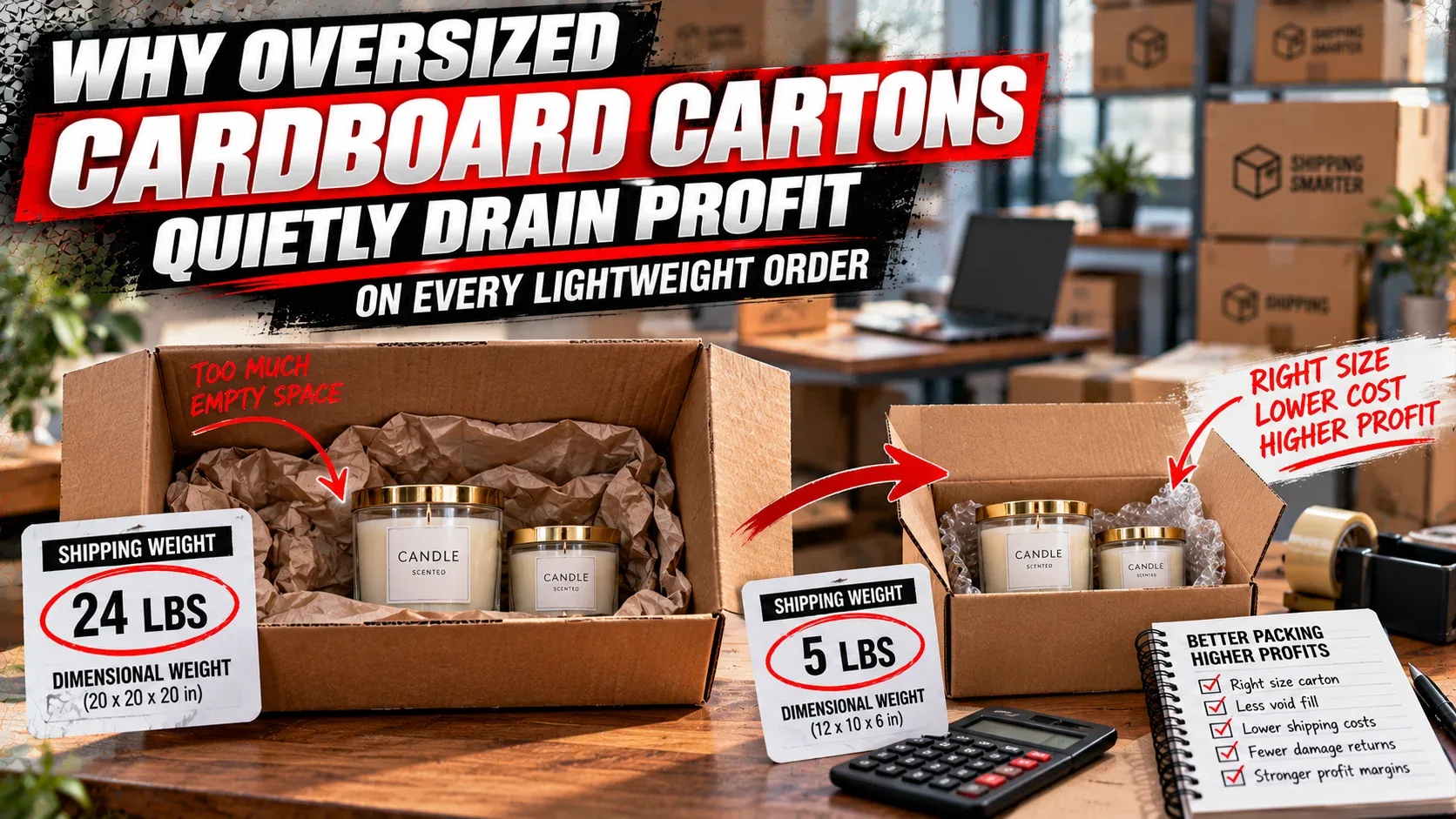
A 5 lb candle set ships in a box big enough for a toaster. The carrier bills it as 24 lbs. Nobody at the seller’s end notices until the monthly statement lands.
Cardboard cartons are the quiet culprit behind a lot of thin margins. Not because they’re expensive (they usually aren’t), but because most first-time bulk buyers grab the size that “fits everything” and call it done. Bad move. Carriers don’t charge for what’s in the box. They charge for the space the box takes up, and that gap adds up fast across 50, 200, or 800 orders a month.
And rates keep climbing. Dimensional weight rules now touch nearly every lightweight parcel, which means a carton that’s two inches too deep can cost more than the product it holds. Sellers who figure this out early keep the margin. Everyone else keeps paying for air.
Carrier rates just changed again, and oversized cartons are the first thing they punish
A candle maker ships a 5 lb order in a 20x20x20 box because that’s what was on the shelf. The label comes back at 24 lbs. Nobody at the packing table notices, so it happens again tomorrow — the day after that.
Carriers adjusted their rate tables again this year, and the pattern holds. Bigger boxes get hit hardest. If you’re buying Cardboard cartons by the case for the first time, size is the number to get right.
How dimensional weight turns a 5 lb order into a 24 lb charge
Carriers don’t bill the scale weight alone. They multiply length by width by height, then divide by 139 or 166 (the divisor depends on the carrier and service). Whichever number is bigger wins.
Run it. 20 x 20 x 20 is 8,000 cubic inches. Divide by 166, and you get roughly 48 lbs; at 139 it’s even worse. A 12x10x6 carton works out to about 5 lbs. Same product, a fraction of the postage.
The 3 places air space costs you money: postage, void fill, and returns
- Postage. You pay for the empty cubic inches, every single shipment.
- Void fill. Extra kraft paper, air pillows, or bubble wrap to stop the item sliding around. That’s material and labor on every order.
- Returns. An item rattling in a big box breaks more often. Even a 3% damage rate wipes out the margin on a lot of small orders.
Measure your product. Add an inch of cushion per side. Buy to that.
What cardboard cartons are made of, and why the difference between cardboard and corrugated matters
Most sellers buy the wrong strength because they never learned what’s inside the box. Cardboard cartons are built from kraft paper, usually with a high share of recycled fiber, pressed into flat sheets and then glued into layers. That’s it. The layers decide everything.
Cardboard vs. carton vs. corrugated: plain definitions for sellers
“Cardboard” is a catch-all word. It covers thin folding board (think cereal boxes) and the rippled stuff your shipments travel in. A carton is simply the finished box. Corrugated is the material: two flat liners with a wavy fluted layer between them, which gives it crush resistance a plain sheet can’t touch. Shipping boxes should be corrugated. Always. Folding board is for retail shelves, not for a truck.
Reading ECT ratings and wall types (single-wall 32 ECT vs. double-wall) without an engineering degree
ECT stands for Edge Crush Test, and it measures how much stacking pressure the box edge takes before it folds. Higher number, stiffer box. Here’s the quick version:
- Single-wall, 32 ECT: the standard brown workhorse. Fine for most orders up to roughly 65 lbs, which covers nearly every candle, shirt, or mug shipment.
- Double-wall, 44 ECT: two layers of flutes. Worth it for dense items near 80 lbs or fragile goods going long distances.
So what does that mean in practice? Don’t buy double-wall for a 3 lb order. You’ll pay extra for strength you never use (and carry more weight on top of it). Match the wall to the load, then shrink the box to fit.
How to pick the right size and strength for lightweight orders
Why does a 6-ounce candle ship in a box big enough for a bowling ball? Because most new sellers pick cardboard cartons by what’s on the shelf, not by what’s in the order. Fix that first, and the strength question gets easy.
Measuring your product and using a carton size calculator the right way
Measure the item at its longest, widest, and tallest points. Then add 1 to 2 inches per side for padding, no more. A carton box size calculator only works if you feed it those padded numbers (not the product’s bare dimensions). Check the result against the carrier’s dimensional weight rule before you buy a case.
When a flat corrugated mailer or poly mailer beats a carton entirely
Shirts, prints, paperbacks. Skip the carton. A flat corrugated mailer or a poly mailer ships with a tiny footprint, so dimensional weight barely registers. They also store flat, which matters if your supplies live in a spare bedroom.
When a standard carton isn’t enough: fragile and dense items
But light isn’t the same as safe. A 3-pound ceramic mug breaks in a thin box just fine. Here’s a quick rule of thumb:
- Under 65 lbs, sturdy goods: single-wall 32 ECT corrugated works.
- Fragile glass or ceramics: add bubble wrap or foam, and keep a snug fit.
- Dense items like books or metal parts: step up to double-wall, 44 ECT.
Test one sample box before ordering in bulk. Drop it from waist height. If it survives, you’ve got your size.
Buying your first bulk cases of cardboard cartons without overstocking
Roughly 6 out of 10 first-time bulk buyers end up with a stack of boxes they can’t use. That’s a dead garage corner and cash you won’t see again. Most of them bought 500 of one size on a hunch.
Skip the hunch. Order the smallest case that gets you a real price break, usually 25 to 50 cardboard cartons per size, and let your sales data do the rest.
Where to get cheap shipping boxes wholesale vs. retail stores, free sources, and marketplaces
Big-box retail stores sell moving boxes at convenience prices. Fine for one emergency. Bad for a business. Wholesale suppliers sell by the case and stock far more dimensions, so you aren’t forcing a small item into a big carton.
- Wholesale suppliers: best per-box rate and the widest size choice.
- Free sources: grocery stores and liquor stores hand out used boxes, but strength is unknown (and old logos look sloppy).
- Marketplaces: handy for tiny quantities, though you’ll pay more per box.
Test three sizes before committing, and track damage rate and cost per order
Pick three sizes that fit your top sellers. Ship 25 of each. Then track two numbers: damage rate and total packaging cost per order, including tape and void fill.
Which size wins? The one with the fewest breaks and the lowest cost per order. Not always the cheapest box.
Only then buy the big case.
Air is the most expensive thing most small sellers ship. It never shows up on a packing list, but carriers bill for it on every single label.
The fix isn’t complicated. Cardboard cartons that fit the product, not the shelf, cut the dimensional charge, shrink the pile of void fill, and keep items from rattling loose in transit. Match the wall strength to the weight and fragility, then stop paying for more than that. For soft goods and flat items, a mailer often wins outright, so don’t assume every order needs a carton.
Sellers who track this tend to find the same thing: a quarter-inch here — an inch there adds up to real money by month three. (It also shows up in fewer damage claims.)
So here’s the next step. Pull your ten best-selling products this week, measure each one with a tape, and compare those numbers against the cartons currently on your shelf. Order three close-fit sizes in small case quantities, ship them for a month, and log the damage rate and cost per order for each. Keep the winner. Drop the rest.