
A lever is a simple machine made from a rigid bar that moves around a fixed point called a fulcrum. When force is applied to one part of the bar, the lever can help lift, move, push, pull, or control a load at another point.
If you are looking for a clear lever definition, examples of levers, or an easy explanation of first-, second-, and third-class levers, this guide explains the concept using familiar objects from everyday life.
What Is a Lever?
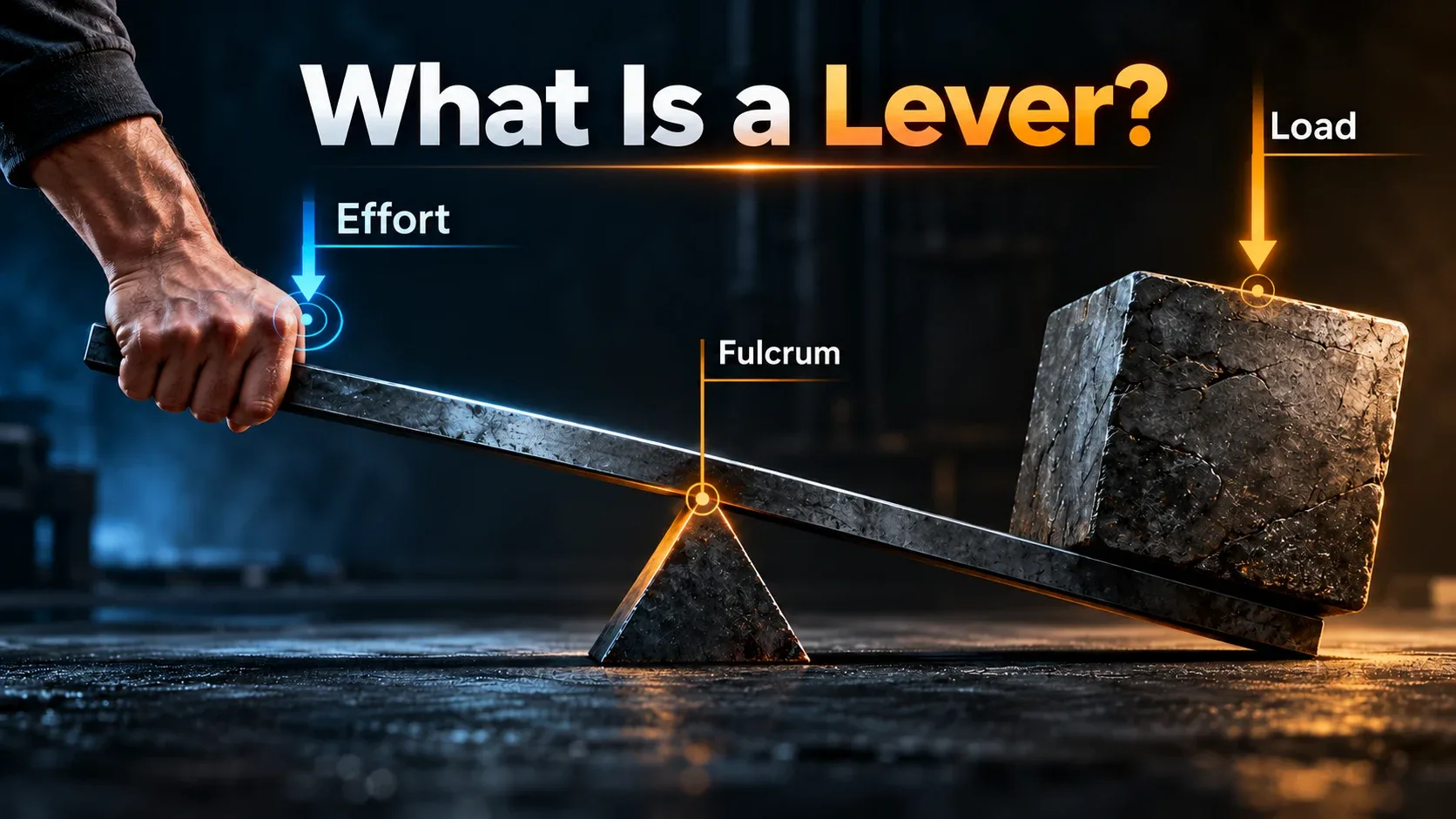
A lever is one of the simplest mechanical devices used to transfer force and motion. In its most basic form, it consists of a rigid object that turns around a pivot point.
The rigid object could be a metal bar, wooden beam, tool handle, human forearm, or another structure capable of rotating around a fixed point.
Imagine using a crowbar to lift a heavy object. The crowbar rests against a supporting point. When you push down on the long end, the opposite end rises and lifts the object. The support acts as the fulcrum, your force is the effort, and the object being lifted is the load.
Main Parts of a Lever
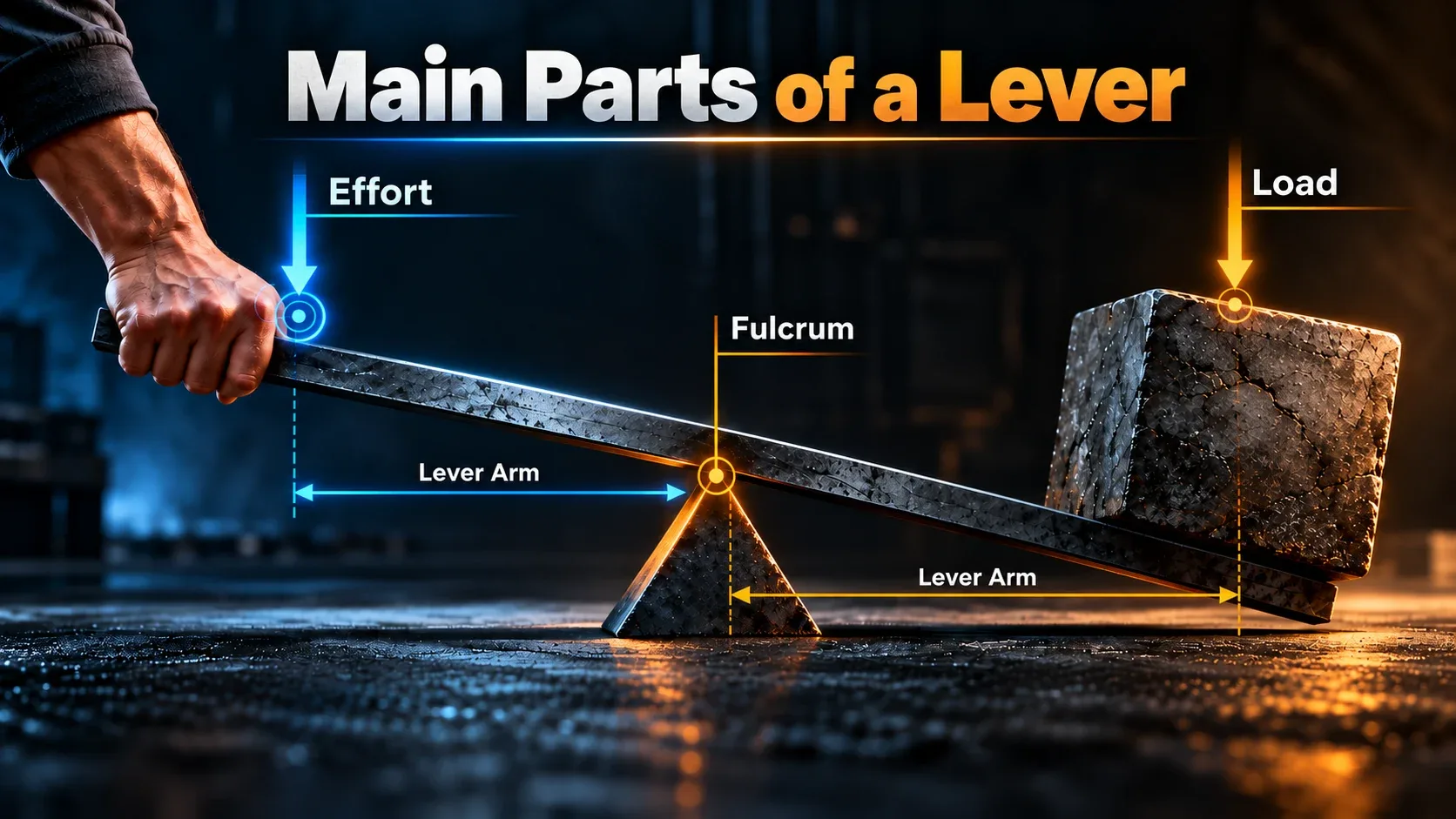
Most lever systems can be understood by identifying four important parts: the fulcrum, effort, load, and lever arm.
Fulcrum
The fulcrum is the fixed point around which the lever rotates or pivots. On a seesaw, the support in the center acts as the fulcrum.
Effort
The effort is the force applied to the lever. It may come from a person’s hand, a muscle, motor, gravity, or another force source.
Load
The load is the resistance or object that the lever is intended to move.
Lever Arm
The lever arm is the distance between the fulcrum and the point where effort or resistance acts.
How Does a Lever Work?
A lever works by rotating around its fulcrum when force is applied. The movement of one part of the lever creates movement at another part.
- A force is applied to the lever.
- The lever rotates around the fulcrum.
- The movement transfers force to the load.
- The position of the fulcrum affects how much effort is required.
A lever can make it easier to move a heavy load when the effort is applied farther from the fulcrum than the load.
Why Do Levers Make Work Easier?
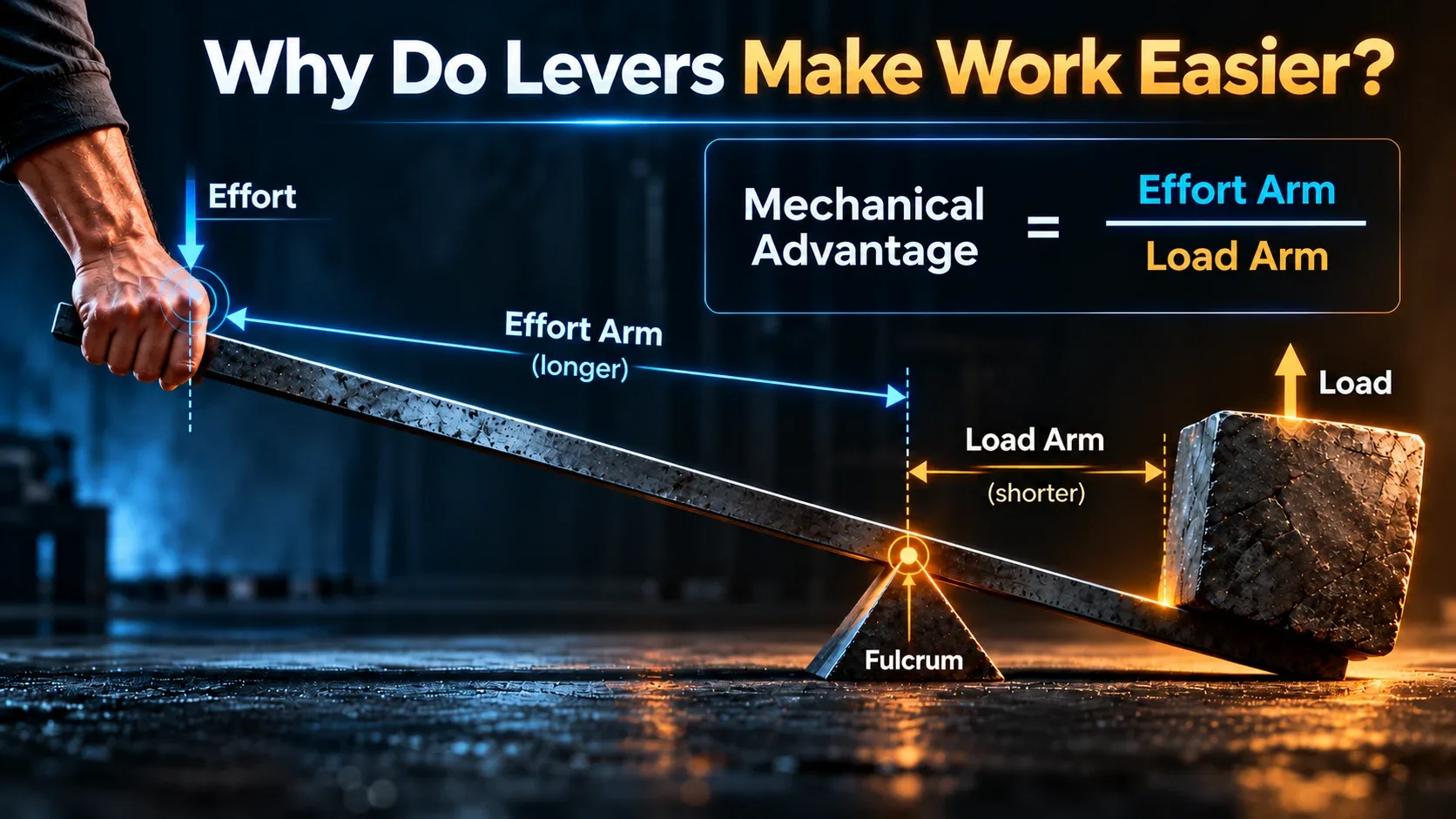
Levers can provide mechanical advantage. This means they can increase the useful force produced from the force applied by the user.
When the effort arm is longer than the load arm, less input force may be needed to move the load.
What Are the Three Types of Levers?
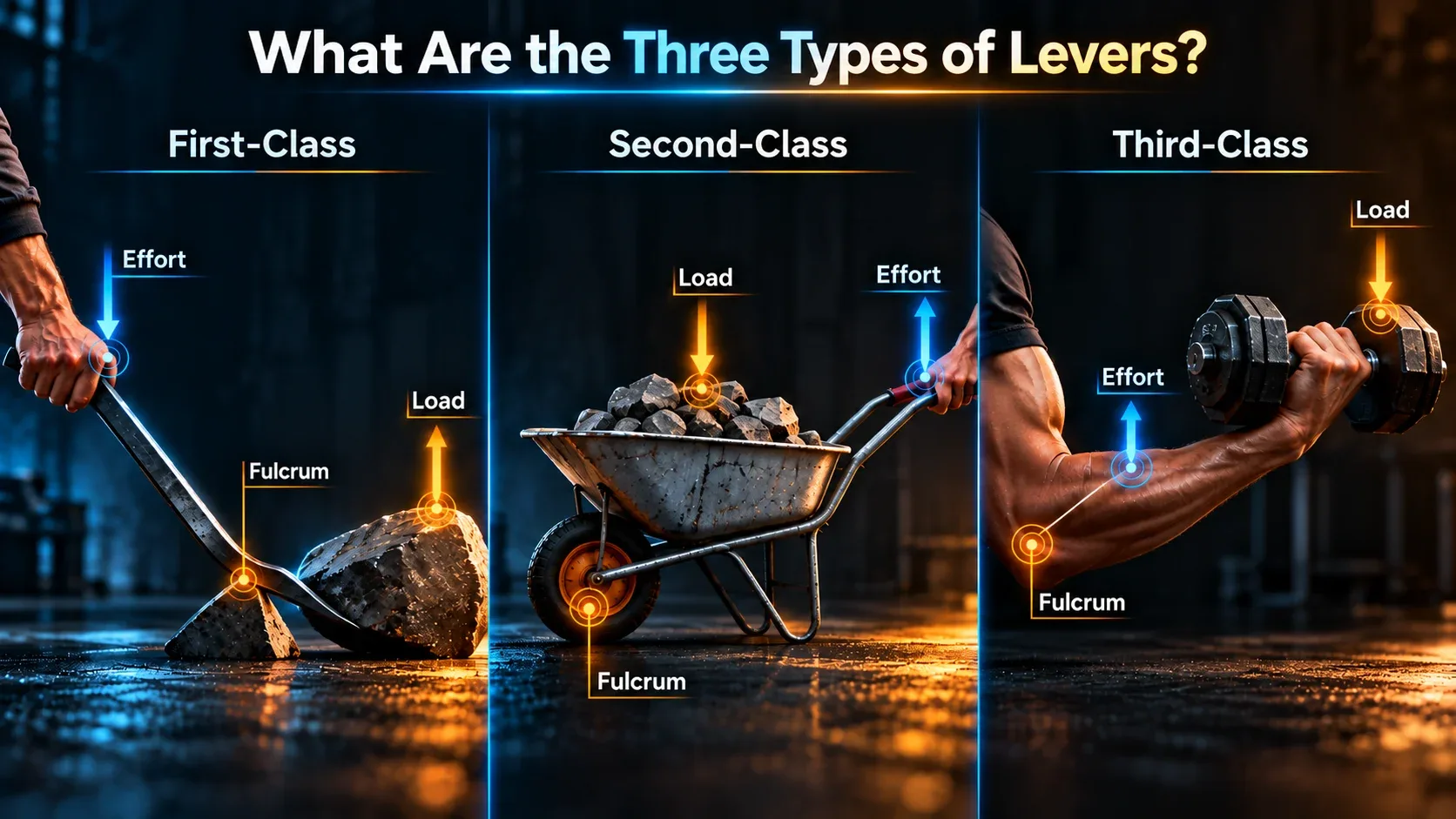
Levers are divided into three classes based on the relative position of the fulcrum, effort, and load.
| Lever Type | Middle Part | Arrangement | Common Example |
|---|---|---|---|
| First-Class Lever | Fulcrum | Effort – Fulcrum – Load | Seesaw |
| Second-Class Lever | Load | Fulcrum – Load – Effort | Wheelbarrow |
| Third-Class Lever | Effort | Fulcrum – Effort – Load | Tweezers |
First-Class Lever
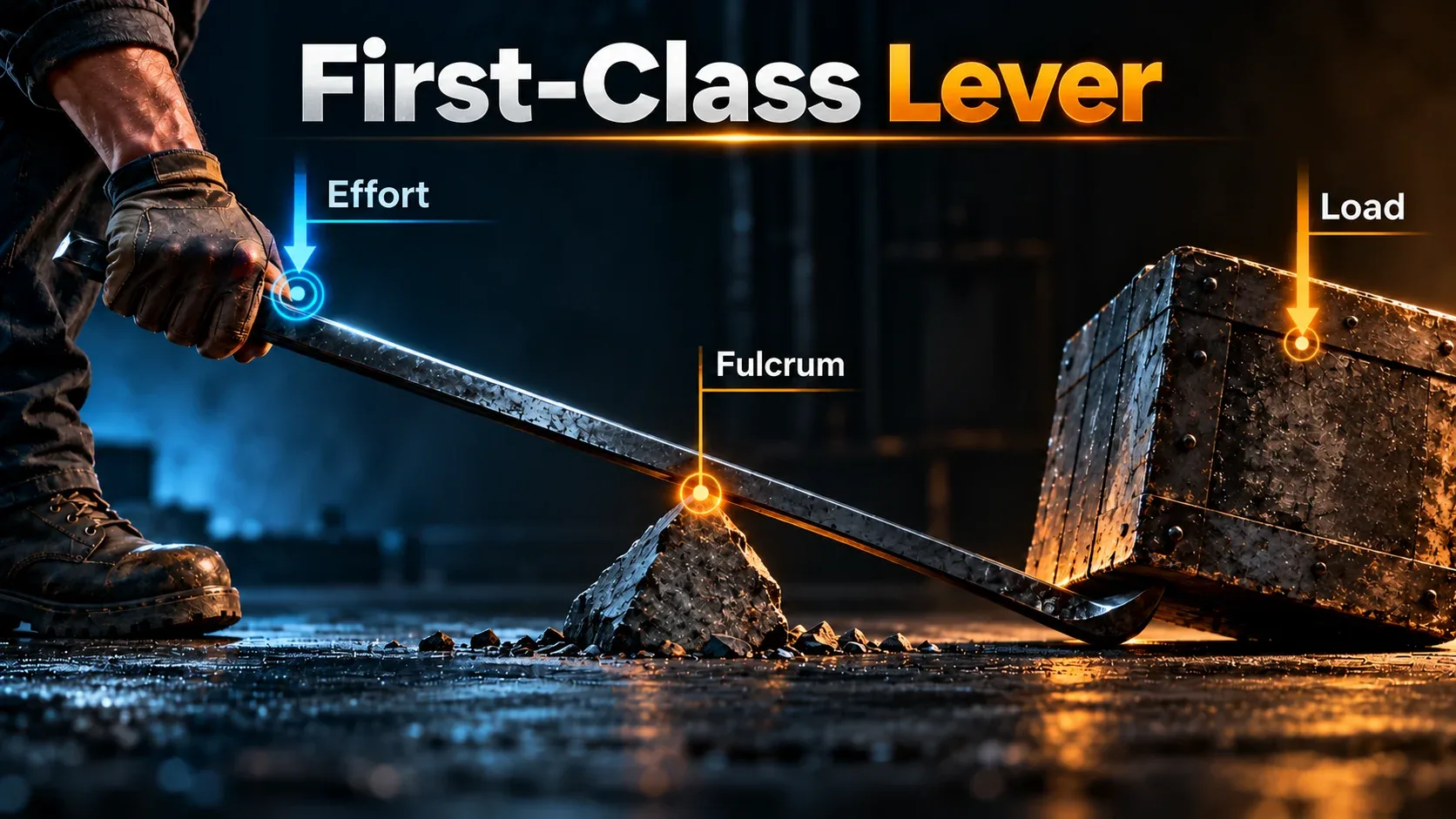
In a first-class lever, the fulcrum is positioned between the effort and the load.
Examples of First-Class Levers
- Seesaw
- Scissors
- Pliers
- Crowbar
- Claw hammer when pulling a nail
Second-Class Lever
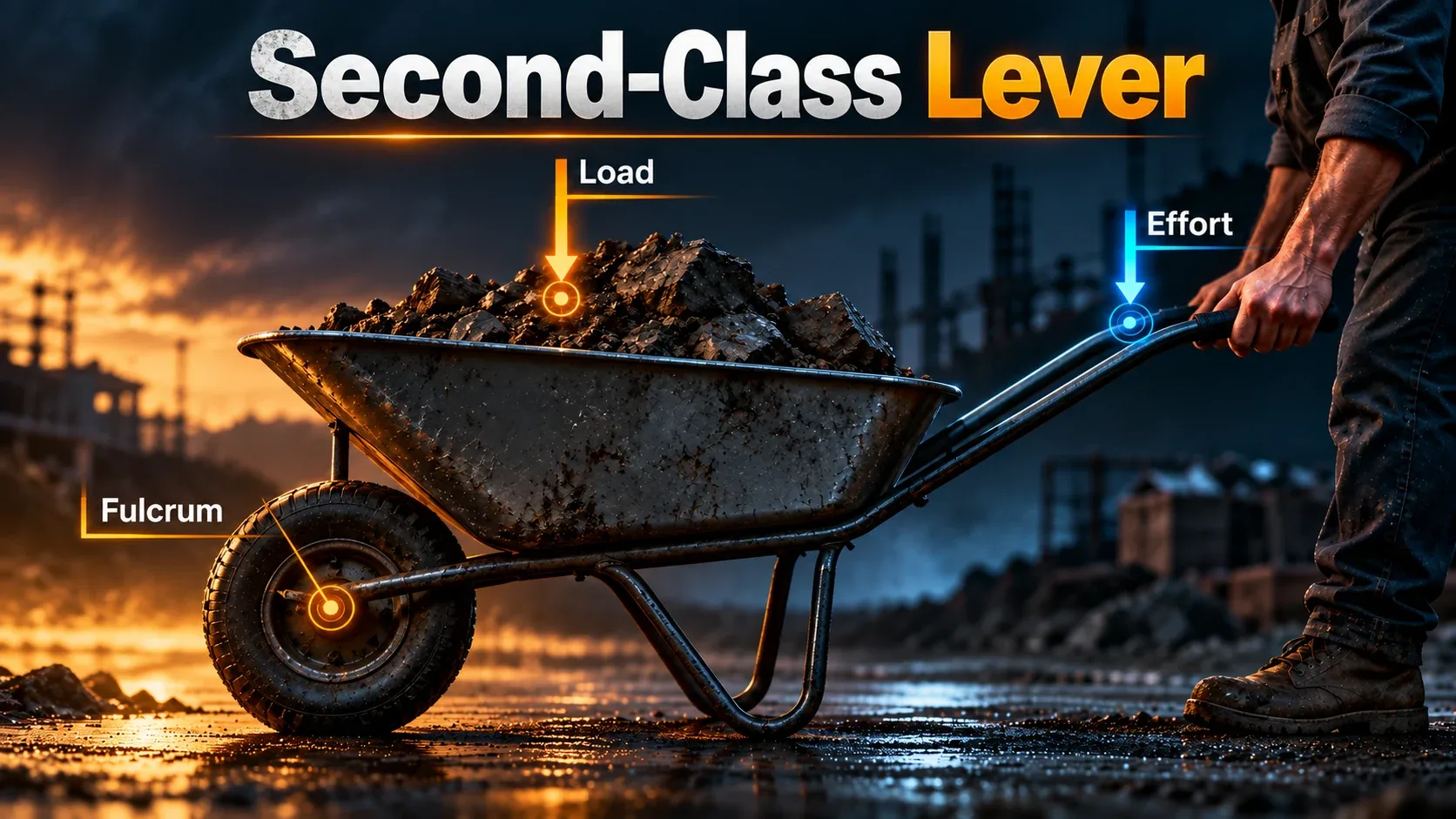
In a second-class lever, the load is positioned between the fulcrum and the effort.
Examples of Second-Class Levers
- Wheelbarrow
- Bottle opener
- Nutcracker
- Garlic press
Third-Class Lever
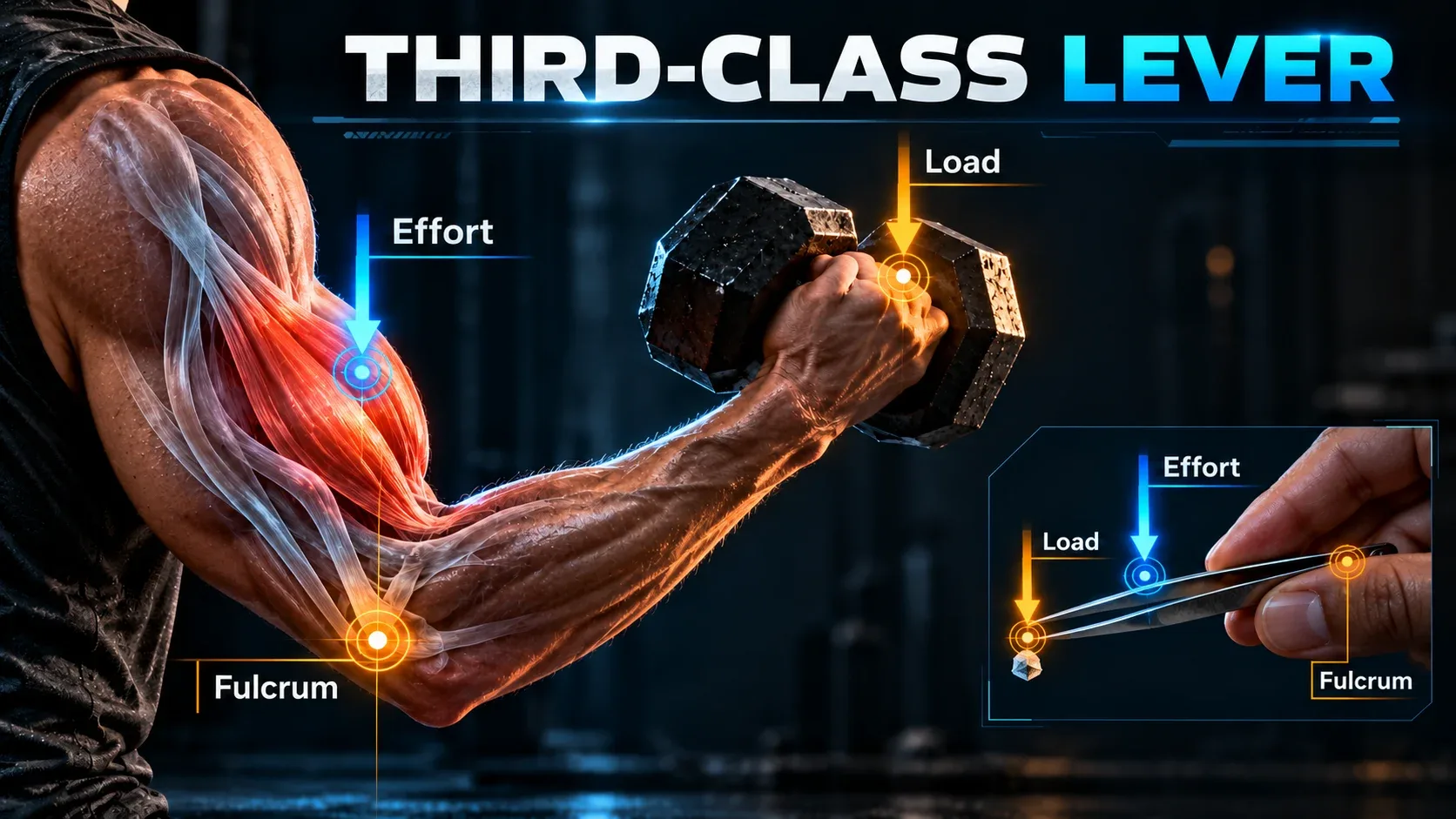
In a third-class lever, the effort is positioned between the fulcrum and the load.
Third-class levers often increase speed or range of movement instead of multiplying force.
Examples of Third-Class Levers
- Tweezers
- Fishing rod
- Broom
- Human forearm
- Shovel during some movements
First-, Second- and Third-Class Levers Compared
| Feature | First Class | Second Class | Third Class |
|---|---|---|---|
| Middle component | Fulcrum | Load | Effort |
| Arrangement | E – F – L | F – L – E | F – E – L |
| Example | Seesaw | Wheelbarrow | Tweezers |
| Typical benefit | Changes force or direction | Usually multiplies force | Usually increases speed or movement |
Examples of Levers in Everyday Life
There are many examples of levers around us. Some are tools, while others are parts of machines or the human body.
Levers Around the Home
- Scissors
- Bottle opener
- Nutcracker
- Tweezers
- Broom
- Stapler mechanism
Workshop Levers
- Crowbar
- Pliers
- Claw hammer
- Shovel
- Cutting shears
Outdoor Examples
- Wheelbarrow
- Fishing rod
- Seesaw
- Garden shears
Examples in the Human Body
- Forearm and biceps
- Foot when standing on tiptoe
- Head and neck movement
Common Lever Examples and How They Work
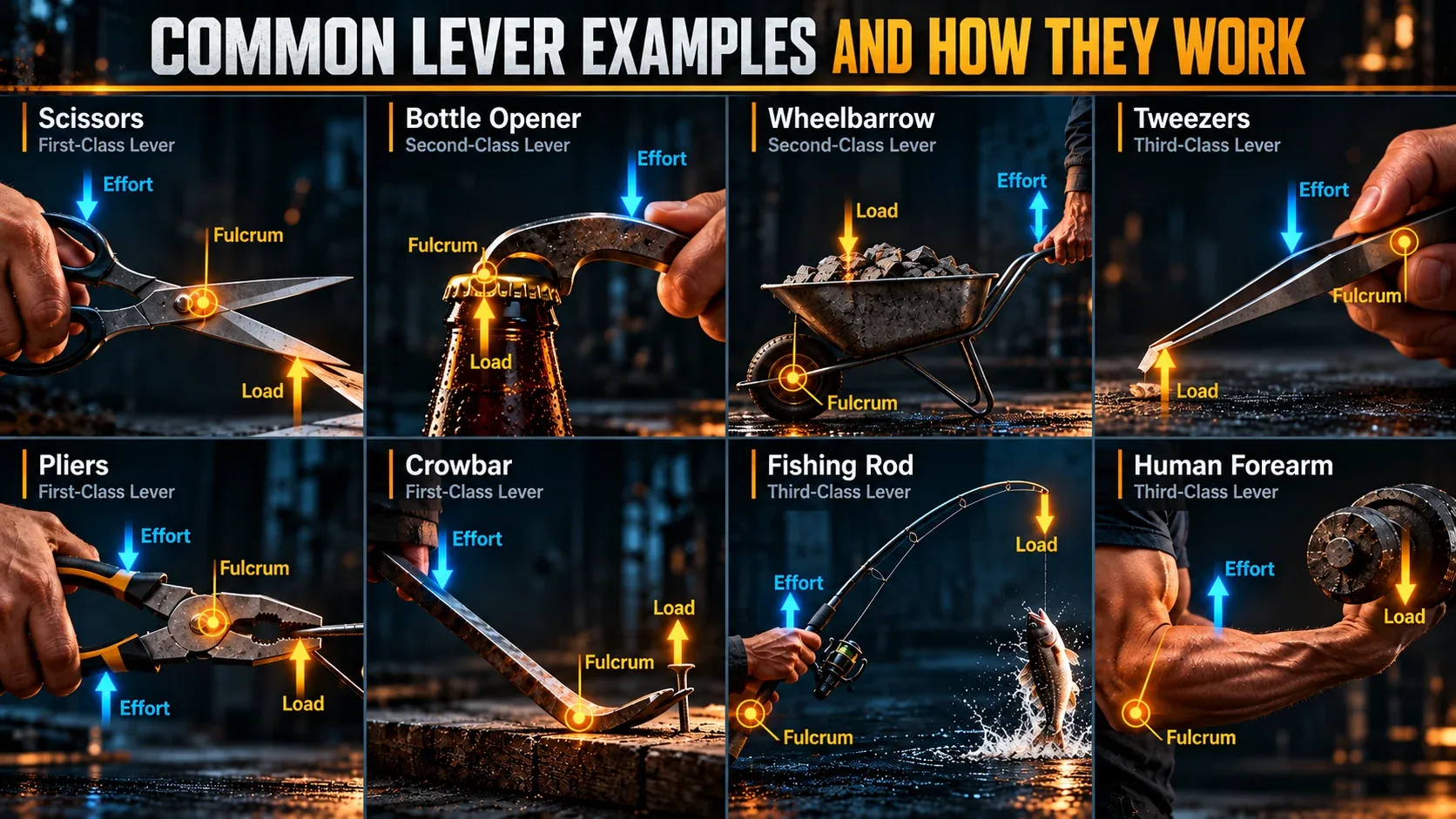
| Lever Example | Class | Fulcrum | Effort | Load |
|---|---|---|---|---|
| Seesaw | First | Center support | Person pushing down | Person at opposite end |
| Wheelbarrow | Second | Wheel axle | Handles | Material in tray |
| Tweezers | Third | Joined end | Finger pressure | Object at tips |
| Bottle opener | Second | Bottle rim | Handle | Bottle cap |
| Human forearm | Third | Elbow | Biceps | Hand and held object |
Are Scissors a Lever?
Yes. Scissors can be understood as two first-class levers joined at a central pivot.
- Fulcrum: Central screw or pivot
- Effort: Force applied at the handles
- Load: Material being cut
Is a Wheelbarrow a Lever?
Yes. A traditional wheelbarrow is a familiar second-class lever.
- Fulcrum: Wheel axle
- Load: Material carried in the tray
- Effort: Force applied at the handles
How Is the Human Arm a Lever?
The human forearm is a common example of a third-class lever when the biceps contracts to lift an object.
- Fulcrum: Elbow joint
- Effort: Force produced by the biceps
- Load: Forearm, hand, and any object being held
Easy Lever Experiment You Can Try
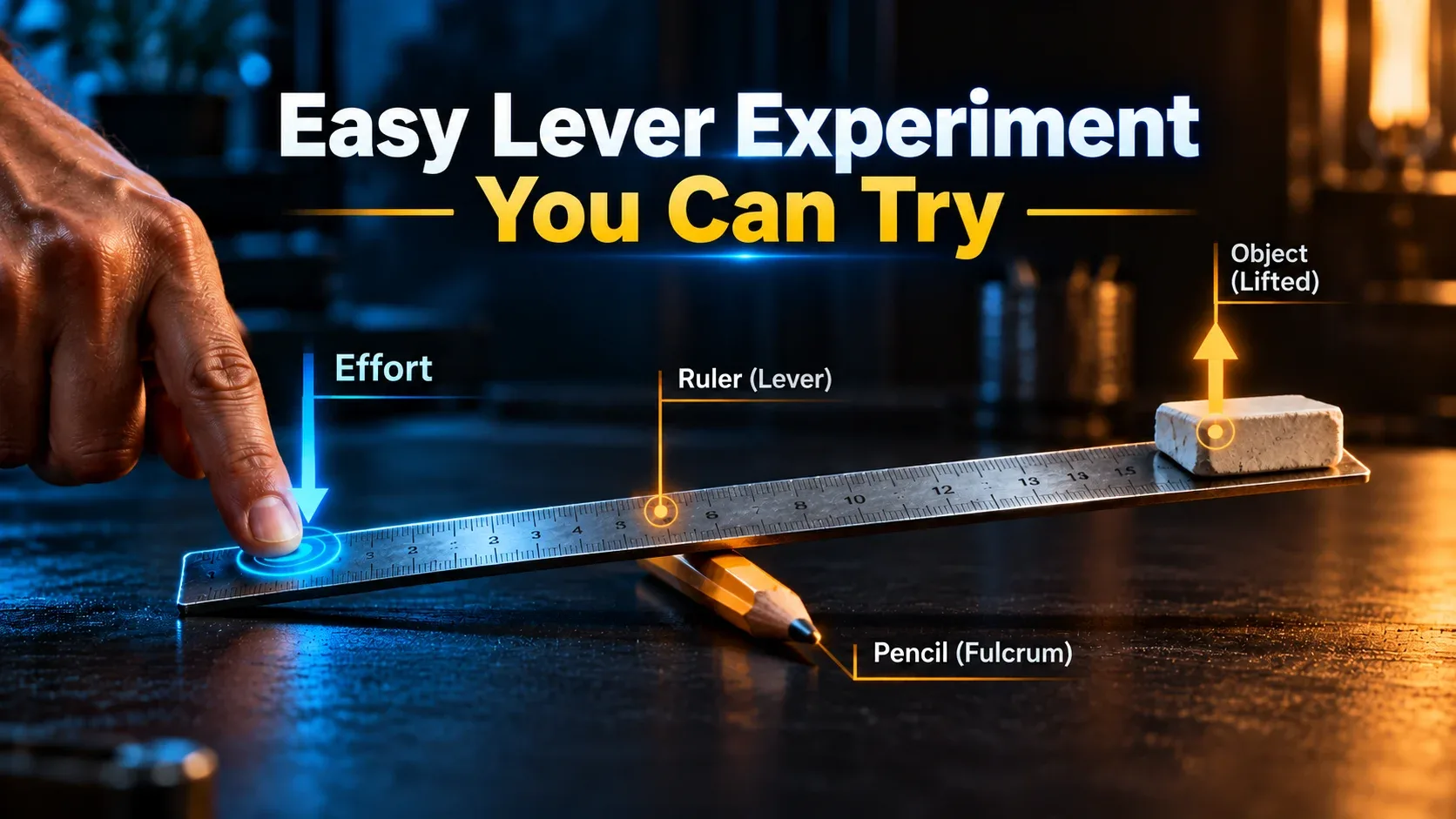
What You Need
- A ruler
- A pencil
- A small object such as an eraser
Steps
- Place the pencil under the ruler so it acts as the fulcrum.
- Place the small object near one end of the ruler.
- Push down on the opposite end.
- Watch the object rise.
- Move the pencil closer to the object and repeat.
- Compare how much effort is required.
This experiment shows how changing the position of the fulcrum changes the mechanical advantage of a lever.
Quick List of Lever Examples
First-Class Levers
- Seesaw
- Scissors
- Pliers
- Crowbar
- Claw hammer
Second-Class Levers
- Wheelbarrow
- Bottle opener
- Nutcracker
- Garlic press
Third-Class Levers
- Tweezers
- Fishing rod
- Broom
- Human forearm
- Shovel
Common Misconceptions About Levers
Every lever multiplies force
Not always. Some levers multiply force, while others increase speed or movement distance.
The fulcrum is always in the middle
Incorrect. The fulcrum is in the middle only in a first-class lever.
A lever must be straight
No. A lever can be straight, curved, or built into a more complex tool.
Frequently Asked Questions About Levers
What is the simple definition of a lever?
A lever is a rigid object that rotates around a fixed point called a fulcrum to transfer force and move a load.
What are 5 examples of levers?
Five common examples are a seesaw, scissors, wheelbarrow, bottle opener, and tweezers.
What are the three types of levers?
The three types are first-class, second-class, and third-class levers.
What is an example of a first-class lever?
A seesaw is a first-class lever because the fulcrum is positioned between the effort and the load.
What is an example of a second-class lever?
A wheelbarrow is a second-class lever because the load sits between the wheel and the handles.
What is an example of a third-class lever?
Tweezers are a third-class lever because the effort is applied between the fixed end and the load.
Why do levers make work easier?
Levers can reduce the amount of force needed to move a load by changing the distance between the fulcrum, effort, and load.
Understanding Levers in Everyday Life
The basic lever definition is straightforward: a lever is a rigid object that rotates around a fulcrum to transfer force and motion.
- The fulcrum is the pivot point.
- The effort is the applied force.
- The load is the resistance being moved.
- First-class levers have the fulcrum in the middle.
- Second-class levers have the load in the middle.
- Third-class levers have the effort in the middle.
Examples of levers include seesaws, scissors, wheelbarrows, bottle openers, tweezers, crowbars, fishing rods, and the human forearm.