
Drilling is one of the most common hole-making processes used in machining, manufacturing, construction, woodworking, and maintenance. It uses a rotating drill bit to remove material from a workpiece and create a round hole of the required size and depth.
Drilling is a machining or hole-making process in which a rotating cutting tool, called a drill bit, removes material from a workpiece to create a round hole.
What Is Drilling?
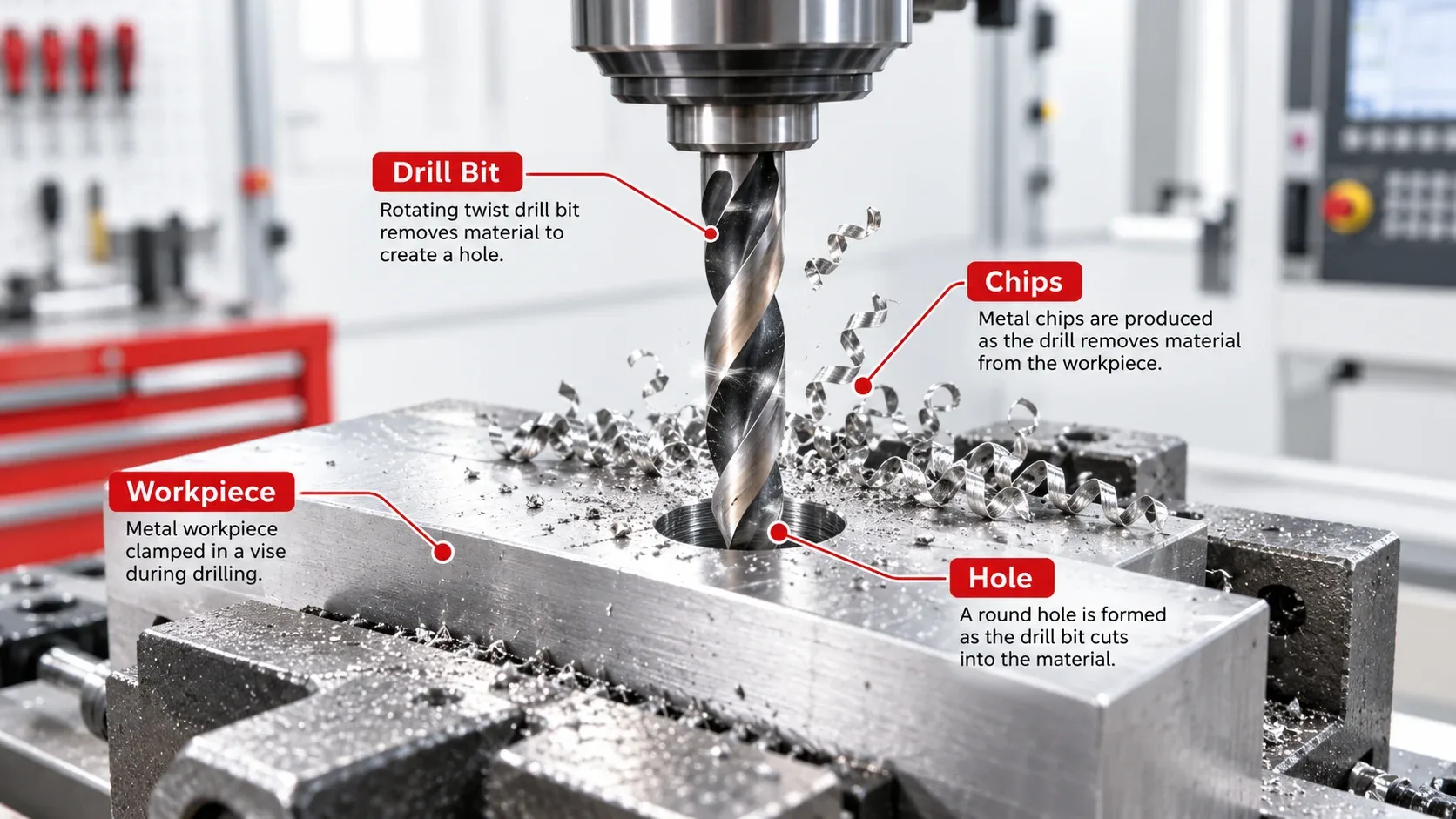
If you are looking for the meaning of drilling, it refers to the process of creating a hole by removing material with a rotating cutting tool. In machining, the drill bit rotates while advancing into the workpiece, allowing its cutting edges to remove material in the form of chips.
Drilling is considered a subtractive process because material is removed rather than added. It is commonly used to create holes for bolts, screws, fasteners, shafts, pipes, electrical fittings, and many other mechanical or structural components.
Drilling is a hole-making process that uses a rotating drill bit to remove material from a workpiece and create a round hole with a specific diameter and depth.
Depending on the application, drilling can be performed manually with a portable drill or automatically using drill presses, machining centers, and CNC drilling machines.
What Is Drilled During the Process?
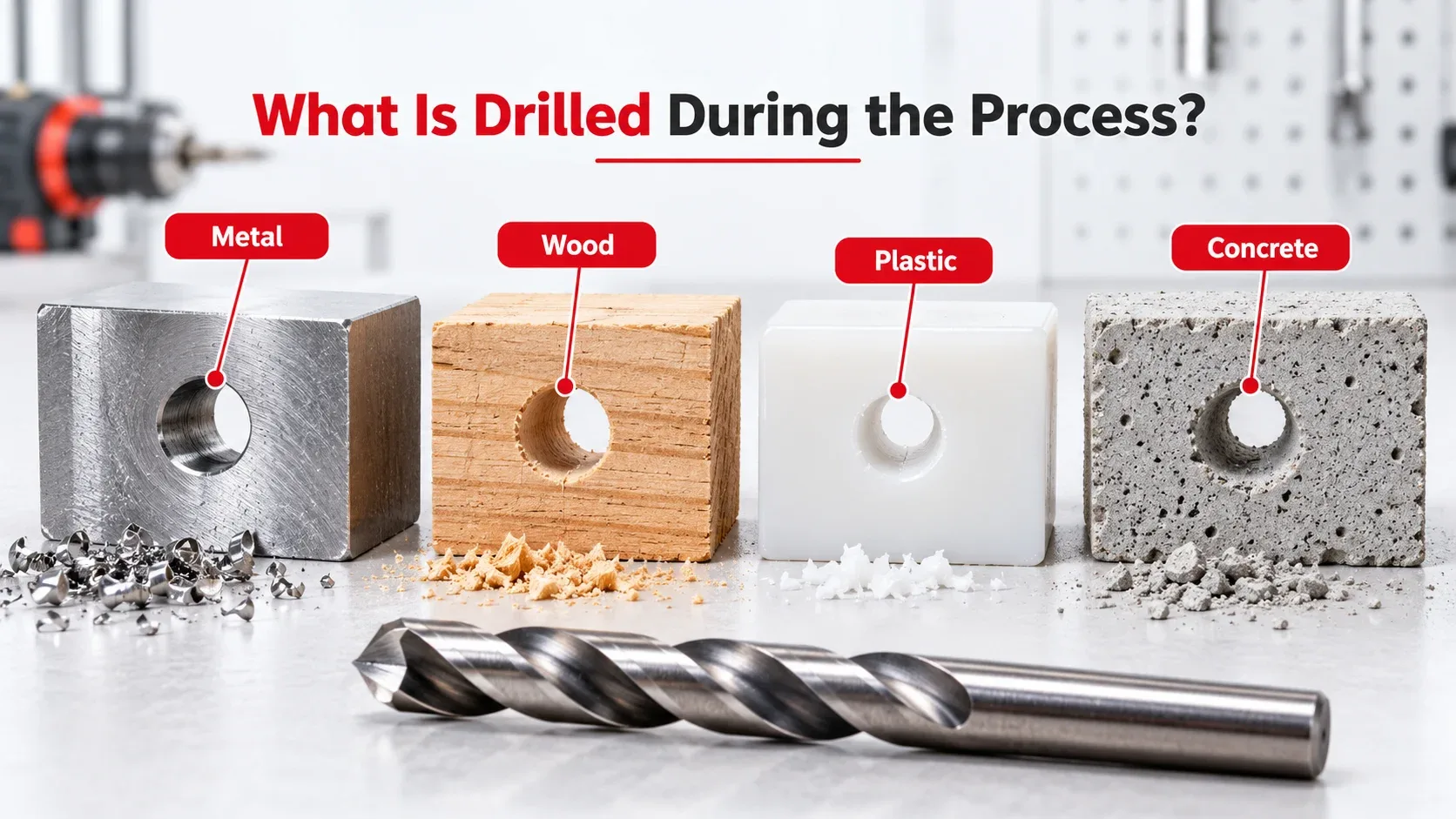
The object being cut is called the workpiece. When people ask what is drilled, the answer depends on the application. The drill bit may enter metal, wood, plastic, concrete, composites, or another material to create a hole.
During drilling, the cutting edges at the tip of the drill bit remove material while the flutes help carry chips away from the cutting area.
Metal
Steel, aluminum, brass, stainless steel, and other metals are commonly drilled in manufacturing and fabrication.
Wood
Wood can be drilled for fasteners, dowels, hardware, wiring, and furniture assembly.
Plastic
Plastics can be drilled when suitable tooling and cutting conditions are used to control heat and cracking.
Concrete
Masonry drilling uses specially designed bits for concrete, brick, and similar materials.
Composites
Composite materials often require specialized drill geometry to reduce delamination or fiber damage.
Cast Materials
Cast iron and other cast materials may also be drilled with appropriate tools and machining parameters.
How Does Drilling Work?
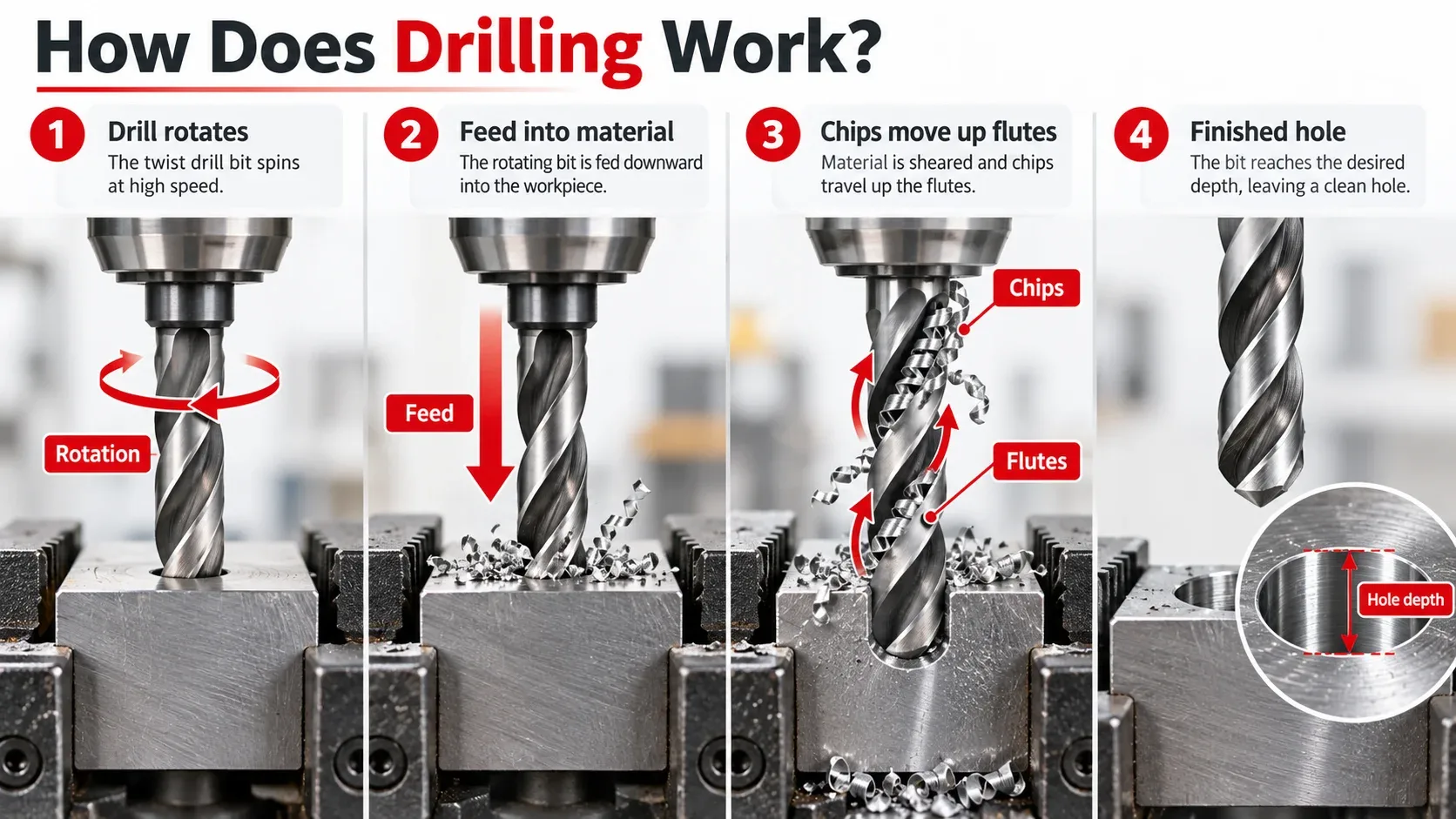
Drilling combines two main movements: rotation and feed. The drill bit spins around its axis while moving into the workpiece. As the cutting lips contact the material, they remove chips and gradually form a cylindrical hole.
- The workpiece is secured.
A vise, clamp, fixture, or other workholding method prevents unwanted movement. - The correct drill bit is selected.
Tool selection depends on hole size, material, machine, and application. - The drill bit is mounted.
The drill is held in a chuck, collet, spindle, or tool holder. - Speed and feed are set.
Cutting parameters are selected according to the material and drill size. - The bit rotates.
The machine spindle drives the drill bit at the selected rotational speed. - The drill advances into the workpiece.
Axial feed pushes the cutting edges into the material. - Chips move through the flutes.
The spiral channels on many drill bits help remove chips from the hole. - The bit is withdrawn.
Once the required depth is reached, the drill is retracted from the workpiece.
Main Parts Used in Drilling
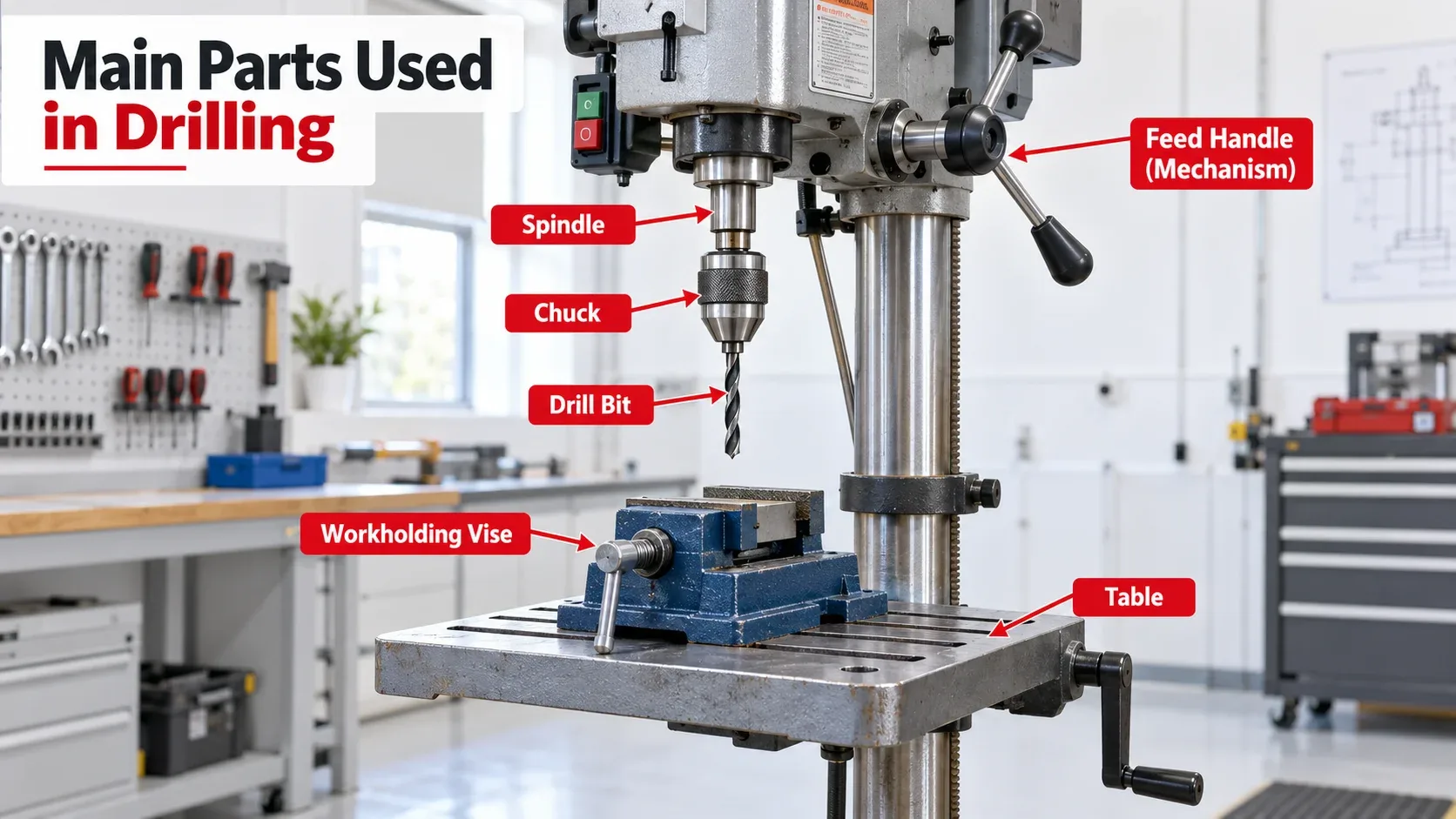
Drill Bit
The drill bit is the cutting tool that rotates and removes material to produce the hole.
Chuck
The chuck holds the drill bit securely and transfers rotation from the machine to the tool.
Spindle
The spindle is the rotating machine component that drives the drill bit.
Table
The table supports the workpiece, vise, fixture, or other workholding device.
Workholding
Vises and fixtures keep the workpiece from moving during drilling.
Feed Mechanism
The feed system controls how quickly the drill advances into the material.
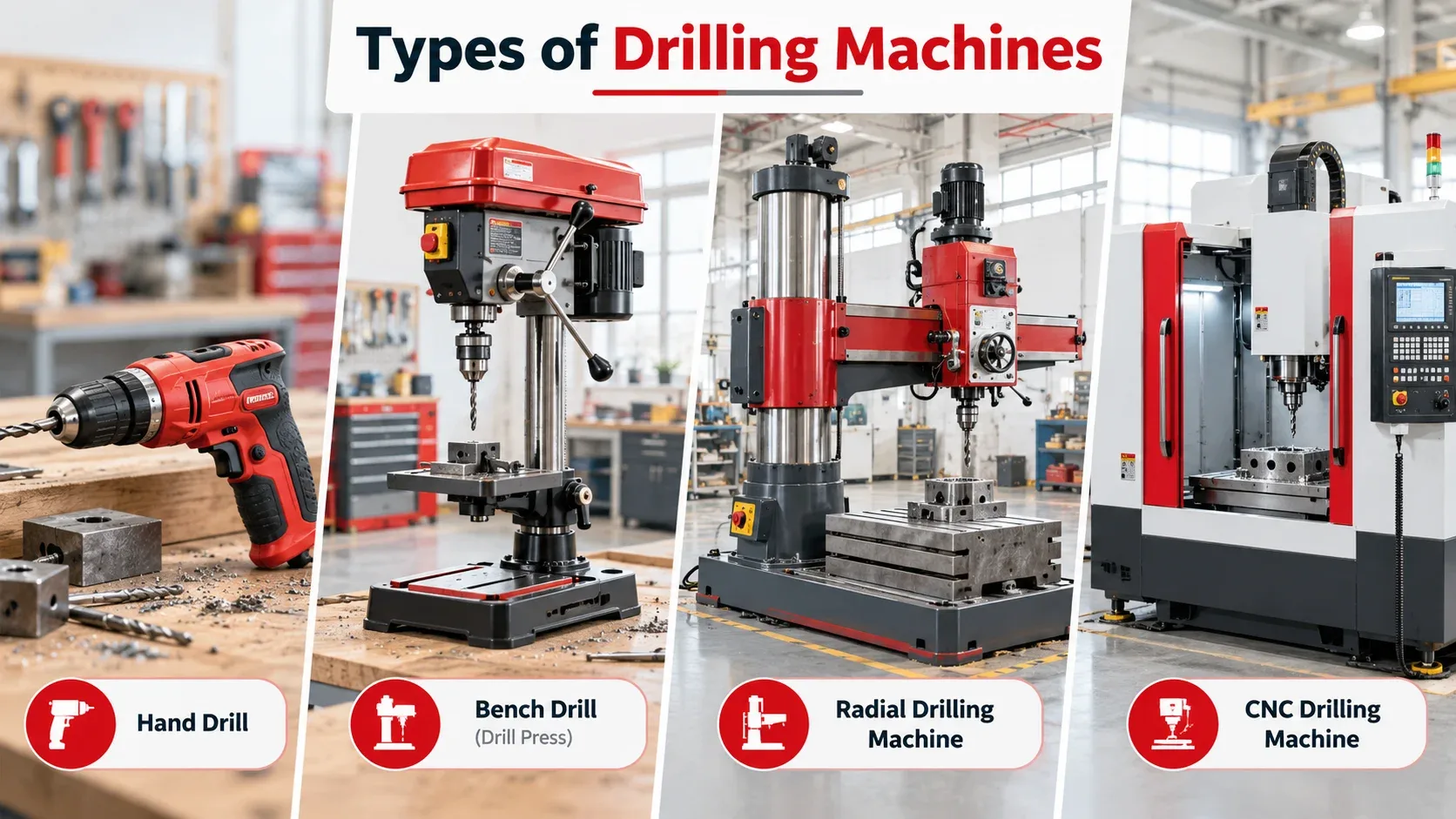
Types of Drilling Machines
Hand Drill
A portable hand drill is widely used for maintenance, construction, woodworking, and light workshop tasks.
Drill Press
A drill press holds the tool and workpiece more rigidly than a hand drill, improving control and repeatability.
Bench Drill
A compact bench-mounted drilling machine is often suitable for smaller components and lighter workshop work.
Radial Drilling Machine
A radial drill allows the spindle to be positioned over larger workpieces without moving the entire component.
CNC Drilling Machine
CNC drilling equipment uses programmed movements to produce holes at precise positions and depths.
Multi-Spindle Drilling Machine
Multi-spindle machines can drill several holes simultaneously, making them useful in repetitive production.
Common Types of Drill Bits
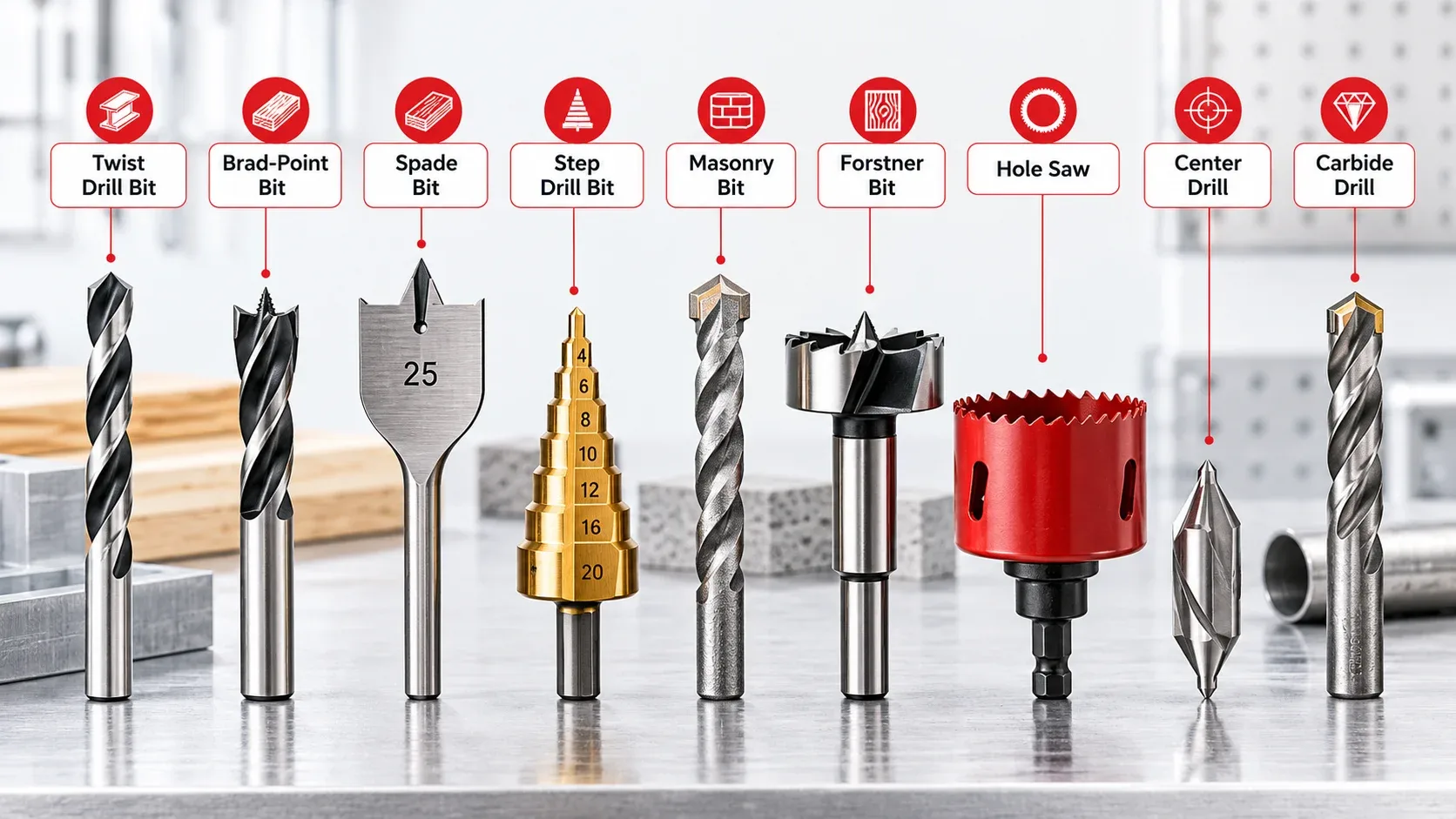
Different materials and hole shapes require different drill bit designs. Selecting the correct bit can improve hole quality, tool life, and chip removal.
Twist Drill Bit
The most common general-purpose drill, recognizable by its spiral flutes.
Brad-Point Bit
Commonly used in woodworking for accurate hole positioning.
Spade Bit
Used mainly in wood to produce relatively large holes quickly.
Step Drill Bit
A stepped tool used to create multiple hole diameters, especially in thin material.
Masonry Bit
Designed for brick, concrete, block, and other masonry materials.
Forstner Bit
Produces clean, flat-bottomed holes in wood.
Hole Saw
A circular cutting tool used for larger-diameter holes.
Center Drill
Used to create a starting feature or center location for later machining.
Carbide Drill
Carbide drills provide high wear resistance and are common in CNC production.
Common Types of Drilling Operations
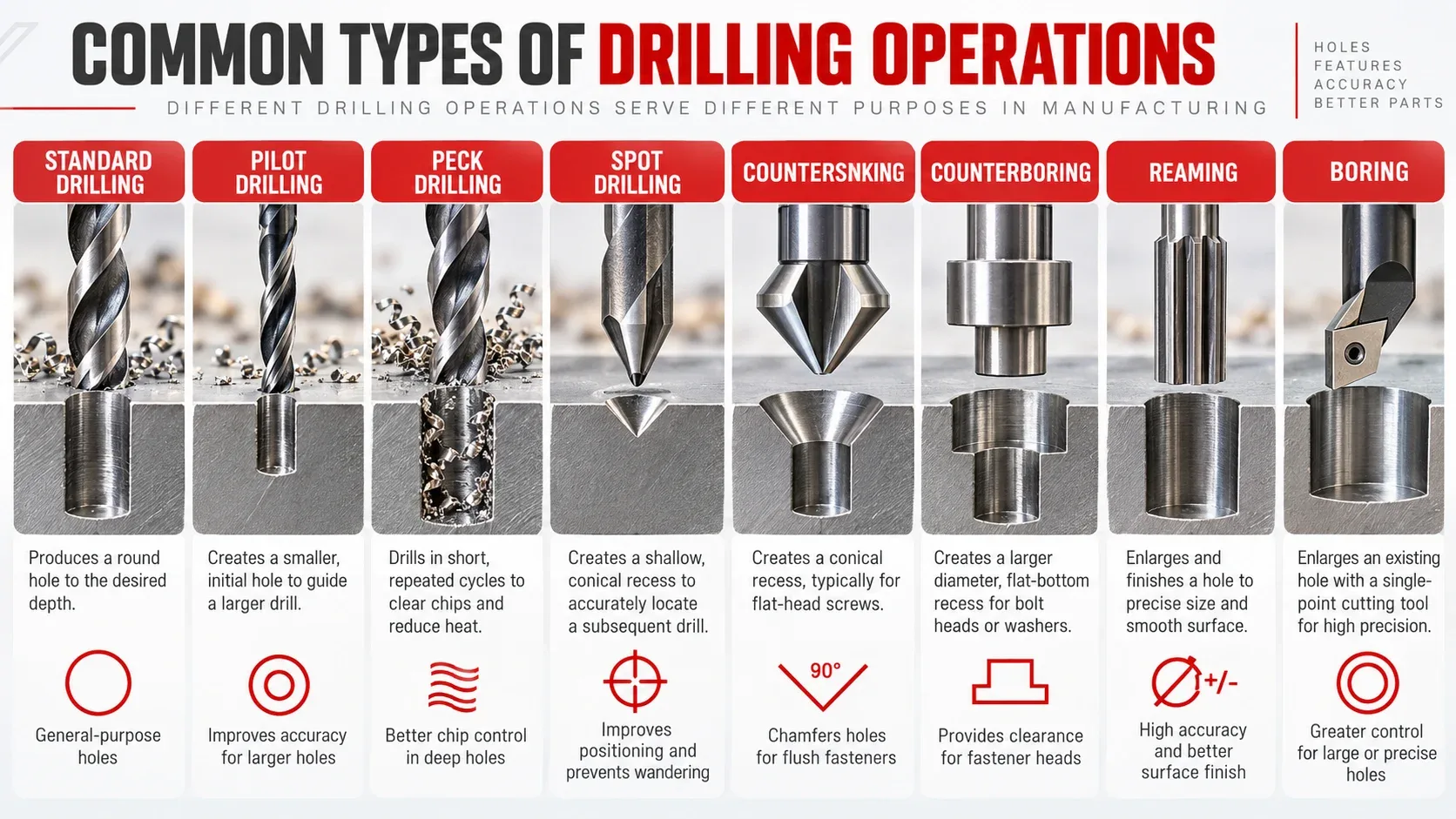
Standard Drilling
Standard drilling creates a basic cylindrical hole using a rotating drill bit.
Pilot Drilling
A smaller hole is created first to guide a larger drill or help position the final hole.
Deep-Hole Drilling
Deep-hole drilling is used when the hole depth is large compared with its diameter.
Peck Drilling
The drill repeatedly advances and retracts to help remove chips from deeper holes.
Spot Drilling
A shallow starting feature helps locate a subsequent drilling operation accurately.
Center Drilling
Center drilling produces a small centered feature used for locating or supporting later work.
Countersinking
Countersinking creates a conical recess around the opening of a hole.
Counterboring
Counterboring produces a larger cylindrical recess with a flat bottom.
Reaming
Reaming removes a small amount of material to improve the size and finish of an existing hole.
Boring
Boring enlarges or corrects a previously created hole rather than creating one from solid material.
Through Hole vs Blind Hole
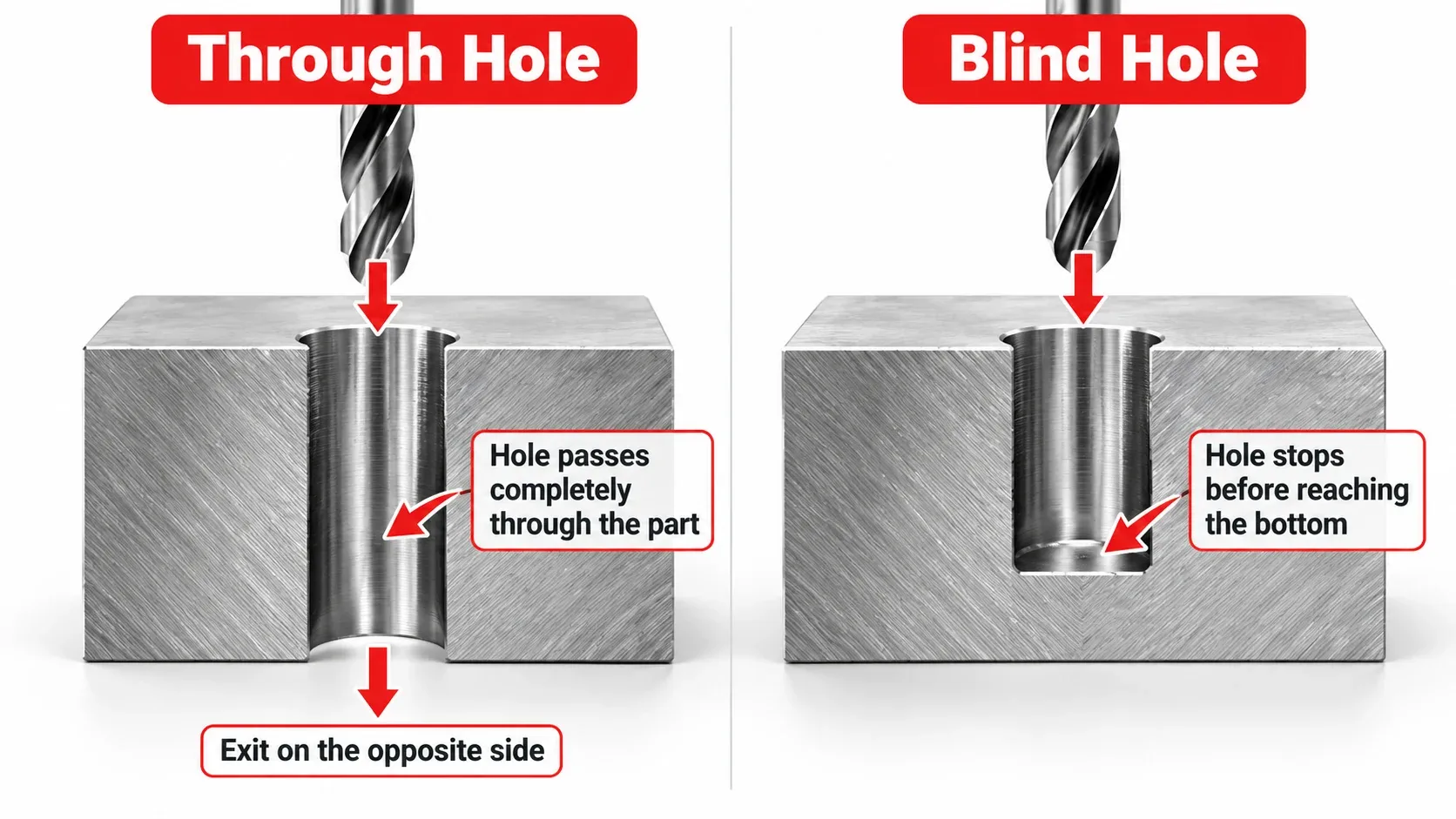
Through Hole
A through hole passes completely through the workpiece, creating an opening on both sides.
Through holes are commonly used for bolts, screws, pins, and assembly fasteners.
Blind Hole
A blind hole stops at a specified depth before reaching the opposite surface.
Blind holes are common where a fastener or feature must not pass completely through the component.
Important Drilling Parameters
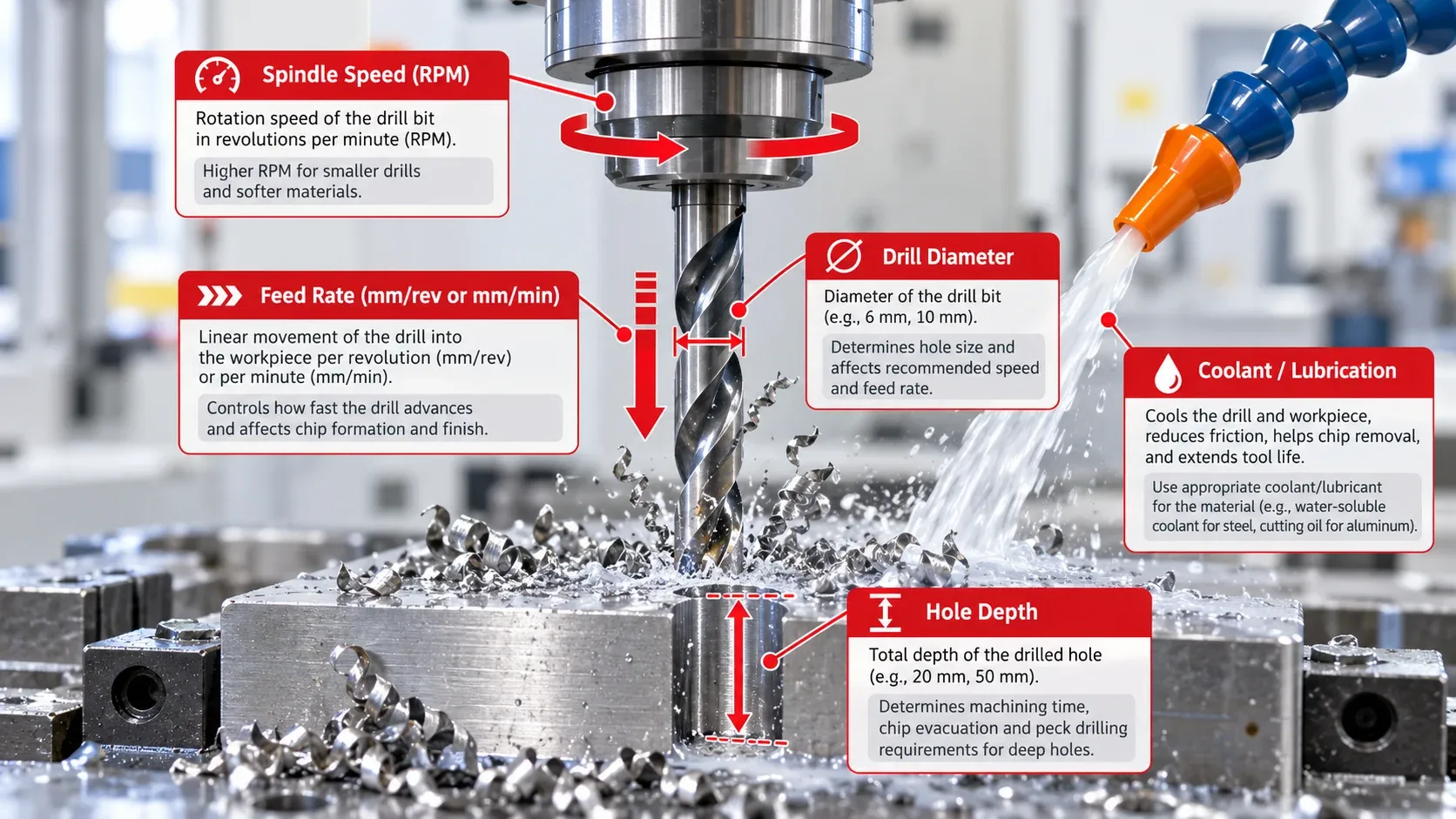
Spindle Speed
Spindle speed describes how quickly the drill rotates, normally expressed in RPM.
Feed Rate
Feed rate controls how quickly the drill advances into the workpiece.
Drill Diameter
Drill diameter largely determines the diameter of the hole being created.
Hole Depth
Hole depth determines how far the drill must travel into the material.
Cutting Speed
Cutting speed describes the relative speed of the cutting edge against the workpiece.
Coolant & Lubrication
Depending on the tool and material, coolant or lubricant may help control heat, reduce friction, and remove chips.
Drilling Process: Step by Step
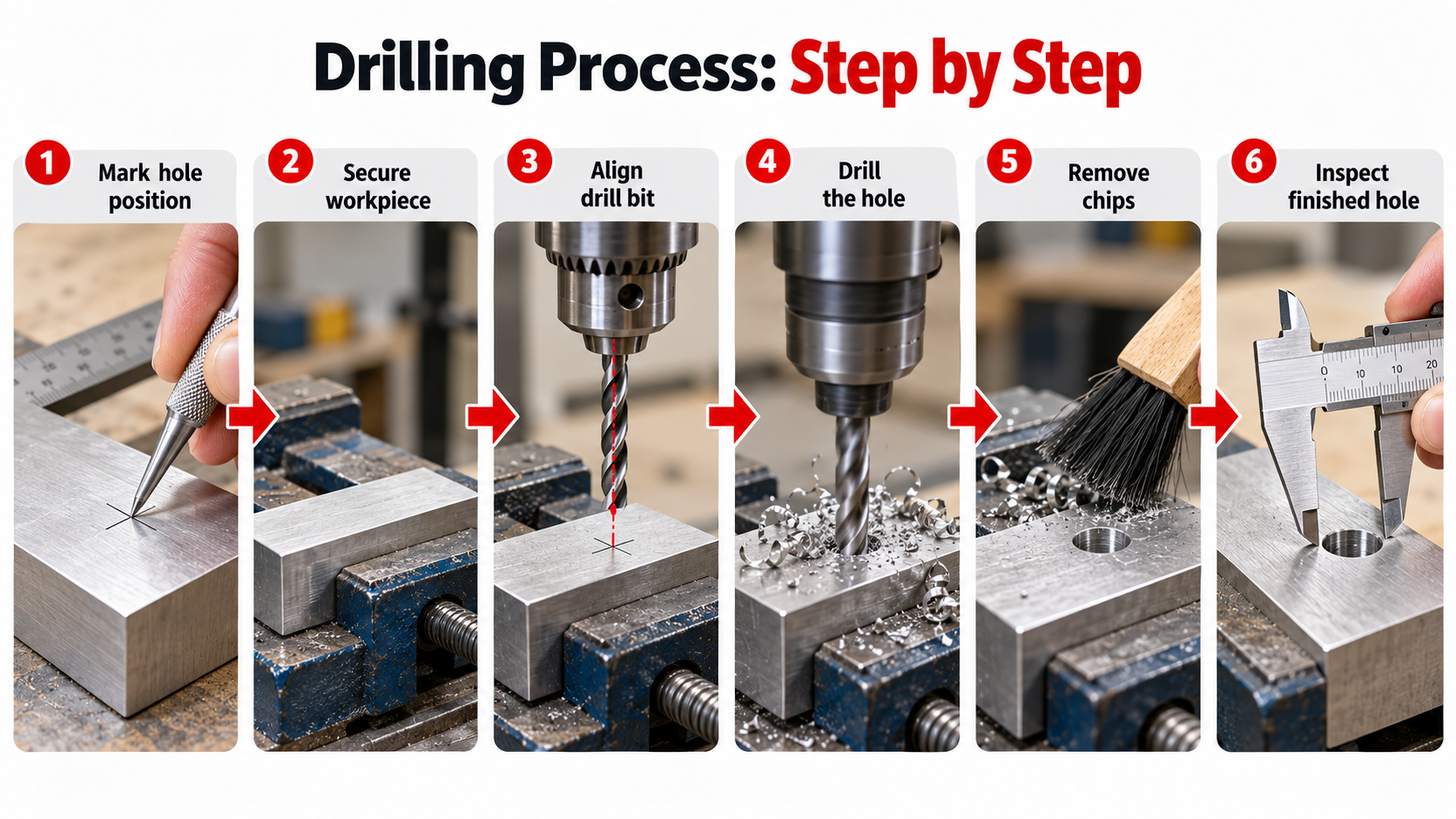
- Review the required hole dimensions.
Confirm diameter, depth, position, tolerance, and any finishing requirements. - Select the drill bit.
Match the bit to the material and required hole. - Locate the hole position.
Mark, spot-drill, or program the required position. - Secure the workpiece.
Use suitable clamps, a vise, or a fixture. - Set spindle speed and feed.
Choose parameters based on drill size, tool material, and workpiece material. - Align the tool.
Ensure the drill is positioned correctly over the hole location. - Begin drilling.
Start rotation and feed the drill into the material. - Control chips.
Ensure chips can leave the hole effectively during the cut. - Reach the required depth.
Stop or retract at the specified depth. - Inspect the hole.
Check size, depth, position, and quality using suitable measuring tools.
What Materials Can Be Drilled?
Aluminum
Many aluminum grades drill efficiently with sharp tools and effective chip evacuation.
Steel
Steel typically requires suitable tool material, speed, feed, and lubrication.
Stainless Steel
Stainless steel can require careful control of heat and feed to reduce work hardening.
Cast Iron
Cast iron is drillable but may produce abrasive chips or dust depending on the grade.
Brass & Copper
Tool geometry and cutting parameters should be matched to the specific alloy.
Wood
Wood is commonly drilled for screws, dowels, fittings, hardware, and construction.
Plastic
Drilling plastics requires attention to heat buildup, cracking, and chip removal.
Concrete
Concrete drilling normally uses masonry bits and appropriate drilling equipment.
Composites
Specialized tools may help control fiber pullout and delamination in composite materials.
Drilling vs Boring vs Reaming
Drilling, boring, and reaming all involve holes, but they serve different purposes.
| Process | Main Purpose | Starting Condition |
|---|---|---|
| Drilling | Creates the initial hole | Usually starts in solid material |
| Boring | Enlarges or corrects an existing hole | Requires a pre-existing hole |
| Reaming | Improves hole size and surface finish | Requires a previously drilled or bored hole |
Drilling vs Milling: What Is the Difference?
Drilling and milling are both material-removal processes, but their primary purposes and tool movements are different.
| Feature | Drilling | Milling |
|---|---|---|
| Main Purpose | Creating round holes | Creating surfaces, slots, pockets, profiles, and complex shapes |
| Typical Tool | Drill bit | Milling cutter |
| Primary Feed | Axial movement into the workpiece | Can involve multiple machine axes |
| Typical Feature | Round hole | Flat surfaces, pockets, slots, contours |
| Machine | Hand drill, drill press, CNC machine | Milling machine or machining center |
Advantages and Limitations of Drilling
Advantages of Drilling
- Simple and widely used hole-making process.
- Suitable for many different materials.
- Wide range of drill bit sizes and designs.
- Can be performed manually or automatically.
- CNC drilling offers high repeatability.
- Suitable for one-off work and production.
- Can be combined with countersinking, reaming, and tapping.
Limitations of Drilling
- Drill bits wear and may need replacement or sharpening.
- Deep holes can make chip evacuation difficult.
- Heat can reduce tool life.
- Large holes may require multiple operations.
- Drill wandering can affect hole position.
- High-precision holes may require reaming or boring afterward.
- Poor workholding can create safety and accuracy problems.
Common Applications of Drilling
Automotive
Drilling creates fastener holes, mounting points, oil passages, brackets, and component features.
Aerospace
Precision holes are drilled for fasteners, structures, assemblies, and aircraft components.
Construction
Drilling is used for anchors, bolts, wiring, plumbing, and structural installation.
Metal Fabrication
Fabricators drill holes for fasteners, fixtures, frames, plates, and assemblies.
Woodworking
Drilling supports dowels, screws, hinges, furniture hardware, and joinery.
Electrical Work
Holes are drilled for cables, conduits, boxes, mounting points, and installations.
Plumbing
Drilling creates openings for pipes, fittings, supports, and fixtures.
Maintenance & Repair
Workshops use drilling for replacement parts, repairs, modifications, and assembly.
Industrial Manufacturing
Automated drilling creates repeatable holes in high-volume production components.
Basic Drilling Safety
- Secure the workpiece before drilling.
- Use the correct drill bit for the material and machine.
- Wear appropriate eye protection.
- Keep loose clothing, jewelry, and hair away from rotating tools.
- Do not hold small workpieces by hand while machine drilling.
- Never touch rotating drill bits.
- Do not remove sharp chips with bare hands.
- Stop the machine before making adjustments when required.
- Follow manufacturer instructions and workplace safety procedures.
Frequently Asked Questions About Drilling
What is the meaning of drilling?
Drilling means creating a hole in a workpiece by removing material with a rotating cutting tool called a drill bit.
What is drilled during drilling?
The workpiece is drilled. It may be made from metal, wood, plastic, concrete, composites, or another suitable material.
What is the main purpose of drilling?
The main purpose of drilling is to create a round hole with a required diameter, position, and depth.
What tool is used for drilling?
A drill bit is the main cutting tool used for drilling. Different bit designs are available for different materials and hole types.
What is a pilot hole?
A pilot hole is a smaller hole drilled before a larger one. It can help guide the larger drill and improve positioning.
What is peck drilling?
Peck drilling repeatedly advances and retracts the drill to help break and remove chips, especially in deeper holes.
What is the difference between drilling and boring?
Drilling normally creates the initial hole, while boring enlarges or corrects an existing hole.
What is the difference between drilling and reaming?
Drilling creates the hole, while reaming removes a small amount of material to improve its final size and surface finish.
What materials can be drilled?
Common drillable materials include aluminum, steel, stainless steel, brass, copper, cast iron, wood, plastic, concrete, and composites.
Final Thoughts on Drilling
Drilling is a widely used hole-making process in which a rotating drill bit removes material from a workpiece to create a round hole.
The process may be performed using a portable hand drill, drill press, radial drilling machine, or CNC machining equipment. The correct tool, cutting speed, feed rate, workholding method, and chip-control strategy depend on the material and hole requirements.
Understanding drill bits, drilling machines, hole types, cutting parameters, and related processes such as boring and reaming provides a strong foundation for machining, manufacturing, maintenance, and workshop work.