
Keeping a vehicle looking new becomes increasingly difficult once it starts accumulating everyday mileage. Highway driving can expose the front end to stones and road debris, while bird droppings, tree sap, road grime, winter contamination, UV exposure, and frequent washing can gradually affect the appearance of the paint.
For car enthusiasts, the question is no longer simply whether to protect the paint. The harder question is deciding which type of protection makes sense.
Two of the most popular options are ceramic coating and paint protection film. They are often discussed together, but they perform very different jobs.
Understanding those differences can help you decide whether your vehicle needs ceramic coating, paint protection film, or a combination of both.
Start With the Paint, Not the Product
Before choosing any protective product, inspect the condition of the vehicle.
Paint protection works best when the finish underneath is already in good condition. If a car has swirl marks, water spots, oxidation, scratches, or other visible defects, covering the surface won’t necessarily make those imperfections disappear.
A thorough preparation process may include washing, chemical decontamination, clay treatment, and machine polishing.
This is particularly important with used vehicles.
A three-year-old car can still have excellent paint, but years of automatic car washes or improper washing may have left thousands of fine scratches in the clear coat. Under direct sunlight, these often appear as circular swirl marks.
Correcting these problems before applying protection gives you a much better finished result.
What Is Ceramic Coating?
Ceramic coating is a liquid product applied over properly prepared automotive paint.
Once applied and cured according to the manufacturer’s instructions, it creates a protective surface that can make the vehicle easier to maintain.
One of the most noticeable characteristics is water behavior.
On a coated vehicle, water tends to bead prominently and move from the surface more readily. Dirt and other contamination can also be easier to remove during routine washing.
A quality ceramic coating can be especially attractive to enthusiasts who want to maintain gloss while reducing the effort required to keep their vehicle looking clean.
Ceramic coatings are also used on more than just exterior paint. Depending on the product, specialized coatings are available for wheels, glass, exterior trim, and other surfaces.
However, ceramic coating has limitations that every car owner should understand.
What Ceramic Coating Doesn’t Do
One of the biggest misconceptions about ceramic coating is that it makes paint scratch-proof.
It doesn’t.
A coating can provide a sacrificial surface and resistance to environmental contamination, but it cannot stop a stone traveling at highway speed from physically striking the paint.
It also doesn’t mean that you can stop washing your vehicle.
Bird droppings, road film, tree sap, mineral deposits, and other contaminants should still be removed rather than being allowed to remain indefinitely.
The advantage is that maintaining the vehicle can become easier when the surface has been properly prepared and protected.
Think of ceramic coating primarily as surface protection and maintenance enhancement, rather than physical impact protection.
That distinction becomes important when we compare it with paint protection film.
What Is Paint Protection Film?
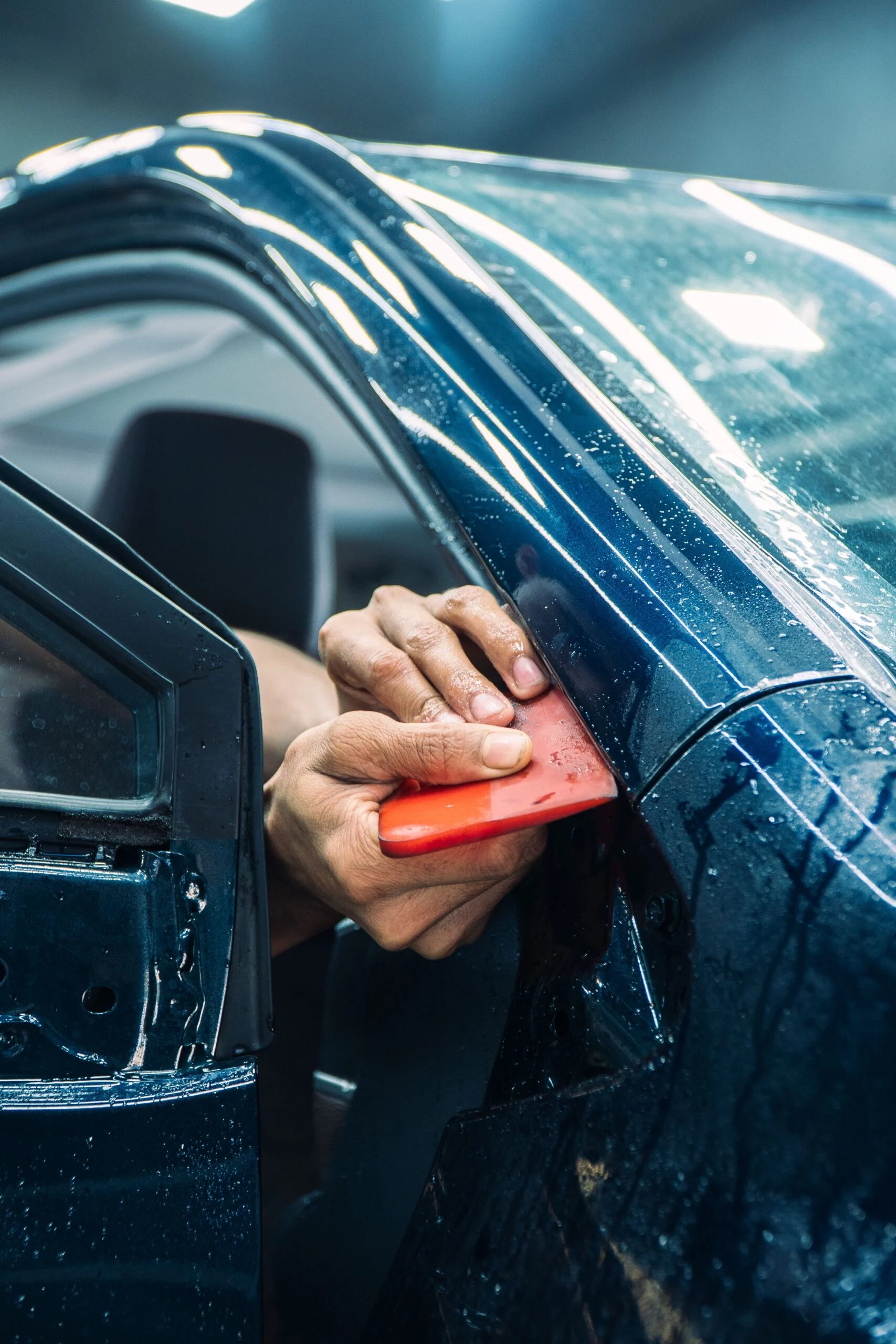
Paint protection film is a transparent urethane film installed directly over automotive body panels.
Instead of creating only a thin protective surface, the film provides a physical barrier between the paint and the outside environment.
This makes PPF particularly useful for protecting areas that are frequently exposed to road debris and stone impacts.
Common installation areas include:
- Front bumper
- Hood
- Front fenders
- Mirror caps
- Rocker panels
- Lower doors
- Rear wheel-impact areas
Some vehicle owners choose partial coverage, while others protect nearly every painted exterior panel.
For a daily driver that spends considerable time on highways, the front end is usually the area most likely to benefit from physical film protection.
Ceramic Coating vs. PPF
The easiest way to understand the difference is to consider what you’re trying to prevent.
If your priorities are easier washing, strong water behavior, gloss, and protection against everyday environmental contamination, ceramic coating makes sense.
If your primary concern is stone chips and physical road debris, paint protection film is the stronger option.
Neither product completely replaces the other because they solve different problems.
Imagine driving behind a truck on the highway.
Small stones and debris are thrown toward the front bumper and hood. Ceramic coating doesn’t provide enough physical thickness to absorb those impacts in the same way that paint protection film can.
Now imagine the same vehicle sitting outside and accumulating dirt, rain, road film, and environmental contamination.
That’s where the surface characteristics of ceramic coating become particularly useful.
This is why many enthusiasts eventually decide that the choice doesn’t necessarily have to be one or the other.
Can You Use Ceramic Coating and PPF Together?
Yes.
Combining the two can provide a very comprehensive approach to vehicle protection.
One popular strategy is installing paint protection film on high-impact areas and using ceramic coating on the rest of the vehicle.
Another approach is applying a compatible coating over the film as well as the exposed painted surfaces.
The idea is simple:
PPF handles physical impact protection.
Ceramic coating helps with surface characteristics, gloss, water behavior, and maintenance.
For a performance car, luxury vehicle, or new vehicle that an owner intends to keep for many years, this combination can be particularly appealing.
Which Areas of a Car Need the Most Protection?
Not every part of a vehicle experiences the same level of exposure.
The front bumper receives direct impacts from road debris. The leading edge of the hood is another common stone-chip area.
Mirror caps protrude from the vehicle and can also take direct impacts.
Rocker panels and lower doors experience contamination thrown from the tires, while areas immediately ahead of or behind the rear wheels can be particularly vulnerable on wider performance vehicles.
Understanding these impact zones can help you spend your protection budget more effectively.
Someone who doesn’t want full-body film might choose a front-end PPF package while using ceramic coating everywhere else.
What About a Brand-New Car?
A new vehicle is one of the best candidates for paint protection because you’re starting before years of damage accumulate.
However, don’t assume that brand-new paint is automatically perfect.
New cars can acquire defects during transportation, dealership preparation, washing, and storage. Even vehicles with very low mileage can have swirl marks or minor surface contamination.
Before applying either ceramic coating or PPF, inspect the finish carefully.
Correcting small defects before protection is much easier than discovering them after the protection has already been installed.
This is particularly relevant with dark paint, where fine defects tend to be easier to see under strong lighting.
What About Older Vehicles?
Older cars can benefit from protection too, but preparation becomes even more important.
If the paint has accumulated scratches, oxidation, water spots, or heavy swirling, some level of correction may be necessary before applying protection.
Protection should generally preserve a finish you’re happy with.
There is little benefit in rushing to coat paint that you already know needs improvement.
A properly corrected older vehicle can undergo a dramatic visual transformation before the protective product is even applied.
Which Option Is Easier for DIY Enthusiasts?
Ceramic coating is generally more approachable as a DIY project.
An enthusiast with experience washing, decontaminating, and polishing paint can prepare a vehicle and apply many consumer-focused coatings at home.
The key is patience.
Preparation usually takes considerably longer than coating application itself.
Paint protection film is different.
Installing film over complex automotive panels requires managing alignment, stretching, curves, edges, contamination, slip solution, and moisture underneath the film.
A small, relatively flat piece can be manageable for someone learning the process.
A bumper with multiple curves, vents, sensors, and body lines is another story entirely.
This is one reason professional PPF installation remains popular even among people who perform most other vehicle maintenance themselves.
Maintenance Still Matters
Neither ceramic coating nor PPF eliminates the need to properly maintain a vehicle.
A protected vehicle should still be washed regularly.
Use clean wash media and appropriate automotive cleaning products. Avoid aggressive brushes that can introduce scratches.
Bird droppings and other potentially damaging contamination should be removed promptly.
If the vehicle has PPF, periodically inspect the edges and high-impact areas.
If it has ceramic coating, pay attention to water behavior and contamination buildup.
Protection works best when it’s treated as part of a maintenance strategy rather than a substitute for maintenance.
Consider How You Actually Use Your Car
The right protection strategy depends heavily on how the vehicle is driven.
A weekend sports car that travels only a few thousand kilometers each year faces different conditions than a commuter that spends two hours a day on highways.
Someone who parks indoors may have different priorities than someone whose vehicle sits outside year-round.
Ask yourself a few practical questions:
How much highway driving do I do?
Where is the vehicle normally parked?
How long do I plan to keep it?
How particular am I about stone chips?
How frequently am I willing to wash and maintain the car?
Am I protecting a daily driver or preserving a special vehicle?
The answers can help determine whether ceramic coating, PPF, or both make the most sense.
A Practical Protection Strategy
For many enthusiasts, a balanced approach works well.
Start by thoroughly inspecting and preparing the paint.
Correct defects that bother you.
Then determine which panels experience the greatest physical impact.
If stone chips are a major concern, protect those areas with paint protection film.
Use ceramic coating where easier maintenance, hydrophobic behavior, and gloss are the priorities.
For a new or high-value vehicle, combining the two can provide broader protection than relying on either product alone.
Ultimately, the best protection isn’t necessarily the most expensive package available. It’s the protection that matches how the vehicle is actually used.
Ceramic coating and paint protection film aren’t competing solutions as much as complementary tools.
One helps preserve and maintain the surface. The other adds a physical barrier against damage that a coating alone was never designed to stop.
Understanding that distinction makes it much easier to choose the right approach—and helps ensure you’re protecting the parts of your vehicle that actually need it most.