
That mystery puddle in your driveway doesn’t have to mean panic. Here’s what Alex needs to know before panic sets in—and how to decide if it’s time to say goodbye to the car.
You step out to your driveway this morning. Your stomach drops. There it is—a puddle under your car.
The panic spiral starts immediately: “Is it dangerous? Can I still drive to work? How much is this going to cost?”
If you’re Uncertain Alex—the car owner with a 10+ year old, paid-off vehicle that’s starting to nickel-and-dime you to death—that puddle feels like a final straw. You’ve already replaced the alternator last month. You’ve already sunk $500 into a repair you weren’t sure you needed. And now this.
Here’s the truth: Not all puddles mean your car is dying. Some are literally just water. Others? Yeah, those mean it’s time to think about what comes next.
Why Fluid Leaks Matter to You (And When They Don’t)
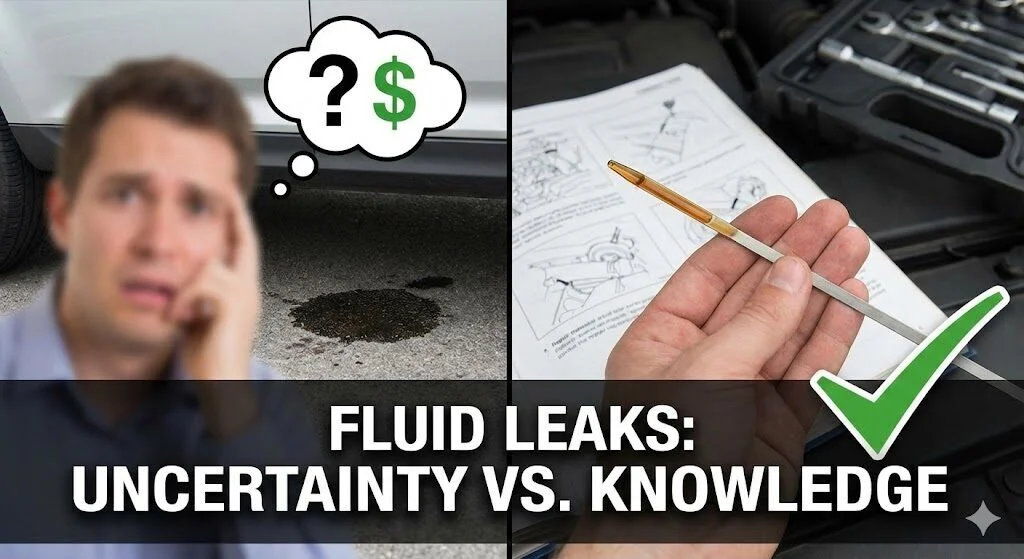
The real issue isn’t the leak itself—it’s the unknown. That uncertainty paralyzes you. You don’t want to be ripped off by a mechanic. You don’t want to drive a “ticking time bomb.” And you definitely don’t want to dump another $2,000 into a car that’s already costing you more to keep than to replace.
Here’s what you need to understand: Your ability to identify the fluid separates the quick, cheap fixes from the red flags that mean it’s time to upgrade.
By the end of this article, you’ll have the answer.
The 7 Clear Fluid Leak Causes You Must Know
1. A/C Condensation (The Good News)
What it looks like: Clear, thin, watery. Odorless. Usually under the center of your car, especially after it’s been parked with the AC on.
What it actually is: Your air conditioning system is doing exactly what it’s supposed to do. The AC condenses moisture, and that moisture drains out. It’s literally water.
Your cost: $0. Seriously.
What you do: Nothing. Park your car and move on with your life. This is the puddle equivalent of waking up to find your phone didn’t spontaneously break overnight.
✓ Safe to drive: Yes | Panic level: 0/10
2. Windshield Washer Fluid (The Harmless One)
What it looks like: Clear or slightly blue/pink (depending on the brand). Thin, watery, with a mild chemical smell.
What it actually is: Your windshield washer reservoir is leaking. That’s it. It’s a $5 reservoir with a $50 replacement cost.
Your cost: $50-150 for a mechanic. DIY? $10 and 20 minutes if you’re handy.
What you do: Schedule a repair when it’s convenient. This is low-priority. You can still see out your windshield with wipers, so don’t rush.
✓ Safe to drive: Yes | Panic level: 1/10
3. Coolant Leak (The “Schedule This Week” One)
What it looks like: Green, pink, orange, or yellow. Slimy to the touch. Sweet smell (like syrup).
What it actually is: Your engine cooling system is leaking antifreeze. This is common in older cars—hoses crack, gaskets fail, water pump seals deteriorate.
Why it matters: Your engine needs coolant to regulate temperature. Without it, you overheat. Overheating can warp your engine head (catastrophic, expensive damage). But you’re not in immediate danger if the leak is small.
Your cost: $150-800 depending on what failed (simple hose: $150; water pump: $400-800).
What you do:
- Check your coolant reservoir—it’s usually a translucent plastic tank under the hood.
- Top it off with the same color coolant your car uses.
- Watch your temperature gauge while driving.
- Schedule a repair for this week (not urgent, but don’t wait 3 months).
⚠ Safe to drive: Yes (cautiously) | Panic level: 4/10
4. Engine Oil Leak (The “Monitor It” One)
What it looks like: Brown, dark brown, or black. Oily and slippery. Smell is hard to describe (kind of metallic/burnt). Usually directly under the engine.
What it actually is: One of the most common leaks in older cars. Oil seals, valve cover gaskets, and drain plugs all fail over time.
Why it matters: Your engine needs oil to lubricate moving parts. A small leak isn’t immediately catastrophic, but if you let it go unchecked, you’ll eventually run low on oil. Low oil = engine damage = $3,000+ to replace the engine.
Your cost: $150-400 for a minor seal replacement; $600-1,200 if it’s a major seal.
What you do:
- Check your oil level weekly using the dipstick (under the hood).
- Keep a quart of oil in your car and top off as needed.
- Schedule a repair within 1-2 weeks.
- Don’t ignore this—small leaks become big problems fast.
⚠ Safe to drive: Yes | Panic level: 5/10 (depends on leak size)
5. Power Steering Fluid (The “Don’t Ignore” One)
What it looks like: Red or pink. Oily. Typically near the front wheels or center of the engine bay. May smell slightly burnt.
What it actually is: Your power steering system is leaking. This is the hydraulic fluid that makes your steering smooth and easy. Without it, your steering wheel becomes hard to turn.
Why it matters: A small leak = harder steering. A big leak = you’re basically driving a 1950s car without power steering. You can drive without it, but it’s exhausting and dangerous, especially in an emergency maneuver.
Your cost: $200-600 depending on where it’s leaking (hose vs. pump).
What you do:
- Check your power steering fluid reservoir (usually under the hood).
- If the steering wheel is getting harder to turn, get this fixed ASAP.
- Schedule a repair this week.
⚠ Safe to drive: Yes (but uncomfortable) | Panic level: 6/10
6. Transmission Fluid (The “This Might Be the End” One)
What it looks like: Bright red or dark red. Oily. Slightly burnt smell. Usually near the center or rear of the car, under the transmission pan.
What it actually is: Your transmission fluid is leaking. In older cars, this is often a sign that internal seals are failing.
Why it matters: Your transmission needs fluid to shift gears smoothly and stay cool. Without it, your transmission can fail. And a transmission replacement? That’s $1,500-$4,000+. For a car you paid off 5 years ago.
This is the one that breaks Uncertain Alex. You see bright red fluid, realize it’s transmission fluid, and suddenly you’re thinking: “Is it time to donate this car?”
Your cost: Minor transmission leak seal: $400-800. Major transmission failure: $2,000-$4,000+.
What you do:
- Check your transmission fluid level (dipstick under the hood, or check your manual).
- If the level is low, top it off with the correct fluid type.
- Drive carefully to a mechanic—get a diagnosis TODAY.
- This is where you decide: Is fixing it worth the cost, or is it time for a new car?
🚨 Safe to drive: Depends on leak size | Panic level: 8/10
7. Brake Fluid (The “DO NOT DRIVE” One)
What it looks like: Light yellow or clear. Slippery. Slightly chemical smell. Usually near the wheels or under the brake master cylinder (top front of engine bay).
What it actually is: Your brake system is leaking. This is the one you need to take seriously.
Why it matters: Your brakes could fail without warning. You could lose braking power completely on the highway. This is a safety issue—not just for you, but for everyone around you.
Your cost: $150-1,000 depending on what failed (caliper seal vs. brake line rupture).
What you do:
- DO NOT DRIVE.
- Call a tow truck. Not because it’s dramatic—because your brakes might not work.
- Get it diagnosed and repaired before driving anywhere.
- Your life is worth the tow fee.
🛑 Safe to drive: NO | Panic level: 10/10
The Real Question: Is It Time to Let Go?
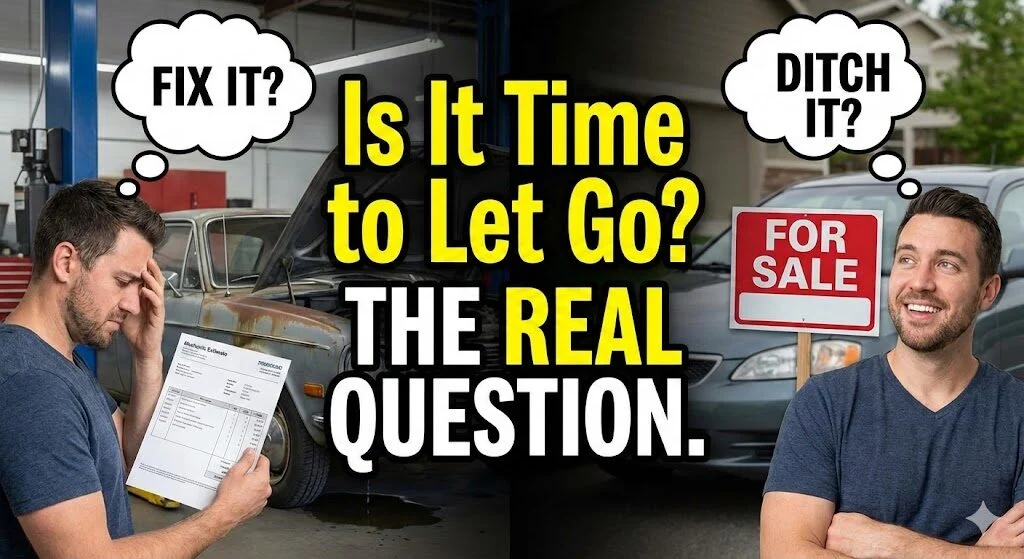
Here’s where Uncertain Alex’s internal monologue matters. You’re not just asking “What’s leaking?” You’re asking: “Is this car still worth keeping?”
Let’s do the math:
- Transmission fluid leak (bright red): $400-4,000+
- Brake fluid leak (light yellow): $150-1,000+
- Coolant leak (green/pink): $150-800
- Engine oil leak (dark brown): $150-400
Now ask yourself: “What’s my car actually worth right now?”
If you’re driving a 12-year-old sedan with 150,000 miles, that car is probably worth $3,000-$6,000 at best. Maybe less if it’s already had repairs.
So here’s the decision tree:
🔍 If the leak is:
- A/C condensation, washer fluid, small oil leak: Fix it. $50-400. Worthwhile investment.
- Coolant leak, power steering: Get it diagnosed. Could be $150-800. Decide based on car’s overall condition.
- Transmission fluid leak (especially if large or recurring): Get a full diagnosis. If repair is $2,000+, it might be time to consider upgrading.
- Brake fluid leak: Fix it immediately. Safety first. But if your car is already on its last legs, use this as motivation to upgrade soon.
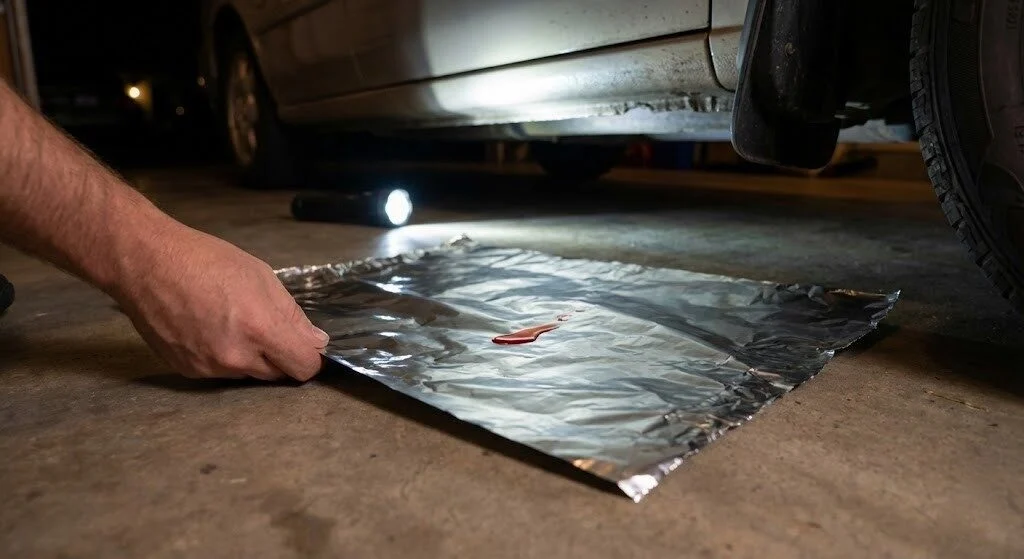
The Aluminum Foil Trick: Diagnose Like a Pro
Before you call the mechanic, use this simple trick to know exactly where the leak is coming from:
- Place aluminum foil or white cardboard under your car overnight. Position it directly under where you see the puddle.
- In the morning, check where the drip landed. This tells you the leak’s origin point (front center = engine, rear center = transmission, wheels = brake system).
- Note the color and consistency. Use our guide above to narrow down the fluid type.
- Take a photo on your phone. Bring this to the mechanic. It prevents upselling and shows you did your homework.
Now you walk into the shop knowing exactly what you’re dealing with. You’re not confused or scared. You’re informed. That changes everything.
When It’s Time to Say Goodbye
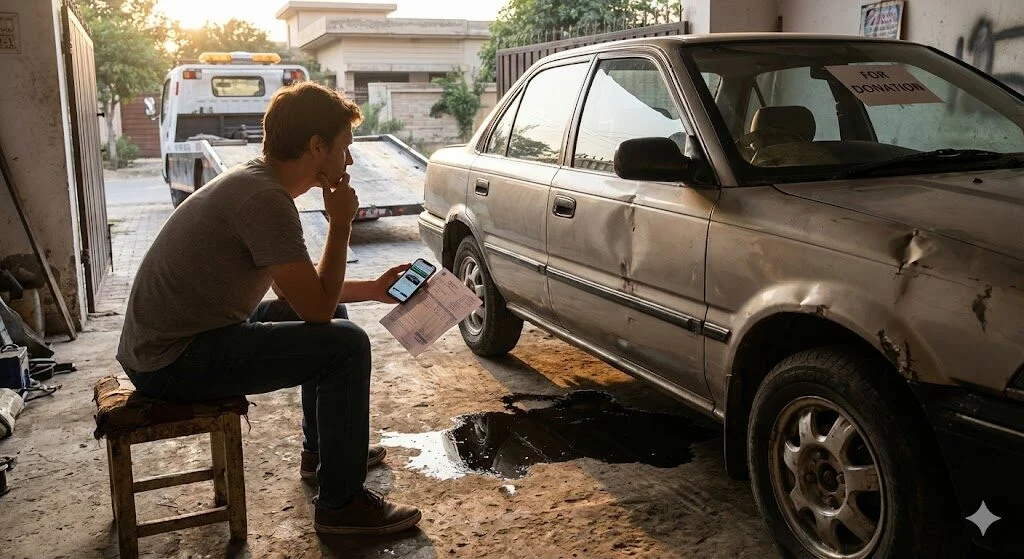
Let’s be honest: Uncertain Alex doesn’t just have a car leak. Alex has a decision to make.
You’re tired. You’ve already spent thousands keeping this car on the road. You’ve got the alternator, the battery, the spark plugs. And now there’s a puddle that might cost $3,000 to fix. Or it might be nothing. But either way, the anxiety is wearing you down.
Maybe it’s time to stop playing repair roulette and upgrade to something reliable.
Here’s the thing: You don’t have to buy new. You could donate your current car and use the tax deduction to offset the cost of a reliable used vehicle. You get:
- ✓ Free towing (no hassle)
- ✓ Tax deduction ($3,000-$5,000 depending on the car’s condition)
- ✓ Peace of mind that you’re helping fund life-saving medical research
- ✓ A reason to upgrade to something that actually works
That tax write-off? That’s real money. That could be the down payment on a 5-10 year old Honda Civic or Toyota Corolla—cars that won’t leave mystery puddles in your driveway.
The Bottom Line
That mystery puddle in your driveway is a diagnostic puzzle, not a death sentence. Maybe it’s just water. Maybe it’s a $50 fix. Or maybe it’s the final straw that tells you it’s time to move on.
Use this guide to figure out which one. Use the aluminum foil trick to know what you’re dealing with. And use that information to make a decision—either fix it and keep going, or accept that it’s time for an upgrade.
Either way, you’re not panicking anymore. You’ve got answers. And with answers comes control.
Because at the end of the day, Uncertain Alex just wants to know: Is my car safe? And am I making the right decision?