

A clear, beginner-friendly reference to common construction tools, building construction equipment names, uses, typical trades, and the safety limits every new worker should understand.
This list covers common hand tools, power tools, measuring tools, and site equipment. PPE such as hard hats, eye protection, hearing protection, gloves, and respiratory protection is essential but is not counted as a construction tool. “Complete” means a broad practical reference—not every specialist tool used across every trade.
How this construction tools list is organized
The 50 items were selected because they are commonly encountered on building sites, in workshops, and during trade training. Names can vary by region: for example, a utility knife may be called a box cutter, and a spirit level may simply be called a level. Always follow local site rules, the manufacturer manual, and your supervisor’s instructions.
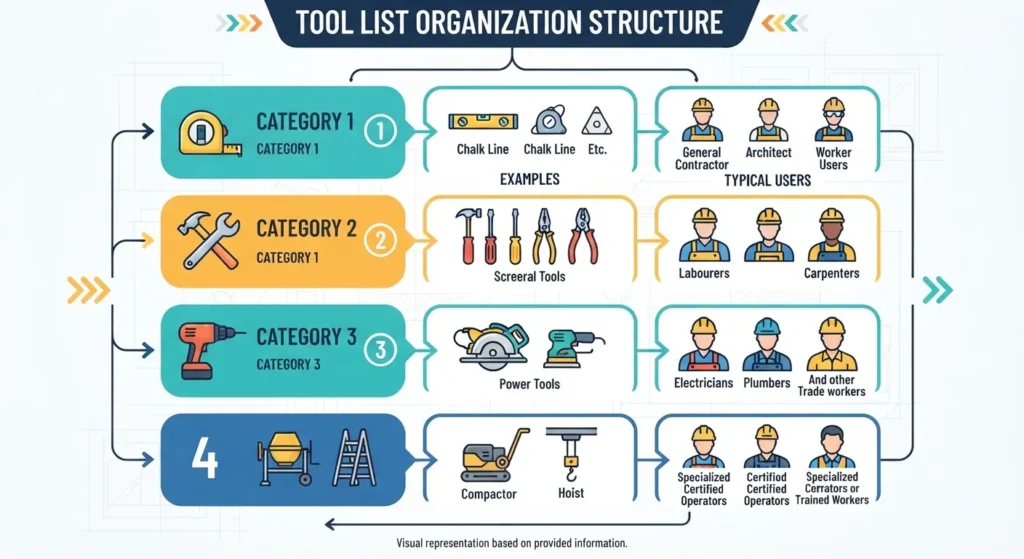
| Category | Examples | Typical users |
|---|---|---|
| Measuring & layout | Tape measures, squares, levels, chalk lines | Most trades |
| General hand tools | Hammers, screwdrivers, pliers, wrenches | Labourers, carpenters, installers |
| Power & cutting tools | Drills, saws, grinders, sanders | Trained trade workers |
| Equipment & access | Mixers, compactors, ladders, hoists | Approved or trained users |
Measuring and layout tools
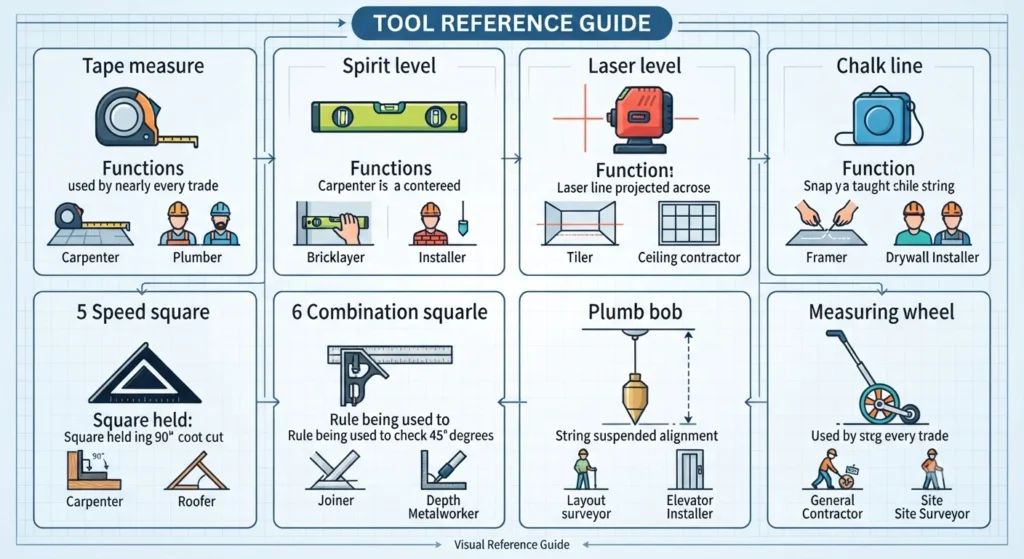
Tape measure
Measuring tool for lengths, openings, and material cuts; used by nearly every trade. Keep the blade clean and retract it slowly.
Spirit level
A bubble level used to check level, plumb, and sometimes 45-degree alignment. Carpenters, bricklayers, and installers use it constantly.
Laser level
Projects a straight reference line for layout, ceilings, tile, and partitions. Protect it from drops and verify accuracy after impacts.
Chalk line
A string coated with chalk that snaps a long straight line on floors, walls, or sheets. Keep fingers clear when releasing the line.
Speed square
A compact triangular square for marking crosscuts, angles, and roof pitches. It is especially common in carpentry and framing.
Combination square
A sliding-rule square used to mark 90- and 45-degree lines and check depths. Useful for joinery, metalwork, and fit-out.
Plumb bob
A weighted point on a string that establishes a true vertical line. Used in layout when transferring points from floor to ceiling.
Measuring wheel
A wheeled distance counter for long runs, site boundaries, and rough layout. Best for estimates rather than precision finish work.
General hand tools
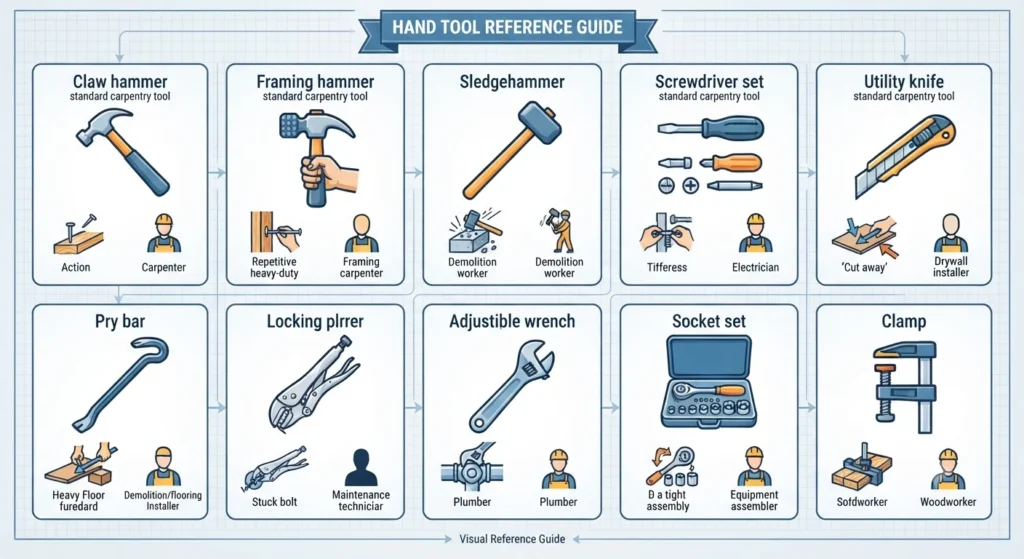
Claw hammer
Drives nails and removes smaller nails with its curved claw; a standard carpentry and general-site hand tool.
Framing hammer
A heavier hammer designed for repetitive framing nails. Its weight improves driving force but increases fatigue for beginners.
Sledgehammer
A long-handled heavy hammer used for demolition, stakes, and breaking work. Wear eye protection and maintain a clear swing zone.
Screwdriver set
Flat, Phillips, and other drivers turn screws in fixtures, hardware, and electrical accessories. Match the tip exactly to avoid slipping.
Utility knife
Retractable knife for cutting packaging, drywall paper, insulation, and flooring. Cut away from your body and replace dull blades.
Pry bar
A steel lever for lifting boards, pulling nails, and separating materials. Use a stable fulcrum and protect finished surfaces.
Locking pliers
Adjustable pliers that clamp and lock onto hardware or material. Useful for gripping, but not a replacement for the right wrench.
Adjustable wrench
A movable-jaw wrench for turning different-size nuts and bolts. Keep the jaws tight to prevent rounding fasteners.
Socket set
Sockets and a ratchet turn bolts efficiently in confined spaces. Common for steelwork, equipment assembly, and maintenance.
Clamp
Holds workpieces firmly while cutting, gluing, drilling, or fastening. Never hold material by hand near a powered blade.
Cutting, drilling, and power tools
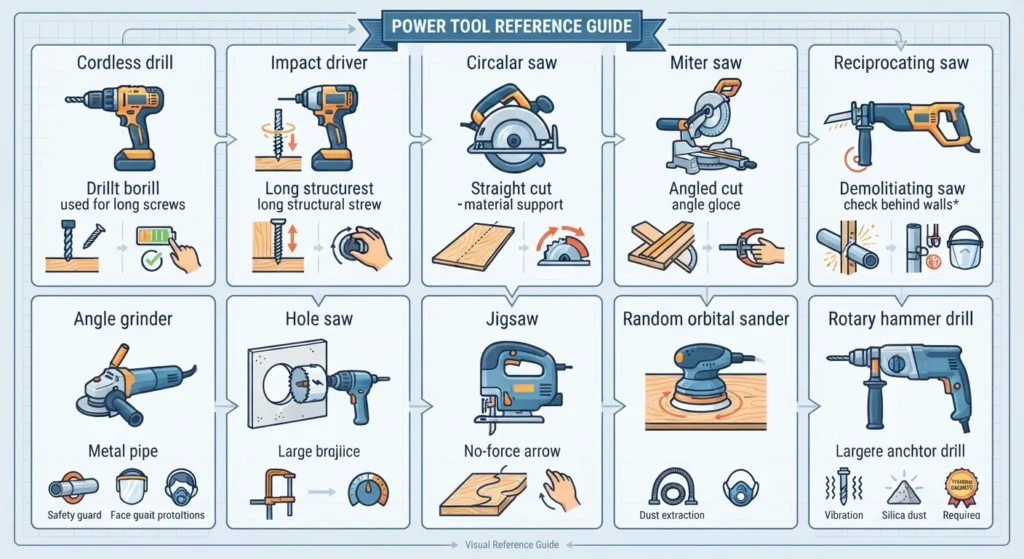
Cordless drill
Drills holes and drives light fasteners in wood, metal, and plastic. Use the correct bit and check battery condition before work.
Impact driver
A high-torque driver for long screws and structural fasteners. It is more forceful than a drill and can strip fasteners if misused.
Circular saw
A handheld saw for straight timber and sheet-material cuts. Support the material, use the correct blade, and control kickback risk.
Miter saw
A fixed saw for accurate crosscuts and angle cuts in trim and framing. Keep hands outside the marked danger zone.
Reciprocating saw
A push-pull blade saw used for demolition and rough cuts. Check behind walls for services before cutting.
Angle grinder
Cuts, grinds, and cleans metal or masonry with compatible discs. Use the guard, correct wheel, eye protection, and face protection.
Hole saw
A cup-shaped cutting attachment for round holes in timber, drywall, or metal. Secure the work and use the correct speed.
Jigsaw
A narrow reciprocating-blade saw for curved and shaped cuts. Let the blade cut without forcing it through material.
Random orbital sander
Smooths timber, filler, and painted surfaces before finishing. Connect dust extraction where possible and use respiratory protection.
Rotary hammer drill
A heavy-duty drill for concrete and masonry anchors. It creates vibration and silica dust, so supervised training is strongly recommended.
Masonry and concrete tools
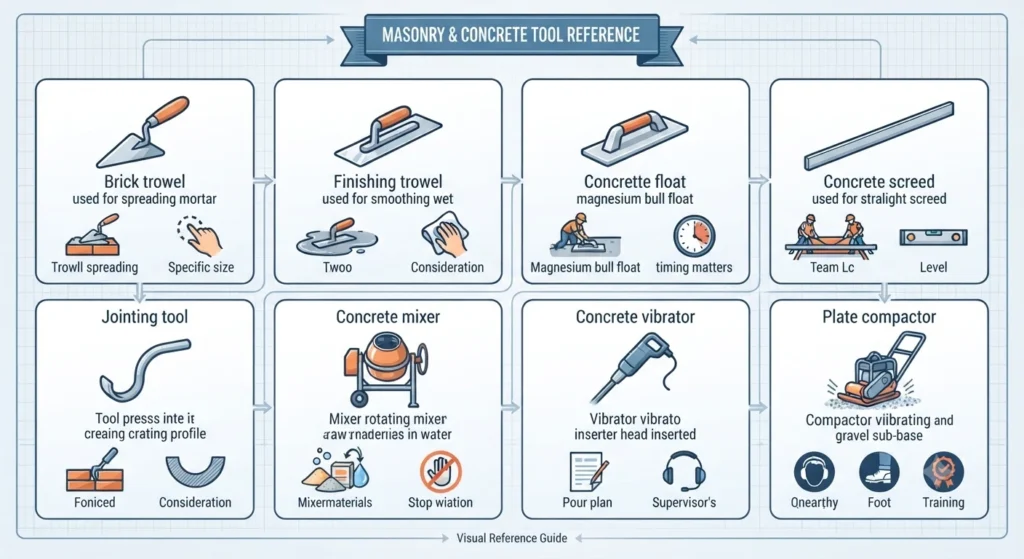
Brick trowel
A pointed trowel for spreading and shaping mortar while laying bricks or blocks. Bricklayers choose size and pattern for the work.
Finishing trowel
A flat steel blade used to smooth plaster, render, or concrete. Clean it promptly to prevent hardened material buildup.
Concrete float
A flat tool that levels and closes a fresh concrete surface after screeding. Timing matters; use it only at the correct stage.
Concrete screed
A straight edge used to strike off fresh concrete to the required level. Often handled by a team across formwork guides.
Jointing tool
Shapes mortar joints between bricks for a neat, weather-resistant finish. The profile is selected to suit the specification.
Concrete mixer
Rotating equipment that mixes cement, sand, aggregate, and water. Keep guards in place and never reach into a moving drum.
Concrete vibrator
Consolidates wet concrete by removing trapped air. Incorrect use can affect the pour, so follow the pour plan and supervision.
Plate compactor
Compacts soil, gravel, or paving sub-base with vibration. Requires training, stable footing, hearing protection, and exclusion zones.
Carpentry and finishing tools
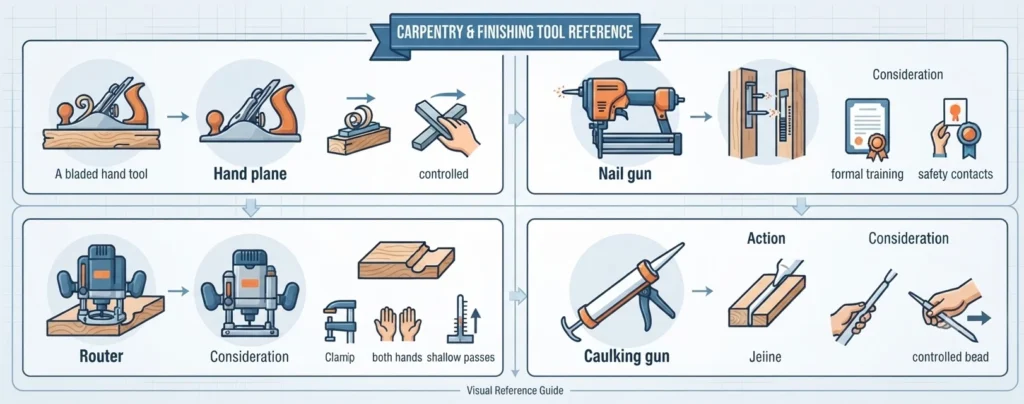
Hand plane
A bladed hand tool that shaves timber for a smooth, straight fit. Keep the blade sharp and plane with controlled strokes.
Nail gun
A pneumatic or battery-powered fastening tool for framing, trim, or roofing. High-risk tool: follow formal training and never bypass safety contacts.
Router
A spinning cutter for profiles, grooves, and recesses in timber. Clamp the work, use both hands, and make shallow passes.
Caulking gun
Dispenses sealant or adhesive from cartridges around joints, gaps, and fixtures. Cut the nozzle carefully and apply a controlled bead.
Site equipment and access tools
Wheelbarrow
Moves soil, concrete, debris, and materials around a site. Balance the load, check the route, and avoid overfilling.
Extension ladder
Provides temporary access at height. Inspect it, place it on firm ground, secure it, and follow local ladder-angle requirements.
Step ladder
A self-supporting ladder for short-duration, low-height tasks. Do not stand on the top cap unless the manufacturer permits it.
Scaffolding
A temporary working platform for height work. It must be erected, altered, inspected, and used under applicable competent-person rules.
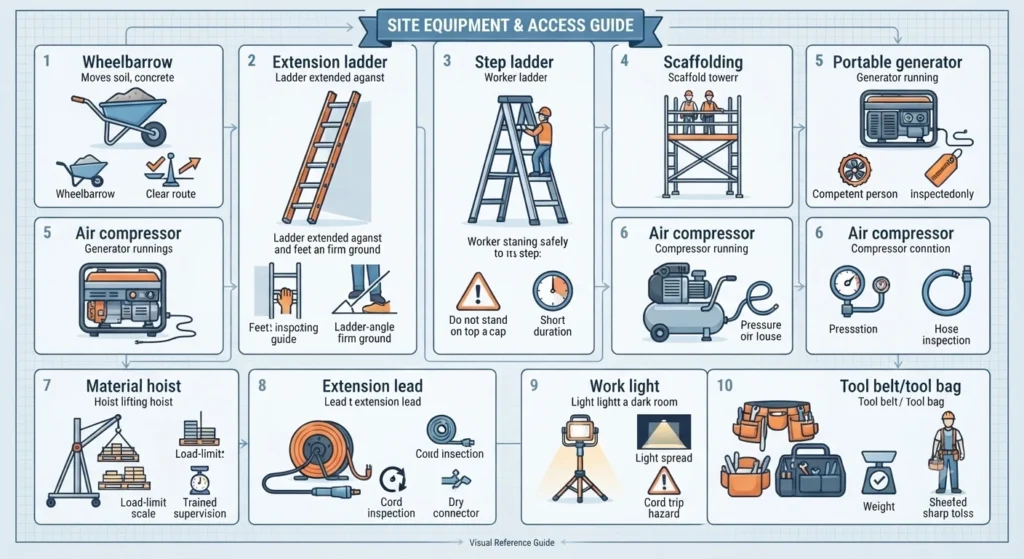
Portable generator
Supplies power where mains electricity is unavailable. Operate outdoors or in a properly ventilated location and manage cords safely.
Air compressor
Provides compressed air for nail guns and some tools. Inspect hoses and fittings; stored air can cause serious injury if released suddenly.
Material hoist
Lifts materials vertically to a work area. Use only within load limits and according to the site lifting plan and trained supervision.
Extension lead
Extends power safely when appropriately rated for the tool and environment. Inspect cords for damage and keep connectors dry.
Work light
Improves visibility in unfinished or poorly lit spaces. Position it to reduce shadows and avoid trip hazards from cords.
Tool belt or tool bag
Carries frequently used hand tools and fasteners. Keep sharp tools protected and avoid overloading your body or access equipment.
A sensible beginner construction tool kit
New workers do not need to buy all 50 items. Start with the core hand and measuring tools required by your employer, course, or trade, then add specialist equipment only when you understand the job and training requirements.
Start with the basics
A practical first kit often includes a tape measure, spirit level, claw hammer, screwdriver set, utility knife, speed square, locking pliers, adjustable wrench, pencil, and tool bag. Ask your supervisor before purchasing expensive power tools: many sites supply approved equipment and specify battery platforms.
Safety, training, storage, and maintenance
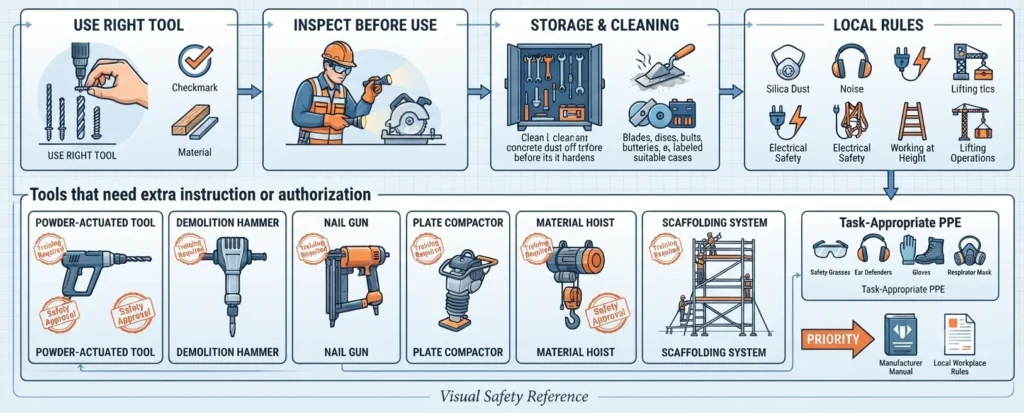
Use the right tool for the material, inspect it before use, keep guards and safety switches in place, and isolate damaged electrical equipment. Store tools dry, clean off concrete or adhesive before it hardens, and keep blades, discs, and batteries in suitable cases. Follow local rules on silica, noise, electrical safety, working at height, and lifting operations.
Tools that need extra instruction or authorization
Do not operate powder-actuated tools, demolition hammers, nail guns, compactors, hoists, scaffolding systems, or high-risk cutting tools without appropriate training, supervision, and site approval. Wear task-appropriate eye, hearing, hand, foot, and respiratory protection. Manufacturer instructions and local workplace rules take priority over this general guide.
Construction tool questions, answered
What are the most commonly used construction tools?
Tape measures, levels, hammers, screwdrivers, utility knives, pliers, saws, drills, trowels, wheelbarrows, ladders, and clamps are among the tools most often seen across general building work. The exact kit depends on the trade and task.
What is the difference between a tool and construction equipment?
A tool is usually handheld or portable and used directly on a task, such as a hammer or drill. Construction equipment generally supports larger work, movement, access, or production, such as a mixer, compactor, scaffold, or hoist.
Which construction tools require special training?
Requirements vary by country and employer, but high-risk tools and equipment often include powder-actuated tools, nail guns, grinders, rotary hammers, compactors, lifting equipment, scaffolds, and access systems. Check your local law, site induction, and supervisor instructions.