Every General Motors vehicle has an identification number that helps establish its manufacturer, model year, vehicle specifications, and production details. Whether you own a Chevrolet Silverado, GMC Sierra, Buick, or Cadillac, knowing how to read this number can help you verify important information about your vehicle.
General Motors vehicle identification number decoding is the process of interpreting a VIN to understand the information encoded by the manufacturer. This is particularly useful when buying a used GM vehicle, researching its original specifications, checking recalls, or finding compatible replacement parts.
This guide explains where to find a GM VIN, how the 17-character system works, what the characters mean, and how to use an official VIN decoder for accurate information.
Quick Answer: How Do You Decode a GM VIN?
Locate the 17-character VIN on your GM vehicle’s dashboard, door-jamb label, or registration documents. Enter it into the NHTSA VIN Decoder. The results can reveal the manufacturer, model year, vehicle type, engine characteristics, and assembly plant, depending on the manufacturer’s available data.
What Is a General Motors Vehicle Identification Number?
A Vehicle Identification Number (VIN) is a standardized identifier assigned to a vehicle during manufacturing. Modern US-market GM vehicles generally use a 17-character VIN containing letters and numbers.
The VIN helps identify the vehicle’s manufacturer, characteristics, model year, manufacturing plant, and production sequence. It is used in vehicle registration, servicing, recall identification, and parts research.
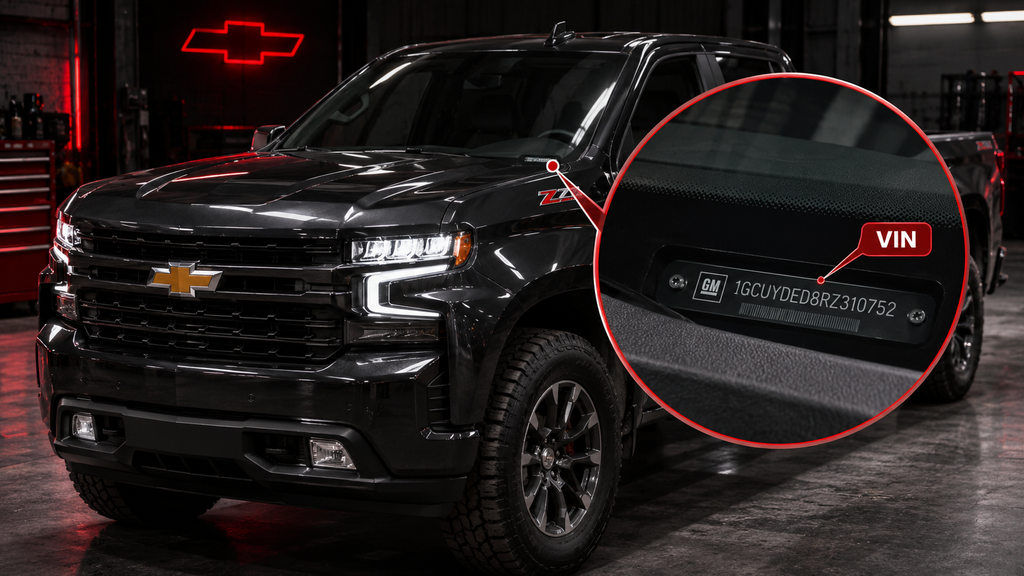
The VIN is especially important when verifying a used vehicle. However, it does not automatically reveal every factory option, repair, accident, or ownership record.
Where Can You Find the VIN on a GM Vehicle?
Most modern Chevrolet, GMC, Cadillac, and Buick vehicles have a VIN plate visible through the windshield on the driver’s side dashboard.
You may also find the VIN in the following locations:
- Driver’s side door-jamb certification label.
- Vehicle registration and title documents.
- Insurance documents.
- Manufacturer service records.
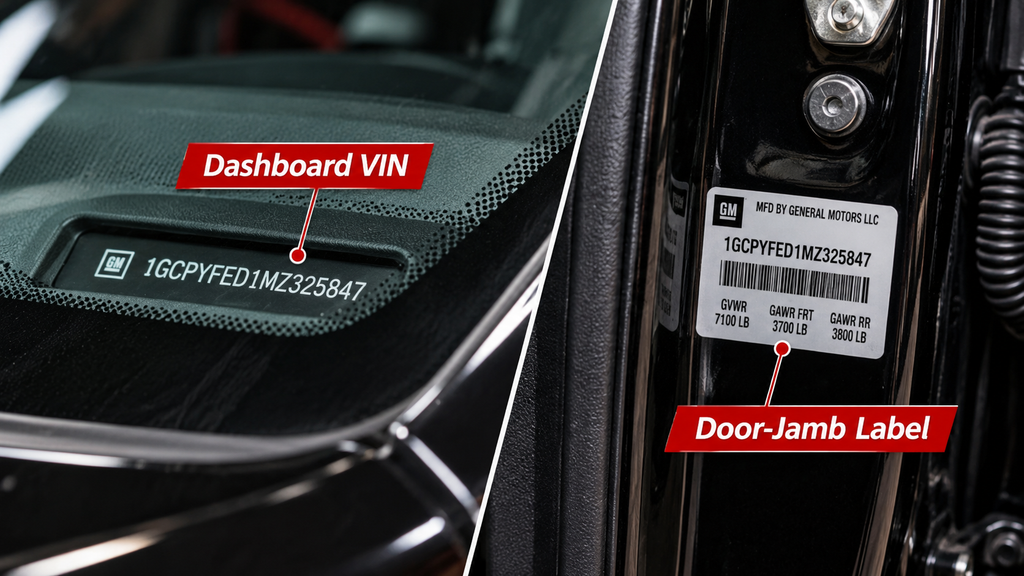
For a used vehicle, compare the VIN on the car with the number shown on its title and other documents. Differences should be investigated before purchasing.
General Motors 17-Character VIN Decoding Chart
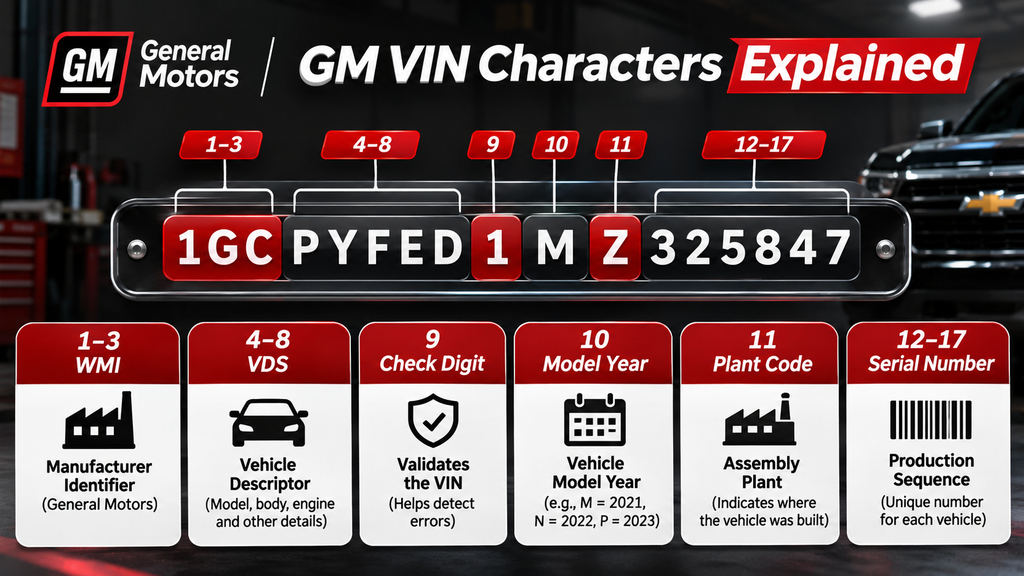
A modern GM VIN follows the standardized VIN structure used for US-market vehicles. Each group of characters serves a particular identification purpose.
| VIN Position | Identification | Information |
|---|---|---|
| 1–3 | WMI | Manufacturer identifier |
| 4–8 | Vehicle descriptor | Manufacturer-defined vehicle attributes |
| 9 | Check digit | Helps validate VIN characters |
| 10 | Model year | Encoded vehicle model year |
| 11 | Plant code | Assembly plant identification |
| 12–17 | Production sequence | Vehicle-specific production identifier |
How to Decode General Motors VIN Characters
Characters 1–3: Manufacturer Identification
The first three characters form the World Manufacturer Identifier (WMI). This identifies the manufacturer according to the applicable VIN rules.
For example, 1G1 is an established WMI used for certain Chevrolet passenger cars, while 1G6 is associated with certain Cadillac passenger cars. GM uses many other WMIs depending on vehicle type and manufacturing location.
Characters 4–8: Vehicle Description
These characters describe manufacturer-defined vehicle attributes. Depending on the vehicle and model year, they may encode information related to model line, body type, engine, restraint system, or other characteristics.
The meanings are not universal across all GM vehicles. Use the appropriate model-year decoding reference rather than assuming one character always identifies the same engine.
Character 9: Check Digit
The ninth position contains a calculated check digit used to help detect an incorrectly entered VIN. It is not proof that the vehicle or its documents are authentic.
Character 10: Model Year
The tenth character represents the vehicle’s model year. Since year codes repeat across cycles, the entire VIN must be considered when determining the correct year.
Character 11: Assembly Plant
The eleventh character identifies the manufacturing plant according to the manufacturer’s decoding records. Plant codes can vary by vehicle program and model year.
Characters 12–17: Production Sequence
The final six positions generally contain the production sequence for standard high-volume manufacturer VINs. These help distinguish individual vehicles within the manufacturer’s identification system.
GM VIN Model-Year Codes Explained
The tenth character of a modern General Motors VIN indicates the model year. Here are examples of recent model-year codes.
| Model Year | VIN Character |
|---|---|
| 2021 | M |
| 2022 | N |
| 2023 | P |
| 2024 | R |
| 2025 | S |
| 2026 | T |
| 2027 | V |
Example: For a modern GM vehicle correctly identified as part of the current model-year cycle, a VIN with T in the tenth position indicates the 2026 model year.
The model year may differ from the calendar year in which the vehicle was manufactured.
Important: Model-year letters repeat over time. Always use the complete VIN and an appropriate decoder to distinguish between different year cycles.
How to Decode a GM VIN for Free
The National Highway Traffic Safety Administration provides a free online VIN decoder based on vehicle information reported by manufacturers.
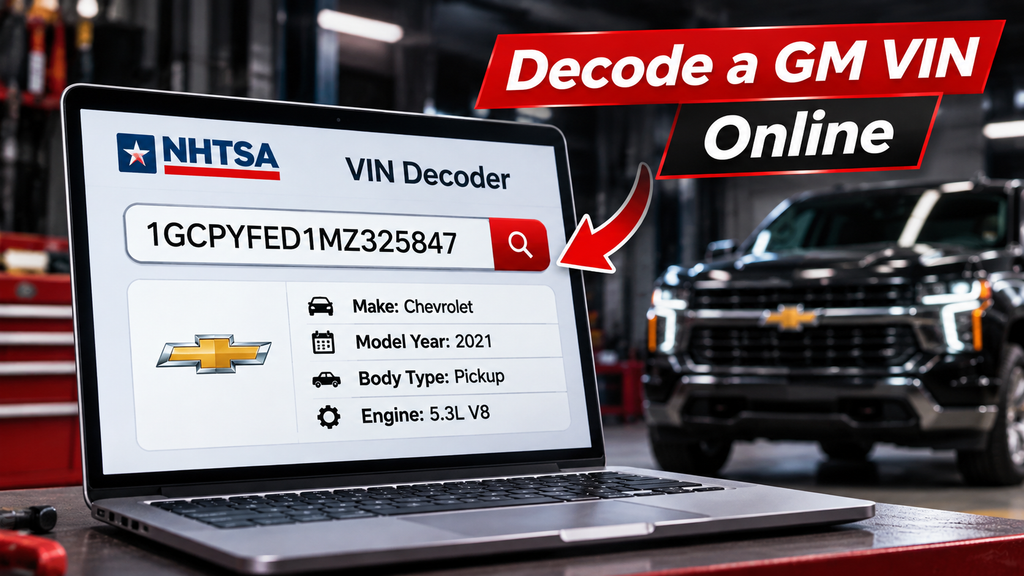
Step-by-Step GM VIN Lookup
- Find the VIN: Check the dashboard or driver’s door label.
- Open the official decoder: Visit NHTSA VIN Decoder.
- Enter the complete VIN: Carefully type all 17 characters.
- Review the decoded results: Check the make, model year, vehicle type, and available specifications.
- Compare the details: Confirm that the information matches the vehicle and its documentation.
If engine information or other specifications are missing, consult GM service documentation or a dealership parts department. A basic VIN decode may not identify every factory-installed option.
GM VIN Decoding for Chevrolet, GMC, Cadillac, and Buick
General Motors uses standardized VIN identification across its modern vehicle brands, but individual manufacturer codes and vehicle descriptor meanings can vary.
| GM Brand | Example Vehicles | Common Lookup Purpose |
|---|---|---|
| Chevrolet | Silverado, Equinox, Tahoe | Engine and model identification |
| GMC | Sierra, Yukon, Terrain | Truck and SUV specifications |
| Cadillac | Escalade, CT5, XT5 | Model and powertrain verification |
| Buick | Encore GX, Enclave, Envista | Model year and vehicle characteristics |
GM VIN vs. RPO Codes: What’s the Difference?
A VIN identifies a vehicle and encodes certain manufacturer-defined attributes. Regular Production Option (RPO) codes provide more detailed information about factory equipment and options.
Depending on the vehicle, RPO information may be found on a Service Parts Identification label, an identification QR code, or in manufacturer build records.
For example, if you need to verify an original axle ratio, paint specification, or optional equipment package, RPO data may be more useful than the VIN alone.
How to Verify a GM VIN Before Buying a Used Vehicle
VIN decoding is especially valuable when purchasing a used Chevrolet, GMC, Cadillac, or Buick. It provides a starting point for checking whether a vehicle matches its advertised description.
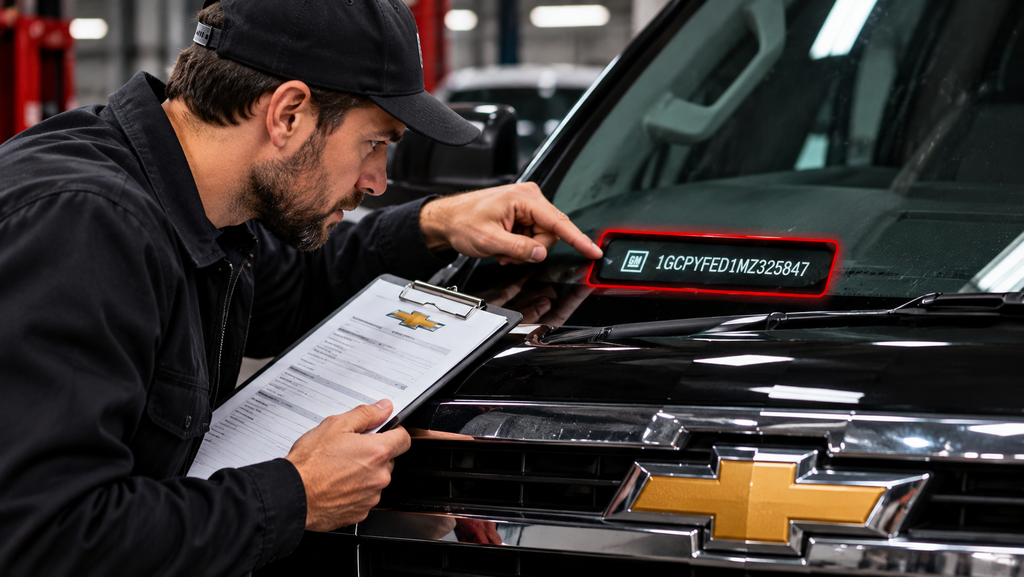
Used GM Vehicle Verification Checklist
Confirm that the VIN has the correct length and format for the vehicle’s model year.
Compare the dashboard VIN with the certification label and title.
Check whether the decoded make, model, and year match the vehicle.
Use the NHTSA recall lookup to review open safety recalls.
Obtain an appropriate vehicle-history report.
Arrange an independent pre-purchase inspection.
Buyer Safety Tip
A correctly decoded VIN does not guarantee that a vehicle has never been damaged, stolen, repaired, or modified. Always verify documents, review available history, and inspect the physical vehicle.
What About Classic GM Vehicles?
Older General Motors vehicles may use VIN systems that differ from the standardized 17-character format introduced for the 1981 model year. Identifying a classic Chevrolet or other older GM model may require factory-specific VIN charts, body tags, engine stamping information, and production records.
Do not apply modern VIN character charts to older vehicles without first confirming their identification system.
Frequently Asked Questions
How do I decode a General Motors VIN?
Enter the complete 17-character VIN into the NHTSA VIN Decoder. Review the manufacturer-reported model year, make, vehicle type, and other available vehicle details.
Can a GM VIN identify the engine?
A GM VIN can encode engine-related information, but interpretation depends on the vehicle and model year. Confirm exact engine specifications using manufacturer documentation when ordering parts.
What does the tenth character of a GM VIN mean?
It represents the model year. For example, T corresponds to 2026 in the current cycle, but year codes repeat, so the full VIN is needed for accurate identification.
Is there a free GM VIN decoder?
Yes. NHTSA provides a free online VIN decoder for manufacturer-reported vehicle identification information.
Can a GM VIN reveal all factory options?
Not necessarily. RPO codes and factory build records are often needed to verify detailed equipment such as axle ratios, original paint, and option packages.
Do classic Chevrolet vehicles have 17-character VINs?
Many pre-1981 GM vehicles use different identification formats. Their decoding requires information specific to the vehicle’s production year and model.
Conclusion
Understanding General Motors vehicle identification number decoding makes it easier to verify a Chevrolet, GMC, Cadillac, or Buick vehicle and interpret important manufacturer information.
The modern 17-character VIN provides information about the manufacturer, vehicle attributes, model year, assembly plant, and production sequence. The official NHTSA decoder is a useful starting point, while factory records and RPO codes can help identify additional specifications.
Before buying a used GM vehicle or ordering replacement parts, compare the VIN with official documents and confirm any critical specifications using vehicle-specific records.